
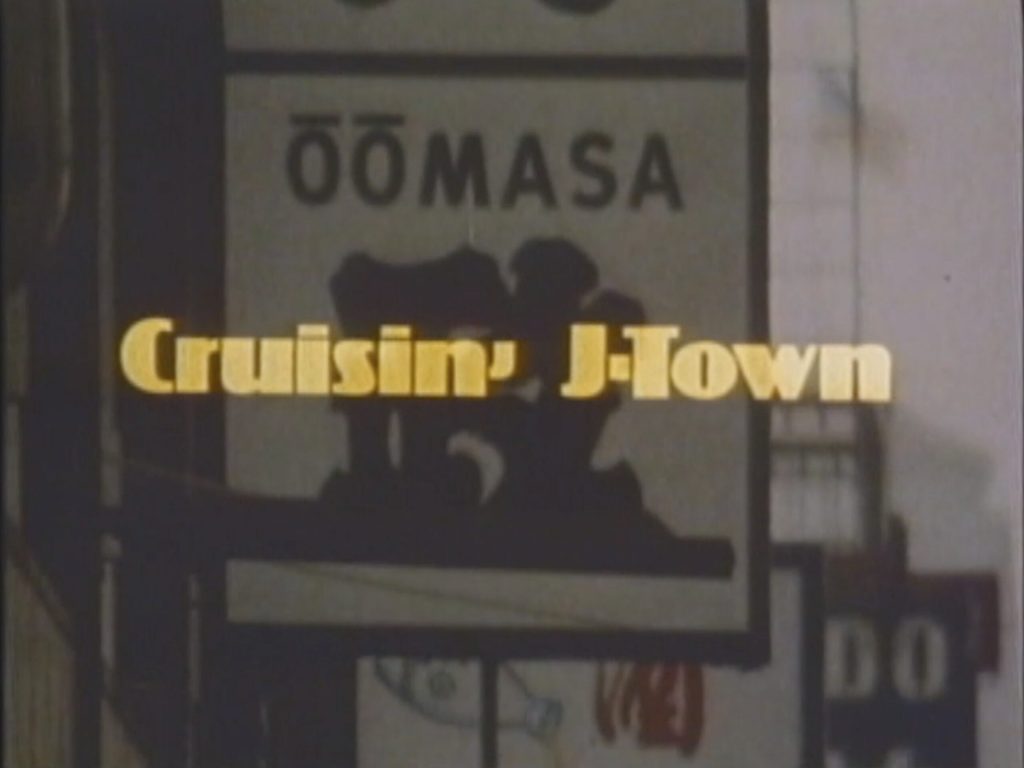
#744) Cruisin’ J-Town (1975)
OR “Hiroshima mon amour”
Directed by Duane Kubo
Class of 2023
“Cruisin’ J-Town” is currently available to stream on the VC Archives website on a pay-what-you-can sliding scale. So send a few bucks their way and check out their collection!
The Plot: UCLA’s Duane Kubo heads over to L.A.’s Little Tokyo (aka J-Town) to document the performances of Japanese fusion jazz band Hiroshima. While “Cruisin’ J-Town” is primarily footage of Hiroshima’s performances, we also get insight from the musicians, many of whom comment on their own identity struggles amidst the rising Asian-American movement of the early ‘70s. The result is an entertaining blend of Japanese tradition and the funkiness of ‘70s jazz.
Why It Matters: The NFR write-up is mostly a rundown of the film, though they call the interviewees “articulate and interesting”, so that’s something.
But Does It Really?: Oh yeah. “Cruisin’ J-Town” covers two favorites of the NFR: diverse culture and UCLA alumni. The film is an engaging and uplifting chronicle of third-generation Japanese Americans as they take the traditions of their ancestors and create something uniquely their own. And as always, I love anything on this list that’s short and/or has a great soundtrack. Welcome to the NFR, “Cruisin’ J-Town”!
Everybody Gets One: While at UCLA, Duane Kubo co-founded Visual Communications, an organization creating and promoting the art of Asian-American and Pacific Islander filmmakers. I’m not sure exactly when or how Kubo met up with Hiroshima, which had started performing in Little Tokyo around 1974, but like Kubo, Hiroshima founder Dan Kuramoto was heavily influenced by the political movement of the late ‘60s and the growing Asian-American movement, so I’m not surprised these two found each other.
Wow, That’s Dated: The end credits list support from the U.S. Office of Education, a government department that split into the U.S. Department of Education and the U.S. Department of Health and Human Services just a few years after this film was released. I wrote this post back in December and initially had a joke about neither of those departments existing by the time this finally got published. I hate it when I’m right.
Title Track: Either the movie takes its title from one of Hiroshima’s songs, or the song gets its name from the movie, I’m not quite sure. Hiroshima released the song in 1980, though it could have been part of their set in 1975. Either way, it’s a banger.
Seriously, Oscars?: No nominations for “Cruisin’ J-Town” from the Oscars or any other awards organization. The 1975 winner for Best Documentary Short Subject was Robin Lehman’s “The End of the Game”, a film about conserving the Afric- wait a minute, didn’t I do this one already?
Other notes
- Yes, the band is named after the city in Japan that was almost entirely destroyed by a nuclear bomb in 1945. While at first glance the naming seems in bad taste, the group was inspired by the city’s phoenix-like rise from the ashes of WWII (Today, Hiroshima is one of the largest cities in Japan). I like the name as a bit of reclaiming by this generation of Japanese Americans. For many, Hiroshima is still synonymous with its wartime decimation, but I like that there’s a small faction of the population out there that associate the name Hiroshima with the band.
- There’s a lovely section of the movie in which Hiroshima member June Kuramoto – Dan’s then-wife – talks about inheriting her grandmother’s koto, the Japanese instrument that she rocks throughout the film. Side note: June is the only original member of Hiroshima who was from Japan, moving to Los Angeles with her family when she was six years old. The rest of the original Hiroshima line-up were all native Angelenos. Side Side note: How can you hate any movie that features a koto solo?
- The final performance in the movie is a jam session with Hiroshima and Daniel Valdez with Teatro Campesino at the Performing Arts Center in San Jose (Kubo’s hometown). This marks Daniel Valdez’s fourth appearance on the NFR, the first outside of his collaborations with his brother Luis.
- I don’t have a lot of notes on this movie; I was just enjoying it so much. The film is simultaneously light and deep, light because of its focus on the music, deep because of the band’s comments regarding racial identity. At the end of the movie, Dan Kuramoto is talking with Daniel Valdez and quotes someone who said that the arts are important because they are common, regardless of race or any other manmade barrier. You can’t see it, but I’m snapping my fingers in agreement.
Legacy
- A few years after “Cruisin’ J-Town”, Duane Kubo co-directed “Hito Hata: Raise the Banner”, which was, according to New Day Films, “the first feature length narrative film created exclusively by Asian Americans.” Kubo returned to the Bay Area in the 1980s and continues to be active in the Asian film community, most recently his work with San Jose’s J-Town FilmFest.
- Visual Communications is still around as well. Check them out!
- In the last half-century, Hiroshima has released 20 albums (two of which went gold) and have received two Grammy nominations. As of this writing, Hiroshima is still performing with several of the original members seen in this film!
 The Horse's Head