
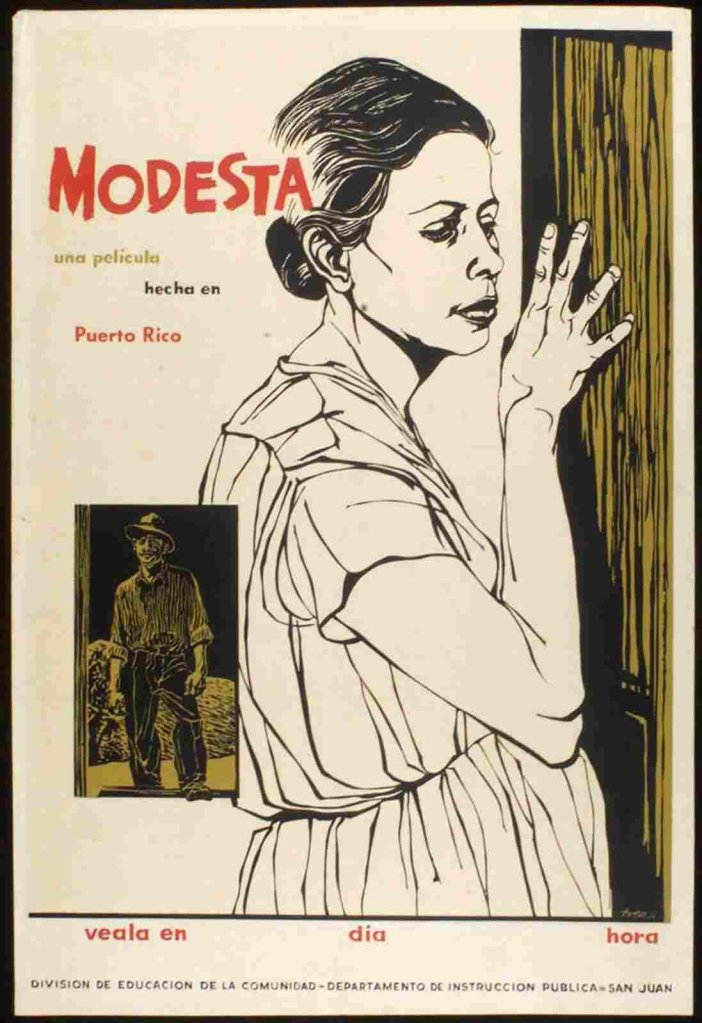
#749) Modesta (1956)
OR “Speak Spanish and Carry a Big Stick”
Directed by Benjamin Doniger
Written by Doniger, Luis A. Maisonet, and René Marqués. Story by Domingo Silas Ortiz.
Class of 1998
The Plot: Modesta (Antonia Hidalgo) is a housewife in a Puerto Rican barrio looking after her husband (Juan Ortiz Jiménez) and their three children with a fourth along the way. One day Modesta’s husband orders her to kill one of their chickens and cook it for dinner while he’s at work. Modesta fails to capture the chicken, and when her husband comes home and berates her for it, Modesta picks up a nearby large stick and hits him over the head with it. News of this spreads quickly in the barrio, and Modesta is soon joined by the neighboring housewives to form the League of Liberated Women, demanding equal status in their marriages, and equal responsibilities from their husbands regarding housekeeping and childcare. Brought to you by Puerto Rico’s División de Educación de la Comunidad, aka the Division of Community Education.
Why It Matters: The NFR write-up is primarily historical background on Puerto Rico’s Division of Community Education and the films they produced throughout the 1950s and 1960s. “Modesta” is singled out for being “[f]eminist at its heart”, and director Doniger gets a shout out. An essay by NFR aficionado Daniel Egan is pretty much all the information we have about “Modesta” and its production.
But Does It Really?: There aren’t a lot of NFR movies filmed in U.S. territories (the only one I can think of is “The Chechahcos” in the then-territory of Alaska), so “Modesta” automatically achieves a unique status on the NFR thanks to its Puerto Rican production. The film itself is a simple fable handled decently if not remarkably, but it goes by quickly enough that it’s hardly worth griping about the film’s shortcomings. Of the dozens of films produced by the Division of Community Education, I don’t know why “Modesta” was the one chosen to represent them on the NFR, but I’m glad it was.
Everybody Gets One: Not a lot of information about Benjamin Doniger or why and how this native New Yorker ended up making movies in Puerto Rico. Prior to his work in Puerto Rico, Doniger served as cinematographer and/or camera operator on a few shorts including “The Cummington Story” and “Journey Into Medicine”. Some sources (including the NFR write-up) state that Doniger was the cinematographer on fellow NFR film “Louisiana Story”, though his only on-screen credit on that film is for sound (the credited cinematographer for “Louisiana” is Richard Leacock). Doniger’s entire directorial filmography consists of films made in Puerto Rico from 1953 to 1959, with “Modesta” being his second film as director.
Title Track: Modesta roughly translates to “humble woman”, which as we see is a very ironic title. “Modesta” should not be confused with Modesto, the California city near my hometown of Stockton. Modesto is the city Stocktonians make fun of to feel better about ourselves.
Seriously, Oscars?: No Oscar nod for “Modesta”. For the record, the 1956 Oscar for Best Live Action Short Subject, Two-Reel went to “The Bespoke Overcoat”, which is one of the most British titles I’ve ever come across. Some sources claim that “Modesta” won a prize at the 1956 Venice Film Festival, but I can’t find anything official to back that up.
Other notes
- I can’t get into the rich and complex history of Puerto Rico in this write-up, but for our purposes here we’ll begin in 1898 when Puerto Rico became a U.S. territory following the Spanish-American War (Puerto Rico had been part of the Spanish Empire up to that point). Recognition of Puerto Rico as part of America has been slow-going; Puerto Ricans weren’t recognized as U.S. citizens until 1917 and didn’t officially become a self-governed territory until the early 1950s. Although Puerto Rico has a Governor and other elected officials, it does not have statehood or representatives in the House or Senate, and Puerto Ricans cannot vote in federal elections (such as the U.S. Presidential elections). On the plus side, very few Puerto Ricans are subject to federal taxes. Anything else I know about Puerto Rico comes from “Progress Island, U.S.A.” Progress!
- Although Puerto Rico had been producing films since the 1910s, almost all their early efforts have been lost to time. Following the election of Luis Muñoz Marín in 1949 (Puerto Rico’s first elected governor), the Division of Community Education was established to promote social reform through radio, books, and yes, film. Between 1950 and 1975, 65 shorts and two features were produced by the Division of Community Education, all filmed in Puerto Rico using locals as actors.
- “Modesta” was filmed in Sonadora, a barrio in Guaynabo. To the best of my knowledge, both Antonia Hidalgo and Juan Ortiz Jiménez were locals, and while this is Hidalgo’s only film credit, Jiménez had a few others over the years. Outside of our two leads, the only other acting credit goes to the catch-all credit for the “los vecinos del barrio Sonadora de Guaynado” (roughly translated to “the Barrio Sonadora community”). I could not find any credit for the narrator, who does a good job of establishing the film’s fable sensibility; he even says “habia una vez” (“Once upon a time”).
- Obviously, “Modesta” is entirely in Spanish, so once again I resorted to an auto-translate of YouTube’s Spanish subtitles. It wasn’t perfect, but it did the job. It helped that everyone in this movie speaks deliberately and a little stilted, which makes the dialogue clearer and therefore gives me a better chance at an accurate translation.
- As pointed out in the NFR write-up, the cinematography highlights the natural beauty of Puerto Rico, while simultaneously glossing over its poverty. Of course, the film isn’t here to address the territory’s poverty issues, but its optimistic message gives you hope that conditions will improve (and they have). Incidentally, the cinematographer for “Modesta” was the film’s co-writer Luis A. Maisonet, a native Puerto Rican.
- Something I never expected to see in an NFR short: cockfighting! Nothing too graphic, thank goodness, but it still feels illegal to be watching this footage.
- The husband is pretty dickish from the start, so I very much enjoyed watching Modesta finally hit him with that stick. Right on, woman!
- This is followed by what I call the “Pick-a-little talk-a-little” section, where all the local housewives spread the word of Modesta’s defiant act against her husband. It’s a fun sequence, but please movie, no more close-ups of people’s mouths as they’re talking.
- The film’s second half is mostly the newly formed League of Liberated Women meeting and discussing their agenda with the men of the neighborhood. It’s a lot like the local access broadcast of your city council meeting; a whole lot of talking about taking action without actually taking action. It’s a bit of a chore to get through, but the point of the movie is an emphasis on these ideals and not necessarily the entertainment factor.
Legacy
- While their film production slowed down in the 1970s, the Division of Community Education continued commissioning other forms of art until its closure in 1989.
- In recent years, more efforts have been made to grant Puerto Rico statehood. A majority of Puerto Rican citizens support statehood, as does their recently elected Governor Jenniffer González-Colón. Unfortunately, statehood is granted by the U.S. Congress, which, as previously mentioned, has no representatives from Puerto Rico and therefore no urgent reason to consider statehood.
- Outside of its initial release in 1956 and its NFR designation in 1998, “Modesta” has more or less disappeared from the public film forum, though thankfully its spot on the Registry guarantees the film a write-up from dweebs like me every couple of years. Puerto Rico wouldn’t get a visible spot in pop culture until a certain Broadway musical made by very White creatives came into being.
 The Horse's Head
One thought on “#749) Modesta (1956)”