
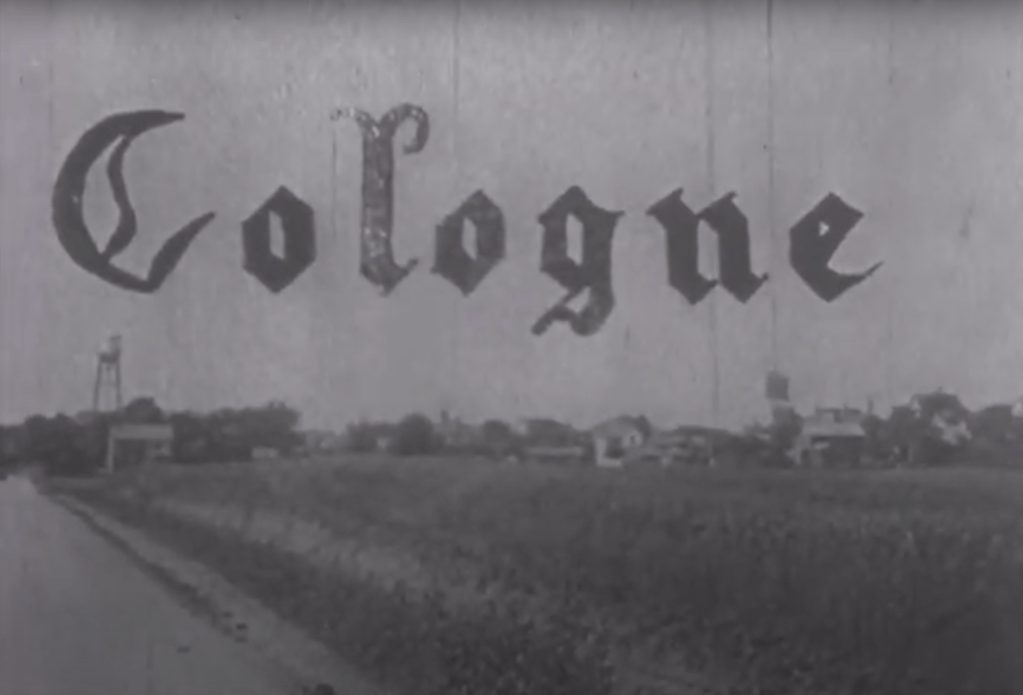
#753) Cologne: From the Diary of Ray and Esther (1939)
OR “Minnesota Nice: The Motion Picture”
Directed by Esther & Dr. Raymond Dowidat
Class of 2001
The Plot: The sleepy town of Cologne, Minnesota gets the artistic amateur film treatment in “Cologne: From the Diary of Ray and Esther”. The Ray and Esther in question are Dr. Raymond Dowidat, a general practitioner, and his wife Esther. The couple have lived in Cologne for two years and document the summer of 1939 with their 16 mm camera. With Esther’s journal entries as a framing device, “Cologne” is a snapshot of what this small town has to offer, with seemingly endless farmland, the town’s feed mill, and the “good-natured German or Hollanders” that comprise Cologne’s population of 350.
Why It Matters: The NFR praises this amateur film for exhibiting “a cinematic sophistication and artistry not usually found in home movies”. An essay by Scott Simmon is an equally brief overview of the movie.
But Does It Really?: While not the first amateur film on the NFR that attempts a narrative, “Cologne” is among the first, marking the start of a recurring trend in the Registry’s 2000s inductees. In a brief 14 minutes, “Cologne” paints quite the picture of small-town Americana, along with commentary that evokes more questions than answers. I always air on the side of giving a pass to any amateur filmmakers on the list, and while I don’t strongly advocate for “Cologne” being in the NFR, I don’t begrudge its induction, so another pass it is.
Everybody Gets One: Like every other amateur filmmaker on this list, any scraps of biographical information about Ray and Esther Dowidat are few and far between. We know that Ray and Esther married in 1937 in Iowa, and later that year moved to Cologne, Minnesota following Ray’s completion of his medical internship. They had three children, the third being born shortly before Ray and Esther started filming “Cologne”. Assuming the Dowidat kids were all born in wedlock, that would mean Esther spent the majority of her two years in Cologne pregnant.
Other notes
- Located roughly 30 miles southwest of Minneapolis, Cologne was incorporated in 1881 with a population of 100 and was named after the fourth most populous city in Germany (a large portion of the Midwest is of German heritage). Prior to the filming of “Cologne”, the biggest event in town seems to have been when Charles August Lindbergh (father of the famous aviator) visited in 1918 while campaigning for Governor. Other than that, the fact that “Cologne” is on the National Film Registry seems to be the town’s biggest selling point.
- Esther’s diary entries are a nice touch, giving the film a cohesive throughline and elevating it above standard home movies. As best I can tell, Esther filmed these diary interstitials shortly after giving birth to her third child John.
- One segment in June is a visit to the town’s feed mill at Cologne Milling Inc. The mill was owned and operated by the Guettler family, who were prominent in Cologne’s history; their family home was added to the National Register of Historic Places in 1978. Representing the Guettler family in this film are Hans, Bill, and “The Old Man” (the film doesn’t specify how they are related to each other or what the Old Man’s actual name is, and my research findings were inconclusive). The mill, now known as Cologne Milling Co., is still in operation.
- Most essays I have read about “Cologne” comment on the seemingly condescending point of view Ray and Esther have of Cologne and its people. The first such example is how they describe Cologne being “at one time an important little railroad town. Now—”, followed by a shot of a train speeding past the city without stopping. And now that I think about it, the “good-natured German or Hollanders” comment does seem a little backhanded. It’s like this film is the Dowidat’s ethnographic study of some far-off civilization.
- August brings us the volunteer fireman’s picnic and parade, with volunteer firefighters from nearby towns lending a helping hand. That would explain why this parade is so big; I think there’s more people in the parade than there are living in Cologne.
- Another prominent citizen of Cologne featured here is Henry Mohrbacher. In addition to being descended from one of Cologne’s founder, Henry owns the town saloon. We also see him making his famous turtle soup, and –Oh god he’s skinning a turtle on camera! Why is there so much graphic animal cruelty on this list? Make it stop!
- More potential disdain for Cologne is on display when Esther writes about how the local saloons “play a very prominent part in the social life of the community”. She follows this up with “In Cologne everybody drinks beer”, followed by a shot of two old men getting into a seemingly good natured barfight. The final entry in which the Dowdiats announce their departure from Cologne has also raised some eyebrows, with Esther stating that she is leaving the town with “[s]ome regrets, many memories – pleasant and bitter”. Ooh, spill the tea, Esther!
- The date of Esther’s final journal entry is noteworthy in hindsight because September 1st, 1939 was the day Germany invaded Poland, marking the start of World War II. Although America wouldn’t enter the war for another two years, “Cologne” offers one of the final glimpses of a country fully removed from the war in Europe.
Legacy
- The Dowidats moved to Minneapolis in 1939, and outside of Ray’s service in the Army during WWII and his work at a VA hospital in Saginaw, Michigan, not a lot is known about Ray or Esther after filming “Cologne”. Ray and Esther’s daughter Adele Johnson discovered “Cologne” in Esther’s attic and donated it to the Minnesota Historical Society in 1989. At some point around 1999, the MHS received a grant from the National Endowment for the Arts to have “Cologne” preserved, which no doubt caught the attention of the National Film Preservation Board, and the rest is history.
- As of the 2020 census, Cologne, Minnesota has a population of over 2,000. I don’t know how many of those 2000 are German, but 95% of the population is White (which is – believe it or not – down from 97% in a previous census).
 The Horse's Head
One thought on “#753) Cologne: From the Diary of Ray and Esther (1939)”