#754) Early Abstractions #1-5, 7, 10 (1939-1956 or 1946-1957)
OR “The Shape of Things to Come”
Directed by Harry Smith
Class of 2006
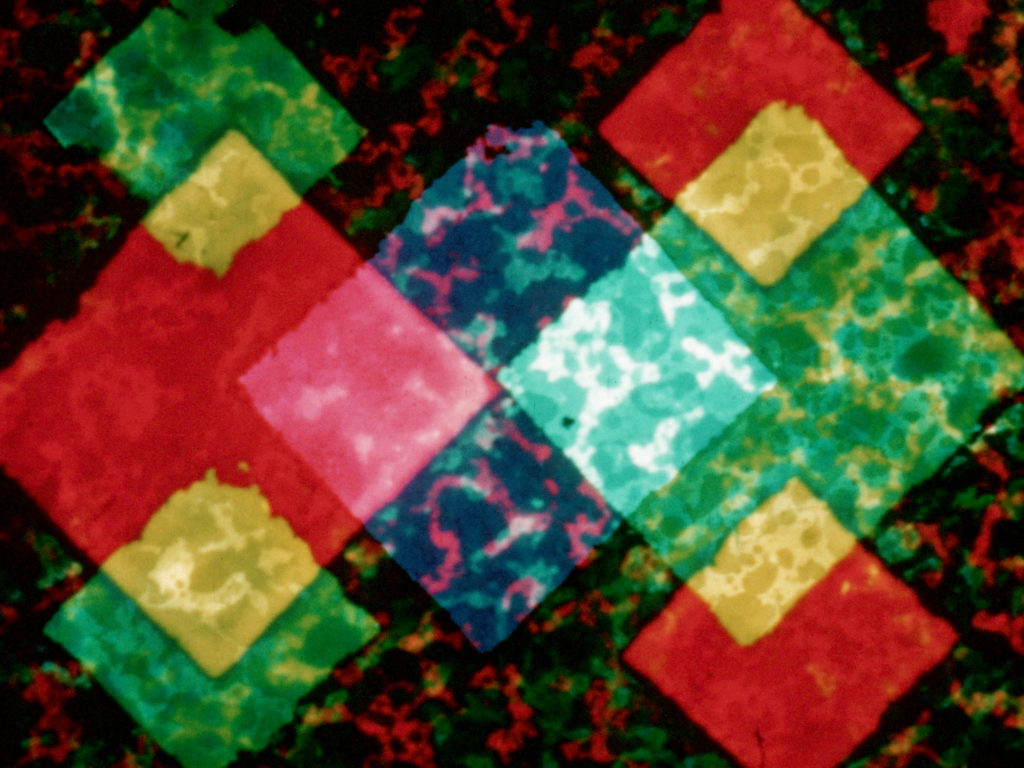
The Plot: How the hell do I describe “Early Abstractions”? Created by the Beat generation’s resident jack-of-all-trades Harry Smith, “Early Abstractions” is a seven-part collision of art, film, shapes, and music. Don’t try to figure it out, just let the images wash over you and go with it.
Why It Matters: The NFR gives a rundown of Harry Smith’s many achievements, and calls the films “a lovely, ever-moving collage of abstraction, color and imagery.”
But Does It Really?: We’ve covered a lot of autodidactic avant-garde filmmakers on this list, but even in that unique group Harry Smith stands out. Although his compilation of American folk music is his greatest legacy (more on that later), Smith’s film work is also worthy of recognition, and “Early Abstractions” fits the bill. As for the films themselves, it’s hard to critique them. Each of the “Early Abstractions” is a free-flowing work in progress that was never meant to be categorized or analyzed, certainly not by the likes of me. My takeaway from them is the experience of watching an artist’s evolution as he figures out what his “voice” is, with the films becoming more complex and polished as they go. “Early Abstractions” won’t suit everyone’s tastes, but they represent yet another creative voice in the experimental art movement of the 20th century.
Everybody Gets One: Born in Portland, Oregon and raised in the Seattle, Washington area, Harry Everett Smith developed two major hobbies at an early age: collecting records and painting. As an adult, Smith moved to San Francisco, where he joined the experimental film scene and amassed as many as 20,000 records (by his estimation) including folk, blues, gospel, and the traditional music of practically every country and region in the world. After moving to New York and running out of money, Smith tried to sell his record collection to Folkways Records, who instead countered with a proposal for Smith to create a folk music compilation album. The result, 1952’s “Anthology of American Folk Music”, chronicled the genre’s more obscure entries from the 1920s and 1930s and has maintained a legacy of its own (see “Listen to This”). Very little is known about the creation of Smith’s “Early Abstractions” series as he kept no record of their production (the 1939-1956 timeline is a generous estimation). Each film in the “Abstractions” series was initially longer (anywhere from 10 to 15 minutes each) and subsequently cut down by Smith himself to synchronize with a selected piece of music that varied from showing to showing. The films didn’t receive their official titles until some point in the 1950s or early 1960s when the Film-Makers’ Cooperative started distributing prints. Smith had of history of selling, destroying, or misplacing his films, and numbers 6, 8, and 9 of the “Early Abstractions” series are presumed to no longer exist.
This section will alternate between Other notes and Things I Thought I Saw During “Early Abstractions” (or TITISDEA for short)
- No. 1: A Strange Dream (1939-1947, or 1946-1948) is, in Smith’s words, “the history of the geologic period reduced to orgasm length.” I feel like I just learned a lot about Harry Smith in that one sentence. “No. 1” utilizes one of Smith’s early go-to forms of animation: painting directly onto 35 mm film.
- TITISDEA1: Red blood cells, a melted popsicle, a chicken embryo, coffee mug stains.
- No. 2: Message From the Sun (1940-1942 or 1946-1948): According to Smith, this film “takes place either inside the sun or in…Switzerland.” This time, Harry uses stickers from 3-ring binder paper as a makeshift stencil, with Vaseline and paint to color the frames.
- TITISDEA2: Film leader, a pie chart, eggs (very pricey these days), the NBC logo from the late ‘70s, Pac-Man, and OSHA’s hazardous materials classification.
- No. 3: Interwoven (1942-1947 or 1947-1949): Harry’s coloring of choice this time is batik, a dying technique more commonly used for fabric. That would explain why the animation seemed a little more “textured” than the first two. On a related note, Harry Smith enjoyed collecting Seminole patchwork, whose distinctive rickrack pattern appears in many of these films.
- TITISDEA3: A hashtag, SMPTE color bars, Mondrian’s “Composition with Red, Blue and Yellow”, an argyle sweater, the Union Jack (or possibly the Confederate flag), a rotary phone.
- No. 4: Fast Track aka Manteca (1947 or 1949-1950) Smith starts experimenting with filming images as opposed to just painting them. We start with footage of Smith’s painting Manteca, inspired by the Dizzy Gillespie song, which each brushstroke representing a note. This is followed by a few minutes of light patterns being superimposed over each other.
- Side note: The song “Manteca” is taken from the Spanish word meaning “lard” and an Afro-Cuban euphemism for heroin. It is not, as I had hoped, named after the California city whose water slides I visited every summer in my childhood.
- TITISDEA4: Headlights, fluorescent lights, constellations, a Saul Bass opening credits sequence (“Man with the Golden Arm”, maybe?)
- No. 5: Circular Tensions (Homage to Oskar Fischinger) (1949-1950) was intended as a “sequel” to “No. 4”, which explains why I had a hard time figuring out where 4 ends and 5 begins. As for Oskar Fischinger, his film “Motion Painting No. 1” had been made a few years earlier, and you can see the influence it had on “No. 5”, with its emphasis on simple shapes and patterns.
- TITISDEA5: Hula hoops, a CBS special presentation, and – oh no I’m being hypnotized!
- No. 7: Color Study (1950-1952): Smith moves on to optical printing with what he calls “Pythagoreanism in four movements”. That’s a fancy way of saying there are a lot of shapes, with a relentless avalanche of squares, circles, triangles, etc.
- TITISDEA7: Mainly all those gosh darn shapes; too many to fully make out what was going on. This one may have defeated me.
- No. 10: Mirror Animations (1956-1957): The biggest leap in terms of Smith’s artistic evolution, “No. 10” is a photo collage with depictions of Buddhism and the Kabballah. After six films of shapes and colors, it’s a relief to see something that, while still abstract in concept, features more concrete visuals. I wouldn’t be surprised if Frank Mouris was inspired by this to make “Frank Film”.
- TITISDEA10: Less abstract in terms of visuals, though I think I saw the electronic game Simon.
Legacy
- Harry Smith made 10 more “Abstractions” between 1956 and 1981, including one that was intended as a feature adaptation of “The Wonderful Wizard of Oz”. Smith continued pursuing his other interests over the years, recording and collecting music, studying the occult, and becoming a bishop in the Ecclesia Gnostica Catholica. Harry Smith died in 1991 at age 68 from a bleeding ulcer. In addition to the NFR induction of “Early Abstractions”, Smith has been inducted into the National Recording Registry, and in 2023 achieved canonized sainthood by the Ecclesia Gnostica Catholica. I’ve covered many accomplished artists on this blog, but this is my first time covering a saint.
Listen to This: Smith’s “Anthology of American Folk Music” was added to the National Recording Registry in 2005. The NRR write-up gives a summary of the album and its “seminal role in the folk music revival of the 1950s and 1960s.” An essay by music researcher Ian Nagoski is a detailed overview the album and Harry Smith, who I guess I should have been calling St. Harry this whole time.
 The Horse's Head
One thought on “#754) Early Abstractions #1-5, 7, 10 (1939-1956 or 1946-1957)”