
#756) Marian Anderson: The Lincoln Memorial Concert (1939)
Filmed by Hearst Metronome Newsreel
Class of 2001
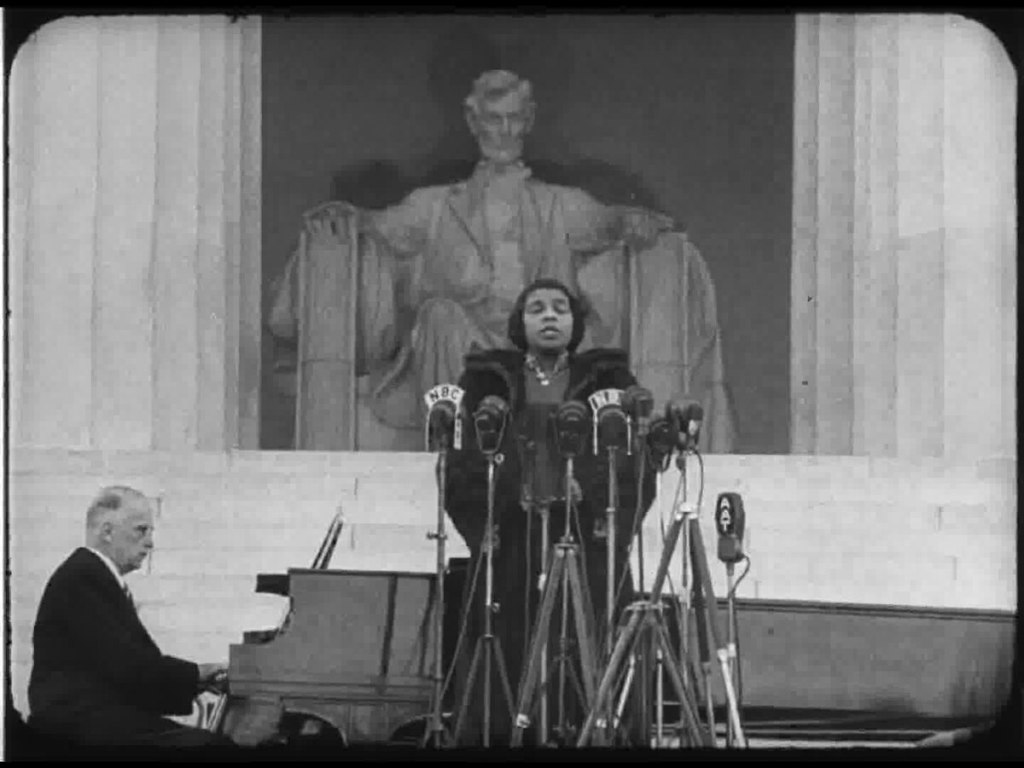
The Plot: By 1939, African American contralto Marian Anderson was one of the most celebrated singers in both America and Europe. Her annual Washington D.C. concerts sponsored by Howard University grew in popularity each year, meaning the university had to seek larger venues annually. When Howard approached the Daughters of the American Revolution (DAR) for use of the Constitution Hall (D.C.’s largest venue at the time) for Anderson’s 1939 concert, they were turned down due to the venue’s Whites-only policy. Anderson’s manager Sol Hurok took this story to the press, and the discrimination made headlines. With support from First Lady Eleanor Roosevelt (who resigned from the DAR in protest) and Interior Secretary Harold L. Ickes, Marian Anderson performed a free concert in front of the Lincoln Memorial on Easter Sunday, April 9th, 1939, for an integrated crowd of over 75,000 people. What followed has been described as “the concert that awakened America”, and a pivotal moment for American civil rights.
Why It Matters: The NFR gives the footage its proper historical context and praises Anderson’s “gooseflesh-inducing” performance. I have never heard the phrase “gooseflesh-inducing” before, and I doubt I ever will again.
But Does It Really?: As a historic event, “Marian Anderson: The Lincoln Memorial Concert” should absolutely be on the NFR. My one quibble: There’s only about five to six minutes of surviving footage of the concert, and most of that is Harold Ickes’ introduction. Marian’s only on camera for about a minute! I can give this footage a historical pass, but the corresponding NBC radio broadcast of the concert is a much better documentation (see “Other notes” and “Listen to This” for more information about the broadcast).
Everybody Gets One: Born to a devout Christian family in Philadelphia, Marian Anderson began performing in her church choir at age six, which led to singing at local functions for as much as 50 cents (almost $20 today). In 1925, Anderson won a singing competition and performed with the New York Philharmonic, launching her professional career. America’s Jim Crow laws of the time meant significantly less venues for Anderson to perform in, so she toured Europe in the 1930s, receiving praise from the likes of Arturo Toscanini, who said, “What I have heard today one is privileged to hear only once in a hundred years.” Upon her return to America, Anderson still faced segregation laws, with the Lincoln Memorial concert becoming a major turning point for the small but growing civil rights movement. Despite her role in this movement, Anderson never considered herself an activist, citing her participation in civil rights as “a culmination of the goodwill of people who…saw me as I am, and not as somebody else.”
Other notes
- Marian Anderson’s concert was filmed by Hearst Metronome Newsreel and edited into a 90-second segment of their “News of the Day” series titled “Nation’s Capital Gets a Lesson in Tolerance”. The surviving raw footage includes most of Harold Ickes’ introductory speech, a few crowd shots, a few establishing shots of the National Mall, and two verses of Marian singing “America” (aka “My Country ‘Tis of Thee”). The edited newsreel uses the first verse of “America” and a few establishing shots, making all that footage of Ickes’ speech a huge waste of time and film. The 90-second time allotment gives you an idea of how this concert was covered by the press at the time; newsworthy, but no need for extensive coverage.
- At a time when America was digging itself out of a depression and trying to avoid another world war, the mistreatment of its Black citizens definitely got put on the backburner. While booking a one-time concert for a Black artist is more performative (for lack of a better word) than any political action or legislature, it’s a step in the right direction, and downright radical by 1939 standards.
- Another disappointing but important piece of information regarding this concert: The DAR weren’t the only group to turn Howard University down. D.C.’s Central High School also wouldn’t lend their auditorium for the Anderson concert, even after news of the DAR rejection became public. Also, when Marian arrived in D.C. with her mother and sister the day of the concert, they stayed at a private residence due to the segregation laws of D.C. hotels.
- You can imagine my increasing frustration as I watched Interior Secretary Ickes prattle on for two, three, four minutes of this very short video. Get to Marian, already!
- Even in her brief filmed appearance in the available footage, Marian does not disappoint. I mean, I knew she was good, but damn what a voice. Contralto singing is no joke, and Anderson delivers a clear, stirring “America”, devoid of any distracting vocal flourishes while still putting her distinct stamp on it. Thank goodness there’s more audio of this.
- Side Note: Has Audra McDonald ever been approached about playing Marian Anderson? McDonald’s classical soprano comes closest to matching Anderson’s voice, and she has played her share of famous singers/civil rights figures in the past. Somebody get on this!
- Shoutout to Kosti Vehanen, providing Anderson’s piano accompaniment for the concert. Vehanen started as a solo pianist in his native Finland, but became a much sought-after accompanist, collaborating with Marian Anderson for most of the 1930s. He even wrote a book about their time together: 1941’s “Marian Anderson: A Portrait”.
- Yeah, the radio broadcast is the way to go. It’s a half hour and you get so much more of the concert, plus color commentary by NBC describing the event and giving some biographical info on Anderson. All that seems to be missing from the radio broadcast is Anderson’s performance of “My Soul Is Anchored to the Lord”, her encore of “Nobody Knows the Troubles I’ve Seen”, and her brief closing remarks thanking the audience.
- Man, between this and “Mr. Smith Goes to Washington”, 1939 was a great year for the Lincoln Memorial. This is the best press Abe’s gotten since Gettysburg.
Legacy
- Marian Anderson would finally perform at the Constitution Hall in 1943 for an American Red Cross benefit. While the DAR had reversed its segregation booking policy by this point, Anderson did not consider her performance at that venue any sort of victory, symbolic or otherwise. Anderson retired from performing in 1965, living quietly in Danbury, Connecticut with her husband, only returning to the limelight to pick up one of her many lifetime achievement awards. Marian Anderson died in 1993 at age 96.
- I was all set to give this post the subtitle “Voice of Freedom” until I learned that’s the name of a 2021 episode of “American Experience” chronicling Marian Anderson and this concert. If only I had gotten to this post earlier…
- Hearst Metronome News ceased production in 1967 (one of the last theatrical newsreels to fold) and in 1981 the entire Hearst Metronome catalog was acquired by the UCLA Film and Television Archive. At some point, the Marian Anderson concert raw footage was reconstructed by UCLA with support from (among others) the National Film Preservation Foundation, which led to its NFR induction (or possibly vice versa).
- Marian Anderson’s Lincoln Memorial concert held the record for “Most Important Historical Event in Front of the Lincoln Memorial” for a solid 24 years. Not so coincidentally, Marian Anderson attended the March on Washington in 1963, and performed “He’s Got the Whole World in His Hands” in almost the exact same spot in front of the Lincoln Memorial.
Listen to This: The National Recording Registry inducted the NBC radio broadcast of Marian Anderson’s Lincoln Memorial concert in 2008. NRR regular Cary O’Dell is on hand with a very comprehensive essay.
Bonus Clip: Eddie Murphy performed his first stand-up special “Delirious” at the DAR Constitution Hall in 1983, and closes out his set with a shout-out to Marian Anderson (who he erroneously calls “Mary”).
 The Horse's Head
2 thoughts on “#756) Marian Anderson: The Lincoln Memorial Concert (1939)”