
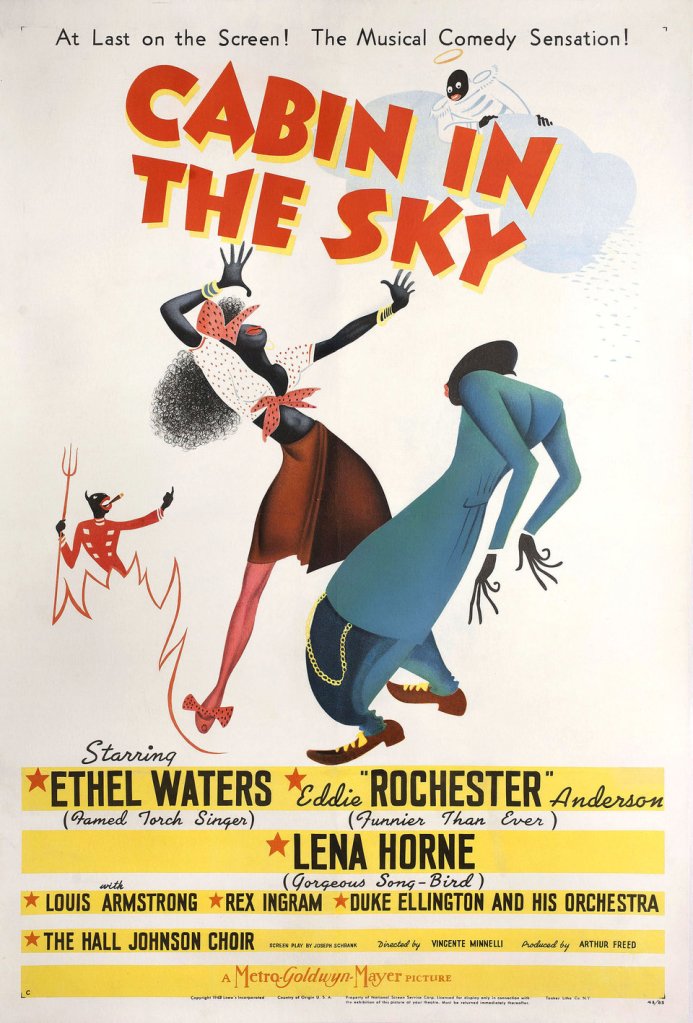
#757) Cabin in the Sky (1943)
OR “The Book of Joe”
Directed by Vincente Minnelli
Written by Joseph Schrank. Based on the musical by Lynn Root, Vernon Duke, and John Latouche. Additional songs by Harold Arlen, E.Y. Harburg, Ford Dabney, Cecil Mack, and Ted Fetter.
Class of 2020
The Plot: Little Joe Jackson (Eddie “Rochester” Anderson) is a chronic gambler who keeps trying to quit at the behest of his devoted wife Petunia (Ethel Waters). When Joe skips church to gamble at a local club, he is shot by gangster Domino Johnson (“Bubbles” John W. Sublett). As Joe lies on his deathbed, he is visited by angel The General (Kenneth Spencer) and devil Lucifer Jr. (Rex Ingram), who fight over custody of Joe’s soul. They agree on a deal to keep Joe alive for six more months, allowing him a chance to repent, but if he slips up, he goes to Hell with Lucifer Jr. Upon returning to his body, Joe vows to be a better husband and spends more time with Petunia, but Lucifer Jr. has a few tricks up his sleeve, including the services of Joe’s old flame Georgia Brown (Lena Horne). Oh, and did I mention it’s a musical with an all-Black cast?
Why It Matters: The NFR calls the film “a glittering cultural record of outstanding African American artistic talent”, though concedes that the film simultaneously “demonstrates the limited film opportunities and acting compromises” of Black entertainers at the time.
But Does It Really?: While the film doesn’t add up to a whole lot, “Cabin in the Sky” has a few things working for it; the sensational on-screen talent, the directorial debut of Vincente Minnelli, and progressive-for-its-time casting. Yes, there are plenty of negative stereotypes to go around, but they’re never at a grotesque extreme, and while the film may be less entertaining than it was 80 years ago because of that, it is still very watchable. If you’re willing to overlook these stereotypes, “Cabin in the Sky” is a fun musical with plenty of big talent on display, and its historical significance helps seal its NFR status.
Shout Out: In a great bit of recycling from MGM, the storm at the end of the movie is the tornado sequence from “The Wizard of Oz”. They’ve got the footage and damn it they’re gonna use it!
Everybody Gets One: No history of great 20th century entertainers is complete without Ethel Waters. A staple of the Black vaudeville circuit since she was nine years old, Waters spent the 1920s and 1930s as one of the most successful (and highest paid) African American blues singers in the country, with such hits as “Dinah” and “Am I Blue?”. She also originated the song “Stormy Weather” during her tenure at the Cotton Club. In addition to headlining the original Broadway production of “Cabin in the Sky”, Waters starred in 1939’s “The Ethel Waters Show”, making her the first Black performer with their own TV show (albeit a one-time special that aired only in New York). Ethel Waters was living in Los Angeles and had already made a handful of films when MGM started production on “Cabin in the Sky”.
Title Track: Sung by Ethel Waters and Eddie Anderson (in his least gravelly work), the song “Cabin in the Sky” is one of only three that made the transfer from stage to screen (the others are “Taking a Chance on Love” and “Honey in the Honeycomb”).
Seriously Oscars?: “Cabin in the Sky” received a Best Song Oscar nomination for “Happiness Is a Thing Called Joe”. While the song lost to “You’ll Never Know” from the Alice Faye musical “Hello, Frisco, Hello”, composers Harold Arlen and E.Y. Harburg had already won their “Over the Rainbow” Oscar at that point, so they’re fine.
Other notes
- “Cabin in the Sky” opened on Broadway in 1940, and while it only ran for five months it was well-received by critics (though even in 1940 a few questioned why a musical with an all-Black cast was written by White people). After a push from the NAACP and other organizations urging Hollywood to make more films starring Black actors, MGM bought the film rights to “Cabin” when their first choice – “Porgy and Bess” – was unavailable. “Cabin” was filmed in summer 1942 for $680,000, a significantly smaller budget than your typical Hollywood musical (for comparison, MGM’s other 1943 musicals were all made for north of one million dollars).
- In addition to budget cuts, “Cabin” was assigned a first-time director, who fortunately for everyone turned out to be Vincente Minnelli. An acclaimed Broadway director in the 1930s, Minnelli spent his first two years at MGM serving as a consultant and occasionally directing a musical sequence or two, all the while learning everything he could about filmmaking. Minnelli happily accepted the offer to direct his first movie, choosing to treat the Black characters as real people rather than one note stereotypes. Among Minnelli’s artistic touches on the film are some inventive camerawork by cinematographer Sidney Wagner, and having the final film processed in sepia tone (which unfortunately didn’t transfer over to the film’s black-and-white video releases).
- “Cabin” is the rare leading film performance for Eddie Anderson, credited here with the nickname “Rochester”, his valet character from “The Jack Benny Program”. Although Little Joe is far less subservient than Rochester, both characters are not without their negative stereotypes (the racial jokes at Rochester’s expense were significantly lessened as “Jack Benny” went on). Side note: Anderson got his trademark raspy voice as a child from shouting while selling newspapers in San Francisco.
- While Anderson is putting in some good work in this film, we are all here for Ethel Waters. Highly underrated as an actor, Waters’ performance here has a bit of everything: a strong dramatic presence, great comedic timing, and oh that singing. In a better world this would have been the first of many big movie musicals for Waters.
- Say what you will about the stereotypes in this movie, but it’s refreshing to see Butterfly McQueen play something other than an anxiety-ridden ditz. She doesn’t have much to do in her few scenes, but at least she’s not running around in hysterics.
- “Cabin” is often linked with “Stormy Weather”, Hollywood’s other all-Black movie of 1943, released three months after this film. In terms of overall quality, “Cabin” outpaces “Stormy” thanks to its book musical foundation and inventive direction. Unfortunately, much like “Stormy”, our two Black leads aren’t allowed to be as affectionate as an on-screen White couple. Come on, let them kiss!
- I went into this movie cold, so I definitely wasn’t expecting the Devil to be in this. (Excuse me, the son of the Devil). Proving the old adage that the Devil is more interesting to play than God, Rex Ingram is clearly having a blast; certainly more fun than Kenneth Spencer is as the strait-laced General. Along with Ethel Waters, Ingram is the only other actor reprising their stage role for this film.
- Other than a hymn during the opening church scene, “Cabin” doesn’t really become a musical until after Joe comes back and a relieved Petunia sings “Happiness is a Thing Called Joe”. In terms of what happiness is, where does Joe rank among a puppy and a warm gun?
- Showing up briefly as Lucifer Jr.’s idea men are Mantan Moreland, Willie Best, and the comedy team of Fletcher Rivers and Leon James, aka Moke and Poke. Also popping up in this scene: Louis Armstrong, whose brief appearance here makes more sense once you learn they cut his song from the final film. At least we get to hear him play the trumpet for about five seconds.
- Line that made me laugh out loud: Lucifer Jr. complaining about having to work with the B team of devils because “the A boys are over there in Europe!”
- While this isn’t Lena Horne’s film debut, it’s the performance that made audiences take notice of her. Her Georgia Brown is a sort of precursor to Lola from “Damn Yankees”, the seductive vamp under the influence of the Devil. Perhaps Horne’s most notable scene in this movie is the one they cut: a reprise of “Ain’t It the Truth” (Armstrong’s excised song) performed by Horne while taking a bubble bath! Apparently, the censors felt a Black woman in a bathtub was too risqué for 1943. Fortunately, that footage survives and pops up in “That’s Entertainment! III”.
- “Taking a Chance on Love” has nothing to do with anything, but it’s a sweet number, featuring dancer Bill (brother of Pearl) Bailey showing off some impressive tap dancing. I’m pretty sure Bill just invented the moonwalk!
- So let me get this straight: You cut Lena Horne’s first solo number, and when she finally sings it’s a duet between her and Eddie Anderson where he does most of the singing? What is wrong with you people?
- Once we return to the gambling club (the not-so-subtly named Paradise), the film ditches the plot for a parade of song and dance numbers. Sure we get Duke Ellington and his orchestra, some aggressive jitterbugging, and more numbers for Lena Horne and Ethel Waters, but get on with it already!
- [Spoilers] I was ready to go along with this movie’s somewhat dark ending with Joe and Petunia in the afterlife (and one of the rare deus ex machina’s to actually involve God), but then they tack on an “it was all a dream” ending that’s not in the original play! What a cop out! They didn’t need to lift everything from “Wizard of Oz”.
Legacy
- While not a massive hit upon release, “Cabin in the Sky” earned $1.6 million at the box office, which thanks to its reduced budget meant it turned a profit. As you can imagine, the film had some difficulties screening in Southern theaters, with one in Mt. Pleasant, Tennessee stopping the film 30 minutes into its first showing on the orders of the town sheriff.
- While “Cabin” and “Stormy Weather” could have been the beginning of a new era in Black film entertainment, Hollywood seems to have patted itself on the back and stopped making Black-focused films until the Civil Rights movement called them out again.
- Following “Cabin”, Ethel Waters made a few more film appearances, including Elia Kazan’s “Pinky” which earned her an Academy Award nomination. Waters also made a splash in the stage and film productions of “Member of the Wedding” and became the first African American woman to star in a nationally broadcast TV series with “Beulah” (although she left after the first season due to the show’s racial stereotyping). Ethel Waters died in September 1977, seven months after her “Cabin” co-star Eddie Anderson.
- While the stage version of “Cabin in the Sky” doesn’t show up that often outside of the odd concert staging, the song “Taking a Chance on Love” has become a standard. The film’s “Happiness is a Thing Called Joe” also gets the occasional cover, including recently by Cher of all people in support of Joe Biden!
- Although Lena Horne worked primarily in film for the next decade or so, she reunited with composers Harold Arlen and E.Y. Harburg for the Broadway musical “Jamaica”. Among the songs she sang every night was “Ain’t It the Truth”, her deleted song from this movie.
- And as we soon learned, Vincente Minnelli was just getting warmed up with “Cabin in the Sky”, cranking out hit after hit for MGM for the next 15 years. Among his follow-ups are fellow NFR entries “Meet Me in St. Louis”, “An American in Paris”, and “Gigi” for which Minnelli won the Best Director Oscar.
 The Horse's Head
2 thoughts on “#757) Cabin in the Sky (1943)”