
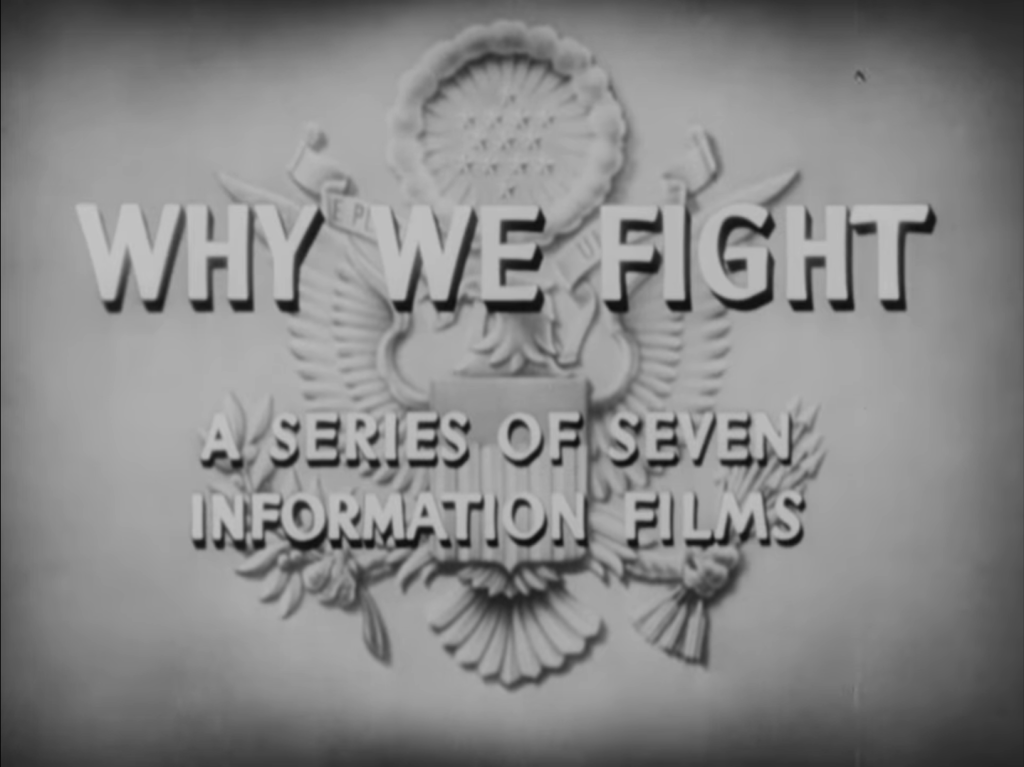
#759) Why We Fight (1942-1945)
OR “World War II 101”
Directed by Frank Capra (All parts), Anatole Litvak (Parts 2-3, 5-7), and Anthony Veiller (Part 4)
Written by Veiller (Parts 1, 5, 7), Eric Knight (Part 1), Julius & Philip Epstein (Parts 2-7), and Anatole Litvak (Part 5)
Class of 2000
This is easily the most oversimplified post I’ve ever written: a seven-hour distillation of World War II distilled even further into a blog post. Every sentence of this post could be its own write-up, but we’ve got to keep things moving, and I encourage you to treat this post as the proverbial tip of the iceberg regarding World War II.
The Plot: “Why We Fight” is a seven-part film series created by Frank Capra for the US Department of War to educate the American military on how World War II came to be and what exactly we’re fighting for. Each film in the series focuses on a different aspect of the war, with episodes devoted to Hitler’s rise in Germany, the Nazi invasion of Poland and France, and the brave fighting from our allies in Britain, Russia, and China. After seven hours of wartime propaganda, you may not agree with its heavy-handedness, but you will understand why we fought.
Why It Matters: The NFR write-up is mostly a rehash of the films’ contents and Capra’s limited resources while making them, highlighting the editing of newsreel footage. An essay by Dr. Thomas W. Bohn gives more historical context and praises the series as “the finest documentary films of World War II”.
But Does It Really?: I’ve watched many NFR films over the years dealing with WWII, but “Why We Fight” is the only one that attempts an extended overview of the entire war. While no single film could possibly succeed at this, “Why We Fight” is the closest we’ll ever get. It’s long and at times unsettling, but the series is an indispensable account of the war while it was in progress, with a bounty of newsreel and documentary footage showing what it was like (albeit the manipulated, American mythologized version). “Why We Fight” is NFR-worthy for its preservation of the sights, sounds, and ideals of the war, but I would hold off on watching all seven of these unless you’re really into WWII (or the NFR).
Wow, That’s Dated: We’ll cover the films’ most egregious bits of propaganda as we go, don’t you worry.
Seriously, Oscars?: Two of the “Why We Fight” films received Oscar attention. “Prelude to War” was one of 25 nominees and four eventual winners for Best Documentary Feature in 1942, the first year that category was presented. “The Battle of Russia” was nominated the next year, losing to another war documentary from our allies in Britain: “Desert Victory”.
Other notes
- Immediately following America’s official entrance into WWII in December 1941, Oscar winning director Frank Capra was among the countless Hollywood artists who enlisted in the U.S. military to help fight. Upon enlisting, Capra was commissioned the rank of Major and assigned to work with Army Chief of Staff George C. Marshall. Unhappy with the underwhelming and incohesive morale lectures given to Army soldiers before deployment, Marshall commissioned Capra to make a series of films to replace these lectures and explain to soldiers why and what they were fighting for. With limited fundings, Capra and his team (including the writers listed above, editor William Hornbeck, and composer Dimitri Tiomkin) utilized available newsreels, documentaries, and battlefield footage to assemble the “Why We Fight” series.
- While Walter Huston is often cited as the sole narrator of “Why We Fight”, he is conspicuously absent for most of the series. In those instances, narrating duties go to Anthony Veiller, one of the series’ writers and co-directors. A handful of other narrators pop up throughout “Why We Fight”, including Warren J. Clear, a high-ranking U.S. military diplomat, and one of many people who the quote “There are no atheists in foxholes” is attributed to.
Prelude to War (1942)
- As the title suggests, “Prelude to War” shows us the global events that led to WWII in 1939, primarily the growth of Germany, Italy, and Japan under the dictatorships of, respectively, Hitler, Mussolini, and Hirohito. The film points to Mussolini’s fascist regime and Japan’s 1931 invasion of Manchuria as the starting points of the war, though most of the time is spent showcasing Hitler’s rise in Germany. All of this is intercut with actions taken by America and the League of Nations to ignore the warning signs and stay out of another war.
- Overall, this is a very powerful start to the series. If Capra had only made this film, he would have fully succeeded in his goal to explain…well, why we fight. Admittedly, the reason “Prelude to War” spoke to me was the parallels between what this film shows us of 1930s Germany and what’s happening in 2025 America. We are in so much trouble.
- On a related note, with America having been politically divided against itself for the last decade, I can’t imagine a film in 2025 bringing together all of modern America to fight a common enemy like “Why We Fight” (hell, we couldn’t even band together to fight COVID).
- The film’s most memorable recurring imagery is a map of the world with black ink spreading across the Axis countires, eventually spreading to the different countries they have conquered (or plan to). This animation was done by Walt Disney Productions, part of the WWII propaganda they cranked out during the war to stay afloat.
- “Prelude to War” was well received by Chief of Staff Marshall and, more importantly, President Franklin Roosevelt, who ordered that the film receive a nationwide theatrical release. After a delay from the Office of War Information, “Prelude to War” hit theaters in May 1943, where it was met with low box-office and mixed reactions from a nation that was already well-aware of why they were fighting.
The Nazis Strike (1943)
- Part Two focuses on Hitler’s decade-long strategy for world domination, taking inspiration from the “Heartland theory” that whoever controls the “old world” (Afro-Eurasia) controls the world. The infiltration of fascist groups into the western world is covered, as is the Nazis’ invasions of Austria, Czechoslovakia, and Poland in 1938-1939. If you thought “Prelude to War” was pure propaganda, strap in.
- This seems like a good time to mention that “Why We Fight” includes clips from “Triumph of the Will”, Leni Riefenstahl’s controversial 1935 Nazi propaganda movie; one of the most influential films in cinema history and one of many important movies ineligible for the NFR. I have seen “Triumph” only once, during a documentary class I took in college. I fell asleep mid-viewing and let me tell you there is nothing worse than being awakened by a 20-foot projection of Hitler yelling at you.
- You most likely know the Nazi invasion of Austria from the role it plays in “The Sound of Music”, and fellow NFR enthusiasts will remember the Czechoslovakia invasion being touched upon in “Czechoslovakia 1968”.
- This film’s most controversial section is its depiction of the Nazi invasion of Poland in September 1939. The film echoes many of the myths being presented at the time about the Polish army’s seemingly ineffectual fight against the Nazis, which is greatly exaggerated here to emphasize Hitler’s growing power. For a depiction of this invasion from the Polish perspective, see fellow NFR entry “Siege“. “The Nazis Strike” also downplays the Russian invasion of Poland, claiming it was a counterattack on Germany. The truth is way more complicated than I can get into here, but this more positive spin on Russia’s involvement stems from Russia being our ally at the time of this film’s production (we see much more of this in “The Battle of Russia”).
Divide and Conquer (1943)
- After Poland is invaded, England and France declare war on Germany. Not wanting a two-front war, Hitler heads west and spends spring 1940 taking over the neutral countries of Norway, Denmark, the Netherlands, and Belgium. “Divide and Conquer” concludes with the devastating surrender of France to the Germans in June 1940 despite the concentrated efforts of the Allied army.
- With the exposition of the first two films out of the way, “Divide and Conquer” focuses primarily on the attacks, with an emphasis on battleground footage, including villages being destroyed and the dead bodies of innocent citizens. Each country’s invasion is paired with a corresponding quote from Hitler promising he wouldn’t attack them. This is easily the most depressing of the “Why We Fight” films so far.
- Despite the especially downer subject matter, “Divide and Conquer” does try to end on a positive note, with a deus ex machina in the form of the Dunkirk evacuation, and the inspirational leadership from France’s Charles de Gaulle.
The Battle of Britain (1943)
- Hitler sends his aerial warfare to attack Britain in late 1940, but the British fight back with the resilience of their people and the strength of the Royal Air Force. Just as the Battle of Britain was a turning point for Allied forces, “The Battle of Britain” is a turning point in “Why We Fight”, becoming an inspirational tale of perseverance in the face of the Nazis.
- Compared to the previous three installments, “The Battle of Britain” is propaganda on the other extreme, depicting Britain as a country of Davids banding together to take down a flying Goliath. Every Brit in this movie embodies the classic “stiff upper lip” trope, always maintaining their composure as they prepare for war. It’s almost like they keep calm and carry on or something like that.
- A large portion of “The Battle of Britain” comes from such British propaganda films as “The Lion Has Wings”, “Christmas Under Fire”, and “London Can Take It!”. That explains the more staged quality of this film, with dramatic cinematography and a few quippy exchanges between Brits.
- Prime Minister Winston Churchill gives us some excerpts from his trademark wartime speeches throughout “Britain”. First up, his “we shall fight them on the beaches” speech from June 1940, and at the end his “Never was so much owed by so many to so few” address from August 1940. Winston’s playing the hits today.
- The only major part of the Battle of Britain overlooked here is the Battle of Pepperinge Eye, where a group of Nazis were taken down by Angela Lansbury and a bunch of enchanted armor.
- Thanks to this film’s depiction of the 1940 holiday season in war-torn London, “Why We Fight” has become the last movie I ever expected to make my “Die Hard Not Christmas” list.
- The final shot of “The Battle of Britain” is the final shot from “Mrs. Miniver”, with the RAF flying in a V formation over a bombed church. As I said in that movie’s post, “Subtle.”
The Battle of Russia (Parts I & II) (1943)
- Having mostly conquered Western Europe, Germany heads back east to settle their score with Russia. The longest of the “Why We Fight” films, “Battle of Russia” is split into two parts. Part I covers Russia and Germany’s rocky relationship, and their battles throughout 1941. Part II focuses on the seven-month Battle of Stalingrad in 1942-1943, and the Russians’ hard-fought victory over the Nazis.
- Now this I found interesting. The United States’ relationship with Russia has always been fraught, so it was fascinating to watch an American film speak highly of Russia, praising its diversity, culture, and resilience against the Nazis. It helps that both this film’s co-director and composer were Russian immigrants, and their love for their homeland is on full display. As with “Nazis Strike Back”, any wrongdoing by Russia is glossed over (allegedly Capra was forced to cut a sequence chronicling Russia’s pre-war invasions of neighboring countries), and no mention is made of the country’s Communist state or Stalin’s recently cemented dictatorship. Even with the film’s propaganda bent, I still appreciated seeing Russia in a positive light before the Cold War hits and we all hate each other again.
- Another classic international film sneaking its way onto the Registry: 1938’s “Alexander Nevsky”, Sergei Eisenstein’s historical epic of the Russian prince who helped fend off German crusaders in 1242. “Nevsky” is one of several films in the opening montage depicting Russia and Germany’s centuries long feud. In addition to Eisenstein, other Russian artists getting a shoutout here include “War and Peace” author Leo Tolstoy, and needle-drops from such classical composers as Stravinsky, Tchaikovsky, and Prokofiev.
- “Battle of Russia” was the second (and final) “Why We Fight” film to receive a general theatrical release, including in Russia where, unsurprisingly, it was very popular, but quickly withdrawn once the Cold War broke out.
The Battle of China (1944)
- We shift gears and spotlight the Japanese army’s attempts to control China throughout the 1930s. In the wake of 1937’s Nanjing Massacre, China unites to strengthen their National Revolutionary Army and fight back. Like the previous two films, “Battle of China” celebrates a country of tenacious citizens fighting a common evil, regardless of how it happened in real life.
- Oh brother, this one. Even by the lax standards of “Why We Fight”, “Battle of China” ramps up the propaganda, manipulating China’s war experience to follow the same rousing story beats as “Britain” and “Russia”. With the film’s disturbing battleground footage and barrage of racial slurs towards the Japanese, I’m increasingly relieved there’s only one more “Why We Fight” film.
- The first and biggest of this film’s manipulations is the Tanaka Memorial, Japan’s alleged four-step strategy for world domination. Despite its utilization here as the equivalent of Germany’s “Heartland theory”, the Tanaka Memorial is widely considered a fabrication created by anti-Japanese groups. There are so many other issues to acknowledge (The use of the term “Proper China”, the complete omission of Communism, etc.), but suffice it to say that “Battle of China” is not interested in any moral nuance and the film’s “facts” should not be taken at face value. Even the U.S. Military felt this film crossed a line, quickly pulling it from circulation within the armed forces due to “political problems”.
- WARNING: While every film in “Why We Fight” contains its share of wartime violence, “Battle of China” includes extensive footage from the Nanjing Massacre, including the on-screen murder of two Chinese civilians shot at close range. Viewer discretion is strongly advised.
War Comes to America (1945)
- But what about the good ol’ U.S. of A.? “War Comes to America” chronicles the history of the United States and its desire to avoid another world war. After initially staying out of things in the 1930s, America starts to show its support to the Allies with the Lend-Lease Act of 1941. But everything changes when Japan bombs Pearl Harbor, and America officially joins the fight.
- As expected, “War Comes to America” is pure patriotism, with ample screentime devoted to all of America’s aspirational ideals. Like the previous entries, America’s checkered past is side-stepped: no mention of Indigenous genocide, the Civil War, or Japanese internment camps. It’s also thoroughly depressing to watch how many of our liberties have been slowly stripped away and diminished over the last 80 years (Religious freedom? What’s that?). Overall, “War Comes to America” is a rehash of everything covered so far in the series from an American point of view. Honestly, you could watch this and “Prelude to War” and get the overall gist of “Why We Fight” (and save yourself about five hours).
- The film begins and ends with the designation that this is only Part I. A planned Part II of “War Comes to America” would have covered our four years fighting in the war, but that film was ultimately nixed by the Army Pictorial Service. This means “Why We Fight” ends somewhat anti-climactically with the attack on Pearl Harbor, and an unresolved “End of Part I” teaser.
Legacy
- The final “Why We Fight” film was completed in June 1945, shortly after Germany’s surrender and Hitler’s suicide, and shortly before Japan’s surrender and the official end of World War II in September (Italy had surrendered in 1943). And America has never had a problem with other countries since.
- Following the end of the war, Frank Capra returned to Hollywood, founded his own independent film company (Liberty Films), and made arguably his best movie – “It’s a Wonderful Life”.
 The Horse's Head
6 thoughts on “#759) Why We Fight (1942-1945)”