
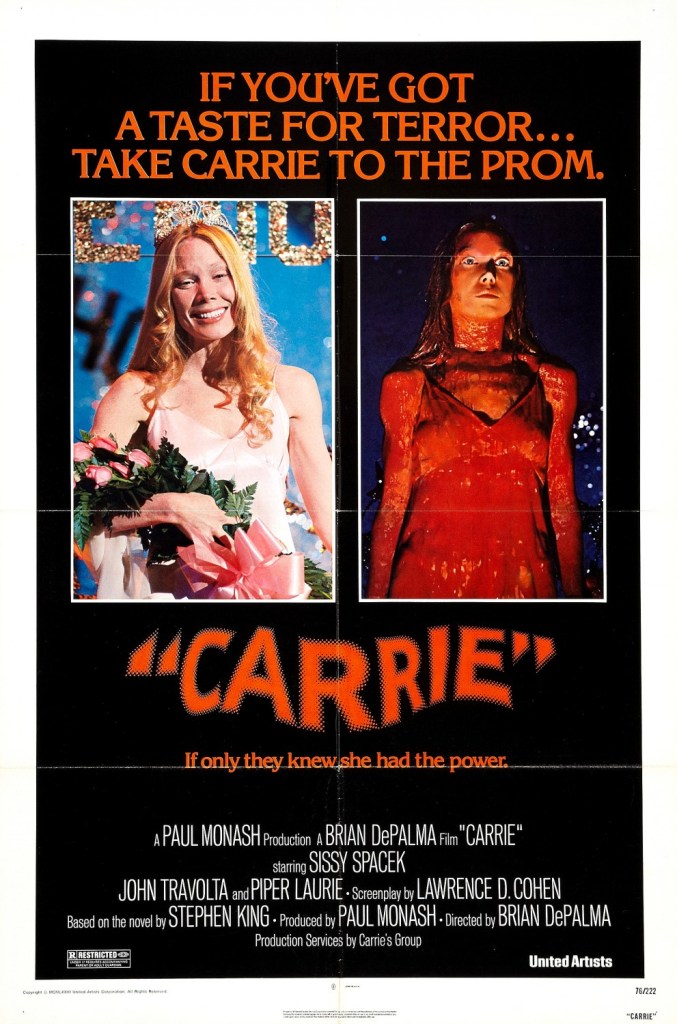
#760) Carrie (1976)
OR “Stephen King’s Grease”
Directed by Brian De Palma
Written by Lawrence D. Cohen. Based on the novel by Stephen King.
Class of 2022
The Plot: Shy teenager Carrie White (Sissy Spacek) is frequently abused by both her high school classmates and her domineering, religious mother Margaret (Piper Laurie). When Carrie has her first period in the locker room, she is ridiculed by the other girls, and starts to experience what turns out to be telekinetic powers. Classmate Sue Snell (Amy Irving) regrets picking on Carrie and makes her boyfriend Tommy Ross (William Katt) take Carrie to the prom as an apology. Meanwhile fellow classmate Chris Hargensen (Nancy Allen), furious about being banned from the prom as punishment for teasing Carrie, plots with her boyfriend Billy Nolan (John Travolta) to get revenge on Carrie at the dance. Little do they know that Carrie is now in control of her newfound powers, and hell hath no fury like a prom date scorned.
Why It Matters: The NFR attributes the film’s success to Brian De Palma “mix[ing] up a stylish cauldron of horrific scenes” with Spacek’s “unforgettable performance”. Spacek is also quoted from a Library of Congress interview calling De Palma “a wonder to work with”.
But Does It Really?: When I started this blog in 2017, “Carrie” was one of the movies that made me say, “Wait, that isn’t on the NFR?” When it finally made the cut five years later, needless to say I had no objections. “Carrie” is a horror classic that has endured thanks to its eternal themes of isolation and social longing, its emphasis on character over frights, and for being really, really scary. De Palma’s inventive directing keeps things interesting to watch, as does the dedicated performances from the entire cast, whose grounded work balances out the supernatural elements. From its iconic prom sequence to its introduction of Stephen King, “Carrie” is a force to be reckoned with, and a no-brainer on this list of significant American films.
Shout Outs: A “Psycho” reference in a De Palma movie? Now I’ve seen everything.
Everybody Gets One: Originally at Columbia as a physics major, Brian De Palma was inspired to become a filmmaker after seeing “Citizen Kane” and “Vertigo”. After directing a few smaller films in New York (including some with a young Robert De Niro), De Palma moved to L.A. and made such films as the cult classic “Phantom of the Paradise” and “Obsession”, his full-blown love letter to Hitchcock. As of this writing, “Carrie” is somehow De Palma’s only movie on the NFR.
Wow, That’s Dated: “Carrie” displays its ‘70s-ness not through any pop culture or dated references, but rather through a partially synth score and some incredible hair styles (looking at you, William Katt’s perm).
Seriously, Oscars?: Despite the Academy’s long-standing aversion to horror movies, “Carrie” received two Oscar nominations for its main actresses. Both Sissy Spacek and Piper Laurie lost in their categories to the women of “Network”: Spacek losing Lead Actress to Faye Dunaway, and Laurie losing Supporting Actress to Beatrice Straight (but that’s another story).
Other notes
- While working as an English teacher in the early 1970s, Stephen King took on a friend’s suggestion to write a short story with a female protagonist. Initially unhappy with the first few pages, King threw his “Carrie” manuscript into the trash, only for his wife Tabitha to recover the pages and encourage him to keep going. “Carrie” was King’s first published novel and upon its publication was a modest hit, gaining traction upon its paperback release. Among its early readers was Brian De Palma, who made it known to studios considering a film adaptation that he wanted to direct. After initial consideration by 20th Century Fox, United Artists bought the film rights, paying King a mere $2500 (which he was happy to get) and giving De Palma the low budget of $1.6 million. “Carrie” was the first film adaptation of Stephen King’s writing.
- Sissy Spacek was initially not in the running for Carrie White, but her husband Jack Fisk (the film’s art director) convinced De Palma to let her audition. Like so many great movies performances, you can’t imagine anyone other than Sissy Spacek playing that part. The only problem is that the character of Carrie is so demure that she keeps getting sidelined in her own movie by the louder, showier supporting characters.
- The first shot of Carrie losing a volleyball game is a perfect introduction to the character, evoking immediate and appropriate sympathy. Things, however, take a weird turn in the opening credits, with a melancholy score playing over slow-motion footage of nude and topless teenage girls in the locker room (What male gaze?). The film shifts gears again with the borderline-traumatic shower scene, where Carrie has her first period and first demonstration of her telekinesis. It’s a lot to take in within the first five minutes, but it’s unsettling in a good way, keeping you on edge for the rest of the movie.
- In a recurring ‘70s trend, no one playing a high schooler in “Carrie” was an actual teenager during production. Sissy Spacek was 27, and the rest of the cast ranged from 22 (John Travolta) to 31 (Edie McClurg). Adding to this confusion is 29-year-old Betty Buckley as Coach Collins. For the most part it’s not too distracting, though as Norma, P.J. Soles is utilizing a precursor to the “Ponytail Stratagem” known as the “Baseball Cap Commutation”.
- After 1961’s “The Hustler”, Piper Laure’s film offers dried up and she headed back to New York, working exclusively in theater and TV. Although Laurie didn’t like the script for “Carrie”, she was charmed by Brian De Palma and agreed to play Margaret assuming the movie was a black comedy. Her performance is definitely out there, but surprisingly never full-on camp, which given the material is a tough needle to thread.
- For the record, the statuette in the prayer closet is of Saint Sebastian, not Jesus. Saint Sebastian was shot with multiple arrows in a persecution of Christians, and then later became the patron saint of archery, which is a little rude. It’s like making Jesus the patron saint of nails.
- So far Carrie’s telekinetic powers include moving objects, blowing up light bulbs, and summoning Bernard Herrmann soundalike cues. Side Note: Herrmann had scored De Palma’s previous films “Sisters” and “Obsession” and was slated to score this movie before his untimely death in December 1975. Composer/songwriter Pino Donaggio took over scoring duties, the first of seven collaborations with De Palma.
- Fun Fact: Brian De Palma held auditions for “Carrie” in a joint session with George Lucas for “Star Wars”, and it’s fun to think that all these actors were this close to being in one of the biggest blockbusters ever. Of the “Carrie” cast, I could see William Katt as Luke Skywalker in an alternate universe far, far away. On a related note, there is no truth to the rumor that Sissy Spacek and Carrie Fisher were originally cast in each other’s roles.
- Nancy Allen does a good job keeping Chris a petty teenager without going into full-on “Mean Girls” mode. She’s also quite charming, which explains how she became Mrs. Brian De Palma a few years later. Playing her boyfriend is rising star John Travolta in full-on Vinnie Barbarino mode. Also, I won’t go into detail about what Chris is doing to Billy in their first scene together, but is she a ventriloquist?
- Because this film’s most iconic moments are at the beginning and end, I always forget about the lengthy middle section of everyone preparing for the prom. It’s a lot of dialogue scenes, most of which don’t feature Carrie at all! Once Carrie is back in the picture, however, we do get a very satisfying scene of her using her powers to stand up to Margaret.
- “I can see your dirty pillows” is an iconic line, but doesn’t it seem a bit out of character for Margaret?
- Ah, ‘70s proms: live music, feathery hair, and all the ruffled tuxes you can feast your eyes on. We get some sweet moments throughout as we experience Carrie’s joy at her supposed acceptance into the popular groups. The film’s last pleasant sequence is Carrie and Tommy on the dance floor, filmed with the actors on a platform rotating in one direction with the camera revolving around them in the other direction. I get what De Palma was going for, but we need to stop the movie because I think I’m gonna –
- And then Carrie is named Prom Queen in a rigged election, and your heart breaks as she obliviously takes her place on stage directly under a bucket of pig’s blood prepared by Chris. I spent most of the scene yelling at Carrie to move a few feet to her right. Well, the whole scene is in slow-motion, so it was more like “Moooooooooove Caaaaaaaarrrriiiieeeee”.
- You know it’s coming, and you know it’s not going to be pretty, but Carrie’s revenge on the prom is gloriously unrestrained bedlam. It’s scary and gruesome (and with a higher body count than the novel) but because you have spent so much time with Carrie, there’s a sorrow underneath all this chaos. Side note: I love this scene’s use of split screen. Even the conventional rules of moviemaking go out the window in the fracas.
- The final showdown between Carrie and Margaret is also wonderfully intense, with Margaret getting a great reveal as Carrie heads to the bathroom. Also is it me or does Margaret’s hair get puffier with each scene?
- Everyone’s favorite bit of “Carrie” trivia: one shot in the final scene was filmed with Amy Irving walking backwards, with the footage being reversed to give her walk a dreamlike quality. It’s all well and good until you notice the cars driving backwards in the distance.
Legacy
- “Carrie” was released in November 1976, and was an immediate financial and critical hit, quickly developing a cult standing. The success of the film helped boost sales of the original novel, solidifying King’s place as a popular horror novelist. As of this writing, Stephen King has published 65 novels and over 200 short stories. Many of these have film adaptations, two of which are in the NFR alongside “Carrie”: “The Shining” and “The Shawshank Redemption”. For the record, King likes the film version of “Carrie”, even considering its ending better than the one in his book.
- Brian De Palma’s immediate follow-up to “Carrie” was “The Fury”, another movie featuring a high school girl with psychic powers. De Palma’s subsequent filmography includes “Blow Out”, “Scarface”, “The Untouchables”, and the first “Mission: Impossible” movie.
- “The Fury” was one of many films in the wake of “Carrie” that involved children or teenagers with telepathic powers. Among them: “The Initiation of Sarah”, “Firestarter”, “Scanners”, and “Zapped!”, the latter being the only time a Scott Baio movie will ever be mentioned in connection with the NFR.
- In the late 1990s, a horror film called “The Curse” was hastily re-written to work as a legacy sequel to “Carrie”, the result being the disastrous “The Rage: Carrie 2”. Only Amy Irving reprised her role from the original, and while she has since regretted her appearance, she admits the production paid her “a shitload of money”.
- In addition to the sequel, there have been two subsequent film adaptations of the novel, both of which skew closer overall to the book, but then take some wild swings at the end that didn’t sit well with audiences or critics. Fingers crossed that the recently announced limited series adaptation by Mike Flanagan fares better. Speaking of unsuccessful adaptations…
- A stage musical of “Carrie” opened on Broadway in 1988 and had a litany of artistic misfires and production woes, closing in three days and losing its entire $8 million investment. A re-written, scaled-down Off-Broadway revival in 2012 fixed some of the problems (emphasis on some) but remains in the shadow of the original’s legendary flop.
 The Horse's Head
5 thoughts on “#760) Carrie (1976)”