
#762) Siege (1940)
Directed by Julien Bryan
Class of 2006
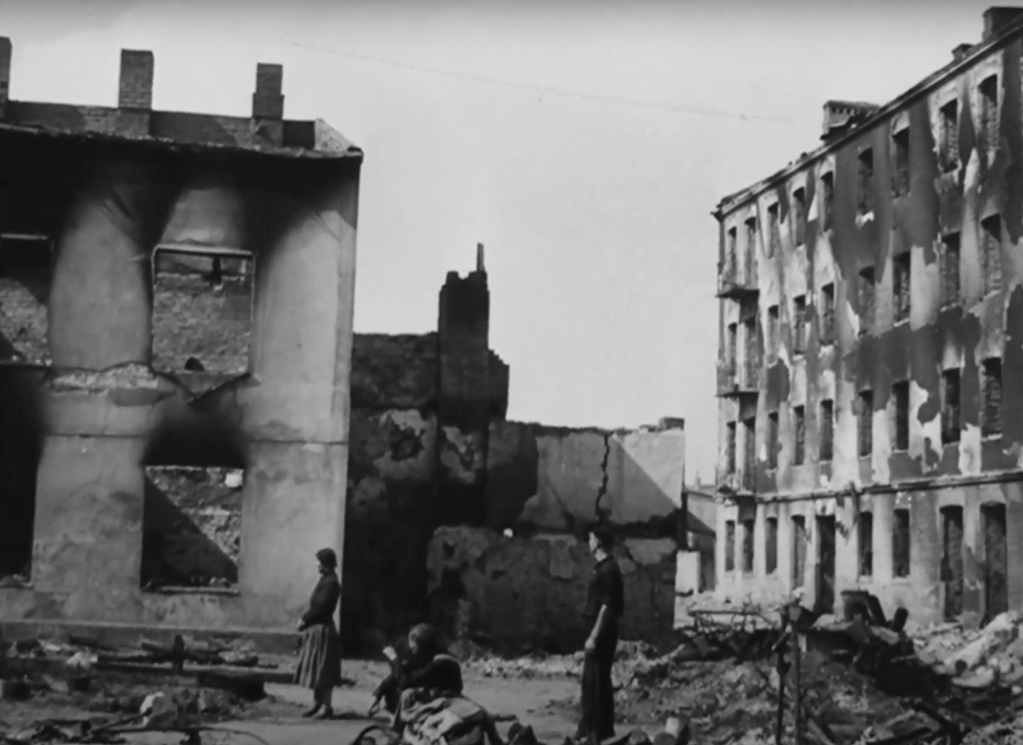
On September 1st, 1939, the city of Warsaw, Poland was attacked by German warplanes in what became known as the Siege of Warsaw, historically considered the start of World War II. Two days later, American photographer Julien Bryan arrived to document the ongoing attacks. Filmed over the following two weeks, “Siege” is a first hand account of Warsaw’s citizens fighting back against the Nazis. Unlike other, in this film’s parlance, “meager censored news reports” of the time, “Siege” doesn’t sugarcoat the uphill battle faced by Warsaw, as fires and air strikes destroy the city and claim the lives of 18,000 civilians.
Having recently completed the marathon that was “Why We Fight”, I was trepidatious about watching another WWII film. Thankfully, “Siege” was a unique enough viewing experience, and much, much shorter. Because “Why We Fight” has to cover so much ground (and has an obvious American bias), several major events of the war can only be touched upon briefly. “Siege” gives us an on-the-ground account of the war’s first two weeks, told entirely from the perspective of the civilians who suffered the first of this war’s many casualties. “Siege” is lightning in a bottle documentation from a then-neutral country, and it is this compassionate yet unflinching perspective from Julien Bryan that makes “Siege” a noteworthy American film.
Why It Matters: The NFR hails the film as “a unique, horrifying record of the dreadful brutality of war” and includes a link to the film via the US Holocaust Memorial Museum’s YouTube page.
Everybody Gets One: Following a stint as an ambulance driver in WWI and attending the Union Theological Seminary in New York, Julian Bryan chose not to become ordained, opting instead to travel the world, documenting his journeys through written travelogues, photographs, and of course film. Most of his travels in the 1930s chronicled the rise of Nazism in Germany (some of Bryan’s footage of Nazi Germany was featured in fellow NFR entry “The March of Time: Inside Nazi Germany”). Bryan happened to be traveling to Warsaw via train in early September 1939 when he learned the city had been invaded. Upon his arrival, Bryan contacted the mayor of Warsaw and received a permit to document the city mid-attacks with his Leica still camera and his Bell & Howell movie camera.
Seriously, Oscars?: “Siege” received an Oscar nomination for Short Subject (One-Reel), losing to “Quicker ’n a Wink”, which comically chronicled MIT’s experiments with stroboscopic photography. Look no further for proof of America’s disinterest in the war than the Academy voting for “Ooh, shiny!”
Other notes
- As is often the case with NFR films chronicling massive destruction of any kind, I don’t have much else to say about “Siege”. The film’s imagery of a city on fire and citizens crying over the dead bodies of their loved ones says more than I ever could. I can only nod in agreement with Bryan’s final words within the film, “May God have mercy on them.”
Legacy
- Upon his return to the United States, Julien Bryan published several of his photographs of the Siege in both Life and Look Magazine. He also wrote a corresponding book (also called “Siege”) and sold his ten-minute film to RKO for distribution across their theaters.
- Following the release of “Siege”, Julien Bryan made several shorts for the Office of the Coordinator of Inter-American Affairs, primarily about Latin American cultures. After the war, Bryan created the International Film Foundation and continued making documentary shorts for the rest of his career. Julian Bryan died in 1974, a few months after receiving a Decoration of Honor from Poland for documenting the Invasion of Poland.
- In 2003, Bryan’s son Sam donated his father’s wartime photos and film to the United States Holocaust Memorial Museum. Their inclusion in the museum’s film archive no doubt caught the eye of the National Film Preservation Board, with “Siege” making the NFR three years later.
 The Horse's Head
2 thoughts on “#762) Siege (1940)”