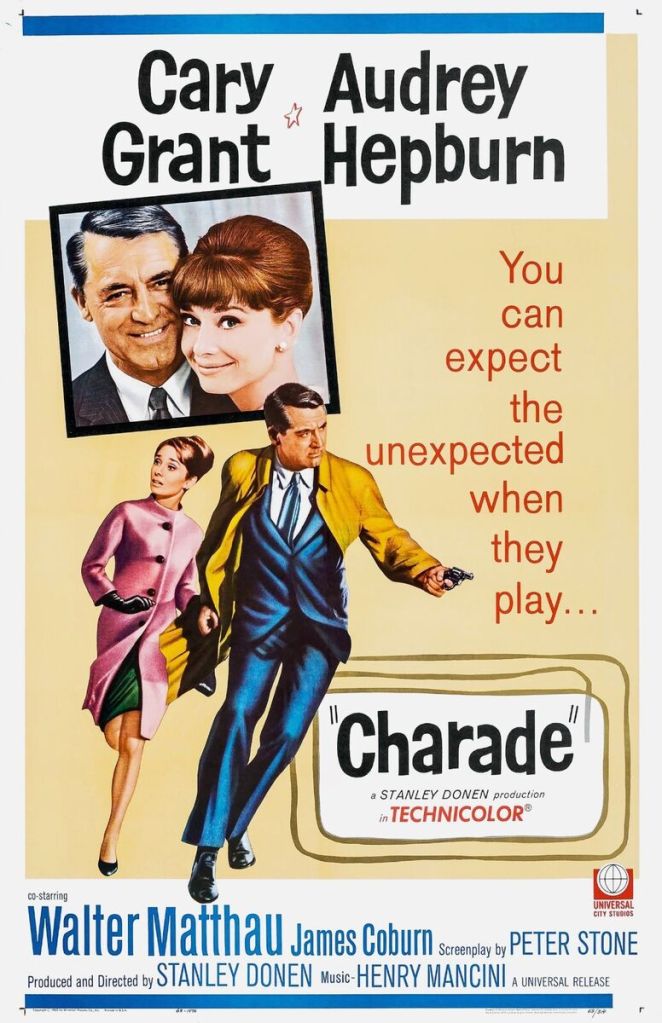
#764) Charade (1963)
OR “Nord au Nord-Ouest”
Directed by Stanley Donen
Written by Peter Stone. Story by Stone and Marc Behm.
Class of 2022
The Plot: Following the mysterious death of her aloof husband Charles, Regina “Reggie” Lampert (Audrey Hepburn) is informed by CIA administrator Hamilton Bartholomew (Walter Matthau) that her husband stole $250,000 from the OSS during World War II, and was murdered by one of the men he double-crossed to get the money. Staying in a Paris hotel, Reggie receives numerous threats from Charles’ betrayed comrades (Ned Glass, James Coburn, George Kennedy), who believe she has the stolen money. She also receives support from Peter Joshua (Cary Grant), a charming tourist she previously had a flirtation with in the French Alps. Mysteries and identities are unraveled, and nothing is what it seems in this movie once called “the best Hitchcock movie Hitchcock never made”.
Why It Matters: The NFR gives an overview of the film and its “elegant and sophisticated” stars. An essay by fellow film blogger Michaela Owens focuses on how Reggie uses food as a coping mechanism throughout the movie. I fully understand the irony of what I’m about to say, but man that is a niche film observation.
But Does It Really?: I saw “Charade” for the first time about 15 years ago, but mercifully forgot enough of it that I was charmed all over again on this viewing. “Charade” gets my vote for the last great Classic Hollywood rom-com. The film successfully blends its genres with A+ talent across the board: winning lead performances, a superb script, airtight direction, plus some gorgeous location shooting in Paris. While not as revered as the rest of Grant, Hepburn, and Donen’s respective filmographies, “Charade” is an underrated classic that more than holds up six decades later, and I’m delighted it has found its rightful spot in the NFR.
Shout Outs: Reggie mentions “An American in Paris” while she and Peter walk along the Quai de Montebello. And in a nice bit of fortuitous foreshadowing, Peter references “On the Street Where You Live” from “My Fair Lady” (Audrey Hepburn would be cast in the film version shortly after production wrapped on “Charade”).
Everybody Gets One: Peter Stone got his start writing for television and the theater, but couldn’t get his screenplay “The Unsuspecting Wife” sold anywhere. On the suggestion of his agent (and with assistance from author Marc Behm), Stone adapted the script into a novel, now called “Charade”, had excerpts published in Redbook magazine, and started making the rounds to studios now very interested in the book’s film rights. Stone quickly sold the screenplay to Stanley Donen, and was on set every day for any last-minute changes, calling the production “an absolutely grand experience”.
Wow, That’s Dated: As with any old movie, there’s a lot of analog technology that would have to be completely overhauled if the film were made today (see “Legacy” below for how that didn’t pan out well). Oh, and the $250,000 would be about $4 million in today’s money.
Title Track/Seriously, Oscars?: Despite being a critical and box office hit, “Charade” only received a single Oscar nomination for its title song. Composer Henry Mancini and lyricist Johnny Mercer had won the Best Song Oscar the previous two years for their work in “Breakfast at Tiffany’s” and “Days of Wine and Roses”, but their potential threepeat was denied when the award went to “Call Me Irresponsible”, a song that has more than outlasted the film it came from: the Jackie Gleason comedy “Papa’s Delicate Condition”.
Other notes
- This thing is already so gloriously 1960s thanks to its animated (in every sense of the word) opening credits by Maurice Binder, the man who gave us the James Bond gun barrel opener, as well as many Bond credit sequences.
- Another sign of the early ‘60s: Actual location shooting! This movie goes to great lengths to prove that it’s really Audrey and Cary in the French Alps. Shoutout to cinematographer Charles Lang for keeping the cinematography engaging even when there aren’t beautiful French vistas to shoot.
- Cary Grant and Audrey Hepburn are so effortlessly charming in this; it’s as if they were set loose on the streets of Paris and the cameras just captured their natural repartee. Our stars’ wonderful chemistry is aided by the fact that the script was written with both of them in mind. Grant and Hepburn are so damn good that I may have to ignore this film’s major Michael Douglas Scale readout. There’s a 25 year age-gap between our romantic leads, a fact that made Grant hesitant to accept the part. He finally agreed when the age difference was written into the script, and the romantic sequences re-written to make Reggie the initiator, not Peter. Also helping matters is that Reggie is never infantilized; she’s an adult in a very adult situation, supported by another (albeit much older) adult. I never thought I’d find an NFR movie that could make me overlook standard Hollywood romantic age gaps, but you did it “Charade”.
- If you’re going to have this much upfront exposition, don’t have it delivered with a very thick French accent. Jacques Marin does his best as Inspector Grandpierre, but I definitely lost a few pertinent details. More exposition gets handed out a bit easier by Walter Matthau in a fun little turn before he struck gold with “The Odd Couple”. Side note: This movie has not one, but three future Best Supporting Actor Oscar winners: Matthau, George Kennedy, and James Coburn.
- My one quibble about the script: If Charles had the $250,000 he stole during the war, why did he auction off all of his belongings for the exact same amount of money? Even if he had already spent the stolen money and was raising the funds to flee the country, why the exact same amount? And doesn’t this all unnecessarily put Reggie in jeopardy? Fortunately, this movie is so charming that I didn’t think about any of this until after the movie was over.
- Our trio of heavies are the right level of threatening for a rom-com/spy thriller hybrid. Ned Glass’ more comedic turn is nicely balanced by Coburn and Kennedy’s menace. And while it’s always nice to see George Kennedy show up on this list, I don’t appreciate that his character’s hook hand furthers the negative association of any “otherness” with villainy. Where’s Harold Russell when you need him?
- The line that got the biggest laugh from me: Peter, upon realizing he and Reggie are walking right next to Notre Dame, “Who put that there?”
- Is it just me or is this French kid Jean-Louis really annoying? I groaned out loud when he returned for the film’s third act. And clearly Jean-Louis’ actor Thomas Chelimsky is doing just fine without my grousing; he’s now a neurologist in Virginia. Also, you’re not hearing things: Jean-Louis is dubbed by a French woman throughout the movie.
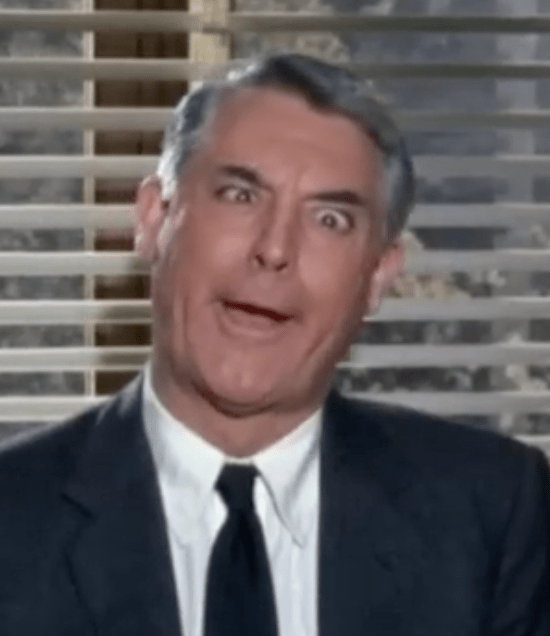
- One of the reasons I feel “Charade” has stayed under the radar all these years is because no one wants to spoil its surprises. There are so many delightful twists and turns in “Charade” that you want to give others the pleasure of discovering them on their own viewing. No spoilers, but what I will say about the film’s ending is that 1) Charles’ murderer falls for the old “villain get distracted while monologuing his motives” trick and 2) I love the face Cary Grant makes during the film’s final scene. I hope that was an outtake that found its way into the final cut.
Legacy
- “Charade” premiered in September 1963 for a one-night benefit screening in Washington D.C (President Kennedy had a private screening at the White House at the same time and loved it). Upon its wide release that December, “Charade” was a critical success that would go on to be one of the highest grossing movies of the year (and Universal’s biggest hit of 1963). Unfortunately, whoever put the copyright notice in the opening credits forgot to include the word “copyright” or its symbol. Therefore due to copyright law at the time, “Charade” immediately fell into public domain, meaning the film could be aired on TV (and eventually get a home video release) by anyone without having to pay Universal.

- Cary Grant liked the screenplay for “Charade” so much that he requested Peter Stone write a draft of his next movie, the 1964 comedy “Father Goose”, which earned Stone an Oscar for Best Original Screenplay. Grant had tried to get Audrey Hepburn to reunite with him on “Father Goose”, but she was already committed to “My Fair Lady” (which, somewhat ironically, Grant had passed on). Despite their desire to make another movie together, “Charade” was the only time Grant and Hepburn shared the screen before Grant’s retirement in 1966, with Hepburn semi-retiring from films shortly thereafter.
- “Charade” received the remake treatment with 2002’s “The Truth About Charlie”. Despite Jonathan Demme at the helm and a promising early starring role for Thandiwe Newton, “Charlie” falls into the “Stick With the Original” column so many remakes find themselves in. There’s no substitute for Cary Grant, and if there is, it definitely isn’t Mark Wahlberg. Side note: Because “Charlie” used enough plot elements from “Charade”, it was determined that Peter Stone should receive a screenplay credit. Stone opted to be credited under the alias “Peter Joshua”.
 The Horse's Head
3 thoughts on “#764) Charade (1963)”