
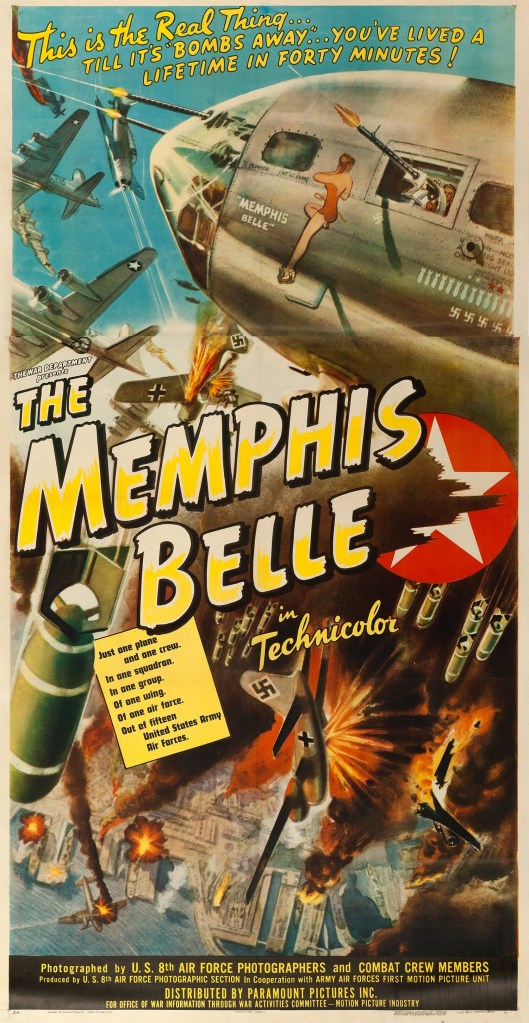
#772) The Memphis Belle: A Story of a Flying Fortress (1944)
Directed by William Wyler
Written by Wyler, Jerome Chodorov, and Lester Koenig
Class of 2001
The Plot: After flying 24 missions over France and Germany in World War II, an American B-17F bomber plane nicknamed Memphis Belle is assigned its 25th and final mission: bombing the Nazi forces in Wilhelmshaven, Germany. Knowing that this mission will conclude their tour of duty and send them home, the Belle crew, led by Captain Robert K. Morgan, is determined to succeed. But as the plane (and the rest of the 324th Bomb Squadron) flies over enemy territory, the prospect of victory takes an uncertain turn. From the director of “Mrs. Miniver” comes another bit of wartime rabble-rousing, this time documenting real-life pilots and a (mostly) true story.
Why It Matters: The NFR writeup is primarily a rehash of the film’s production, with praise going to Wyler’s directing and Koenig’s script. There’s also a link to view the film via the Library of Congress online screening room.
But Does It Really?: We are in the thick of this blog’s WWII era, and while I am definitely experiencing some wartime propaganda fatigue, I found “Memphis Belle” to be an intriguing watch. It’s still very much another bit of military propaganda, but “Memphis Belle” has a few things going for it. For starters, it’s in color; and with William Wyler at the helm, the narrative is more dramatic than the standard “good vs. evil” storyline (not by much, but it’s something). Also, by 1944, Allied victory seemed in reach, so “Memphis Belle” is more upbeat with the prospect of an end in sight, and therefore more watchable after the preceding uncertainties of titles like “Siege” and “Why We Fight”. A pass for “Memphis Belle”, Wyler’s key contribution to the war effort, and the film that gets me that much closer to being done with the NFR’s WWII entries.
Shout Outs: I’m pretty sure that is Flower, the effeminate skunk from “Bambi”, painted on the nose of a B-17 nicknamed “In Der Fuehrer’s Face”, featured briefly in the film’s opening. Makes sense, the plane’s nickname is also a Disney reference.
Title Track: The plane Memphis Belle got its name from its pilot, Captain Robert K. Morgan, as a tribute to his fiancée Margaret Polk. Originally to be named Little One (Morgan’s pet name for Polk), the name was changed after Morgan and copilot Captain James A. Verinis saw the Joan Blondell/John Wayne film “Lady for a Night”, which featured a steamboat named Memphis Belle (Polk hailed from Memphis, Tennessee). Side note: Morgan and Polk called off their engagement shortly after Morgan’s return to the U.S. in 1944, but the two remained friends, and Polk was among those who actively campaigned for the plane’s preservation following the war.
Seriously, Oscars?: Although “Memphis Belle” played a theatrical run, it did not receive an Oscar nomination. For the record: 1944’s Best Documentary Short went to a film from the U.S. Marine Corps: “With the Marines at Tarawa”.
Other notes
- Following the successful release of “Mrs. Miniver” in summer 1942, director William Wyler volunteered with the U.S. Air Force, serving as a major and directing two documentaries, the first of which was “Memphis Belle”. Wyler originally planned to chronicle the bomber Invasion 2nd with the 401st Bomb Squadron, but sadly it was shot down over Germany in April 1943. Wyler selected the Memphis Belle because he liked the name, and given the successful track record of Morgan and his men, Wyler felt the plane had “a pretty good chance of coming back.” Even then, Wyler had another film crew discreetly working with the 303rd Bombardment Group and their Hell’s Angels bomber just in case something happened to the Belle.
- The Memphis Belle was one of 12,000 B-17F bomber planes manufactured by Boeing in 1942 alone, completing construction that July and arriving at an RAF base in Cambridgeshire, England that October. The “Flying Fortress” of the title was coined by Seattle Times reporter Richard Williams who, upon seeing the first B-17 in 1935, described it as a “15-ton flying fortress”, a phrase quickly copyrighted by Boeing.
- While the Memphis Belle did fly a mission over Wilhelmshaven in May 1943, not all of the footage in “Memphis Belle” was from that mission. Some of the footage was shot during an earlier mission over Wilhelmshaven done by the Jersey Bounce the previous February, with additional footage taken from the Belle’s other missions over France around the same time. Tragically, it was during one of these France missions in April 1943 when one of the Belle’s fellow bombers – nicknamed Daisy Mae – was shot down, killing among others this film’s co-cinematographer Harold J. Tannenbaum.
- All this background out of the way, the film proper is quite engaging. The stakes are set up well without hitting you over the head with anything, and the footage, especially the aerial shots of the planes, is breathtaking. Wyler succeeds at making you feel as if you’re in the middle of the action, and I was on the edge of my seat during the second half wondering what will happen to everyone.
- The narrator of “Memphis Belle” is Eugene Kern, best known as…the narrator of “Memphis Belle”. Seriously, this is his only film credit; I have no idea who this guy is. There’s also a point where another narrator slips in, and that appears to be Art Gilmore, previously mentioned on this blog for lending his voice to fake FDR in “Yankee Doodle Dandy”.
- This film doesn’t shy away from the casualties of war, showing us that while the Memphis Belle made it back, its crew was badly injured, with at least one member killed in action. The drama of this moment is undercut a hair by one surviving crew member receiving a life-saving blood transfusion while smoking a cigarette.
- Surprise guest stars: The King and Queen of England! King George VI and consort Queen Elizabeth (better known later on as The Queen Mother) travel to the base to congratulate the Belle’s surviving crew members. For those of you keeping track on the King George VI historical drama timeline, this would be four years after he was Colin Firth in “The King’s Speech” and about three years before he was Jared Harris in “The Crown”.
- This all begs the question: Will the NFR ever run out of WWII footage? I mean, there has to be a finite amount, right?
Legacy
- A final cut of “Memphis Belle” was screened for President Franklin Roosevelt, who enthusiastically urged that the film receive nationwide distribution. Paramount Pictures picked up the distribution rights, and “Memphis Belle” held its premiere in Memphis on April 4th, 1944, with a national release nine days later.
- William Wyler made one more military-sanctioned film during the war: “Thunderbolt”, a documentation of the Twelfth Air Force stationed in Italy. “Thunderbolt” was filmed in 1944, but due to a variety of technical and legal issues didn’t get released until 1947. Upon his return home from the war, Wyler’s first studio feature was “The Best Years of Our Lives”, a film whose influences can definitely be traced back to Wyler’s experience with Memphis Belle. Look no further than Dana Andrews’ performance as a traumatized former bombardier pilot.
- The Memphis Belle got the dramatic film treatment once again in the 1990 film “Memphis Belle”. Directed by Michael Caton-Jones and co-produced by William’s daughter Catherine Wyler, “Memphis Belle” is a fictionalized version of the Belle’s final mission. Upon its release, the film received mixed reviews from critics, who agreed that the film was good, but also felt it was bogged down by a generous helping of war movie cliches.
- As for the plane itself: After its final mission, the Memphis Belle returned to America for a six month, 31-city war bond tour. The Belle eventually ended up on display in Memphis, Tennessee near the city’s fairgrounds. Decades of neglect led to the plane’s deterioration, with practically every instrument picked off by tourists over the years. Since 2018, a fully restored Memphis Belle has been on display at the National Museum of the United States Air Force in Dayton, Ohio, where it was unveiled on the 75th anniversary of its final mission.
Further Viewing: While working on a film restoration of “Memphis Belle”, filmmaker Erik Nelson discovered 90 hours of outtake footage Wyler shot of the Belle and her crew in the US National Archives. Nelson turned these outtakes into the 2018 documentary “The Cold Blue”.
 The Horse's Head
3 thoughts on “#772) The Memphis Belle: A Story of a Flying Fortress (1944)”