
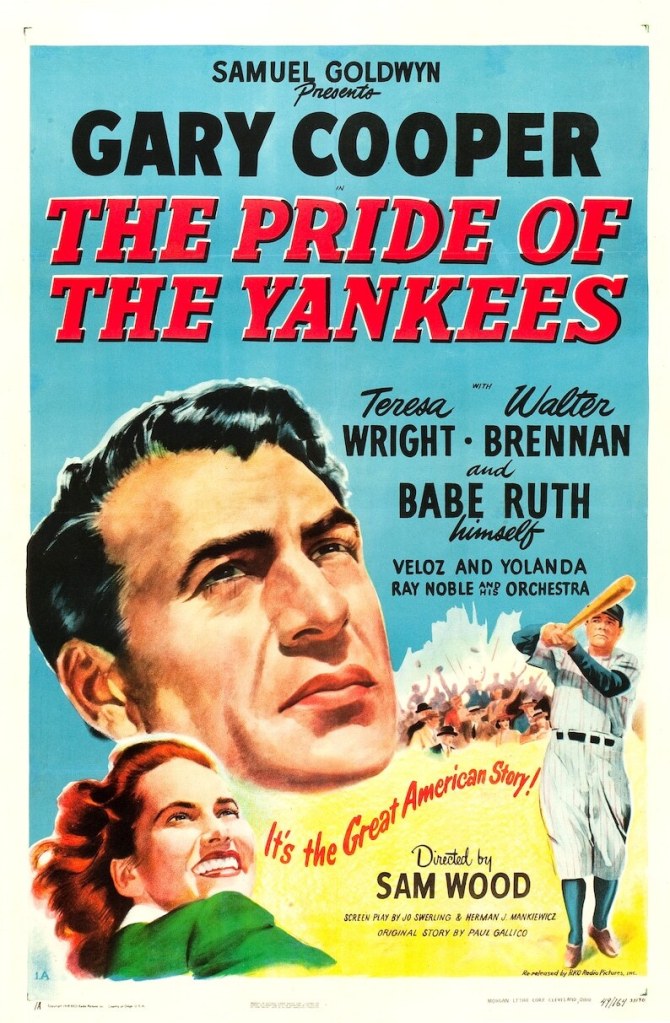
#773) The Pride of the Yankees (1942)
OR “Lou’s on First”
Directed by Sam Wood
Written by Jo Swerling and Herman J. Mankiewicz. Story by Paul Gallico.
Class of 2024
The Plot: Gary Cooper IS Lou Gehrig, the New York Yankees’ legendary first baseman, nicknamed “The Iron Horse” due to his incredible batting average and his then-record of over 2100 consecutive games. We follow Gehrig from his childhood dream of becoming a baseball player, to his early success in the minor leagues (much to the disapproval of his mother [Elsa Janssen]), and his legendary 16 year run with the Yankees. Gehrig quickly establishes himself as a fan favorite, especially with Eleanor Twitchell (Teresa Wright), a Chicago socialite Gehrig woos and eventually weds. But just as things are looking up for Gehrig and his new bride, Lou notices a sharp decline in his physical ability to play the game, receiving a grim diagnosis of amyotrophic lateral sclerosis (aka ALS, aka Lou Gehrig’s disease). Despite only being given a few months to live, Gehrig perseveres, giving a farewell address at Yankee Stadium declaring himself “the luckiest man on the face of the earth”.
Why It Matters: The NFR gives a summary of the movie, Lou Gehrig, and the final scene, with the film being declared “[o]ne of the seminal sports films that has inspired audiences for decades”.
But Does It Really?: This is definitely a minor classic. Overall, the film is fine; it holds up well and has some good performances, but there’s definitely some trimming that should have happened to bring this thing in under two hours. Released in theaters just over a year after Lou Gehrig’s passing, the film is clearly coming from a place of love, and although it plays fast and loose with some historical events, it manages to avoid feeling too clichéd or treacly. With its iconic final speech and Gehrig’s ongoing legacy, “Pride of the Yankees” was going to make the NFR at some point, but as you can tell there was no rush, with the film spending 35 years in the NFR dugout before finally making it to bat (or something like that; baseball metaphors aren’t my strong suit).
Seriously, Oscars?: One of the biggest hits of the year, “Pride of the Yankees” received 11 Oscar nominations, one nod behind that year’s eventual Best Picture winner, “Mrs. Miniver”. While “Yankees” lost most of its nominations to “Miniver” (which, coincidentally, also starred Teresa Wright), it took home one trophy for Daniel Mandell’s editing. Director Sam Wood wasn’t nominated for “Yankees” because he was already nominated in the Best Director category for the drama “Kings Row”.
Other notes
- Samuel Goldwyn secured the film rights to Lou Gehrig’s life story in July 1941, about six weeks after Gehrig’s passing. Goldwyn was initially reluctant to make a Gehrig biopic (he was not a baseball fan), but was persuaded after seeing the newsreel footage of Gehrig’s farewell speech. Eleanor Gehrig was involved in the film’s production as a consultant, and Gary Cooper was her first choice to play her late husband (with Spencer Tracy an approved back-up).
- A few interesting things in the opening credits: After the obligatory thanks for “Mrs. Lou Gehrig” as well as Ed Barrow of the Yankees and Gehrig’s agent Christy Walsh, we get Sam Wood’s director credit, which oddly shares the screen with William Cameron Menzies’ art direction credit. Huh? We also get a written prologue saluting Gehrig attributed to Damon Runyon, who as far as I can tell made no other contribution to the film’s script. Maybe he was a fan.
- The first chunk of the movie is Gehrig’s childhood in East Harlem with his German immigrant parents (even though they’re Swedish in the movie). It’s standard biopic stuff, but it sets up the rest of the movie well enough. Fun Fact: Douglas Croft (the kid playing young Lou) would go on to play Dick Grayson/Robin in the first “Batman” film serial in 1943.
- The film rests on Gary Cooper’s performance, and unsurprisingly Coop uses his natural charm to deliver a winning performance. His Lou can be strong when he needs to be, but is equally endearing in his shy, awkward phase. My one quibble: during filming Cooper was three years older than Gehrig was when he died. This is especially noticeable when 40 year old Cooper plays Gehrig in his university days.
- Like his producer, Gary Cooper was not a baseball fan and essentially had to learn how to play the game from scratch. A longstanding story is that Cooper (who was right-handed) was filmed batting with his right and running to third base, with the footage flipped optically to match the left-handed Gehrig. This has been debunked in recent years, with evidence that Cooper learned to bat left-handed. Only one brief shot of Cooper throwing a ball right-handed was flipped, with all other throwing shots were achieved in wide shots with a double: baseball player Floyd “Babe” Herman who was slumming it in the minors at the time of filming.
- In one of his rare non-Western NFR appearances, Walter Brennan plays reporter Sam Blake, a composite of several reporters who covered Gehrig, including Fred Lieb, a close friend of Gehrig’s. This has got to be Brennan’s least Walter Brennan-y performance ever; there’s nary a “dagnabbit” in sight, consarn it!
- I wasn’t expecting the recurring subplot about Gehrig’s mom disapproving of his profession or his marriage. This was apparently true of the real life Anna Gehrig (referred to only as “Mom” or “Mama” in the film), who successfully chased away Lou’s girlfriends before Eleanor showed up.
- Mama Gehrig describes America as “a wonderful country where everybody has an equal chance”. Who wants to break it to her?
- Once Gehrig joins the Yankees, several of Gehrig’s real-life teammates appear playing themselves, including Babe Ruth! Like his fellow ball players, Ruth is no actor, but he’s good here, though admittedly he doesn’t have to do much except be charming and swing a bat every now and then. Unfortunately, Ruth was in bad physical health throughout the shoot, which caused some production delays.
- I think the movie’s biggest inaccuracy is that despite several scenes in the Yankees dugout, there’s no scratching or spitting from anyone.
- It’s been a minute since we’ve covered a Teresa Wright movie on this blog. As always, Wright is her usual, charming, proto-Eva Marie Saint self, in only her third movie! Eleanor Gehrig had wanted Barbara Stanwyck or Jean Arthur to play her, but was eventually won over by Wright. Side note: Eleanor is a co-lead/supporting role, but Teresa Wright was already competing in the Oscars’ Supporting category for “Mrs. Miniver” (which she would eventually win), so she got bumped up to Lead Actress, losing to her “Miniver” co-star Greer Garson.
- On one of Lou and Eleanor’s first dates, they go to a nightclub and watch a lengthy dance number by Veloz & Yolanda that goes on forever and has nothing to do with anything. Frank Veloz & Yolanda Casazza were a husband and wife dance team performing in New York at the time of filming, and producer Samuel Goldwyn insisted on the two appearing in “Pride of the Yankees” because he worried that women would be otherwise uninterested in a baseball movie. When I think of scenes that could have been cut to shorten the runtime, this scene is number one with a bullet.
- The dance number is followed by a performance of Irving Berlin’s “Always” by Ray Noble and His Orchestra. While equally superfluous as Veloz & Yolanda, “Always” becomes the film’s leitmotif for Lou and Eleanor’s romance, playing in the underscore and/or being hummed by our leads throughout the rest of the movie.
- Most of Gehrig’s career successes are touched upon via a montage of clipped-out newspaper headlines in Eleanor’s scrapbook. What a convenient hobby for Eleanor to take up for the purposes of narrative pacing. I guess it would have taken too long for her to knit all those headlines.
- As well made as this movie is, it never feels like it’s leading towards anything. Of course the ALS diagnosis is as unexpected here as it was in real life, but that doesn’t happen until three-quarters of the way through the movie. Up to that point the movie just feels like it’s meandering from one biographical highlight to the next. On a related note, it occurred to me during this viewing that the NFR doesn’t have a lot of quote-unquote “terminal illness movies” on the list. The only one I can think of off-hand is “Knute Rockne”, but that’s a subplot in the middle of the movie.
- The only scene I knew about going in was Lou’s farewell address at Yankee Stadium’s Lou Gehrig Day on July 4th, 1939. It’s appropriately stirring, and I respect the decision to not include any underscoring while Gehrig is talking. I didn’t realize this was the last scene in the movie; he calls himself “the luckiest man on the face of the earth”, walks off the field, and roll credits! Director Sam Wood fought for this ending, rather than the studio-preferred version with a final kiss between Lou and Eleanor.
Legacy
- “Pride of the Yankees” was released in summer 1942, and went on to be RKO’s highest grossing release of the year. Unfortunately, due to Samuel Goldwyn’s distribution fee, the film ended up losing money. This was apparently par for the course with RKO’s Goldwyn films, and the studio continued to distribute Goldwyn’s movies for another decade.
- The “luckiest man” speech has received plenty of parodies over the years, but my favorite will always be Norm Macdonald on “Saturday Night Live”. “I was being…sarcastic.”
- Lou Gehrig has several memorials and tributes named after him, including MLB’s annual Lou Gehrig Memorial Award, which has been given out every year since 1955, including on five occasions to players with the New York Yankees.
- After her husband’s death, Eleanor Gehrig spent the rest of her life managing Lou’s estate and raising awareness of ALS. In 1976, Eleanor wrote the memoir “My Luke and I”, which became the 1978 TV movie “A Love Affair: The Eleanor and Lou Gehrig Story”, starring Blythe Danner and Edward Herrmann. Although Eleanor lived another 43 years after Lou’s death, she never remarried, writing in her memoir “I would not have traded two minutes of my life with that man for forty years with another.”
Further Viewing: “How to Play Baseball”, the Goofy cartoon that preceded “Pride of the Yankees” during its original theatrical run. Apparently Samuel Goldwyn requested Disney make a baseball short for this movie, and “How to Play Baseball” was completed in just under three months to meet the “Pride” release date.
 The Horse's Head
4 thoughts on “#773) The Pride of the Yankees (1942)”