
#774) Serene Velocity (1970)
OR “Gehr and Far”
Directed by Ernie Gehr
Class of 2001
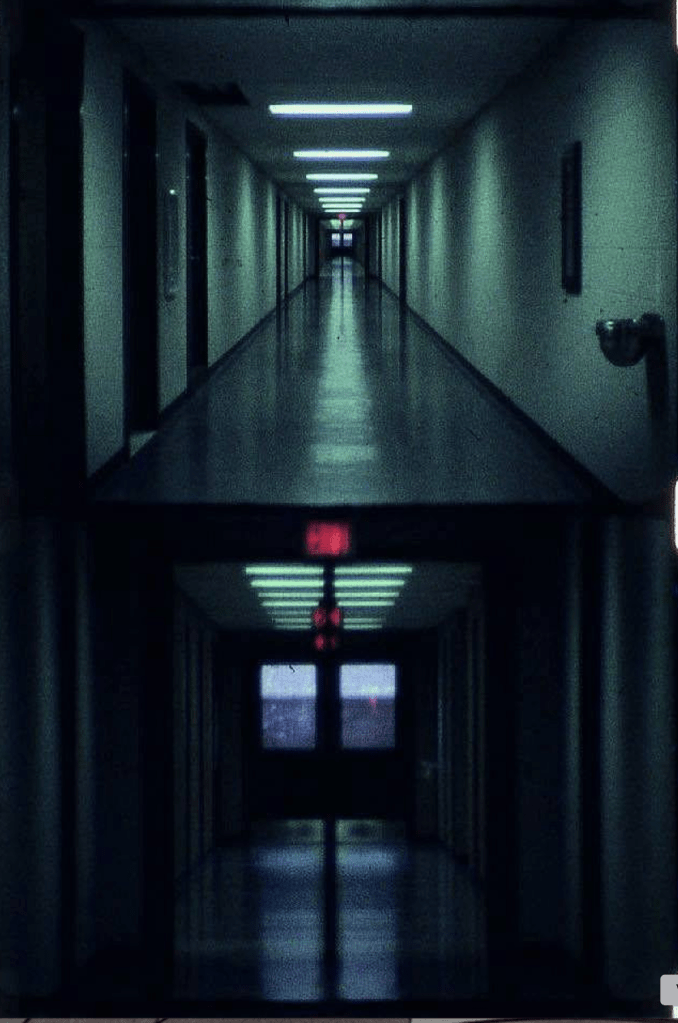
The Plot: The avant-garde practice of structural filmmaking comes to the NFR with Ernie Gehr’s “Serene Velocity”. Filmed in a basement hallway at Binghamton University, “Serene Velocity” is a static shot of the hallway at night, with changes in the focal length showing you less and more of the hallway, edited to alternate between smaller and wider focal lengths. While the contrast is minimal at first, by the end of the film you find yourself seemingly zooming back and forth from one end of the hallway to another. Even Ernie Gehr felt nauseous after first seeing it!
Why It Matters: We have an historic first for the blog: “Serene Velocity” has accidentally been left off the NFR’s page of inductee descriptions and essays! While I was able to find the Library of Congress’ press release for the NFR Class of 2001, it does not include descriptions for each inducted film beyond its release date and primary cast and crew. But I’m sure someone in the Library had something nice to say about “Serene Velocity”, right?.
But Does It Really?: The NFR loves them some avant-garde filmmaking, and while most of these filmmakers are unknown to your average moviegoer, Ernie Gehr is legendary within the experimental film community, and his breakthrough work in “Serene Velocity” is an appropriate selection to represent his filmography. This all being said, it is 23 minutes of a hallway, spiced up with editing that is equal parts measured and unrestrained. It’s like if one of Andy Warhol’s movies was edited to look like “The Wild Bunch”. If you’re watching this at home to cross it off your NFR list, take some Dramamine beforehand.
Everybody Gets One: We don’t know a lot about Ernie Gehr’s early years, other than he was inspired to become a filmmaker after seeing the films of Stan Brakhage while living in New York in the 1960s. While teaching at New York’s Binghamton University in 1970, Gehr was walking down the hallway in the film department’s basement and was inspired by its cold, plain appearance to film his next short there. “Serene Velocity” was shot over the course of one evening on a 16mm film camera, with Gehr changing the camera’s focal length by increments of 5 mm throughout the shoot. Following the shoot, Gehr’s fingers had become swollen from hours of manually pressing the release button for each frame.
Wow, That’s Dated: Towards the end of the film, we see a bowl-shaped object attached to the right side wall of the hallway. At first I thought this was a drinking fountain, but other write-ups believe it to be an ashtray. It is so bizarre to think of a time when smoking was so commonplace we built ashtrays into our structures.
Title Track: I will argue that “Serene Velocity” is neither serene nor does it execute velocity in the truest definition of the word. Discuss.
Seriously, Oscars?: If this blog has taught me anything, it’s that experimental films don’t get Oscar nominations. I’d be amazed if the Oscars knew experimental films even existed. For the record: the Oscar for Live-Action Short Subject in 1970 went to “The Resurrection of Broncho Billy”…whatever the hell that is.
Other notes
- A quick word about structural film: This subgenre of experimental film came into vogue in the mid 1960s thanks to films like Tony Conrad’s “The Flicker” and Michael Snow’s “Wavelength”. While difficult to characterize, most examples of structural film are films captured at a fixed point, typically in some sort of minimalist setting, with the only movement coming from how the film is edited, often creating a flicker effect. “Serene Velocity” definitely checks off those boxes. We’ll learn more about structural film (and the role Library of Congress paper prints played in the movement) when I get around to covering Ken Jacobs’ “Tom, Tom, the Piper’s Son”.
- Another technical note about “Serene Velocity”: Gehr opted to screen the film at 16 fps, so that each frame appears on screen longer (each “shot” in the film is 4 frames). While “Serene Velocity” has a runtime of 23 minutes, there are versions of the film online that run about 15 minutes, most likely because it’s being played at the standard 24 fps frame rate. I imagine watching the 24 fps version is more seizure inducing that the 16 fps version.
- As with most experimental films, “Serene Velocity” is not a piece of entertainment, but rather a piece of art you watch and observe. As the film progresses, its juxtaposition of focal lengths becomes somewhat hypnotic. For me, it felt like an optical illusion, or like the most intense eye exam ever. “Better 1 or 2 or 1 or 2 or 1 or 2…”
- This hallway could definitely use some artwork or at least a plant. Apparently this was the hallway Gehr would walk down to get to the editing room at Binghamton, so maybe a few film posters on the wall to brighten things up?
- The floor reflection of the overhead lights kinda looks like the robot from “The Black Hole”. BO.B.? Maybe V.I.N.CENT. You may be wondering “Why a ‘Black Hole’ reference?” and to that I say “This film is 23 minutes of a hallway, what the hell else is there to talk about?”
- As we get closer to (and further away from) the double doors at the end of the hallway, you can see daylight beginning to seep through. And that’s as close as this film gets to any sort of narrative.
- If you think about it, this film has pretty much the same plot as that Grover bit from “Sesame Street”. “This is near…this is far!”
Legacy
- “Serene Velocity” played at a number of museums and festivals in 1970, including San Francisco’s First International Erotic Film Festival! The film was well received upon these initial screenings, and has since gained a reputation as an important example of structural filmmaking. For the record: Gehr objects to his films being called “structural”, arguing that the term and similar labels “stop people from actually seeing, actually experiencing the work.”
- Ernie Gehr continued making films in New York until his move to San Francisco in the 1990s, where he taught film at the San Francisco Art Institute. As of this writing, Gehr is still with us, experimenting with digital filmmaking and making appearances at various career retrospectives (including last year at MoMA).
 The Horse's Head
One thought on “#774) Serene Velocity (1970)”