
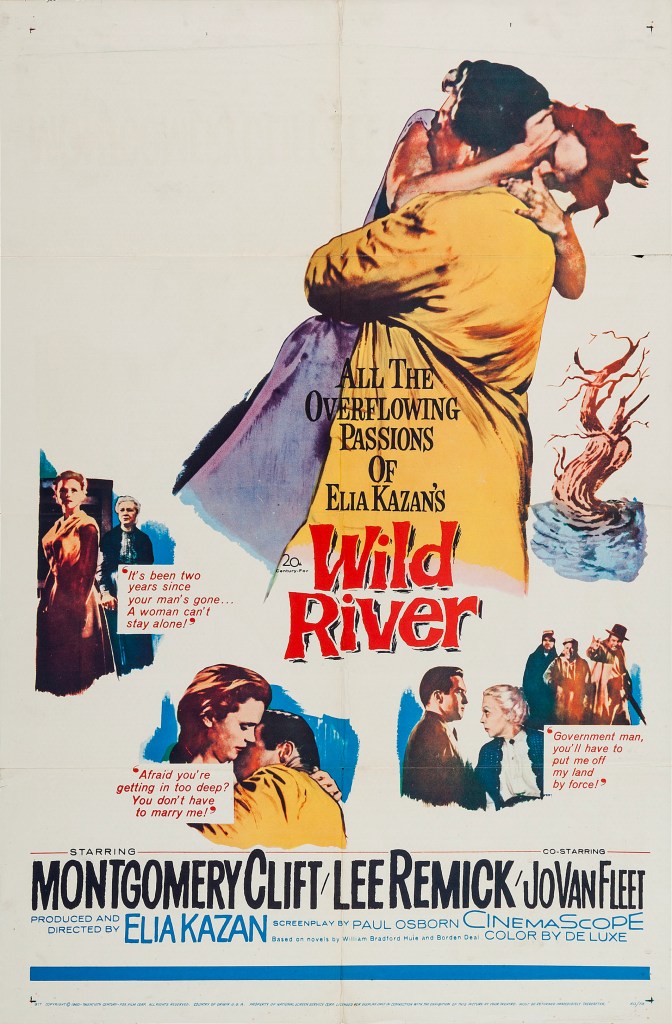
#778) Wild River (1960)
OR “By a Dam Site”
Directed by Elia Kazan
Written by Paul Osborn. Based on the novels “Dunbar’s Cove” by Borden Deal and “Mud on the Stars” by William Bradford Huie
Class of 2002
The Plot: In 1937, Tennessee is in a transitional phase as the Tennessee Valley Authority (TVA) builds several dams across the state’s rivers to prevent flooding, as well as purchasing nearby land and relocating families residing within the flood zones. TVA bureaucrat Chuck Glover (Montgomery Clift) heads to Garthville, Tennessee when one family refuses to sell their land on Garth Island within the Tennessee River. Glover is unable to reason with the family matriarch Ella Garth (Jo Van Fleet), but forms a mutual attraction with her widowed granddaughter Carol Baldwin (Lee Remick). At the same time, Glover runs into trouble with the locals when he proposes hiring Black workers to help with the land clearing and paying them equally to their White counterparts. With its liberal leanings and a cast of Actors Studio alum, this film has all the earmarks of an Elia Kazan production.
Why It Matters: The NFR calls the film “often overlooked and visually stunning”. Their brief write-up does, however, contain two factual errors: they state the film’s year of release as 1961, and refer to Lee Remick’s character as Ella’s daughter-in-law.
But Does It Really?: This one baffles me. There’s nothing wrong with “Wild River”, it’s a well-made film with good work on both sides of the camera, but no one has made a compelling argument to me for its NFR inclusion. “Wild River” is not an important movie in Kazan’s body of work, had a brief and unremarkable theatrical run, and has rarely been referenced or discussed in the ensuing 65 years, even within the confines of Kazan’s filmography. As a standalone movie, “Wild River” is an engaging examination of time and place, but as an NFR entry it doesn’t pass muster.
Shout Outs: Some of the historical flooding footage at the beginning comes from “The River”, the government-sanctioned documentary about how great the TVA is.
Title Track: I think it would be easier to list the working titles this film didn’t go by. Originally taking its name from its source material “Mud on the Stars”, the film’s multiple screenplay drafts contained such titles as “Time and Tide”, “God’s Valley”, “The Swift Season”, and “As the River Rises” before settling on “Wild River”. After the film’s initial box office disappointment, the title was changed again to “The Woman and the Wild River” with a promotional re-emphasis on the love story.
Seriously, Oscars?: No Oscar nominations, but “Wild River” was named one of the top 10 films of 1960 by both Cahiers du Cinéma and the National Board of Review.
Other notes
- Elia Kazan had been wanting to make a film about the TVA ever since visiting Tennessee in 1937 as assistant director on “People of the Cumberland”. “Wild River” is the rare movie that is adapted from two novels, both set in the Tennessee Valley in the 1930s. “Dunbar’s Cove” is about a farmer refusing to move from his land before it becomes flooded, while “Mud on the Stars” focuses more on the era’s race relations, including the TVA’s hiring of Black labor. The only other movie I can think of that was adapted by merging two novels by different authors was “The Towering Inferno” (and no, that is not a joke).
- Filming of “Wild River” took place in the fall of 1959 in Bradley County, Tennessee, primarily in the towns of Charleston and Cleveland. Interior sets were filmed in Cleveland’s National Guard Armory, and over 100 locals were hired as bit players, extras, and crew members.
- I’m not Montgomery Clift’s biggest fan, but I liked him in this. Critics at the time dismissed his performance as too stiff, but I think it works for the character, a stranger in a strange land. Granted, critics would have been comparing this performance to all of Clift’s work before his near-fatal car crash in 1956, but I don’t have that baggage and can more easily judge the performance on its own merits. Also, Clift kinda looks like Edward Norton. Well, I guess it’s the other way around.
- Chuck’s secretary Betty is played by Barbara Loden, future writer/director/star of “Wanda”. Loden and Elia Kazan met during filming, and would marry seven years later. I assume the sparks started flying immediately, because Loden gets several close-ups and cutaways despite her limited screen time.
- In addition to being Barbara Loden’s film debut, “Wild River” is the first screen appearance for Bruce Dern! As local townsperson Jack Roper, Dern doesn’t get much to do in his handful of scenes, mainly just running in, saying a line, and leaving. We don’t even get to see his face in his first scene.
- As the elderly Ella Garth, Jo Van Fleet gives an impressive performance; even more impressive when you learn that she was 45 during filming! Bonus shoutout to credited makeup artist Ben Nye: that is some of the most natural old-age makeup I’ve ever seen in a movie.
- For the role of Carol, Fox pushed for Marilyn Monroe, but Kazan’s first and only choice for the part was Lee Remick, his breakout discovery from “A Face in the Crowd”. Carol doesn’t have a lot to do for the first third of the movie, but Remick keeps her very present in her scenes, even when she’s just in the background observing Chuck and Ella’s back-and-forth. When Carol begins her relationship with Chuck, both Remick and Clift help make the situation more believable by injecting tons of subtext. The dialogue is about the land and the river, but those eyes are telling a different story.
- We learn from his tombstone that the name of Carol’s deceased husband is James Baldwin. The author and Civil Rights activist of the same name was already an established writer by 1960, so if that’s meant as a nod to him, having it on a White guy’s tombstone is a weird choice. Speaking of Civil Rights; Kazan keeps his progressive streak going by casting a large number of Black actors in the film, including Robert Earl Jones, father of James Earl Jones.
- While at Carol’s house, Chuck uncovers her deceased husband’s shotgun. Upon the gun’s reveal, I wrote down the note “Chekov’s shotgun” and continued with my viewing.
- My problem with this movie is how it was shot; not the compositions of cinematographer Ellsworth Fredricks, but rather the initial choice of how to shoot the film. “Wild River” was filmed in De Luxe color and widescreen CinemaScope, but I think the film would have worked better in black-and-white and a more standard aspect ratio. Perhaps color and widescreen were mandated by the studio (this was only Kazan’s second film in color after “East of Eden”), but the color makes the Tennessee landscape too beautiful, and the CinemaScope gives the whole thing an unnecessarily epic feel. Maybe I just associate the Depression with black and white, but I kept thinking how much better this film would have been without the distracting aesthetics.
- One scene near the end features Chuck drunkenly confronting Ella late one night. This scene is notable due to Clift’s well-known alcohol problem following his car crash. Apparently Kazan made Clift promise he wouldn’t drink during the shoot, and whether or not Clift kept his word depends on who you ask.
- As I’ve said before on this blog, “It’s not a movie about racial tensions until a White male lynch mob shows up”. As the locals start surrounding Carol’s house and things take a violent turn, I kept an eye out for the inevitable return of Chekhov’s shotgun. Not only does the shotgun fail to make an appearance here, it’s never mentioned again. They brought it up earlier with no pay off. Come on!
- I don’t have much else to say about this movie. It’s good, but is it NFR good? The film doesn’t waste too much time reaching its inevitable conclusion (and I appreciated the ongoing rain as a metaphor for the impending flood), but I wasn’t too attached to the story or its characters, and by the end I was ready to move on and go about the rest of my day. And I have say that despite the title, that river wasn’t wild at all. Maybe they’re thinking of that Meryl Streep/Kevin Bacon movie?
Legacy
- “Wild River” was released in May 1960, and while critics were mostly positive, the film didn’t catch on with audiences and 20th Century Fox quickly pulled the film from theaters. Kazan always blamed Fox for the film’s failure, and often listed “Wild River” among his favorites of his own films.
- Kazan’s next film was “Splendor in the Grass” with Natalie Wood, a film that as of this writing isn’t on the NFR, but would make more sense there than “Wild River”.
- Although “Wild River” is largely forgotten, it is still highly regarded by Southerners, especially those whose families were directly impacted by the floods. Perhaps the biggest fans of “Wild River” are the people of Bradley County, Tennessee, where most of the movie was filmed. In 2010, Cleveland, Tennessee held “Wild River Days” celebrating the film’s 50th anniversary. The festivities are included in the 2011 documentary “Mud on the Stars”, along with interviews from locals who witnessed the production first-hand.
 The Horse's Head
hello.
LikeLike
The man speaking in the beginning of the video is my grandfathers father. This was filmed in Trumansburg, New York. If you look to his left the sign is indicative of this. Also, many of the building behind him are still standing in the town I referred to.
The children he speaks of are my grandfathers siblings. I would love to know if anyone knows how I can find the whole interview…. this story has carried much of my families history, trauma, and structure. My grandfather passed a few years ago…. and I have had many revelations about who I am as a person as a consequence of the loss of all of his siblings. He was ultimately the one child who survived of ten. my entire family is a miracle in many ways, as we all tend to be if we look deeply at the dynamics that are in play for any single person to survive this existence unscathed physically. anyway…this may be a message into the ether….maybe it will unfold more of the curiosity of my lineage.
LikeLike