
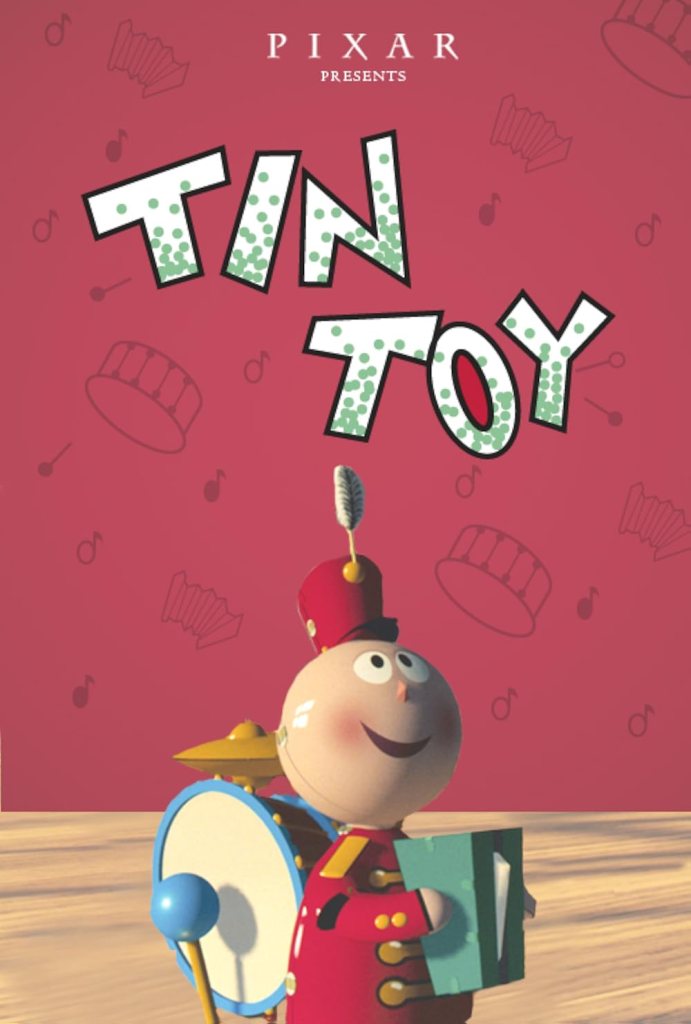
#784) Tin Toy (1988)
OR “Band vs. Beast”
Directed & Written by John Lasseter
Class of 2003
The Plot: Tinny is a small one-man-band toy excited for playtime, until he sees that the child who wants to play with him is a slobbering infant whose idea of playing involves putting toys in his mouth and throwing them across the room. Tinny tries to hide from the baby, but soon showcases the first instance of Pixar asking the question, “What if toys had feelings?”
Why It Matters: The NFR hails the film as “one of Pixar’s best short subjects” despite its “clunky foray into human characters”. I’ve read some backhanded compliments from the NFR in my time, but this one takes the cake. You never want an organization like the NFR to use the word “clunky” when describing your contribution to American culture.
But Does It Really?: If it’s 2003 and Pixar is in its creative prime and “Toy Story” isn’t NFR eligible for another two years, then “Tin Toy” is a natural choice to represent Pixar on the list. Like “Luxo Jr.” before it, “Tin Toy” is an important stepping stone movie in the history of Pixar. The technology is crude by modern standards (and don’t worry, we’ll get to the baby), but the film serves as an incubator for the kind of heartfelt, original storytelling the studio would later perfect in its features. A pass for “Tin Toy” on the NFR.
Shout Outs: Look quickly for a picture of Luxo Jr. hanging on the wall. Because who doesn’t have a framed photo of a lamp hanging in their living room?
Seriously, Oscars?: In 1989, “Tin Toy” won the Oscar for Best Animated Short, the first computer-animated short to take home the prize. The clip below not only includes the presentation for Best Animated Short (and the acceptance speech by co-producers John Lasseter and William Reeves), but also for Best Live-Action Short, which went to “The Appointment of Dennis Jennings”, produced by Dean Parisot and Steven Wright. Yes, that Steven Wright.
Other notes
- In the late 1980s, Pixar was still a struggling independent company that only made animated shorts to serve as demonstrations of its computer technology. “Tin Toy” was conceived as a test for their PhotoRealistic RenderMan, a software program that helps speed up the rendering process for 3D animation (which they still use to this day). Producer William Reeves pitched a CG render of a baby to test the software, and John Lasseter came up with the story of “Tin Toy” after watching his infant nephew put any toy within reach in his mouth, and imagining the scenario from the toy’s point of view. Pixar was on shaky financial ground in 1988, and there was talk of eliminating the animation department entirely, but “Tin Toy” was allowed to proceed after an impassioned pitch from Lasseter to Pixar chairman Steve Jobs, who invested $300,000 of his own money into the film.
- This is the second film I’ve covered this year that has “The Price is Right” playing in the background. We are one step closer to inducting that “Price is Right” episode where that lady’s tube top falls off.
- My god that is one creepy looking baby. It’s like a cross between a possessed baby doll and a raisin. It’s so horrifying it distracts from the short’s otherwise excellent animation, especially Tinny’s characterization. In all fairness, Pixar wasn’t pleased with the baby’s final look either. The limited production timeline of “Tin Toy” prevented Pixar from perfecting some of the baby’s details (primarily its movement, which is very stiff in the final film), though believe it or not they were able to refine its face, which apparently looked even worse in the beginning. Also in everyone’s defense, it would take about another decade before computer-animation technology could handle more realistic human characters.
- The short makes up for its anticlimactic ending with some interesting credits. Several longtime Pixar employees get mentioned here, as does a “Very, Very Special Thanks” to Steve Jobs. There’s also a section called “Babies John Looked at a Lot”; which definitely could use a retitling. It’s also worth freeze-framing the legal disclaimer at the end for such extra details as “Seatbelts save lives”, “This bag is not a toy”, and an addendum to the standard no illegal reproduction disclaimer: “or we won’t be your friends anymore.” Even with their hectic production schedule, its nice to see the Pixar team retained its sense of humor.
Legacy
- A work-in-progress version of “Tin Toy” premiered at the SIGGRAPH conference in Atlanta in August 1988, and received positive feedback even in its incomplete form. In the ensuing months, the completed film played the animation film festival circuit, as well as an Oscar-qualifying theatrical run, with its subsequent win helping cement the validity of computer-animation as an art form.
- The success of “Tin Toy” led to Pixar forming a deal with Disney to produce computer-animated films. Initially hesitant to make the leap from shorts to features, Pixar proposed a TV special that would serve as a sequel to “Tin Toy”. Plans for “A Tin Toy Christmas” were cancelled due to budget issues, and Disney encouraged Pixar to start working on a feature. Some elements from “A Tin Toy Christmas” evolved into the plot and characters in Pixar’s eventual first feature: “Toy Story”.
- Pixar has made a few references to “Tin Toy” in their subsequent work over the years, most notably Tinny’s cameo in “Toy Story 4”. While a harmless nod to Pixar’s own history, this easter egg has led to the fan theory that “Tin Toy” is a “Toy Story” prequel and that the baby is actually Andy. Please people, not everything is connected in a cinematic universe.
- “Tin Toy” is one of the first in a long line of memorable Pixar shorts. Personal favorites include “Geri’s Game”, “Bao”, “Presto”, and that “Toy Story” short at the fast-food restaurant with the very random “Condorman” reference. I can’t believe anyone remembers “Condorman”.
 The Horse's Head
3 thoughts on “#784) Tin Toy (1988)”