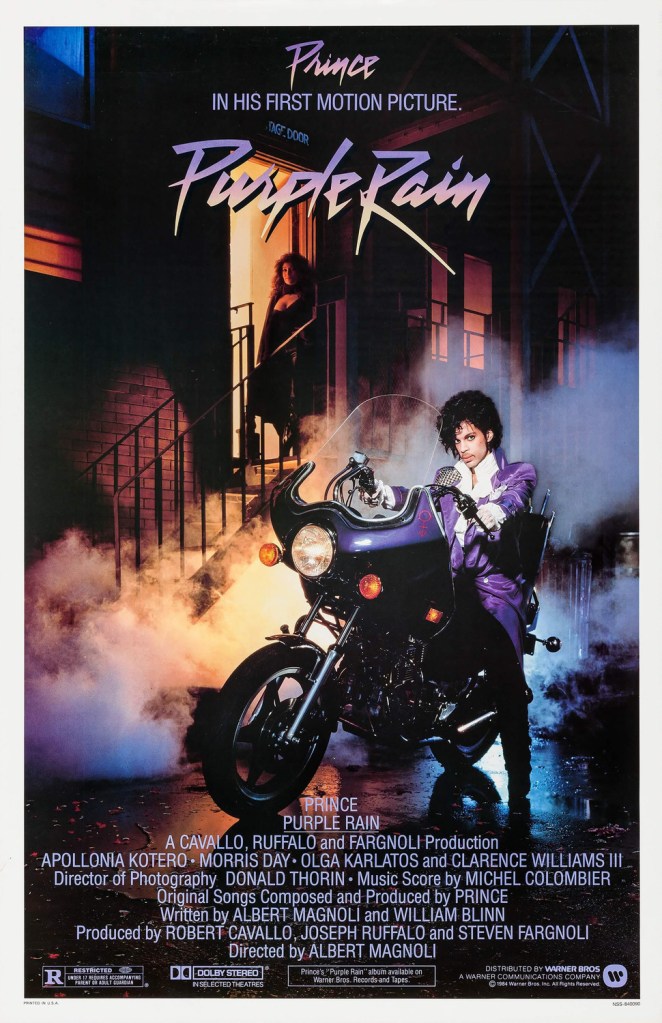
#785) Purple Rain (1984)
OR “For Funk’s Sake”
Directed by Albert Magnoli
Written by Magnoli and William Blinn. Original songs by Prince, Morris Day, Jesse Johnson, Dez Dickerson, John L. Nelson, Wendy & Lisa, and Apollonia 6.
Class of 2019
The Plot: The Kid (Prince) performs with his funk rock band The Revolution nightly at the First Avenue club in Minneapolis. One night, he meets aspiring performer Apollonia (Apollonia Kotero) and after some initial resistance, the two begin a romantic relationship. Apollonia is also being wooed by Morris Day (Morris Day), the lead singer of rival group The Time who wants Apollonia for a girl group that can take over The Revolution’s house band slot at First Avenue. As working relationships within The Revolution become strained, Prince struggles to come up with a new song while simultaneously dealing with his new relationship and the escalating fights between his parents (Clarence Williams III & Olga Karlatos). And if none of that interests you, there’s still plenty of prime Prince music to hold your attention.
Why It Matters: The NFR gives “Purple Rain” its proper historical context, calling it the film that “secured [Prince’s] place as a movie star and entertainment legend.”
But Does It Really?: Sometimes I have to remind myself that the NFR’s criteria is films that are “culturally, historically or aesthetically significant”. Nowhere does it say that these films need to be good; such is the case with “Purple Rain”. As a narrative feature it’s a mess, impeded by Prince’s stilted acting and some increasingly problematic story beats. But “Purple Rain” didn’t make the NFR based on its strength as a film, but rather as representation of Prince: one of the most prolific, influential artists of this or any time. If you’re a Prince fan, “Purple Rain” is a perfect ‘80s time-capsule, and while the film itself is far from essential, Prince’s sheer star-power makes “Purple Rain” an undeniably iconic moment in pop culture.
Everybody Gets One: Easily the least mid-western person to ever come out of Minnesota, Prince Rogers Nelson was named after his father John L. Nelson’s stage name from his jazz pianist days – Prince Rogers. Prince started writing music and playing guitar in his childhood, and by 19 his demo recordings landed him a contract with Warner Bros. Records. By the early ‘80s, Prince (with his band The Revolution) had scored such hits as “I Wanna Be Your Lover”, “1999”, and “Little Red Corvette”, and made it known to his management that he wouldn’t renew his contract unless he could star in a movie. Prince wrote the initial treatment himself before handing it off to screenwriter William Blinn, whose screenplay was originally titled “Dreams”.
Title Track: “Purple Rain” was conceived as a country song Prince would co-write with Stevie Nicks. When Nicks backed out, Prince collaborators Wendy & Lisa gave it a more rock ballad feel, and the rest is history. As for the title, Prince’s description is a continuation of his religious influence, with a blue sky turning red ahead of Judgement Day, creating purple rain.
Seriously, Oscars?: Although none of the individual songs in “Purple Rain” received an Oscar nomination, Prince won an Oscar in the category of Original Song Score. Side note: The Song Score category technically still exists, now known as Best Musical, and is only presented when enough original musicals are released in a calendar year for the Academy’s music branch to “activate” the category. 1984 was the last year this award was handed out, and given the dearth of original movie musicals in the last 40 years, “Purple Rain” is most likely the category’s final recipient.
Other notes
- James Foley was originally approached to direct “Purple Rain”, but when he turned down the offer, he recommended his editor Albert Magnoli. In addition to directing the film, Magnoli co-edited with Michel Colombier, and made substantial enough changes to William Blinn’s original script to warrant a co-writing credit.
- “Purple Rain” was filmed primarily in Prince’s hometown of Minneapolis. This was no doubt the Mill City’s biggest production since Mary Tyler Moore froze while tossing her hat in the air on 7th Street.
- Admittedly, my dislike of “Purple Rain” comes from my own biases towards Prince. I have nothing against the Purple One, in fact I like a lot of his songs, but I’ve never been fanatic about him. I also didn’t grow up with his music, so I have no nostalgic connection to boost my entertainment value. Prince fans can more easily forgive this movie’s setbacks, but if you don’t have that pre-built love for Prince going in, this is a tough watch.
- Oh boy the acting in this movie. With the exception of Apollonia and the Kid’s parents, everyone is played by non-actors, and it shows. Prince can’t quite meet the demands of his character, but that makes sense once you learn he was the muscle behind the movie. The Kid is how he wants to be perceived on screen: an aspirational character rather than one written around his strengths and natural qualities. I’ll give Prince this though: he’s quite agile, contorting himself onstage with a seemingly infinite amount of energy, and I guess that’s where it counts the most. Ultimately, Prince is like Elvis in “Jailhouse Rock”; lively and engaging while performing a song, rigid and unconvincing everywhere else.
- The Kid’s leading lady was originally written for Prince’s then-girlfriend Vanity, but once they broke up she turned down the part, leading to the casting of unknown model/TV actress Apollonia Kotero. She doesn’t get much to do, but she looks great watching from the audience as the Kid performs onstage. Side note: Apollonia is Kotero’s middle name, and she went professionally by Patty Kotero before switching to Apollonia for “Purple Rain”.
- While there are many biographical elements in “Purple Rain”, I can’t find anything suggesting that Prince’s home life was as horrendous as depicted here. Shoutout to Clarence Williams III for proving there’s life after “Mod Squad”.
- And then Apollonia proves her devotion to the Kid but stripping down and cleansing herself in Lake Minnetonka. Maybe I’ve been too hasty condemning this movie…
- Prince’s cold working relationship with band members Wendy & Lisa is not too far from real life, with Prince more-or-less firing the two when he dissolved The Revolution in 1986. Although Wendy Melvoin and Lisa Coleman are no longer romantically involved with each other, they continue to collaborate on their music to this day.
- If you haven’t picked up on it yet, this movie has some serious issues with women: Spousal abuse, verbal harassment, plus the scene where Morris’ assistant Jerome throws a woman in a dumpster! Many critics have complained about this film’s misogynistic streak since its release, with a recent article for Far Out Magazine suggesting the film should be removed from the NFR! While this point is well taken, I’m here to tell you: If you removed every movie on the NFR with this much mistreatment of women, there’d only be about three movies left. I’m not saying that any of this is acceptable, but it is an unfortunate part of our cultural heritage and a reminder that we can and must do better.
- Random thing I found in my research: Replicas of that weird cone puppet Prince talks to/for were sold exclusively during the “Purple Rain” tour in 1984-1985, with one recently selling on eBay for $4000!
- This is what it looks like when montages cry. Turns out this film’s random mid-movie montage is carrying on a long-standing film tradition: montages made up of scenes cut from the movie. Prince wrote “When Doves Cry” to cover the montage, which explains the song’s vague movie-related lyrics (“Maybe I’m just like my father”). Astonishingly, “When Doves Cry” was the breakout single of the “Purple Rain” album upon its release.
- “Darling Nikki” is easily the dirtiest song in the movie, and had an unintentional impact on our culture. In 1985, future second lady Tipper Gore heard her 11 year old daughter Karenna listening to this song, and long story short, records now have the “Parental Advisory” sticker for explicit content.
- Apollonia’s solo number “Sex Shooter” is definitely the film’s low-point, but it’s an appropriate time to point out that “Purple Rain” is one of two NFR movies to receive a Razzie nomination (the other is “The Shining”). Apollonia Kotero was nominated for Worst New Star, and “Sex Shooter” was up for Worst Song. While it lost both categories, I won’t disagree with these nominations.
- Prince clearly has a penchant for capes; both he and Apollonia wear them at different points in the movie. Is it any wonder he did the songs for “Batman”?
- Yes, the performance of “Purple Rain” is iconic, but at this point in my viewing I was ready for it to all be over. Prince follows up “Purple Rain” with two encores, some sort of phallic guitar hose, the mandated freeze-frame ending all good ‘80s movies have, and credits that feature the entire album on shuffle.
Legacy
- “Purple Rain” the album was released in June 1984, with “Purple Rain” the film hitting theaters that July. Both were bona fide hits, with Prince simultaneously having the number one movie, album, and single (“When Doves Cry”) in America.
- Prince’s fascination with being a movie star didn’t end with “Purple Rain”. Over the next decade Prince would star in and direct four films, including this movie’s sequel “Graffiti Bridge”. While none of his subsequent films were as well received as “Purple Rain”, his screwball comedy homage “Under the Cherry Moon” has gotten a reevaluation in recent years.
- There’s no way I can cover all of Prince’s post-“Purple Rain” career in a brief paragraph. Suffice it to say he continued being an untouchable rock icon until his unexpected death in 2016, leaving behind a legacy of music and more unfinished projects than Orson Welles. The NFR induction of “Purple Rain” is just one of countless posthumous honors Prince has received.
- Although Albert Magnoli only directed a handful of movies in his career, his work on “Purple Rain” kept him in Prince’s orbit through the rest of the ‘80s; directing some of his music videos, ghost-directing his concert film “Sign o’ the Times”, and even serving as his manager for a few months in 1989!
- Tangentially related, but worth a mention: During a contractual dispute with Warner Bros. in the early 1990s, Prince refused to perform under his stage name, opting instead for the unpronounceable “Love Symbol” and being referred to as “The Artist Formerly Known as Prince”. Late-night comedians had a field day with that one.
- While “Purple Rain” still gets referenced throughout pop culture, I would argue it’s the album and not necessarily the movie that’s getting the nod. The legacy of “Purple Rain” was summed up best by Agent Mulder in a 1997 episode of “The X-Files”: “Great album. Deeply flawed movie, though.”
Listen to This: The “Purple Rain” album made the National Recording Registry in 2011, with the NRR calling it “provocative and controversial”. Guest essayist Eddie Santiago provides a thorough write-up on the production and impact of “Purple Rain”.
 The Horse's Head
Last year I saw Purple Rain at my local repertory movie theater, and the acting is so terrible. Luckily the movie is 90% music and it sounded terrific on the theater’s new sound system.
LikeLiked by 1 person