
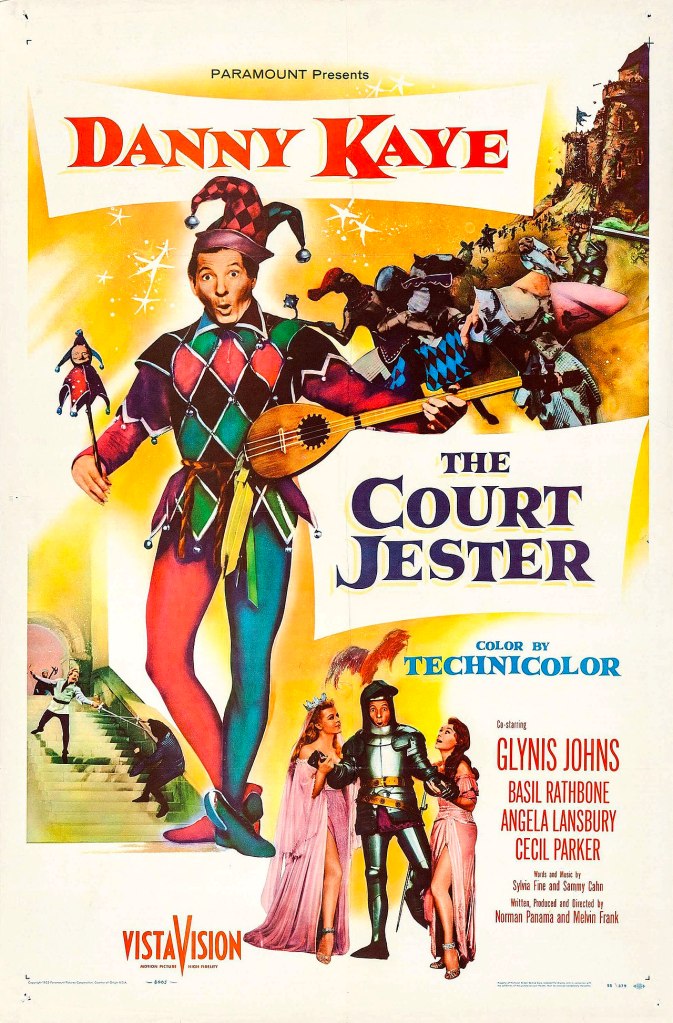
#790) The Court Jester (1956)
OR “Kaye Turn”
Directed & Written by Norman Panama & Melvin Frank. Songs by Sammy Cahn and Sylvia Fine.
Class of 2004
The Plot: The throne of England has been usurped by King Roderick the Tyrant (Cecil Parker) over its rightful ruler, a baby with a royal birthmark on his posterior. The baby is being kept safe by the Black Fox (Edward Ashley) and his band of rebels, including Hubert Hawkins (Danny Kaye), the group’s minstrel who longs to fight alongside the Black Fox. While on a mission to protect the baby with the Maid Jean (Glynis Johns), Hubert and Jean hatch a plan for Hubert to infiltrate the castle posing as the king’s new court jester. There’s plenty of obstacles in Hubert’s path, including a battle with the villainous Lord Ravenhurst (Basil Rathbone), but all of this is secondary to the comedic antics of Danny Kaye. Also there’s something about a pellet with the poison in a chalice with a…a flagon from…a vessel…we’ll come back to that.
Why It Matters: The NFR write-up for “The Court Jester” isn’t very celebratory of the film, with the only superlatives going to the “lilting” songs and Basil Rathbone being his “reliably swashbuckling self”. The write-up also describes Danny Kaye as “mercurial”, which I guess in this context means lively and quick rather than the more negative definitions I associate with the word.
But Does It Really?: “The Court Jester” is on the NFR as representation of Danny Kaye, who while all but forgotten today, was one of the most beloved entertainers of the 20th century. As for the film itself, it’s funny in places, but the entertainment value primarily relies on how much you enjoy Kaye’s schtick, especially his penchant for complicated tongue-twisters. For me, it all wore thin after awhile, and not helped by how many unnecessary plot points and musical numbers are packed into this movie. While “The Court Jester” isn’t as well remembered or celebrated as it once was, I don’t begrudge one of Kaye’s films making it onto the Registry.
Everybody Gets One: Hailing from Brooklyn, David Daniel Kaminsky worked a number of odd jobs before serving as an emcee in the Catskills, where he started going by the stage name Danny Kaye. A vaudeville stint led to his breakout role in the Broadway musical “Lady in the Dark”, in which he performed his first patter song: “Tschaikowsky (and Other Russians)”. Kaye’s film career took off in the 1940s under contract with Samuel Goldwyn, with such films as “The Secret Life of Walter Mitty” and “Hans Christian Andersen”. “The Court Jester” was part of Kaye’s contract with Paramount, as was “White Christmas”, which finally made the NFR last week! Additionally, this film was Kaye’s second collaboration with Norman Panama & Melvin Frank, two former Bob Hope writers who had recently made the leap to directing and producing.
Seriously, Oscars?: No Oscar nominations for “The Court Jester”, though Danny Kaye did get a Golden Globe nomination for Best Actor in a Comedy, losing to Cantinflas in “Around the World in 80 Days”. Although Kaye never received an Oscar nomination in his entire film career, he won two special achievement Oscars: an Honorary Oscar in 1954 “for his unique talents”, and the Jean Hersholt Humanitarian award in 1981.
Other notes
- “The Court Jester” was initially budgeted at $2.4 million dollars with a 48 day shooting schedule. By the time production wrapped the film was 28 days behind schedule and cost closer to $4 million dollars, making it the most expensive comedy ever made up to that point. “The Court Jester” was the second film under Kaye’s production company Dena Productions, named after his nine-year-old daughter.
- We’re off and running with Kaye’s opening credits song “Life Could Not Better Be”. It’s mostly Kaye doing his schtick and interacting with the credits, but I see why they frontloaded this movie that way: we’re about to enter a long Kaye-less exposition dump once the film begins proper.
- At this point in Basil Rathbone’s career, he was primarily a stage actor, and when a film did come along it was a thankless supporting part like in this or “The Magic Sword”. And while we’re here: Keep sucking in that gut, Rathbone.
- There isn’t a lot of information on British character actor Cecil Parker, so instead let’s focus on the actor playing his daughter Gwendolyn: Dame Angela Lansbury! It’s always nice seeing Angie pop up on this list, but I don’t appreciate how many of her NFR entries are a waste of her immense talents. For every “Manchurian Candidate”, there’s a “Court Jester” or “National Velvet”.
- Kaye’s first in-movie number is “Outfox the Fox”, which also prominently features…[deep exhale] Hermine’s Midgets. Unfortunate billing aside, this is the most people with dwarfism I’ve seen in a single NFR entry since “The Wizard of Oz”, so that’s a positive, right?
- Glynis Johns gets the best entrance in this movie, swinging from a vine in the forest to greet the Black Fox. Knowing Johns for most of my life solely as Mrs. Banks, it’s fun to see her play a much more active part here as the woman doing all the actual work. My one grouse, she’s Danny Kaye’s love interest in this? It’s not even the 12-year age gap that bothers me so much as it is watching Danny Kaye do a love scene.
- As I settled in with this movie and its overall vibe, I realized that “The Court Jester” is one of the last “general entertainment” kind of films that dominated in the 1940s, when all Hollywood movies had to appeal to a wide audience in a “something for everyone” kind of way. By 1956 this type of filmmaking wasn’t dead, but it was certainly dying. American film was starting to get more sophisticated in the 1950s, with comedies dealing more with modern issues rather than the old “Let’s put [name of comedian] in a [name of film genre]” template.
- Showing up early on as the real court jester is…John Carradine? Given his stature in the industry, I assumed Carradine would have a bigger part: at the very least a return in the third act for some kind of “that man is an imposter, I’m the real jester” type deal. But nope: He shows up for one scene, gets knocked out by Glynis Johns, and that’s a wrap for John Carradine.
- Hey hey hey, Danny, it’s 1956: you leave the foreign gibberish to Sid Caesar.
- Apparently this is the movie where the exchange “Get it?” “Got it.” “Good.” originated from. I mean, it had to come from somewhere, and it gets repeated enough here that I could see how people picked it up.
- Also making a welcome appearance in this movie: Mildred Natwick! I just watched “Barefoot in the Park” for the first time, so it was nice to see Natwick pop up here as Griselda, the kingdom’s resident witch. It’s not much of a part, but at least she’s allowed to be funny.
- So Hubert changes in and out of Griselda’s hypnosis when anyone snaps their fingers? Even himself? That’s a hell of a design flaw. I can see why Griselda’s on the chopping block. Side note: Hollywood Reporter film critic Jack C. Moffitt claimed in his review that the hypnotism bit in this film was stolen from a routine he had written for 1937’s “Mountain Music” with Bob Burns and Martha Raye (though Moffitt did admit he stole that bit from a similar one in Charlie Chaplin’s “City Lights”).
- “The Maladjusted Jester” isn’t the pivotal showcase it’s intended to be, but Kaye’s good with a tongue twister, I have to give him that. Shout out to the song’s lyricist: writer Sylvia Fine, aka Mrs. Danny Kaye.
- Another big centerpiece that fell flat for me is the knighting ceremony, when Hubert is caught up in the knights’ drill routine. The knights are played by members of the Jackson Michigan Zouave Drill Team, who had recently performed their close-order drill formations on “The Ed Sullivan Show” and were cashing in on their 15 minutes of fame with their appearance here.
- Like I said before, there is too much plot going on around here. I haven’t even mentioned Gwendolyn’s betrothal to Sir Griswold, or Hubert being mistaken for an assassin: there’s just no time, and none of it really matters. A lighthearted comedy like this should only have the bare minimum of plot points taking you from joke to joke, but the ratio is way off here. The film’s second act suffers the most due to serving as set-up for the third act’s big jousting tournament.
- One thing I will say about Sir Griswold: he’s played by Robert Middleton, who also narrated “Duck and Cover“!
- As a former ‘90s kid, you cannot have characters in a movie repeatedly say the phrase “mortal combat” without me either shouting it back or saying “Finish him” and/or “Fatality”.
- We finally arrive at the film’s most famous bit: Hubert trying to remember that “The pellet with the poison’s in the chalice from the palace and the vessel with the pestle is the brew that is true.” It goes on for awhile, but admittedly it’s pretty funny, especially when the “flagon with the dragon” is thrown in and Hubert’s confusion spreads to other characters. Side note: This is the film’s second instance of alleged comedy plagiarism, with many critics noting the similarity between this bit and one from Bob Hope’s “Never Say Die (“There’s a cross on the muzzle on the pistol with a bullet…”). Like the aforementioned “Mountain Music”, “Never Say Die” also stars Martha Raye. Is she the Kevin Bacon-esque center of the comedy bit universe?
- We got a lot of plotlines trying to get resolved during the film’s chaotic third act, but in the middle of it we get the film’s other highlight: the swordfight between Hubert and Lord Ravenhurst. This is a good time to mention that all three of Basil Rathbone’s NFR movies feature him in a climactic swordfight with our hero. Is this why we haven’t gotten a Rathbone “Sherlock Holmes” movie on the NFR yet?
- Ah yes the classic NFR movie that ends with our hero flashing part of an infant’s rear end. How did this get past the censors?
Legacy
- Despite some decent critical praise, “The Court Jester” only grossed $2.2 million at the box office, meaning it didn’t even recoup its initial budget, let alone the final one. In subsequent years, the film’s TV airings led to a reappraisal, and it’s now considered the best of Danny Kaye’s star vehicles.
- “The Court Jester” still gets referenced from time to time, primarily “the pellet with the poison” and “Get it? “Got it.” “Good”, though I doubt that most people referencing the latter know what it’s from.
- Norman Panama and Melvin Frank continued their creative partnership through the 1960s, and had successful solo writer/director careers after that. Of their later films, Frank’s “A Touch of Class” is the probably the best known.
- Danny Kaye’s film career was wrapping up when “The Court Jester” was released, but he continued to be a welcomed presence on TV, including on his own variety show in the 1960s (with “Life Could Not Better Be” as its opening theme). Beyond his career in entertainment, Kaye’s most impactful work was his nearly 40 year association with UNICEF as their “ambassador-at-large”. Danny Kaye died in 1987 at age 76, with Sylvia Fine passing four years later at age 78.
 The Horse's Head
One thought on “#790) The Court Jester (1956)”