
#793) V-E +1 (1945)
Directed by Samuel Fuller
Class of 2014
While “V-E + 1” isn’t available for viewing on its own, the footage was incorporated into the 1988 Emil Weiss documentary “Falkenau, vision de l’impossible” [aka “Falkenau, The Impossible”], which can be viewed here.
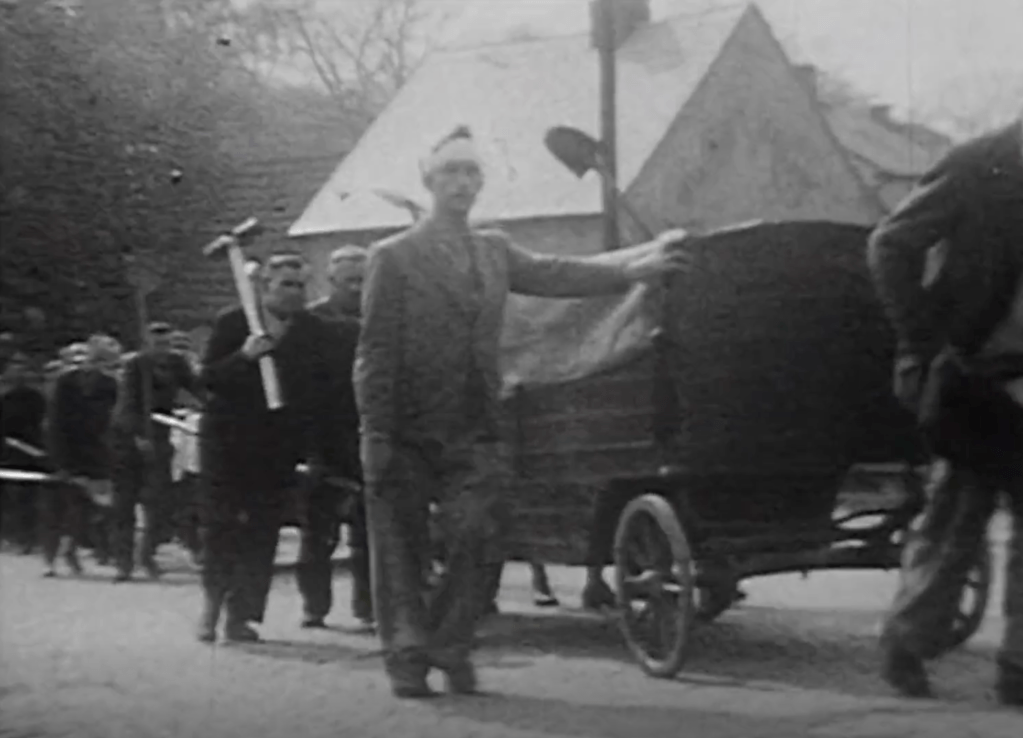
Before he was a maverick filmmaker, Samuel Fuller was a budding screenwriter who joined the Army once the United States entered World War II, serving with the 16th Infantry Regiment, 1st Infantry Division. On May 8th, 1945, two days before Victory in Europe Day (aka V-E Day) and the official end of the war, Fuller and his infantry liberated a German concentration camp in Falkenau, Czechoslovakia. Once the fighting ended, Fuller’s commanding officer ordered Fuller to grab his 16mm Bell & Howell movie camera (a gift from Fuller’s mother) and start filming. In roughly 20 minutes of black-and-white footage, Fuller documents the citizens of Falkenau (many of whom denied any knowledge of the camp’s existence) going into the camp and, upon military orders, picking up the dead bodies of the prisoners, dressing them, loading them onto a large wagon, taking the wagon across town to the cemetery, and giving the prisoners a proper burial. Reflecting on it over 40 years later, Fuller described the experience as “an impossible nightmare I’ll never forget”.
As of this writing, “V-E + 1” is the last NFR entry I’m covering about WWII, and without intending it, the film works as a somber coda to all the other NFR WWII films. After years of watching manipulative propaganda and fictionalized rabble rousing, “V-E + 1” provides a rare glimpse at what happens after a war. No celebrations, no triumphant music, just silent footage of survivors being forced to bury the dead. It was a sobering viewing experience for me; witnessing the weight of what was happening, as well as reflecting on everything I’ve learned about WWII in the last nine years of this blog. “V-E + 1” makes its case for NFR inclusion loud and clear, and I’m glad it has been inducted alongside its more patriotic contemporaries.
Why It Matters: No superlatives in the NFR write-up, just historical context, though there is mention of Fuller’s later filmography that “forced audiences to confront challenging societal issues”.
Other notes
- I fully recommend watching the “V-E + 1” footage within the “Falkenau, The Impossible” documentary. While the footage itself is silent, it is presented within the documentary with running commentary from Samuel Fuller himself, chomping on his ever-present cigar and providing crucial context to the footage; giving names to the anonymous soldiers onscreen and reflecting on this traumatic moment in his life/world history. He also revisits the site of the concentration camp in what is now Sokolov, Czech Republic, vividly recalling the attack on the camp before he started filming. As powerful as the footage is on its own, having Fuller’s insight makes it all the more impactful.
Legacy
- After the war, Samuel Fuller returned to Hollywood to continue his writing career. He eventually became a director, helming two more future NFR films: “Pickup on South Street” and “Shock Corridor”. Fuller would not make a movie about his wartime experience until 1980’s “The Big Red One”, which included a reenactment of the Falkenau concentration camp’s liberation. This experience led to Fuller finding and preserving the original 16mm footage now known as “V-E + 1”, which he dubbed “my first movie”.
 The Horse's Head
One thought on “#793) V-E + 1 (1945)”