
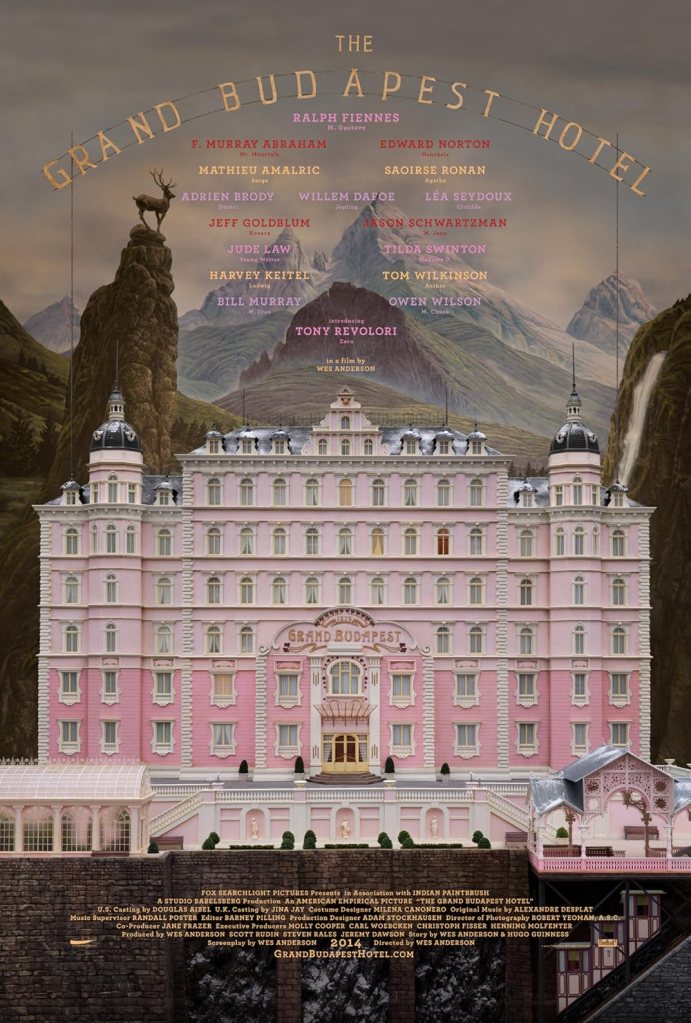
#796) The Grand Budapest Hotel (2014)
OR “In Fiennes Form”
Directed & Written by Wes Anderson. Story by Anderson & Hugo Guinness.
Class of 2025
The Plot: As told as a flashback within a flashback within a novel, Zero Moustafa (Tony Revolori) is hired as a lobby boy at Zubrowka’s elegant Grand Budapest Hotel. He is taken under the wing of Monsieur Gustave H. (Ralph Fiennes), the meticulous concierge who has had a number of dalliances with the hotel’s elderly dowager patrons. When his longtime conquest Madame D. (Tilda Swinton) passes away, she bequeaths Gustave the valuable painting Boy with Apple, much to the disdain of her adult son Dmitri (Adrien Brody), who plots to steal it. But you’re not watching a Wes Anderson movie for the plot; you’re here for his trademark vintage aesthetic and ever-expanding roster of A List ensemble members.
Why It Matters: The NFR praises the film’s “visually striking and emotionally resonant story” and hails Wes Anderson as “one of the most stylistically distinctive American filmmakers of the last half-century.” There’s also an extended quote from Anderson describing the major influence the Library of Congress Photochrom Prints collection had on the final film.
But Does It Really?: As with many a recent NFR inductee, it’s a bit odd watching a movie for this blog that I feel I just saw when it came out (and by “just” I mean 12 years ago). I recall enjoying “The Grand Budapest Hotel” at the time, even if it did feel like Wes Anderson had finally fully escaped reality into Wes Anderson Bingo Land. Looking back on the film with some historical context, “Grand Budapest” is the Wes Anderson movie where it all comes together. With this film, not only did Anderson achieve the full aesthetic we associate with “a Wes Anderson movie”, but he achieved success with audiences, critics, and the awards circuit, a hat trick that none of his subsequent films have surpassed. While I’m still on the fence about whether “Grand Budapest Hotel” is a worthy NFR inductee, Wes Anderson is an iconic and canonized director who should have more than one film on the Registry, and “Grand Budapest” will do in a pinch.
Everybody Gets One: As the most recent NFR entry (as of this writing), “The Grand Budapest Hotel” serves as the NFR debut for a number of major actors, including Adrien Brody, Jude Law, Edward Norton (along with his performance in “Frida”), Saoirse Ronan, Léa Seydoux, Tilda Swinton, and Tom Wilkinson. This is also the only NFR credit for Hugo Guinness, artist and New York Times illustrator who contributed paintings to previous Anderson films (though somewhat ironically he didn’t paint Boy with Apple).“Grand Budapest” is Guinness’ first writing credit.
Seriously, Oscars?: A rare Oscar contender from the first half of a calendar year, “The Grand Budapest Hotel” tied “Birdman” for the most nominations at the 2015 Oscars (nine) and most wins of the night (four). Although “Birdman” prevailed as the Best Picture winner, “Grand Budapest” won for its Production Design, Makeup and Hairstyling, Costume Design, and Music (Original Score). While Wes Anderson went home empty-handed that night, he would finally win his first Oscar in 2024 for his animated short “The Wonderful Story of Henry Sugar”.
Other notes
- When we last saw Wes Anderson on this blog, he had just established himself as a promising new filmmaker with the success of “Rushmore”. In the next 15 years he made such films as “The Royal Tenenbaums”, “The Life Aquatic with Steve Zissou”, “Fantastic Mr. Fox”, and “Moonrise Kingdom”, all of which received critical acclaim and financial success, if not major mainstream or awards attention. “The Grand Budapest Hotel” was a long gestating collaboration between Anderson and Hugo Guinness that finally came together once Anderson started reading the writings of Stefan Zweig, who longtime readers may recall as the author of “Letter from an Unknown Woman”.
- The press release for the NFR Class of 2025 puts a lot of emphasis on Wes Anderson’s use of the Library of Congress’ Photochrom Print collection. For the curious, photochroms are black and white photos hand-painted on the negative, and you can definitely see the influence on “Grand Budapest”. Check out the Library’s collection here.
- I think the alternate title for “Grand Budapest” was “Fun with Aspect Ratios”. The bulk of the film set in 1932 is filmed in the classic square Academy ratio of 1.37:1, the 1968 scenes are filmed in 2.40:1 widescreen, and the film’s first framing device is in the traditional 1.85:1 ratio. It definitely helps keep things straight, and its a much quicker transition than a dissolve.
- While we’re on the subject of framing devices, I’m gonna say this film has two bookends too many. We start with a young woman at the Author’s memorial in a cemetery. She starts reading the Author’s novel The Grand Budapest Hotel, and we segue to the Author (Tom Wilkinson) reciting the book’s opening passage. This takes us to Jude Law as the young Author at the hotel in 1968, and then we flashback to 1932 and the actual story. As much as I love seeing Tom Wilkinson on the NFR, and as funny as I found his intrusive grandson, we could have trimmed his scenes and the cemetery stuff and not lose anything.
- When we think of Wes Anderson’s films, we think almost entirely of his stylized aesthetic, which tends to sideline the great performances. The reason I think “Grand Budapest” stands out among Anderson’s latter filmography is Ralph Fiennes’ performance. Fiennes is clearly having a field day playing Gustave, peppering in a bit of humanity that holds the film together.
- Of the ensemble, Tilda Swinton was the only actor who wasn’t Wes Anderson’s first choice. He had originally courted Angela Lansbury to play Madame D., but Lansbury had to back out due to her commitment touring with “Driving Miss Daisy” in Australia. Swinton’s good, and that’s a very impressive makeup job, but why not go for another elderly British actress? Were Rosemary Harris and Vanessa Redgrave unavailable?
- Zero’s encounter with the Nazi-adjacent immigration officers is unfortunately timely these days, though it does set up one of the best lines in the movie: Gustave’s “Take your hands off my lobby boy!”
- Between this and “Birdman”, 2014 was a good year for Edward Norton. This is Norton’s second Wes Anderson film following “Moonrise Kingdom”, and the beginning of his return to mainstream Hollywood following his “difficult” reputation and showbiz exile. We also get Adrien Brody between Oscar wins, seen here as…Salvador Dalí’s evil brother?
- As Zero’s beloved Agatha, Irish actor Saoirse Ronan plays something she has never gotten to play before: Irish. After trying out various accents for Agatha (including American and German), Ronan and Anderson agreed that her natural Irish lilt worked best for the character. And while we’re here, Ms. Ronan’s first name is pronounced “sir-sha”, like it rhymes with inertia. Stop asking her.
- Willem Dafoe stroking Jeff Goldblum’s Persian cat and then throwing it out a window: great movie moment or the greatest movie moment?
- Shoutout to Tony Revolori as Zero, successfully navigating a character who spends most of his screentime observing in the background, but can still step up and influence the story when he needs to. I was curious what Revolori has been up to in the last 12 years: turns out he’s in those new Spider-Man movies that I’ve never gotten around to watching. Glad he’s getting that Marvel money. Bonus shoutout to F. Murray Abraham as older Zero, making this the second NFR movie that Abraham narrates in flashback (with no old age makeup required this time).
- I liked the “Society of Crossed Keys” sequence, particularly Bill Murray’s extensive mustache and the amusing “take over” runner. Also, one of the society’s members is played by Wally Wolodarsky, Wes Anderson go-to and longtime “Simpsons” writer who co-wrote, among other episodes, the one where Homer falls down the Springfield Gorge.
- At a time when CG effects were under fire for being too prevalent in Hollywood movies, Anderson comes to the rescue with practical effects and a stop-motion ski chase sequence. That being said, there’s a handful of green screen shots throughout the movie, though they’re minimal and nonintrusive.
- Oh wow, Owen Wilson’s in this. This is Wilson’s first NFR appearance as an actor; he was previously represented as the co-writer of “Rushmore”.
- The credits give special billing to pretty much the entire production team before the traditional roll-up credits. Also keep watching for a Special Thanks to the Library of Congress, and animation of a dancing Russian man!
Legacy
- “The Grand Budapest Hotel” was released in March 2014, and to this day is still the highest-grossing Wes Anderson film. “Grand Budapest” was also a critical darling and major Oscar player, and in the ensuing years routinely ranks among the best films of the 21st century (so far).
- Wes Anderson’s subsequent filmography includes “Isle of Dogs”, “The French Dispatch”, and “Asteroid City”. His most recent was 2025’s “The Phoenician Scheme” which…I did not care for. It seems like Wes Anderson’s recent movies just check off a list of actors and aesthetics, but it had its moments. Not enough for me to recommend it, but still.
Bonus Clip: Way back in the day I co-hosted a radio show with stand-up comic Clay Newman where we talked about TV and movies and stuff. For our 2015 Bullshit Oscar Special we did an opening sketch where we pulled a Billy Crystal and inserted ourselves into all eight of that year’s Best Picture nominees, including “The Grand Budapest Hotel”. Clay ad-libbed most of his lines, and his “Grand Budapest” tag still makes me laugh. Now if only I had sprung for an actual microphone.
 The Horse's Head