
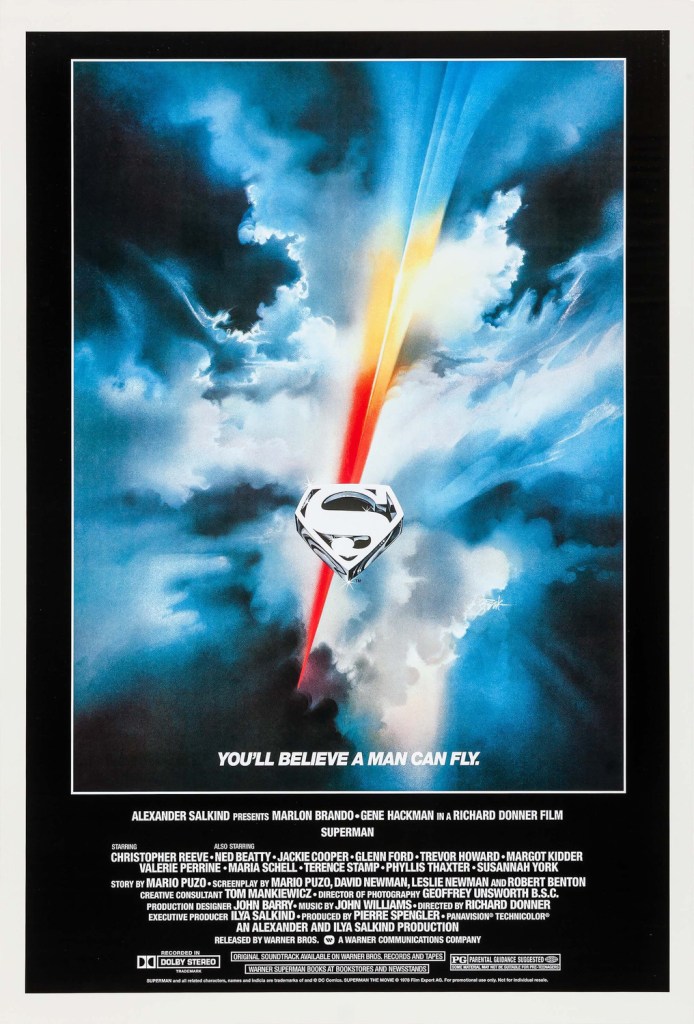
#800) Superman (1978)
OR “Pretty Fly for a Tights Guy”
Directed by Richard Donner
Written by Mario Puzo and David Newman and Leslie Newman & Robert Benton. Story by Puzo. Based on the character created by Jerry Siegel & Joe Shuster.
Class of 2017
The Plot: Look, up in the sky! It’s a bird! It’s a plane! It’s Superman (Christopher Reeve)! Born on the planet Krypton as Kal-El, Superman is sent to Earth during Krypton’s destruction by his father Jor-El (Marlon Brando). Landing on Earth and raised in Smallville by the Kents (Glenn Ford and Phyllis Thaxter), Kal-El —now known as Clark Kent — becomes aware of his Kryptonian superpowers, which his adopted father insists be used for good. Clark grows up to become a mild-mannered newspaper reporter for the Daily Planet in Metropolis, which he uses as a front while he continues to save Metropolis as Superman. Along the way he woos fellow reporter Lois Lane (Margot Kidder), matches wits with supervillain Lex Luthor (Gene Hackman), and fights a never-ending battle for truth, justice, and the American way.
Why It Matters: The NFR calls the film “[b]eautiful in its sweep, score and special effects”, and declares Reeve “the definitive Man of Steel”. An essay by film critic Chuck Koplinski is a thorough appreciation of the film and its behind-the-scenes struggles.
But Does It Really?: As a movie, “Superman” is slowly paced to the point of frustration, but as a cultural touchstone it can’t be beat. What the film lacks in focus it more than makes up for with Reeve’s central performance (and his chemistry with Kidder), aided by John Williams’ unforgettable score and the film’s overall epic scope and occasionally impressive special effects. “Superman” is not one of the great movies on the Registry, but its iconography has had a lasting impact on pop culture, and its NFR standing as an important American film is undeniable.
Shout Outs: No direct references to other NFR films within “Superman”, but Christopher Reeve stated that he based his performance of Clark Kent on Cary Grant’s work in “Bringing Up Baby”. Also, if “Rock Around the Clock” is playing and Glenn Ford is nearby, does that count as a “Blackboard Jungle” reference?
Everybody Gets One: Born in New York and raised in New Jersey, Christopher Reeve caught the acting bug at a young age, ultimately becoming one of only two students picked for Juilliard’s Advanced Program in 1973 (the other was Robin Williams). Reeve had to drop out of Juilliard after less than two years to fulfill a contractual obligation with the soap opera “Love of Life”, but he always returned to the theater when he could. Reeve was initially not considered to play Superman because the producers wanted an established name such as Burt Reynolds, Paul Newman, or Al Pacino (my favorite potential contender is Muhammad Ali!). Once Brando and Hackman were cast, unknown actors were tested, and Reeve finally won the part after being campaigned for by the film’s casting director Lynn Stalmaster, who had seen his stage work. Reeve’s performance has been repeatedly singled out over the years as the reason “Superman” was so successful.
Wow, That’s Dated: Among the pieces of the Superman mythos that were starting to show their age in the ‘70s: print media and phone booths (though the movie gets a good visual gag out of the latter).
Seriously, Oscars?: One of the biggest hits of 1978, “Superman” received three Oscar nominations for its Score, Sound, and Editing. While it lost these awards to “Midnight Express” and “The Deer Hunter”, the film did receive a Special Achievement Oscar for its Visual Effects.
And now for An Oversimplified History of Superman. Based on the short story “The Reign of the Superman” by Jerry Siegel (with illustrations by Joe Shuster), Superman made his official debut in DC Comics’ Action Comics Issue #1 in April 1938. Superman was an instant success, getting his own comic book series in June 1939, which has continued on and off over the last nine decades. Adaptations of Superman in other media began almost immediately, starting with a radio series starring Bud Collyer, and later a TV show starring George Reeves. Superman’s first film appearance was in a series of animated shorts produced by Fleischer Studios (where he was again voiced by Collyer), followed by two live-action serials with Kirk Alyn. Although Superman prevailed in comics and on TV throughout the 20th century, he would not get another live-action film adaptation until producers Ilya & Alexander Salkind acquired the film rights from DC Comics in 1974. It was agreed that both “Superman” and “Superman II” would be filmed simultaneously, leading to a nineteen month shoot with a budget of $55 million, the most expensive film(s) ever made up to that point.
Other notes
- The thing to remember about “Superman” is that it was the film that made superhero movies epic. Before 1978, superhero film and TV shows were cheap and campy (think ‘60s “Batman”), and while “Superman” has its campier elements, it’s definitely not cheap. The grandeur is on full display during the unnecessary prologue and what feels like the longest opening credits ever. Thank goodness for John Williams’ stirring score to put us all in the right mood, though hearing his “Superman” theme always makes me think of the “Seinfeld” finale.
- What in god’s name is Marlon Brando doing here? The inexplicable appearance of Brando as Jor-El makes a lot more sense once you learn he was planning on using the money to produce a “Roots”-style miniseries about Indigenous people (which ultimately fell through). How much money was Brando paid, you ask, for his brief screentime? $3.7 million, plus almost 12% of gross profits, earning Brando about $23 million (roughly $114 million in today’s money). For comparison, Gene Hackman was paid $2 million for his work, while Christopher Reeve received $250,000.
- Oh right, this movie was made in the ‘70s, therefore its pacing is slower than the glaciers at the Fortress of Solitude. Because “Superman” and its sequel were filmed simultaneously, they were conceived as two parts of a larger story, which explains why a majority of this movie feels like set-up, because it is. This also explains Terence Stamp’s brief appearance as General Zod, which is just there to set him up as the villain in “II”. That’s all well and good, but I ain’t kneeling before Zod anytime soon.
- Even Superman’s adopted hometown of Smallville has an epic scope to it, thanks to some choice on-location shots across rural Canada and gorgeous Rockwell-esque cinematography from Geoffrey Unsworth. We also get Glenn Ford as Pa Kent, in what is probably his second-best NFR performance in my opinion.
- It takes almost an hour for Superman to grow up and become Christopher Reeve, but it’s worth it. The filmmakers really struck gold with Reeve; he is instantly endearing as both Superman and Clark Kent, and matched by Margot Kidder’s Lois Lane. Such actors as Stockard Channing and Anne Archer were in serious contention to play Lois, but Kidder adds an appropriate amount of toughness and playfulness to the character. The natural chemistry between Reeve and Kidder is easily the best part of the movie (the interview scene in particular is fantastic).
- If you thought it took a long time for Christopher Reeve to show up, it takes even longer for Gene Hackman to finally put in an appearance. I thoroughly enjoyed Hackman’s performance as Lex Luthor, primarily because he’s basically doing his own thing, as if he’s starring in a completely different movie, which I found refreshing this far into the proceedings. He also plays well off of Ned Beatty and the recently departed Valerie Perrine as Lex’s less-than-helpful accomplices.
- This movie has several faults, but the flying scenes aren’t one of them. The special effects team used every trick in the book to make Superman fly, and the results speak for themselves. Just as the poster predicted, I believed a man could fly.
- It amuses me that the filmmakers felt the need to sneak a song into the movie. A collaboration between John Williams and Leslie Bricusse, “Can You Read My Mind” is another in the proud tradition of inner monologue songs on the NFR. However, as far as “falling in love while flying” songs are concerned, it’s no “A Whole New World”.
- Brando is just one of multiple actors with brief turns in this movie that made me wonder “What are you doing here?”. Among them: former “Our Gang” star Jackie Cooper as Perry White, British stalwarts Trevor Howard and Susannah York as Kryptonians, film critic Rex Reed as himself, and Larry Hagman as one horned-up Army major. But the most random to me was the combination of John Ratzenberger and Phil Brown observing the hijacked missile launches. Cliff Clavin and Uncle Owen: together at last.
- Speaking of “What are you doing here?”, yes that is “Godfather” author Mario Puzo credited here as one of the writers. Although the producers gave him a proposal he couldn’t decline ($600,000), Puzo’s drafts were too campy and veered too far from the Superman mythos for the producers’ tastes. Very little of Puzo’s script made the final cut, hence the “Story by” credit.
- The California fault line finale adds a hint of the ‘70s disaster genre to the proceedings. In all fairness, “Superman” is a better earthquake movie than “Earthquake”.
- Someone please explain this movie’s time travel aspect to me. Did the earthquake still happen? Are there two Supermen out there now? Just how wibbly-wobbly-timey-wimey does this all get? Whatever, I’m ready for this thing to be over.
- The very end of the movie features text declaring “Next Year ‘Superman II’”: The cinematic equivalent of Babe Ruth’s called shot.
Legacy
- “Superman” opened in December 1978, and quickly became one of the highest grossing films of the year (second only to “Grease”). Despite the declaration at the end credits, “Superman II” would be delayed over two years, in part due to the firing of original director Richard Donner, who clashed with the Salkinds during production (but hey, who didn’t?). The “Superman” franchise spawned two additional sequels (plus the spin-off “Supergirl”), but each was met with diminishing returns. “Superman II” was somewhat redeemed by the “Richard Donner Cut” completed in 2006.
- Superman has endured over the decades in practically every type of media, including multiple TV series (“Lois & Clark”, “Superman: The Animated Series”, “Smallville”, etc.). As of this writing, there have been three attempts to bring Superman back to the big screen, and while they each met with varying degrees of success, all of them have stayed in the shadow of the 1978 movie.
- As soon as “Superman” wrapped, Christopher Reeve spent the remainder of his career playing roles on stage and screen as far removed from The Man of Steel as possible (I love his performance in “Noises Off”). A horse-riding accident in 1995 left Reeve paralyzed from the neck down, but he continued to act and direct, as well as advocate for a number of causes, including disability rights and stem cell research. Christopher Reeve died in 2004 at age 52, his on-screen legacy as Superman matched by his off-screen advocacy and generosity. Reeve was living proof that not all superheroes wear capes.
When I started this blog nine years, I thought there was an outside chance I’d make it to 700 movies, but definitely didn’t believe 800 movies was possible. Thanks for flying along with me all these years. More to come.
Happy Viewing,
Tony
 The Horse's Head
8 thoughts on “#800) Superman (1978)”