
#276) The March (1964)

March-on-Washington-for-Jobs-and-Freedom.-1963

#276) The March (1964)

Directed by James Blue

Class of 2008

As is usually the case with my write-ups of historical events, this post is a massive oversimplification of The March on Washington for Jobs and Freedom, and is not the be-all and end-all on the subject. There’s a lot of information out there about the march, and you should check it all out. Educate yourself!

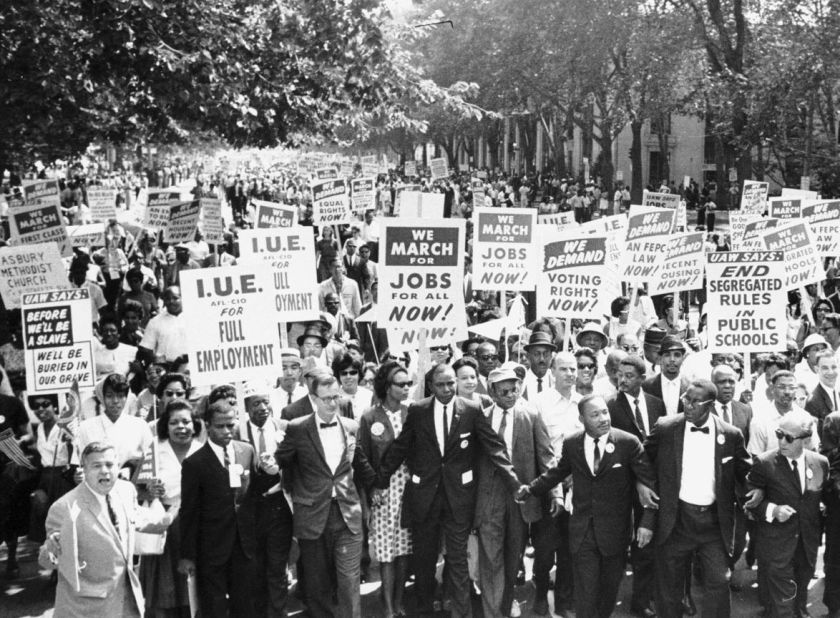
August 28th, 1963: American citizens and organizations take to the streets of Washington D.C. to peacefully protest the lack of civil rights for African-Americans; an event coinciding with the centennial of the Emancipation Proclamation. Starting at the Washington Monument, The March on Washington for Jobs and Freedom is attended by over a quarter of a million Americans, some holding pre-approved signage calling for unity and an end to Jim Crow, and many singing such protest songs as “We Shall Overcome”. Appropriately enough, the march ends at the Lincoln Memorial, with speeches by such civil rights leaders as Roy Wilkins and John Lewis, and performances from Marian Anderson and Mahalia Jackson. But the main event is when Southern Christian Leadership Conference leader Dr. Martin Luther King Jr. takes the podium and delivers his instantly iconic “I Have a Dream” speech. The march is a turning point in the Civil Rights movement and, while not without its detractors (Malcolm X called it a “farce”), would eventually lead to the Civil Rights Act of 1964.

Documentarian James Blue was commissioned by the United States Information Agency to cover the march and create a film to be viewed by various government agencies. The result is a streamlined version of the day’s events, but the hope of the marchers comes across, as does the overall feeling of history in the making. Watching this march 55 years later, obvious parallels can be made to the protests of recent years, and this film gives me the cautious optimism that peaceful protests can still be successfully orchestrated by concerned citizens. Any footage of the March on Washington is deserving of preservation, and “The March” is a succinct film that gives you healthy sample of what that day was like.

Everybody Gets One: I admit to not knowing anything about James Blue prior to researching this post, but it turns out the University of Oregon has all the information you want on the man. Although “March” is his only NFR entry, Blue was a prolific documentarian and his 1968 film “A Few Notes on Our Food Problem” (another USIA commission) was nominated for the Best Documentary Oscar.

Other notes

  • If the United States Information Agency sounds familiar, you may remember them from my write-up of “Czechoslovakia 1968”. With rare exceptions, USIA films were not meant for public viewing, until a congressional act passed in 1990 allowed them to be viewed after 12 years.
  • Kudos to the restoration team; this film looks amazing. Of all the documentaries I’ve covered so far, “The March” has easily the cleanest print.
  • I understand that it was still summer, but it seems weird to hold the pivotal moment of the Civil Rights movement on a Wednesday.
  • Among the notable attendees of the march (though not appearing in “The March”): Rosa Parks, Jackie Robinson, Dick Gregory, Marlon Brando, Ruby Dee & Ossie Davis, Lena Horne, Charlton Heston, Harry Belafonte, and James Baldwin (who was controversially not allowed to give a speech). Side note: Keep an eye out for Bob Dylan in the crowd while Joan Baez is performing.
  • At age 23, Civil Rights leader and future Congressman John Lewis was the youngest speaker at the Lincoln Memorial. His speech was preemptively edited by march organizers to remove anything that may be perceived as antagonistic, including a line calling President Kennedy’s Civil Rights bill “too little, too late”. Lewis is still going strong and fighting the good fight representing Georgia’s 5th
  • If you watch “The March” on the US National Archives YouTube page, you’ll notice something very weird: “I Have a Dream” is completely muted. Closed Captioning gives the disclaimer “The audio has been redacted due to a copyright restriction from Dr. King’s family.” Turns out that after a legal dispute with CBS, the audio of the “I Have a Dream” speech is the copyright of the King estate, and this YouTube upload either couldn’t or wouldn’t get clearance. Definitely tarnishes the viewing experience.
  • For the curious, here’s the full “I Have a Dream” speech (“The March” cuts it down to about six minutes). I can’t say anything that hasn’t already been said: it’s one of the most important speeches in world history, and if nothing else, Dr. King knew how to work a room. The actual dream part of the speech wasn’t originally included, making that section History’s Greatest Ad-Lib.
  • You know who the real hero is? Whoever decided that no one should follow Martin Luther King. There were closing remarks by March organizer A. Philip Randolph, but King was the last speaker. Good call, everyone.
  • According to the Baltimore Sun’s coverage of the march, despite fears from White America that there would be violence and riots, only three arrests were made that day, none of them African-Americans.
  • To reiterate, I am deeply under-qualified to talk about any of this, and a 1000 word blog post can only scratch the surface. There are countless websites that chronicle the March on Washington, but I’ll always recommend any video or audio you can find from that day. Words can paint a picture, but the recordings are a powerful way to revisit the march and to truly see how far we’ve come and still have to go.

Listen to This: There are a lot of recordings that go along with the Civil Rights movement, and several of them have made their way onto the National Recording Registry. First and foremost is Dr. King’s “I Have a Dream” speech, which is embedded above. There’s also Pete Seeger’s rendition of “We Shall Overcome”, a song heard frequently throughout “The March”. And last but far from least is Marian Anderson’s recording of “He’s Got the Whole World in His Hands”. While the NRR selection is her 1936 rendition, Anderson reprised the song for the March on Washington.
#275) 12 Angry Men (1957)

MV5BMWU4N2FjNzYtNTVkNC00NzQ0LTg0MjAtYTJlMjFhNGUxZDFmXkEyXkFqcGdeQXVyNjc1NTYyMjg@._V1_

#275) 12 Angry Men (1957)

OR “The Jury Dozen”

Directed by Sidney Lumet

Written by Reginald Rose. Based on his teleplay.

Class of 2007

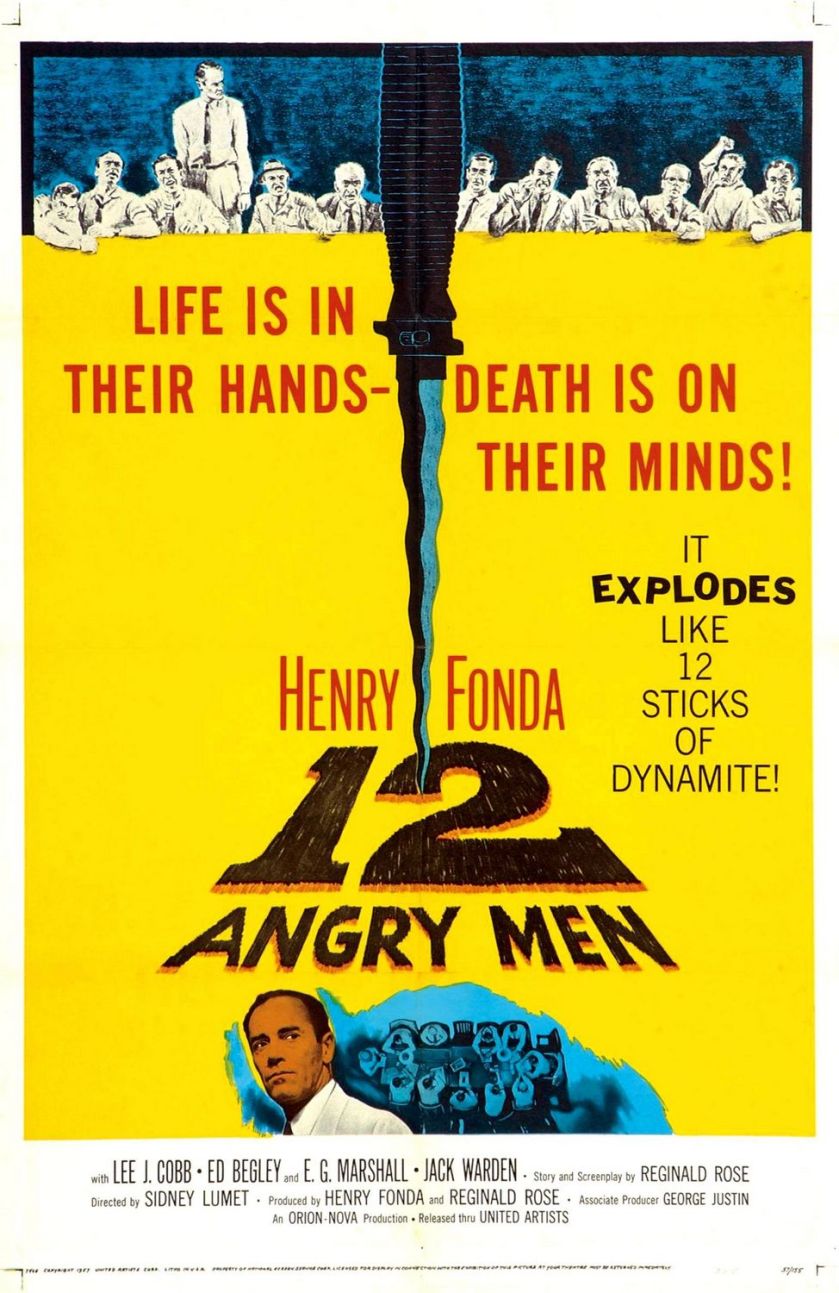
The Plot: An 18-year-old slum kid (John Savoca) is on trial for the murder of his father, and a verdict of guilty will lead to the boy’s execution. In the jury room, 11 of the men are ready to vote guilty, but one dissenting juror (Henry Fonda) has a reasonable doubt that the boy committed the crime. The 12 go over every detail of the case, from recounting witness testimonies to examining evidence, and slowly other jurors start changing their votes to “not guilty”. Will #8 convince the others that there is a reasonable doubt, or will #3 (Lee J. Cobb) keep everyone in line with his prejudiced “one of them” viewpoint?

Why It Matters: The NFR calls the film “a classic” and suggests it can be viewed as “commentary on McCarthyism, Fascism or Communism.” There’s also an essay by Sidney Lumet expert Joanna E. Rapf.

But Does It Really?: “12 Angry Men” is definitive proof that a great movie can be made out of people in a room talking for 90 minutes. Sidney Lumet’s execution of this film is flawless, as is the finest ensemble of actors in any one movie. “12 Angry Men” is the rare movie that highlights our judicial system without either over-praising or condemning it. The jury process is flawed, but the power falls on the people, and the responsibility should not be taken lightly. “12 Angry Men” is one of my favorite movies and only gets better with age.

Shout Outs: No direct references, but Juror #7 does whistle the Laurel & Hardy “Dance of the Cuckoos” theme at one point.

Everybody Gets One: Writer Reginald Rose, jurors Ed Begley (Sr.), Jack Klugman**, E.G. Marshall, George Voskovec, and Robert Webber.

Wow, That’s Dated: The crime hinges on such dated things as double features and New York’s elevated trains.

Seriously, Oscars?: “12 Angry Men” was a critical hit, but United Artists didn’t give the film a proper release, and it suffered financially. The film did, however, manage three Oscar nominations: Picture, Director, and Adapted Screenplay, but lost all three to “The Bridge on the River Kwai”. How Fonda and Cobb weren’t nominated for their performances is just unforgivable.

Other notes

  • You do not need to watch the original “Studio One” teleplay of “Twelve Angry Men”. The film delves into the characters and their motivations on a much deeper level than the TV version, which lacks overall energy. Being shot for live TV, the teleplay also suffers from actors flubbing their lines and the occasional camera gaffe. That being said, the side-by-side comparison is an intriguing reminder of a time when film and TV were two distinctly separate media.
  • The line “The alternate jurors are excused” unexpectedly tickled me. I just enjoy the notion that these two extras were so close to being in a classic movie.
  • Juror #2 is John Fiedler, aka the original voice of Piglet. Now you know why he sounds so familiar.
  • “You can’t dispute facts”. That’s not just a quote, it’s a reminder.
  • This film is easily one of the most impressive directorial debuts. Lumet knows exactly what he wants and he knows how to get it from everyone. Every aspect of the film is expertly crafted, from the cinematography to the editing. I recommend reading Lumet’s book “Making Movies” to learn about the specific way “12 Angry Men” was shot (plus insight on his dislike of teamsters).
  • The close-ups of #9 staring directly into the camera are a bit unsettling. Did Jonathan Demme direct those shots?
  • Everyone’s great, but George Voskovec as #11 is the unsung hero. The “guilty” voters are the flashier parts, but the subtlety Voskovec brings to his character is brilliant.
  • It’s comforting to know that even film greats like Henry Fonda and Martin Balsam sweat in the summer heat.
  • “The Remarkable Mrs.….” Maisel?
  • Speaking of, that plot point always bothered me. Jurors are swayed because #4 can’t remember details from four nights ago. That’s very different from the kid not remembering where he was two hours ago, “emotional stress” or not. But whatever Fonda, you made your point.
  • Jack Klugman is many things, but a street tough is not one of them.
  • The most impressive shot in the whole film is one long take that contains two monologues: #10’s racist rant, and #8’s “prejudice always obscures the truth” speech. Kudos to everyone involved.
  • I always laugh at E.G. Marshall’s maybe-too-serious reading of the line “No one wears eye glasses to bed.”
  • It’s really hard to single out any one actor in this film; they’re all so great. But Lee J. Cobb might clinch it with his final monologue. It’s so emotionally raw, I found myself actually tearing up as #3 finally recognizes his prejudice. Cobb made me see the tragic figure inside Juror #3, not surprising considering Cobb played THE tragic figure: Willy Loman.
  • I’ll argue that this film doesn’t need that last shot. You could just fade to black after they exit the jury room. The awkward exchange between #8 and #9 on the steps takes away from the anonymity of the courtroom.
  • The only juror I haven’t mentioned yet is #6, played by Edward Binns. He’s great too!

Legacy

  • “12 Angry Men” launched the 50-year directing run of Sidney Lumet.
  • You have watched “12 Angry Men” either as a team-building exercise, a dissection of conflict resolution, or a lesson in critical thinking.
  • “12 Angry Men” returned to television in 1997 with an update directed by William Friedkin, starring Jack Lemmon as #8 and George C. Scott fulfilling his destiny as his generation’s Lee J. Cobb.
  • Speaking of remakes, practically every country has made their own version. Among them, the 2007 Russian movie “12”, which was nominated for the Best Foreign Language Film Oscar.
  • Your community theater is doing a production of “12 Angry Jurors” right now, because they’re the first ones to recognize how relevant it still is.
  • Supreme Court Justice Sonia Sotomayor has cited “12 Angry Men” as influencing her decision to study law. By comparison, Brett Kavanaugh was inspired to study law after a viewing of “Animal House”. But seriously, fuck that guy.
  • Every sitcom has done a “12 Angry Men” spoof, but will anything ever top “Inside Amy Schumer”?

Further Viewing: Did you know that Rob Reiner does an impression of Lee J. Cobb’s performance in this film? Well now you do, Meathead.

** 2018 Update: Jack Klugman now also has “Days of Wine and Roses” on the list. Way to go Quincy!

#274) Flesh and the Devil (1926)

kinopoisk.ru

#274) Flesh and the Devil (1926)

OR “Garbo Cheats!”

Directed by Clarence Brown

Written by Benjamin Glazer. Based on the novel “Es war” (English title: “The Undying Past”) by Hermann Sudermann.

Class of 2006

The Plot: While on leave from the German military, Leo von Harden (John Gilbert) meets and falls for the beautiful Felicitas von Rhaden (Greta Garbo). The sparks fly immediately and a great romance begins, but abruptly ends when Felicitas’ husband the Count (Marc McDermott) comes home and finds them together. The Count challenges Leo to a duel, which Leo wins with a fatal shot. The military sends Leo to Africa for five years, but he is able to get his sentence reduced to three years, thinking of returning to Felicitas the whole time. When Leo does return home, he discovers Felicitas is now married to Ulrich von Eltz (Lars Hanson), his best friend since childhood. And this little love triangle just gets more melodramatic from here.

Why It Matters: The NFR acknowledges the “blistering chemistry” between Greta Garbo and John Gilbert, while calling the film “[o]ne of the last silent film classics”.

But Does It Really?: I will give the film the historical significance of Greta Garbo and John Gilbert, but that’s about as generous as I’m feeling. On the whole the film, like many other silent movies, just doesn’t hold up. Everything in this movie goes on a little too long, and melodrama as a genre is very hard to view through a modern lens. I give “Flesh and the Devil” a slight pass, but I’m in no rush to watch it again.

Everybody Gets One: It’s the studio system in its prime: I’ve really got to start calling this section “Everybody Gets At Least Two in the Studio Era”.

Wow, That’s Dated: Among other things, this movie features a ball where the women carry actual dance cards.

Take a Shot: No one says the title, but Pastor Voss does tell Leo, “When the devil cannot reach us through the spirit…he creates a woman beautiful enough to reach us through the flesh.” So there’s that.

Other notes

  • Despite the poster, the Devil does not actually appear in this movie.
  • Every time the MGM logo shows up in a silent movie I keep hoping for an intertitle that says, “Roar!”
  • Lars Hanson kinda looks like young Peter Cushing. Where was he during “Rogue One”?
  • Leo and Ulrich are physically close to each other a lot. Forget Gilbert and Garbo, I think this is the romance.
  • The kids on the “Isle of Friendship” made the same blood pact as the kids from “It”.
  • Oooh, early matte paintings. That was cutting edge for 1926.
  • But seriously, is Garbo a beard for these two? Get a room!
  • Wow, that is one bright lighter. Is it powered by Marcellus Wallace’s soul?
  • I’m sure this is what the filmmakers were going for, but having Leo and Felicitas smoking cigarettes strongly implies that they did it.
  • You know Leo, if you want your moustache to be that tiny, do you really want a moustache to begin with?
  • Shoutout to cinematographer William Daniels (no, not that one). There’s some really good use of light and shadow throughout the film.
  • John Gilbert definitely paved the way for your Errol Flynn’s and your Kevin Kline’s.
  • The Felicitas montage is unintentionally hilarious. Someone had fun with those intertitles.
  • The second half of the movie gives you a better idea of why most silent movies don’t hold up today: too dialogue heavy. If it’s not being conveyed visually, you might as well just read the book.
  • The running gag with the twins is a bit weird, and without a real payoff either. Fun Fact: one of the twins is Cecila Parker, best known as Marian Hardy in the “Andy Hardy” movies.
  • Boy, the Pastor is really preaching fire and brimstone because of one infidelity. This is why I distrust organized religion.
  • At one point Hertha calls Leo “a surly old bear”. I’ve been called something along those lines.
  • Nice optical effect for the snowfall. Are they inside the Rosebud snow globe?
  • One of my notes simply reads, “Oy, these two.” I know it’s a melodrama, but all this “it’s okay because we love each other” crap is really too much.
  • Now Gilbert’s giving me an early Clouseau look.
  • Maybe it’s just the print I’m watching, but that last reel needs a bit of a cleaning. “Decasia” looks better.
  • This movie’s ending is the ultimate cinematic depiction of “bros before hoes”.

Legacy

  • “Flesh and the Devil” helped launch Garbo’s star. She was so grateful to director Clarence Brown and cinematographer William Daniels that she ensured they work on as many of her subsequent films as possible.
  • Garbo and John Gilbert made three more romantic pictures for MGM, and continued their chemistry off-screen as well. After their relationship ended, Garbo tried to get Gilbert more work, but his alcoholism led to a fatal heart attack at the age of 36.
  • The relationship between Garbo and Gilbert was turned into the 1980 TV movie “The Silent Lovers” with Barry Bostwick and Kristina Wayborn.

#273) Hoop Dreams (1994)

hoop-dreams-md-web

#273) Hoop Dreams (1994)

OR “Rebound for Glory”

Directed by Steve James

Written by James and Frederick Marx

Class of 2005

The Plot: William Gates and Arthur Agee are two African-American teenagers from inner-city Chicago with dreams of playing professional basketball. Both are recruited by the predominantly white St. Joseph High School: William on the varsity team, Arthur on the freshman team. William excels initially, thanks to encouragement from his mother Emma and brother Curtis (a former NBA hopeful himself) as well as the coaching of Gene Pingatore, but a knee injury causes him to falter athletically and academically. Arthur is unable to continue at St. Joseph following some financial hardships for his parents Sheila and Bo, but blossoms once he is transferred to John Marshall High. All of this, however, just scratches the surface of a movie that examines socio and economic struggles, race-relations, and the price that comes with dreaming big.

Why It Matters: The NFR can’t throw enough superlatives at “Hoop Dreams”: “groundbreaking”, “intimate and comprehensive”, “complex and ultimately rewarding”.

But Does It Really?: Okay you got me: “Hoop Dreams” is amazing. I can’t remember the last time I was so moved by a documentary. “Hoop Dreams” is an emotionally draining ride, but man is it worth it. Almost instantly I was rooting for William and Arthur, and I watched them literally grow up before my eyes. When done correctly, documentaries are an exhilarating amplification of life: the victories are sweeter and the setbacks more discouraging, because we know it’s real and it can happen to anyone. The world of “Hoop Dreams” is fueled by the kind of hope and sheer determination that we all strive for in the face of everyday adversity. And any movie that can bring all of that out is unquestionably worthy of preservation.

Shout Outs:  Arthur listens to “Turn Off the Radio”, which samples dialogue from “Do the Right Thing”.

Everybody Gets One: Born in Virginia, Steve James went to school at Southern Illinois University, Carbondale. Most of James’ films deal with the Chicago area and its economic and class struggles. “Hoop Dreams” was originally intended to be a half hour PBS special, but James realized this was a larger story, and filmed over 250 hours of footage over the course of five years.

Take a Shot: I was not expecting this film to have a title song. But then again, I don’t expect that from any documentary on this list.

Seriously, Oscars?: Settle in: this movie’s the reason I have a “Seriously, Oscars?” section.

“Hoop Dreams” was a hit with both critics and audiences in 1994. It was named the #1 film of the year by both Siskel and Ebert, and was a shoo-in to win Best Documentary at the Oscars, possibly even receiving a Best Picture nod. The film garnered one nomination: for Editing. The uproar over the film’s omission from Best Documentary was unprecedented, and the Academy launched an investigation. The results were disheartening to say the least. Most of the voters for Best Documentary would turn off “Hoop Dreams” (and countless other documentaries) during screenings because they had lost interest. These voters also skewed the rankings to purposefully bump “Hoop Dreams” down to sixth place. This investigation led to a complete overhaul of the Documentary Branch and the nomination process.

For the curious, “Hoop Dreams” lost Editing to “Forrest Gump”, while Best Documentary went to “Maya Lin: A Strong Clear Vision”. Steve James wouldn’t be nominated in the Documentary category until 2018 with “Abacus: Small Enough to Jail”.

Other notes

  • This film covers a lot of topics I am vastly under-qualified to tackle. But I will ask this: how much pressure is too much pressure? A little bit can be a good motivator, but we as a culture put a lot a pressure on our athletes, both amateur and professional. William’s story is a good example of being pushed a little too far in pursuit of your dream.
  • Allegedly, Oscar voters turned off “Hoop Dreams” about 15 minutes in. Who hurt you?
  • Gene Pingatore is an Al Pacino HBO movie waiting to happen. Just slap on some of that Big Boy Caprice makeup and he’s ready to go.
  • I don’t follow basketball, but I am on the edge of my seat watching these games. I have never been more emotionally invested in a sporting event, and it’s from 30 years ago!
  • When did we decide ass-slapping our athletes was okay?
  • After being laid off from them, Bo Agee may be the first person in history that doesn’t like Sara Lee.
  • Arthur is sporting the Dwayne Wayne flip-up sunglasses! I thought those were so cool when I was a kid!
  • Why would you continue to deal drugs when you know there’s a camera crew nearby?
  • And now some detailed footage of William’s knee surgery. It makes the operation in “All That Jazz” look like a makeup tutorial.
  • Wow, this Nike All-American Camp is bringing out the big guns. Dick Vitale! Bobby Knight! Spike Lee! Wait, Spike Lee? I guess being a lifelong Knicks fan qualifies you to speak at these things.
  • Everyone please stop saying “blacks”! It’s the PC ‘90s, the phrase “African-American” definitely was a thing back now!
  • Sheila’s graduation from the nursing program is the moment that finally brought me to tears.
  • Do William and Arthur not share any screen time? When did this become “Heat”?

Legacy

  • St. Joseph sued the makers of “Hoop Dreams”, expecting the film to be a non-profit TV program, not a for-profit feature. The Hoop Dreams Fund was launched at St. Joseph as part of the settlement, and continued through 2009.
  • In 1999, Roger Ebert named “Hoop Dreams” the best film of the decade. Steve James returned the compliment by directing the 2014 Ebert documentary “Life Itself”, a title taken from Ebert’s initial “Hoop Dreams” review.
  • Gene Pingatore is still coaching at St. Joseph after 48 years. He recently coached his 1,000th winning game, the first basketball coach in Illinois to do so.
  • Arthur Agee played basketball at Arkansas State for two years, but turned down a chance to play with the Connecticut Pride, opting instead to appear in the movie “Passing Glory”, directed by Steve James! Agee is also the subject of the 2007 documentary “Hoop Reality”, examining his life in the decade since “Hoop Dreams” was released.
  • William Gates graduated from Marquette with a communications degree. Although he never played professional basketball, he did train with Michael Jordan for his 2001 comeback. Gates’ son, William Gates Jr., received a basketball scholarship from Furman University. Sequel?

#272) Ben-Hur (1959)

Ben_hur_1959_poster

#272) Ben-Hur (1959)

OR “Jews for Jesus: The Motion Picture”

Directed by William Wyler

Written by Karl Tunberg. Uncredited additional material by Gore Vidal, Maxwell Anderson, S.N. Behrman, and Christopher Fry. Based on the novel by General Lew Wallace.

Class of 2004

The Plot: Judah Ben-Hur (Charlton Heston) is a prince in ancient Jerusalem, and has recently come into conflict with his childhood friend/Roman tribune Messala (Stephen Boyd). Their differing views on religion and loyalty drive them apart, and following an incident involving Roman soldiers, Messala orders Judah’s arrest, even though Messala knows Judah is innocent. Over the next few years, Judah survives slavery on a Roman galley, participates in the greatest chariot race ever, and ultimately finds solace in the teachings of a man saying he is the Son of God.

Why It Matters: The NFR gives some background and trivia, but the only part of the film to get a superlative is the “breathtaking” chariot race. As always, William Wyler expert Gabriel Miller is on hand with an essay.

But Does It Really?: This is another one of those classic movies whose reputation has started to waver over time. “Ben-Hur” will always have the chariot race going for it, but the rest of the film can drag a bit. And it doesn’t help that there’s another version of this film on the Registry that’s an hour shorter. The 1925 version is the better overall version, but this “Ben-Hur” is also worthy of preservation, if just for that chariot race and its representation as one of the countless religious epics of the late ‘50s/early ‘60s.

Everybody Gets One: Actors Stephen Boyd and Hugh Griffith, and producer Sam Zimbalist, who died of a heart attack during production. And shoutout to opera star Claude Heater as Jesus. It’s a shame they don’t let him sing.

Wow, That’s Dated: This movie has a pretty severe BROWNFACE WARNING. Welsh actor Hugh Griffith plays the Arab Sheik Ilderim, and they layer on the makeup. It’s a “Mickey Rooney in ‘Breakfast at Tiffany’s’” level of off-putting.

Seriously, Oscars?: “Ben-Hur” was the biggest hit of 1959 and led the Oscars with 12 nominations. The film won 11, a record that has been tied, but never surpassed. The only category “Ben-Hur” didn’t win was Adapted Screenplay, no doubt due to the controversy regarding who of the film’s many writers deserved the final screen credit. “Ben-Hur” is the kind of epic the Oscars loved voting for around that time, but is it really a better movie than fellow Best Picture nominee “Anatomy of a Murder”, or the unrecognized likes of “Some Like it Hot” and “North by Northwest”?

Other notes

  • This film’s production history is so enormously complex it has its own Wikipedia page. It’s definitely worth a perusal, but be warned: not everyone’s story matches up.
  • The opening credits take place over Michelangelo’s “The Creation of Adam”. Did I accidentally start watching “The Agony and the Ecstasy”?
  • Stephen Boyd’s performance is a bit over-the-top. I guess his extra-hammy work in “The Oscar” has tainted his other films for me.
  • Sorry Gore Vidal, but I’m not picking up on the homosexual subtext you claim to have added to the Judah/Messala scenes. But hey, compared to “Rope” anything else is “North by Northwest”.
  • Judah refuses to name names to the Roman authorities. Nice allusion, Wyler.
  • All of the events in this movie could have been prevented if the house of Ben-Hur hadn’t settled on a shoddy roofing job.
  • It’s interesting to watch the evolution of obscuring Jesus’ face in these movies. He went from being shot like The Onceler to being shot like George Steinbrenner.
  • While a slave on the galley, Charlton Heston is dressed identically to how he will look in “Planet of the Apes”, complete with beard!
  • Okay, that galley attack sequence is awesome. From the model work to the fight choreography, it’s second only to the chariot race in terms of entertainment. Be on the lookout for extras with actual missing limbs adding realism to the melee.
  • Rome has more Brits than an Imperial Star Destroyer.
  • While dining with the Sheik, Judah manages a belch. There’s your Oscar-winning moment!
  • Finally we have an intermission! The act break is about 2 hours and 20 minutes into the film. By comparison, the 1925 version was almost over at this point.
  • A scene in a bathhouse with scantily clad men? Yeah, Gore Vidal wrote this.
  • But seriously, how did a nothing part like Hugh Griffith’s win Best Supporting Actor over George C. Scott’s in “Anatomy of a Murder”? No wonder he stopped showing up to these things.
  • And now for the climactic chariot race. It’s a classic for a reason. The amount of time and skill it took to pull this off is unfathomable, but completely justified by the final product. Several of those stunts left me speechless.
  • Speaking of: No one died. Moving on.
  • Oh the irony of watching Charlton Heston having to pry someone’s cold, dead hands off of him.
  • As with any adaptation of a 500-page novel, different versions of “Ben-Hur” emphasize different aspects of the book. The 1925 version focuses more on Judah’s spiritual awakening, while this version focuses on Judah’s relationship with Messala. The 1959 subtitle should be “A Tale in Which the Christ Shows Up Even Less Than Before”.
  • I realized during the crucifixion scene that I didn’t make a “Ben-Hur” joke in my “Intolerance” post. Can I belatedly try one? [Clear throat] “So where was Judah Ben-Hur during all of this?” Thank you!
  • If anyone wants to thank Jesus for curing their leprosy, just wait three days.

Legacy

  • “Ben-Hur” saved MGM from potential bankruptcy. The studio, however, decided to keep going with the business model of putting all their money into one epic every year, with such titles as “The King of Kings” (lukewarm reception), “The Four Horsemen of the Apocalypse” (flop), and “Mutiny on the Bounty” (big ol’ bomb). MGM started getting bought and sold in the late ‘60s and most of the ‘70s.
  • There have been several other film adaptations of “Ben-Hur” over the years. Most noteworthy is a 2003 animated version with Charlton Heston reprising the role of Judah, although it’s never explained why a man in his mid-20s sounds like he’s 80.
  • This film’s iconic chariot race has been referenced and spoofed many times over the years. But I will never forgive this sequence for being the inspiration for podracing.
  • “You truly are the King of Kings.” “Eeeeexcellent.”