#252) Decasia (2002)

DECASIA-2-960x732

#252) Decasia (2002)

OR “Weirdest Clip Show Ever”

Directed & Written by Bill Morrison

Class of 2013

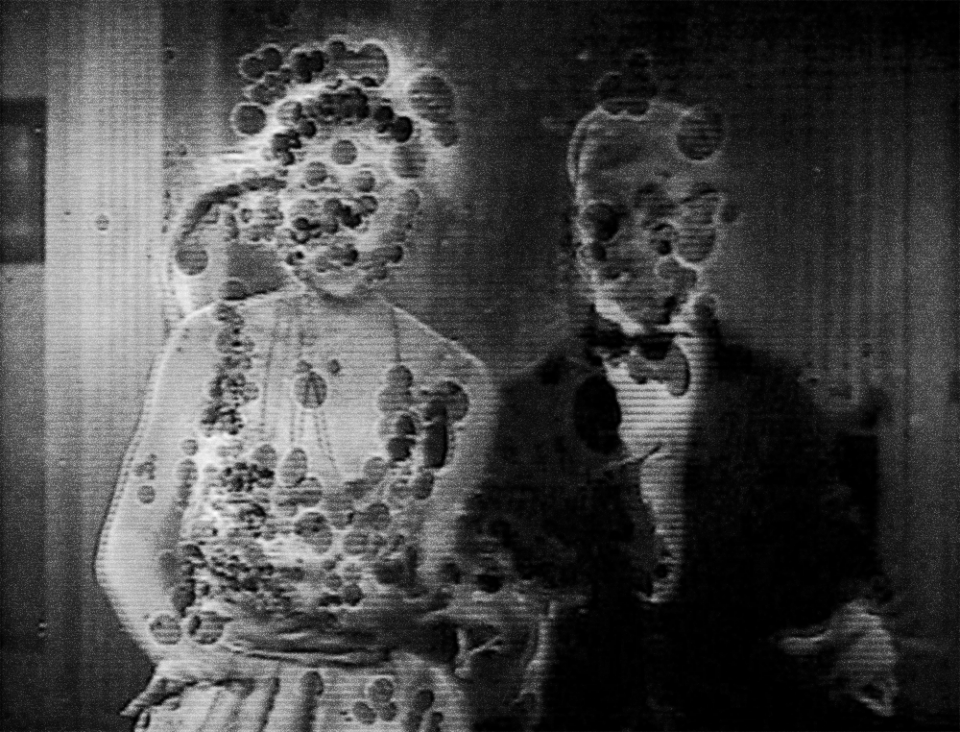
The Plot: Culling from dozens of silent films, with quality varying from deteriorating to unrecognizable, Bill Morrison creates a narrative that showcases these clips in their natural unrestored state, all set to a score by Michael Gordon.

Why It Matters: The NFR write-up is mostly a description of how Bill Morrison put this film together, mixed with critical praise, including from Errol Morris who said “[‘Decasia’] may be the greatest movie ever made.” There’s also an essay by silent film expert Daniel Eagan.

But Does It Really?: Well, it’s that experimental type of film I’m always on the fence about, but I can give this one a pass. Bill Morrison’s contributions to film preservation cannot be ignored, and here he has managed to salvage the unsalvageable and turn it into art. The footage is well-chosen, expertly timed to the music, and masterfully edited to create a unique narrative. This movie works on a lot of levels, with Michael Gordon’s slightly off-balance score keeping things interesting. A must-watch for film lovers, though I hope the Library of Congress realizes that preserving this film doesn’t automatically preserve the footage featured in it.

Everybody Gets One: Bill Morrison is known for utilizing old and decaying film footage in his art pieces. “Decasia” was commissioned to play alongside Michael Gordon’s already completed score of the same name. Morrison scoured multiple film archives to find the footage needed for “Decasia”, including…The Library of Congress! Now I’m getting a clearer idea as to how this film made the NFR cut so quickly.

Wow, That’s Dated: “Soundtrack available on CD”.

Seriously, Oscars?: No Oscar nomination, probably because how do you categorize this movie? Bill Morrison has yet to be nominated for an Oscar in any category, but he is the king of the festival circuit, I’ll tell you what.

Other notes

  • “Decasia” was the first film from the 21st century to be inducted into the NFR. And when you think about it, a movie about preserving film is a natural choice. Suck it, “Lord of the Rings” trilogy!
  • Among those films featured are: “Truthful Tulliver” staring western star William S. Hart, and “The Last Egyptian”, written by, of all people, L. Frank Baum!
  • My first thought while watching this movie was “Shouldn’t this be playing in the background at someone’s art show?” “Decasia” premiered at Sundance, so close enough.
  • The odd blurring between films is interesting to watch, but this may be the Registry title that finally gives me a seizure.
  • Among the lost footage I wish this film had included are the missing reels of “Magnificent Ambersons”, the pie fight ending from “Dr. Strangelove”, the other six hours of “Greed”, and the rest of “The Curse of Quon Gwon”.
  • Of all the movies featured, the one I’d most like to see is the…I’m gonna say horror movie where some guy pulls his buddy out of the water and they scream in terror. It looks promising.
  • Yep, just watched color negative footage of a baby being born, possibly by C-section. I cannot un-see that.
  • Sometimes the scratches on the film make it look like the “Take On Me” music video.
  • While watching “Decasia” you really get a sense of film as a series of images. Each frame has its own set of damages, which break the overall illusion of movement.
  • Then we get to a shot from the 1927 newsreel “Ritchie Trains”. We don’t know who Ritchie is, but thanks to deterioration he appears to be fighting the Tasmanian Devil.
  • This really is a great marriage of film and score. Gordon’s score always keeps you alert, as if something is just about to happen. Not an easy task for a film that is a hodgepodge of random images.
  • I hope those Baptists aren’t using the same body of water from that horror film.
  • In addition to the dervish footage that bookends the movie, we get multiple shots from presumably “The Last Egyptian” of camels traveling across the desert, followed by a sunset. It’s a reverse “Lawrence of Arabia”!
  • This is all well and good, but the greatest found footage will always be the Angela Lansbury workout tape.

In lieu of a “Legacy” section, I’d like to present my own Mini-“Decasia”comprised of Other Notes that were deleted from previous posts. Presented out of context and in no particular order.

  • This movie changes reels like a stick shift.
  • You don’t hear the word “harpy” too often.
  • What is that, a monkey?
  • Jack Valenti: Hollywood’s Rumpelstiltskin
  • For three drunk guys they sure can harmonize.
  • Do you kids know what astro-turf was?
  • One of the dinosaurs just mugged at the camera.
  • Bosco?
  • Back when you could manhandle a rabbit.
  • Man, the bible has a passage for everything. No wonder it’s so popular!
  • Gets married, has a baby, leaves her home, befriends a lamb?
  • Sorry we killed that guy, have some nudity!
  • He’s getting ahead of the tempo! Very “Les Mis”.
  • Not to get all Hitchcock, but is this a metaphor for sex?
  • Eggs! Our one weakness!
  • What the hell is happening?

#251) Sons of the Desert (1933)

Sons-of-the-Desert-Poster

#251) Sons of the Desert (1933)

OR “Comic-Con”

Directed by William A. Seiter

Written by Frank Craven

Class of 2012

No original trailer, but this fan-made one hits the spot.

The Plot: Stan Laurel & Oliver Hardy (Stan Laurel & Oliver Hardy) are members of the Sons of the Desert fraternal lodge who have taken an oath to attend the national convention in Chicago. Knowing their wives (Dorothy Christy & Mae Busch, respectively) won’t approve of them going, Oliver fakes an illness and gets a doctor (Lucien Littlefield) to prescribe a cruise to Hawaii, knowing full well that Mrs. Hardy hates travelling by boat. The ruse works, and the boys have a great time in Chicago. But they come home to discover that the cruise ship they were supposed to be on was hit by a typhoon and sank. With their wives on the verge of figuring out their ploy, the boys get into one fine mess after another.

Why It Matters: The NFR calls it “the duo’s finest feature film” and commend the boys for making the successful transition from shorts to features.

But Does It Really?: One of my notes simply read “Jesus this is funny.” Laurel & Hardy get my vote for filmdom’s best comedy duo, and this film’s reputation as their best is well deserved. “Sons” can feel like several shorts strung together at times, but Laurel & Hardy make it work, and prove they are more than capable of starring in a feature. The laughs come at a pretty strong pace, and the boys’ chemistry only improves with age. “Sons of the Desert” made me laugh out loud more than most modern comedies, and is a welcome (and long-time coming) addition to the Registry.

Everybody Gets One: Director William A. Seiter had been helming films since the silent era when “Sons of the Desert” came along. Although this was his only film with Laurel & Hardy, longtime L&H producer Hal Roach praised Seiter for being one of their best collaborators.

Wow, That’s Dated: This film has such 1933 things as a shoutout to the National Recovery Act, and our appropriation of Hawaiian culture once it became a U.S. territory.

Title Track: This movie makes a good drinking game. The boys’ fraternal order gets mentioned just enough throughout, including towards the end when Mrs. Hardy uses it as an expletive.

Seriously, Oscars?: The Oscars loved L&H when they did shorts, but once the boys jumped to features they stopped getting awards (though “Way Out West” was the exception that proved the rule).

Other notes

  • I love that this movie doesn’t even bother with character names. They are Stan Laurel & Oliver Hardy; it’s just easier on everyone that way.
  • Were Laurel & Hardy the first man-children of cinema?
  • Hardy’s takes to the camera will never not be funny. They kill me every time. It’s like he was physically incapable of not staring at the camera.
  • Laurel’s malapropisms are a fun running gag through all of their films. In this one he mentions the “exhausted ruler” of the lodge, and that their ship “floundered in a typhoid”.
  • A common thread throughout a lot of the comedies on this list is that the execution of a gag outweighs its cleverness. By themselves, each gag in “Sons of the Desert” isn’t particularly funny, but paired with our two well-defined main characters and impeccably delivered one right after the other, they’re a riot.
  • “You wax eater” is my new favorite insult.
  • Yes, both of their wives are particularly shrewish, but part of that is based on the boys’ real-life marital issues. Laurel was in the midst of a divorce during filming, and Hardy was estranged from his wife at the time (Don’t feel too bad for them; they were not lacking in female companionship. Laurel was already seeing his future second wife).
  • Oh right, hazing. That’s why I never joined a frat.
  • Longtime Laurel & Hardy collaborator and fellow film star Charley Chase plays the overly playful lodge brother at the convention. By all accounts, he was quiet and reserved when the cameras were off, but was also an alcoholic known to take sips between takes.
  • The “Honolulu Baby” number has a quick overhead shot of the dancers. Are we sure Busby Berkeley didn’t guest-direct this scene?
  • I suspect the boys would not be able to get away with their scheme if you were remaking this film today, what with cell phones and social media. They would have to be way cleverer about the whole thing.
  • Wow, a shoutout to the prophet Muhammad. Did not see that one coming.
  • If they had been born 20 years later, Laurel & Hardy could have had a sitcom that would have rivaled “Lucy”.
  • I appreciate that neither of the boys’ wives are completely stupid. They definitely hear L&H stumbling around in the attic.
  • Stan’s whimpering is also the best.
  • While not the first of their films to use the phrase, this may be the definitive reading of Hardy’s line “Well, here’s another nice mess you’ve gotten me into.”
  • Wow, this thing is more violent than a Three Stooges short.

Legacy

  • The Sons of the Desert is the name of a fraternal organization comprised entirely of Laurel & Hardy fans. Stan Laurel endorsed the first “tent” shortly before his death in 1965, and they are apparently still going strong.
  • I feel like several “Honeymooners” episodes followed this plot. And, by association, several “Flintstones” episodes as well.
  • Seems like as good a time as any to reference “A Fine Mess”, the Ted Danson/Howie Mandel vehicle so awful director Blake Edwards told people not to go see it.

#250) Faces (1968)

MV5BOTUxZGVhNzctZDZkMS00NjMzLWJkNzgtZDA0OTJiNzA3NjM2XkEyXkFqcGdeQXVyMjI4MjA5MzA@._V1_

#250) Faces (1968)

OR “Mid-Life Crisis: The Motion Picture”

Directed & Written by John Cassavetes

Class of 2011

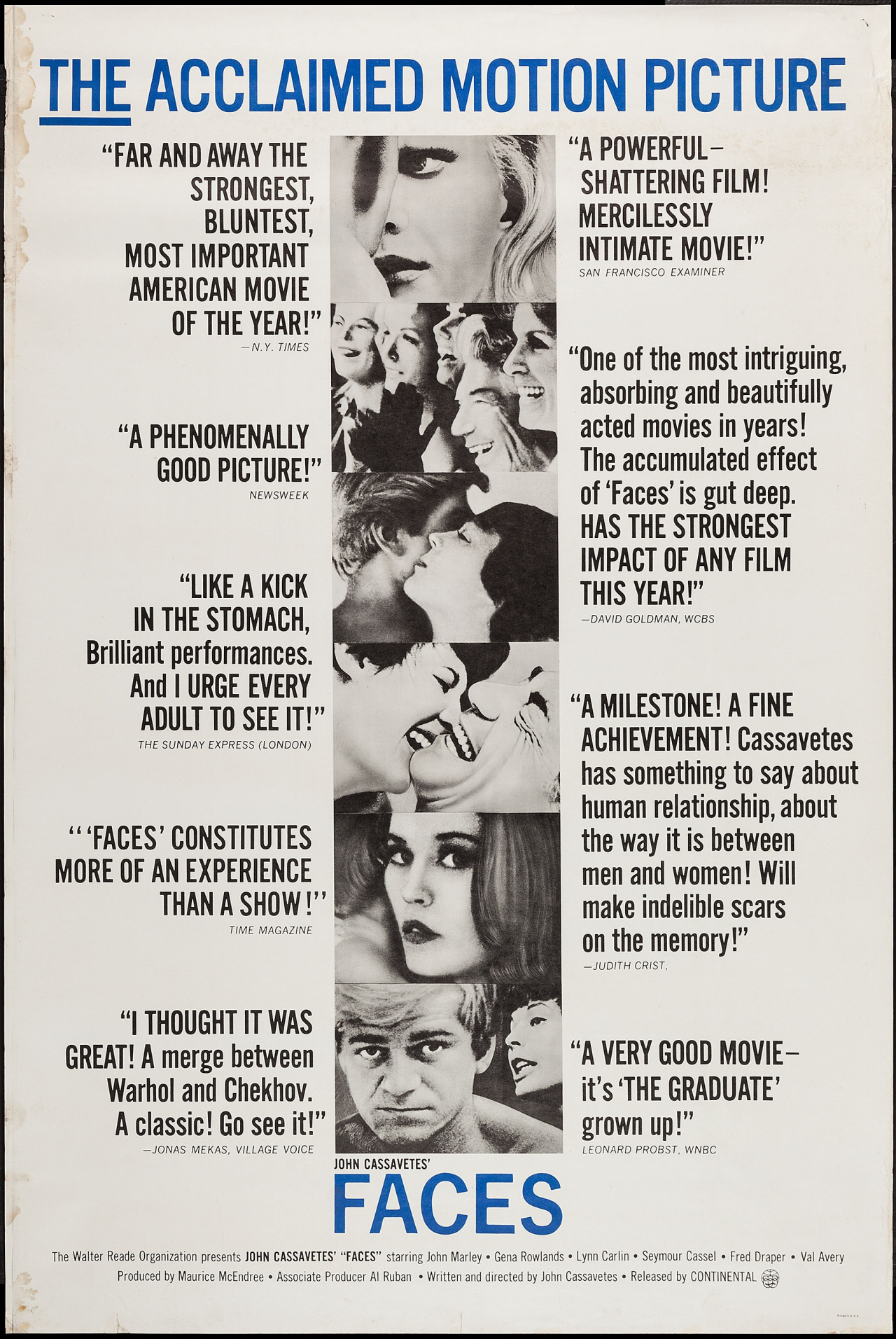
The Plot: Richard (John Marley) is the proverbial “tired businessman” barely maintaining his marriage to housewife Maria (Lynn Carlin). One seemingly uneventful evening suddenly takes an ugly turn, and Richard declares his intention to get a divorce. After a lengthy argument, Richard leaves the house and spends the evening with Jeannie (Gena Rowlands), a prostitute he had a previous encounter/connection with. Meanwhile, Maria and her circle of friends go to the Whiskey a Go Go and pick up young stud Chet (Seymour Cassel). In a documentary-style of filmmaking that was very unconventional for 1968, “Faces” takes the relationships we think we know well and forces us to examine things a little closer, and confront how empty and shallow it may all be.

Why It Matters: Despite calling the film “[a]n example of cinematic excess” (still not quite sure what that means), the NFR write-up praises Cassavetes, Rowlands, Marley, and Carlin.  There’s also an essay by Cassavetes expert Ray Carney, who casually mentions that he was the one who discovered the presumed-lost extended cut of “Faces”. Nice humble brag.

But Does It Really?: I have to confess that this is my first foray into the work of John Cassavetes, and I found “Faces” to be quite engaging. The cinema vérité style takes a minute to get used to, but once I did I found myself unable to turn away from the screen. Everything about this film seemed so natural and unscripted I legitimately did not know where it would go next. “Faces” is way ahead of its time in terms of its frank discussion of married life, gender politics, and even women’s lib. I don’t know where “Faces” stands among Cassavetes’ other films, but its bold storytelling and status as a truly independent film ensures an inevitable place in the NFR. I look forward to watching Cassavetes’ other entries.

Everybody Gets One: Lynn Carlin had a string of episodic TV on her resume, but “Faces” is where she knocks it out of the park, in her film debut no less. She spent the next 20 years playing everyone’s wife or mother before retiring. This is also the only credited NFR appearance for producer/editor/cinematographer Al Ruben (he did some uncredited camera work for “A Woman Under the Influence”).

Wow, That’s Dated: This thing is very 1965, especially once we head out to Whiskey a Go Go. “Faces” is also a pretty thorough examination of the dying breed that was the “tired businessman”.

Seriously, Oscars?: Despite their love for big-budget studio epics, the Academy managed to nominate limited indie release “Faces” in three different categories. Newcomers Seymour Cassel and Lynn Carlin lost the Supporting categories to established veterans Jack Albertson and Ruth Gordon (respectively), while John Cassavetes lost his only screenplay nomination to Mel Brooks for “The Producers”. If only the Independent Spirit Awards had existed back in 1969; this film would have cleaned up.

Other notes

  • First off, I would be remiss if I didn’t mention that this film’s lead actor is John Marley, whose most iconic role is as movie producer Jack Woltz in “The Godfather”. He’s the one who wakes up to find the horse’s head in his bed.
  • I was trying to figure out if Cassavetes made this film with “Dirty Dozen” money or “Rosemary’s Baby” money. It turns out the answer is neither. Production of “Faces” took place in 1965, before he was cast in either movie. Cassavetes and Gena Rowlands financed this film themselves, along with a loan from Bank of America. I presume Cassavetes’ pact with the devil in “Rosemary’s Baby” was to get this film’s distribution deal.
  • We have a major readout on the Michael Douglas Scale. During production in 1965, John Marley was 58, Lynn Carlin was 27. Gross gross gross. Gena Rowlands was 35, meaning this may be the only movie where the husband leaves his wife for an older woman.
  • To save money, most of the film was shot at the home of John Cassavetes and Gena Rowlands, as well as the home of Gena’s mother, Mary “Lady” Rowlands. Lady is credited as the film’s set decorator.
  • As is the case with any movie relying on natural on-set sound for the dialogue, Gena Rowlands’ handful of dubbed dialogue really sticks out.
  • The main difference between John Cassavetes and Ingmar Bergman is that Cassavetes’ characters know how to laugh. Almost everyone in this movie cracks a joke at some point, either to lighten the mood or to be ironic counterpoint.
  • I’m not an expert on Cassavetes, but shouldn’t Peter Falk and Ben Gazzara be in this at some point?
  • See the young blonde woman playing with coins at the bar? That’s Christina Crawford. Yeah, “Mommie Dearest”. That Christina Crawford.
  • As any Cassavetes expert will tell you, this film was not improvised. Cassavetes wrote every word of the dialogue, but the interaction among the characters solely belongs to the actors.
  • Gena Rowlands can say so much with just a look in her eyes. There are several scenes where she doesn’t have a lot of dialogue, but you are always aware of her presence in a way that enhances the scene rather than detracts.
  • And then we get to Seymour Cassel’s part of the movie. For those of you used to his more recent appearances in Wes Anderson movies, Cassel is young and vibrant and a little crazy in this film. I get the feeling he lost a lot of roles to Rod Taylor in his youth.
  • This movie lives up to its title; there are so many close-ups in this film. The screen is filled with faces.
  • With as few spoilers as possible, in the scene where one character revives another character after an overdose, the moment of the revived character being offered a cigarette is now unintentionally funny.

Legacy

  • Cassavetes was able to use the money from “Faces” to form his own distribution company: Faces International.
  • Many directors have cited “Faces” as an influence, from Woody Allen to Martin Scorsese to Robert Altman. Allen has the most transparent disciple of “Faces”: 1992’s “Husbands and Wives”.

#249) Study of a River (1997)

image-w1280

#249) Study of a River (1997)

OR “Hutton on the Hudson”

Directed by Peter Hutton

Class of 2010

The Plot: Independent filmmaker Peter Hutton takes a look at the famous Hudson River in this silent short. Filmed over the course of two years, Hutton observes all 315 miles of this landmark during and immediately after winter has placed ice all over the river.

Why It Matters: The NFR praises the work of Peter Hutton as “thoughtful and beautifully photographed” while also comparing his work to those of painter Thomas Cole. There’s also a very academic essay by the very academic Claudia Costa Pederson.

But Does It Really?: As representation of Peter Hutton’s filmography, this gets a pass. But how many more of these “staring at water” shorts are there on the list? Between this, “13 Lakes” and “H2O”, the NFR really likes their long, artistic shots of water. I’m beginning to think that this three-hour loop of a beach will make the cut eventually.

Everybody Gets One: Not a lot of info on Peter Hutton, other than he was also a painter, a sculptor, and at one time a seaman (possibly in the Marines). His other short films include such titles as “Time and Tide”, “Looking at the Sea”, and “Two Rivers”. I guess you could say all his movies tread the same water. Thank you!

Seriously, Oscars?: No nomination for “Study of a River” or any of Peter Hutton’s work. The film did, however, win the “Most Overlooked Short Film Award” at the 1997 Oberhausen International Short Film Festival, though I feel that winning that award automatically disqualifies you from being “overlooked”. For the curious, the 1997 winner of Best Documentary Short was “A Story of Healing”, a film about volunteer nurses at the Mekong delta in Vietnam. At least the Academy was interested in a body of water that year.

Other notes

  • The Hudson has gone by many names over time. The Iroquois called it Cahohatatea (“the river”), the Mohicans Muhhekunnetuk (“river that flows two ways”), but of course, we named it after the English guy who got lost while trying to find the Northwest Passage.
  • What music should go over silent footage of an ice flow? I don’t know why, but Oasis seems like a good fit.
  • 1997 was a good year for movies about big ships navigating ice-covered water. That’s a fun Netflix subgenre.

Legacy

  • Peter Hutton passed away in 2016, but his film legacy is being preserved not only at the Library of Congress, but also at his home base of Canyon Cinema.
  • I’ll just assume Hutton’s “Two Rivers” was meant to be a sequel to “Study of a River”.
  • As for the Hudson River, the most exciting thing to happen to it in recent years was when that 747 made an emergency landing. They even made a movie about it!

#248) Jezebel (1938)

jezebel-us-one-sheet-movie-poster

#248) Jezebel (1938)

OR “Belles Are Ringing”

Directed by William Wyler

Written by Clements Ripley & Abem Finkel and John Huston. Based on the play by Owen Davis Sr.

Class of 2009

The Plot: It’s New Orleans during the antebellum period and Julie Marsden (Bette Davis) is an independent but selfish southern belle. Julie’s engagement to mild-mannered banker Pres Dillard (Henry Fonda) is jeopardized when she insists on wearing a red dress to the highly important Olympus Ball, where unmarried women are expected to wear white. Embarrassed in front of high society by Julie’s actions, Pres calls off the engagement and heads north for work. When yellow fever breaks out near New Orleans, Pres returns to help, and spends the weekend at the country plantation of Julie’s Aunt Belle (Fay Bainter). Julie uses this time as a chance to win Pres back, but is it too late for Julie to change her spoiled ways?

Why It Matters: The NFR admits the film has “its melodramatic underpinnings” but praises Davis to the hilt, calling her performance “flawless” and “[c]ast to perfection”. There’s also an essay by William Wyler expert Gabriel Miller.

But Does It Really?: I’m all for more Bette Davis on this list (she’s only got three entries), and “Jezebel”, while not her breakthrough role, is certainly the first to solidify her standing as a major Hollywood player. On the whole, the film is fine. Davis is great of course, but “Jezebel” doesn’t quite gel the way it should. Julie’s character arc doesn’t hit the marks it needs to (especially towards the end), and to make matters worse, the film is swarming with “happy slaves” that tarnish any modern viewing. It’s also one of those pre-feminism films where the leading lady is strong and independent, but still defined by her man. “Jezebel” is iconic enough to warrant NFR inclusion, but it’s definitely on the list for what it represents rather than what it actually is.

Shout Outs: Not a direct shout out per se, but this film exists partially to cash in on the anticipation leading up to the film version of “Gone With the Wind”. GWTW producer David Selznick angrily wrote Jack Warner about the similarities between the two projects, and Warner was quick to point out that the stage version of  “Jezebel” preceded the original novel of “Gone With the Wind” by two years. Side note: Either Warner Bros. wouldn’t let Bette Davis be considered for Scarlett O’Hara or she was considered, only to be rejected by Selznick. Accounts vary.

Wow, That’s Dated: It’s the antebellum period and the film is a precursor to “Gone with the Wind”. As you can imagine, we’re in trouble right from the start.

Title Track: Aunt Belle references the famous biblical figure just once to prove a point to Julie.

Seriously, Oscars?: “Jezebel” was nominated for five Oscars, including Best Picture. The big winner that year was another film based on a play; “You Can’t Take It With You”, but Bette Davis managed to take home her second Best Actress Oscar for “Jezebel”. Fay Bainter won Best Supporting Actress for this film, no doubt aided by her Oscar-nominated lead work in that year’s “White Banners”. Bainter was the first performer in Oscar history to be nominated for both lead and supporting in the same year. Despite much of the “Jezebel” team (including Davis) singling out William Wyler for its success, Wyler missed out on a Best Director nod.

Other notes

  • The main story with this movie is its somewhat difficult production. Wyler demanded countless retakes, which both Davis and Fonda initially took issue with until they started seeing the dailies. Filming went anywhere from 25 to 30 days behind schedule.
  • For those curious about John Huston’s involvement on the screenplay, it was just another project when he worked at the Warner Bros. script department, all with the goal of ultimately writing and directing his own movies. Another one of Huston’s early projects was the screenplay for “Sergeant York”.
  • Why is everyone in New Orleans from Kentucky?
  • Bette Davis makes a hell of an entrance in this film: riding a horse side-saddle and using her riding crop to lift up her skirt. You flout those conventions!
  • Uh-oh, Fonda’s trying an accent. He’s okay, but it definitely wavers.
  • Speaking of Fonda, it was during production of “Jezebel” that Henry’s daughter Jane was born. And when is she gonna make this list?
  • Fay Bainter strikes me as a proto-Maureen Stapleton. She also seems to be stuck with Laurie Metcalf’s Resting Concerned Face.
  • All this talk about a red dress in a black & white movie. Seems a little weird, don’t you think?
  • Someone invent the phonograph so Julie’s entrance to the ball can have a record scratch.
  • One of the servants is named Uncle Cato? Does he attack the family without warning to keep their senses sharp?
  • Uggggggh, anti-abolition talk. This is why you never discuss politics at the table.
  • Contrary to what Preston says, “I disapprove of what you say, but I will defend to the death your right to say it” is not a Voltaire quote. It’s actually from Evelyn Beatrice Hall in her biography “The Life of Voltaire”.
  • Man, Davis and Fonda are just so…young in this film. I can’t get over it. I guess I’m used to their later work.
  • The duels in this film are not as exciting as “Hamilton” has led me to believe.
  • Amy’s going for the Elliot Page Record for Most Expository Questions per Minute.
  • Running down a spiral staircase in a hoop skirt must be difficult.
  • That ending goes where it needs to go, but as previously stated, it’s just not the bulls-eye it needs to be. Even the great Bette Davis can only do so much.

Legacy

  • “Jezebel” solidified Bette Davis as a leading lady to be reckoned with, and not just a flash-in-the-pan Hollywood starlet.
  • Bette Davis would collaborate with William Wyler on two more films based on plays, each leading to more Oscar nods for both of them: 1940’s “The Letter” and 1941’s “The Little Foxes”.
  • Some good came from the “Jezebel” vs. “Gone With the Wind” debate: Selznick liked Max Steiner’s score for “Jezebel” so much he hired Steiner to compose GWTW’s now iconic music.