#242) Show People (1928)

show-people-movie-poster-1928-1020435011

#242) Show People (1928)

OR “A Star is Torn”

Directed by King Vidor

Written by Agnes Christine Johnston and Laurence Stallings

Class of 2003

The Plot: Peggy Pepper (Marion Davies) travels from Georgia to Hollywood with one goal: to become a star. Aided by her father General Marmaduke Pepper (Dell Henderson), Peggy gets her start in a frivolous Mack Sennett-esque comedy. Peggy is hesitant to do the film, preferring to be a dramatic actress, but co-star Billy Boone (William Haines) advises her to “take it on the chin” and guides her through the production. The film is a hit, but Peggy immediately abandons Billy for another, more prestigious studio, rebrands herself as “Patricia Pepoire”, and starts dating suave leading man Andre Telfair (Paul Ralli). Peggy must choose between her glamorous but empty Hollywood dream, or a less exciting but more fulfilling life with Billy. Added Bonus: This movie has more Hollywood cameos than “The Player”.

Why It Matters: Deemed a “silent gem”, the NFR praises the film for “[g]ently skewering the industry that created it”, and gives shoutouts to Davies and Vidor.

But Does It Really?: “Show People” is a perfect representation of the silent era’s last hurrah. Released one year after “The Jazz Singer”, “Show People” is one of the last silent films to succeed during the sound craze. Also on display are the fine comic chops of Marion Davies, whose personal life has overshadowed the work of a promising comedy star. “Show People” never overstays its welcome, ages far better than many of its contemporaries, and still manages to be a funny love letter to early Hollywood. Worthy of preservation, and definitely worth a watch.

Everybody Gets One: This film’s two leads are probably better known for their off-screen lives rather than their on-screen work. Forever identified as William Randolph Hearst’s mistress, Marion Davies was a popular silent film star who specialized in light comedy. Hearst’s possessiveness over Davies’ career and his push for her to be in more dramatic work did more harm than help. Co-star William Haines spent years as a bit player before finally breaking through as a leading man and box-office draw. He was fired from MGM in the mid ‘30s when Louis B. Mayer forced him to choose between his career and his homosexuality. Haines chose the latter and retired from acting soon after.

Wow, That’s Dated: This movie is the giant megaphone wielding, mood music playing world of the 1920s Hollywood Studio System.

Seriously, Oscars?: “Show People” would have been eligible for the 2nd Oscars in 1930, the only year no official nominees were announced. Was “Show People” snubbed in favor of “talkies”? Was it even on the Academy’s radar? Or did the Oscar’s dismissal of comedies start early?

Other notes

  • While released through MGM, “Show People” was produced by Cosmopolitan Productions, the film company created by William Randolph Hearst specifically for Marion Davies. She’s even credited as a producer.
  • We open with a lot of shots of 1928 Hollywood, including the studio entrances of Paramount, MGM, and the long gone First National. Also, I suspect that phonograph shop isn’t there anymore either.
  • “Beezark”? I guess it means a lunatic or crazy person. Intertitles are a gold mine for ‘20s phraseology.
  • You know what I miss? The name Marmaduke. It roughly translates from Gaelic to “leader of the seas”, I don’t see why it can’t still be a name. And if you ask me, does anyone really remember that dog? So much for being a “great” dane.
  • This is John Gilbert’s easiest paycheck; just step out of your car and say hi. I wonder if this was a “Bowfinger” situation and he didn’t even realize he was in a movie.
  • It took me almost 250 movies, but at long last we have a “pie-in-the-face” gag. Hearst objected to Davies being the recipient of said pie, so a compromise was reached: someone else would get the pie, while Davies would get spritzed with a bottle of seltzer water, which she takes like a pro.
  • Harry Gribbon is giving me everything as the comedy director. His physicality is perfection. It’s a shame most of his movies are lost.
  • Gloria Swanson gets name-dropped twice as a comparison to Peggy’s success. I guess it really was the pictures that got small.
  • And then the cameos start pouring in. Charlie Chaplin is very game as the celebrity fan that Peggy doesn’t recognize. Matinee idol Lew Cody is chatting up “It” author Elynor Glyn. There’s even an appearance by that young starlet Marion Davies, whom Peggy takes an instant dislike to.
  • Davies’ physical timing is exceptional; she is giving a solid performance through-and-through. What could have been if only Hearst hadn’t gotten in the way?
  • Why is Billy dressed like one of the SNL Bees?
  • The banquet scene is a who’s-who of silent film stars. Most of them are unrecognizable today, but among the diners are Louella Parsons, John Gilbert (again!), Norma Talmadge, William S. Hart (in his final film appearance), and Douglas Fairbanks.
  • Shoutout to Sarah Bernhardt, only recently departed at the time of filming.
  • The final cameo is reserved for the director himself. King Vidor pops up in the last scene as, what else, a film director.

Legacy

  • Both Marion Davies and William Haines made the transition to talkies, but Hearst’s excessive lobbying severely limited Davies’ film options, until she finally acquiesced and went into early retirement. She stayed by Hearst’s side up to his death in 1961.
  • After being fired from MGM, William Haines and partner Jimmie Shields lived together and operated an interior design dealership until Haines’ death in 1973. William Haines Design is still in operation and very successful (though their website still lists Nancy Reagan as a client).
  • Lucille Ball cited Marion Davies as an influence on her own comic persona. If only Marion had gotten involved with a Cuban bandleader instead…
  • For the record, the character of Susan Alexander Kane, untalented opera singer and mistress/second wife of “Citizen Kane”, is not based on Davies. Hearst and Davies still took the film as a personal attack, but Welles would state in later years that he admired Davies both as a person and as a performer, calling her “an extraordinary woman”.
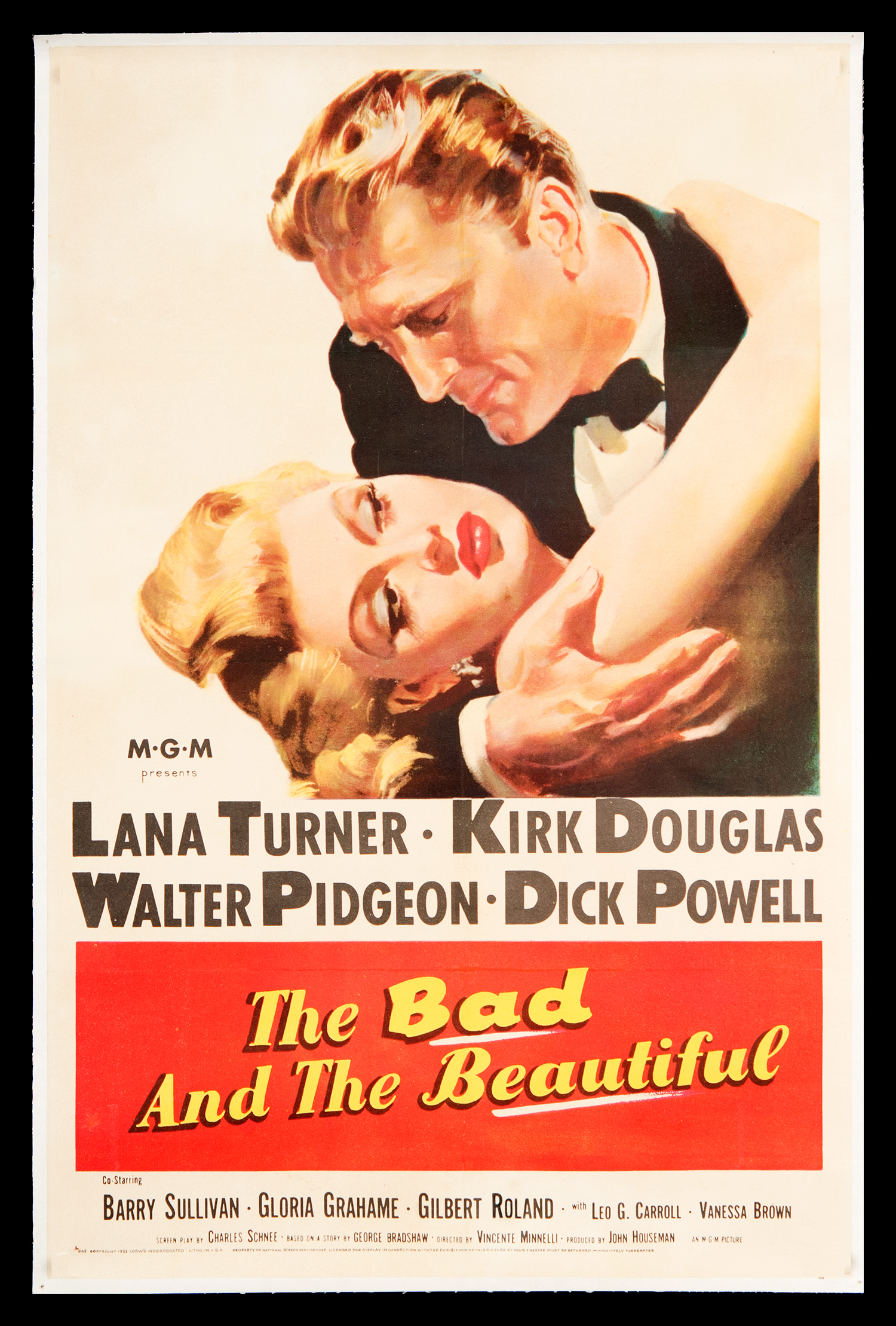
#241) The Bad and the Beautiful (1952)

the-bad-and-the-beautiful-us-movie-poster

#241) The Bad and the Beautiful (1952)

OR “Captain Kirk”

Directed by Vincente Minnelli

Written by Charles Schnee. Based on the short story “Tribute to a Badman” by George Bradshaw

Class of 2002

The Plot: Hollywood producer Jonathan Shields (Kirk Douglas) has made some great movies, but always at the cost of alienating those closest to him. Down on his luck, Jonathan tries to recruit three former colleagues for one last picture. Each of them is extremely hesitant, despising Jonathan but also aware that they owe their success to him. Director Fred Amiel (Barry Sullivan) helped Jonathan produce his early pictures for Harry Pebbel (Walter Pidgeon), but had a falling out when Jonathan wouldn’t let him direct his dream project. Actress Georgia Lorrison (Lana Turner) was a bit player when Jonathan cast her as his leading lady (on and off-screen). Novelist James Lee Bartlow (Dick Powell) didn’t want to come to Hollywood to pen a screenplay, but Jonathan talked him into it, a decision with major consequences for Bartlow and his wife Rosemary (Gloria Grahame). Told through three separate flashbacks, we get a sense of the lengths Jonathan would go to make his movie his way.

Why It Matters: The NFR calls it a “captivating Hollywood story” and praises Lana Turner’s performance and David Raksin’s score.

But Does It Really?: I…don’t know. “The Bad and the Beautiful” is a well-made tale of corrupt Old Hollywood, and it says what it wants to say without being mean-spirited, but it doesn’t have the cultural or historical qualities I’m looking for with an NFR inductee.  I’ll label this movie a “minor classic” and recommend it to any classic film lover without hesitation, but that may be it.

Shout Outs: “Doom of the Cat Men” is an obvious stand-in for “Cat People”.

Everybody Gets One: As with most studio films, all the major players show up in at least one other NFR title. The notable exceptions are character actor Barry Sullivan and actress/model Elaine Stewart.

Wow, That’s Anachronistic: For a movie set in the ‘30s and ‘40s, they make very little effort to make this a period piece. A car here, a camera there, but everyone seems to be in a ‘50s aesthetic.

Title Track: The film was shot under the name “Tribute to a Bad Man”, but no one liked that title, so MGM publicity head Howard Dietz pitched “The Bad and the Beautiful”, a nod to the F. Scott Fitzgerald story “The Beautiful and the Damned”. Producer John Houseman hated that title too, but it stuck.

Seriously, Oscars?: “The Bad and the Beautiful” received six nominations and won five, one of the rare times the biggest winner of the night wasn’t a Best Picture nominee. The film took home Best Story and Screenplay, Art Direction, Cinematography, Costume Design, and Supporting Actress for Gloria Grahame (more on that win later). The only nominee to go home empty-handed was Kirk Douglas, but how do you compete against Gary Cooper in “High Noon”?

Other notes

  • “Bad” was produced by John Houseman, who you know either as the “Paper Chase” guy or the old man in “Naked Gun” and “Scrooged”.
  • Pretty impressive that Lana Turner gets top billing over obvious lead (and by then equally famous) Kirk Douglas. Kudos to her agent.
  • Who is the inspiration for Jonathan Shields? Some say David Selznick, others Orson Welles. I suspect that all of the characters in this film are amalgamations of many of Hollywood’s worst qualities, and don’t represent any one person.
  • I could listen to Walter Pidgeon read the Canadian phone book; that is a rich voice.
  • Silent film star Francis X. Bushman plays the eulogizer at the beginning. It’s nice to hear him saying something other than sci-fi babble.
  • Shoutout to Poverty Row, the nickname for the B-picture studios of the ‘30s and ‘40s.
  • The look of complete disdain on the actors playing the Cat Men is hilarious. Speaking of, a horror movie where you never see the monster? You taking notes, Spielberg?
  • Sure, Gaucho is your stereotypical “Latin lover” character, but at least he’s played by native Mexican Gilbert Roland (birth name Luis de Alonso). This could have been a lot worse.
  • A producer lets himself into your apartment and waits for you to come home at 4am? Run, Georgia, run!
  • The character of temperamental director Henry Whitfield is allegedly based on Alfred Hitchcock. Like the Shields debate, I’m skeptical about this one. Sure he’s British, but I’d be more inclined to accept this if he was portly and/or psychologically manipulative to his leading lady. Coincidentally, Whitfield is played by Leo G. Carroll, who would work with Hitch in “North by Northwest”.
  • Speaking of allusions, the other temperamental director is Von Ellstein, definitely not von Sternberg or von Stroheim. This may be the only direct parallel in the entire film.
  • That’s a young uncredited Barbara Billingsley as the costume designer on Georgia’s film. And that is no jive.
  • Either it started raining as soon as Georgia started driving, or she’s speeding through a car wash.
  • I did not realize Dick Powell made movies where he isn’t singing at Ruby Keeler. His performance was a pleasant surprise to me.
  • At long last we arrive at Gloria Grahame. At face value Rosemary is shallow and one-note with limited screentime, so how did Grahame spin that into Oscar gold? It turns out “Bad” was just one of four movies Grahame appeared in in 1952. Among the others were fellow Oscar nominee “Sudden Fear” and Best Picture winner “The Greatest Show on Earth”. Grahame’s Oscar was a versatility win for all four performances, “Bad” just happened to be the chosen one. That being said, I still can’t forgive the Academy for giving this award to anyone other than Lina Lamont.
  • The final credit is a thank you to the Motion Picture Academy for letting them use the Oscar statuettes in the film. So that’s how they won!

Legacy

  • Most of the film’s major players reunited a decade later for another takedown of moviemaking: “Two Weeks in Another Town”.
  • This is the movie that gave us the trend of “The Adjective and the Adjective” movie titles throughout the ‘50s. “The High and the Mighty”, “The Bold and the Brave”, “The Wild and the Innocent”, “The Fast and the Furious” (No kidding, there’s an actual Roger Corman movie from the ‘50s that also has that title).

#240) The Thin Blue Line (1988)

Thin_Blue_Line_1988_original_film_art_2000x

#240) The Thin Blue Line (1988)

Directed & Written by Errol Morris

Class of 2001

The Plot: In November 1976, Dallas police officer Robert Wood was shot and killed while pulling over a car for having its headlights off. Officer Teresa Turko did not see the assailant before they drove off, but an investigation led to 16-year-old David Ray Harris, who said he was a passenger in the car when the driver, 28-year-old Randall Adams, committed the crime. Adams was arrested and the trial produced several surprise eyewitnesses who testified that they saw Adams shoot the officer. Adams was given the death sentence, eventually commuted to a life sentence in 1980. Case closed, right? Errol Morris disagrees, and interviews many of the key players years later to see if their stories hold up. Through innovative reenactments and a great Philip Glass score, Morris shows the crime from several points of view, but definitely tips the scales of justice in favor of Adams’ innocence and Harris as the culprit.

Why It Matters: The NFR gives an overview, highlights the film’s effect on the actual case, and praises Philip Glass’ score.

But Does It Really?: “The Thin Blue Line” is a game changer in the world of documentaries. Before this, documentaries were either talking heads or cinema vérité, but Morris broke the mold with a movie that pushes what non-fiction on film can be. It helps that the real case is endlessly fascinating (and you should definitely read into it), and Morris showcases all perspectives in a gripping, fascinating experience. The film’s true legacy is its definitive proof that movies can change the world. (See “Legacy” for the film’s main impact).

Everybody Gets One: This is Errol Morris’ only film on the NFR, though I suspect “The Fog of War” will make it eventually. Morris’ career as a filmmaker started on a bet with Werner Herzog, who said he would eat his shoe if Morris ever made his proposed film about a pet cemetery. The movie was “Gates of Heaven” and Herzog held up his end of the deal.

Wow, That’s Dated: The final scene hinges on footage of a tape recorder.

Title Track: Prosecutor Doug Mulder used the phrase in his closing argument to remind the jurors that the police are “the thin blue line” between order and anarchy.

Seriously, Oscars?: “The Thin Blue Line” was famously not nominated for Best Documentary, leading to public outcry from the likes of Michael Apted and Roger Ebert. The exclusion is partially Morris’ fault: he didn’t want the film labeled a documentary, opting for the “nonfiction” moniker instead, a term the Academy used in their decision to consider “Thin Blue Line” ineligible for Best Documentary. There were also reports of Academy members turning the film off midway through screenings, suggesting a strong dislike of the film within the Documentary branch. If only screeners had existed back then.

Other notes

  • “The Thin Blue Line” was distributed by Miramax, then co-owned by Harvey Weinstein. That’s right, Harvey Weinstein helped distribute a movie about a man who gets away with a crime and is then charged for a similar crime years later. Payback’s a bitch.
  • Side Note: I had a film professor who went to the University of Wisconsin, Madison at the same time as Errol Morris. Lots of namedropping. Lots of namedropping.
  • “The Thin Blue Line” started off as a completely different film about Dr. James Grigson. Nicknamed “Doctor Death”, Grigson’s diagnosis of Texas criminals led to over 100 death sentences (Texas will only approve the death sentence if a doctor can convince the jury the defendant would cause more harm if acquitted). While interviewing Randall Adams, Morris wasn’t convinced that Adams was the sociopath Grigson made him out to be, and investigated his case further. Grigson gets a brief mention in the final film.
  • This dramatic reenactment sponsored by Burger King! Have It Your Way!
  • They can get the footage from “The Student Body” and “The Swinging Cheerleaders” with no problem, but the pivotal “Carol Burnett Show” footage is nowhere to be seen. I can’t even find a clip on YouTube. Burnett will not let you watch her tribute to Ray Charles without ponying up.
  • Edith James is my favorite person in this whole thing. It helps that she’s the most human of the bunch, and that she is only tangentially connected to all of this.
  • There are a lot of times where different interviewees try to discredit Officer Teresa Turko, suggesting she didn’t follow protocol at the scene of the crime. I hesitate to ask this, but would they be this harsh if she was a man?
  • I’ll be honest: I didn’t take a lot of notes for this one. I found myself caught up in the crime as well as the film (which is impressive considering I’ve seen this film before). There’s so much to keep track of I couldn’t risk writing a lot down for fear of missing something (which, again, is a high compliment for a movie I’ve already seen).

Legacy

  • Some films influence pop culture, some films are technological breakthroughs, but some films change lives. Due to the evidence that appears in the film, the Texas Court of Criminal Appeals overturned Adams’ prison sentence. Adams received a retrial, and was released from prison in 1989. Because it was a dismissal and not a pardon, Adams did not receive any restitution for his false imprisonment. Following a suit against Morris to reclaim the rights to his life story, Adams returned to obscurity, to the point where his death wasn’t reported by the press until eight months after the fact.
  • David Ray Harris was eventually tried and executed for the 1985 murder that gets mentioned near the end of the film. He was never tried for the murder of Officer Wood.
  • Errol Morris continues cranking out documentaries (and the occasional book) every few years. He did eventually make a movie called “Mr. Death”, but the subject was electrocution technician Fred A. Leuchter, rather than Dr. James Grigson.
  • Dramatic reenactments started popping up in documentaries following this film. The trope was beaten to death by a little show called “Scandalmakers”. “Perhaps an attic shall I seek.”
  • Once again, “Documentary Now!” absolutely nails the film they’re lampooning with “The Eye Doesn’t Lie”.

#239) Regeneration (1915)

053925-000-A_regeneration_02-1446425303366

#239) Regeneration (1915)

OR “Content Dictates Reform”

Directed by Raoul Walsh

Written by Walsh and Carl Harbaugh. Adapted from the book “My Mamie Rose” by Owen Kildare.

Class of 2000

The Plot: Owen Conway (Rockliffe Fellowes) has lived a tough life. His mother died when he was very young, his foster parents were abusive alcoholics, and he eventually ends up on the street and joining a gang (and this is all in the first 10 minutes!). One day he meets upper-class socialite Marie Deering (Anna Q. Nilsson). They are attracted to each other and Owen is compelled to change his ways. Owen wants to escape his life of crime, but is it too late?

Why It Matters: The NFR praises director Walsh, specifically his “naturalistic edginess” and “masterful use of close ups”. There’s also a very detailed essay by Raoul Walsh expert Marilyn Ann Moss.

But Does It Really?: This one is “historical significance” at best. “Regeneration” was the beginning of Raoul Walsh’s 50-year career as a director, and one of the first movies produced by Fox Films (now 20th Century Fox). As a viewing experience over 100 years later, it’s a bit on the slow side, but there are some interesting bits of film technique throughout (you can see the Griffith influence with Walsh’s use of intercutting). “Regeneration” is a noteworthy, if not pivotal, moment in American film history. In terms of its place among classic silent films, it falls somewhere down the middle: not on the same level as Chaplin or Griffith, but not an excruciating viewing experience either. “Regeneration” may only work as an academic viewing for the serious film buff, but it won’t be on the final.

Everybody Gets One: Almost everyone in this film, with the exception of Walsh and Nilsson. Leading actor Rockliffe Fellowes was one of many silent film stars who didn’t quite make the transition to talkies. Cinematographer Georges Benoit had just arrived from France and would collaborate with Raoul Walsh over the next few years.

Wow, That’s Dated: Aside from the slum life of the early 1910s, this film depicts a time when police officers would all pile into one car like the Keystone Kops.

Other notes

  • It’s been a while since I’ve had a “Belloq Film” on the list. “Regeneration” was presumed lost until a print was found in the ‘70s.
  • Owen’s mother is “passing gratefully”? Shouldn’t that be “gracefully”? I don’t think she appreciates dying.
  • Yikes, Oliver Twist had a better upbringing.
  • Owen could really benefit from the Fresh Air Fund. While you’re there can you figure out what happened to that kid on the boat?
  • Whoa, lots of glue marks on this print. The Library of Congress can only do so much.
  • If the name Anna Q. Nilsson sounds familiar, you’re remembering her from her brief appearance in “Sunset Boulevard”. She plays herself as one of Norma Desmond’s “waxworks” at the bridge game. “Regeneration” showcases Nilsson in her prime as an actress.
  • Co-writer Carl Harbaugh shows up in this film as D.A. Ames.
  • In his quest for realism, Raoul Walsh filmed on location and populated his scenes with real life residents of the Lower East Side (including prostitutes and gangsters). We know this to be true because let’s just say some of these extras have faces for radio.
  • The highlight of the film may be the fire onboard the ferry. Boy, that escalated quickly. I do enjoy the intertitle assuring us that “[a]ll the kiddies were saved.”
  • Skinny has excellent depth perception for someone with an eye patch.
  • And then Walsh gets arty with some optical effects. Though the bible quote “Vengeance is Mind, Saith the Lord” seems a bit harsh. Surely there’s another way to phrase that.
  • So the moral of this film is don’t trust anyone?

Legacy

Further Viewing: And now, because you’ve been so patient, here’s the obvious “Doctor Who” reference I’ve refrained from making until this moment.

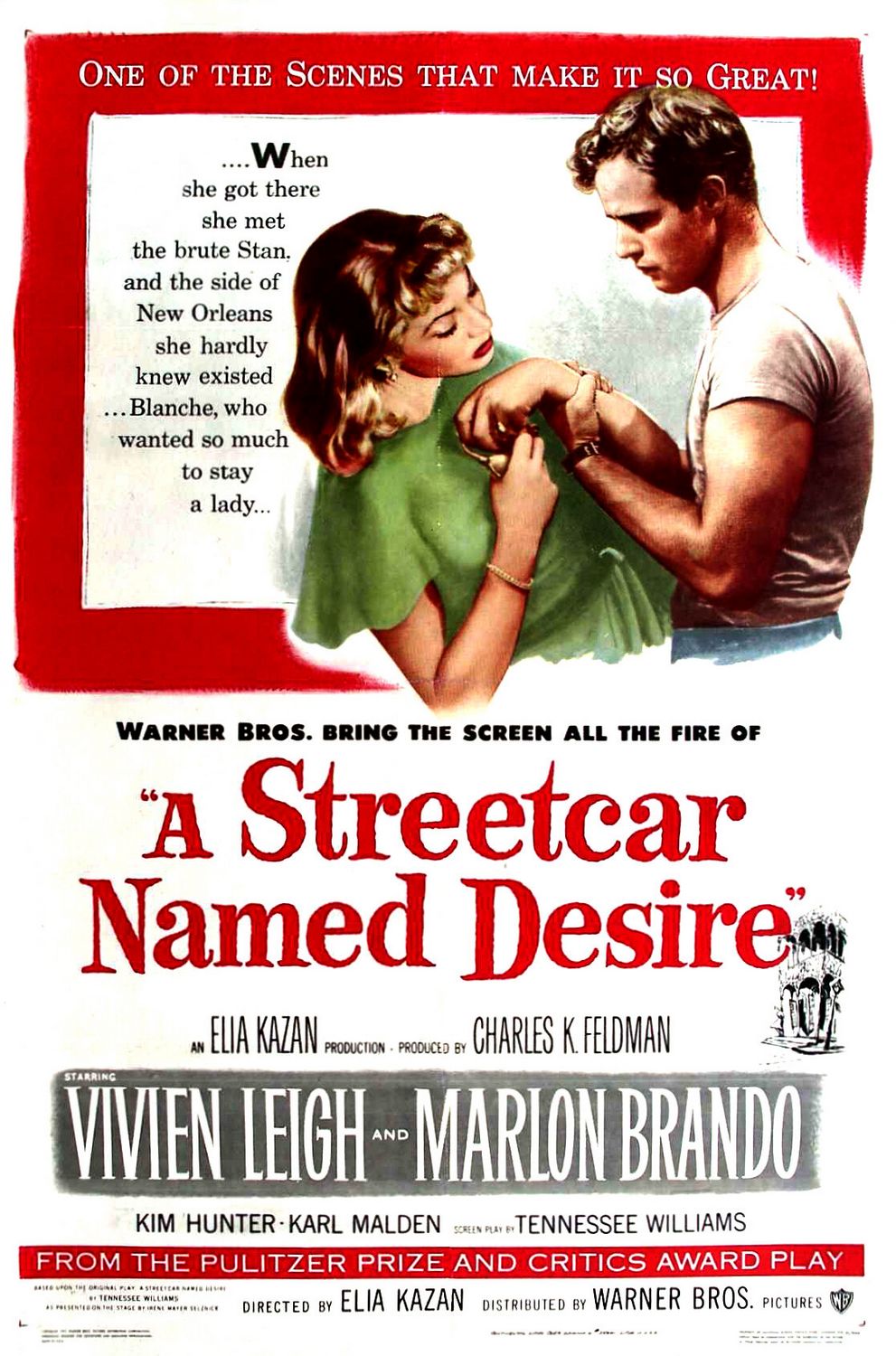
#238) A Streetcar Named Desire (1951)

streetcar_named_desire_xlg

#238) A Streetcar Named Desire (1951)

OR “A Method to Her Madness”

Directed by Elia Kazan

Written by Tennessee Williams, based on his play. Adaptation by Oscar Saul.

Class of 1999

The Plot: The French Quarter of New Orleans gets an unexpected visitor when southern belle Blanche DuBois (Vivien Leigh) arrives from Mississippi to stay with her younger sister Stella (Kim Hunter). Blanche has a hard time adjusting to Stella’s cheap apartment, and an even harder time coexisting with Stella’s barbaric husband Stanley (Marlon Brando), who immediately questions Blanche’s stories. During the course of Blanche’s stay her mental health starts deteriorating, putting her relationship with Stanley’s poker buddy Mitch (Karl Malden) in jeopardy. Can three Tennessee Williams characters share an apartment without driving each other crazy? (Spoilers: No. No they cannot.)

Why It Matters: No superlatives from the NFR, just a plot summary, a few pieces of trivia, and a poster!

But Does It Really?: The play is better, but the movie is still one of the best stage to film adaptations. “Streetcar” is one of those rare movies where everyone is on the same page. There isn’t a false note in any of the performances, with Leigh, Brando, and Hunter at the center giving strong, conflicted characterizations. The film suffers from some Production Code meddling (Homosexuality? What’s that?), but Kazan et al are able to rise above it and create a film that can stand alongside the play as a classic by its own merits.

Everybody Gets One: Most of the film’s supporting cast, many of whom had originated their roles on Broadway. Among them Peg Hillias as Eunice, Edna Thomas as the Flower Lady, and Ann Dere as the Nurse.

Wow, That’s Dated: The title was already dated before the film came out. The actual “Desire” streetcar stopped running in 1948, and had to be brought in from New Orleans especially for the film.

Title Track: Blanche says the title once at the very beginning to a character credited as “The Helpful Sailor”. Fun Fact: That’s Mickey Kuhn, aka Beau Wilkes from “Gone with the Wind”. It’s the reunion we all wanted!

Seriously, Oscars?: “A Streetcar Named Desire” led the pack at the 1951 Oscars with 12 nominations, and walked away with four awards: Actress (Leigh), Supporting Actor (Malden), Supporting Actress (Hunter), and Art Direction (Richard Day & George James Hopkins). First-time nominee Brando famously lost Best Actor to overdue Humphrey Bogart for “The African Queen”, and the film lost Best Picture to “An American in Paris”. Five of the film’s other nominations went to fellow NFR entry “A Place in the Sun”.

Other notes

  • In addition to director Elia Kazan, nine actors made the transition from stage to screen. The major exception was Blanche, originally played by Jessica Tandy. Vivien Leigh did play the role in the West End (directed by Laurence Olivier), and was chosen over Tandy for her star power. Tandy’s film career took off eventually.
  • During the opening credits, the title is preceded by the preface “The Pulitzer Prize and New York Critics Award Play”. For the record, the Tony Awards opted for “Mister Roberts” that year. Seriously, Tonys?
  • I gotta say, Vivien Leigh does a good American accent. Of course she had some prior experience.
  • This isn’t his film debut, but this is where Marlon Brando catapulted to fame. In one fell swoop, America was struck by his natural acting style unlike any seen in film before, while at the same time completely baffled trying to figure out what the hell he was saying.
  • It’s hard to match Tennessee Williams’ flowery and poetic dialogue with realistic Method acting, but this cast finds the balance quite well. Almost like they performed this script eight times a week for several months.
  • My favorite line no one quotes: “Funerals are pretty compared to deaths.”
  • I’m sure there had been previous attempts to bring the Method to Hollywood, but it helps that Marlon Brando takes his shirt off.
  • Greek-American actor Nick Dennis IS Pablo Gonzales.
  • Kudos to Kim Hunter, whose walk down the stairway after Stanley’s “Hey Stella” was so sexually charged it had to be trimmed by the censors.
  • Of course Stella has no objection to Blanche calling Stanley and his friends “apes”. She knows that in the future apes will try to domesticate the humans.
  • Oh Malden, you’re so endearing in this part. You just want to take Mitch home with you. Well…except for the part where he tries to assault Blanche. That’s out of line.
  • Yeah, the play’s edges are dulled by the Production Code censoring. There’s still sexual tension throughout, but the neutering prevents it from getting where it needs to be.
  • A lot of ripping clothes in this film. Stanley goes through more shirts than the Incredible Hulk.
  • This film’s use of sound should not be underestimated. It helps highlight Blanche’s descent into madness in a way you can’t on stage. It’s a shame the Warner Bros. sound department lost the Oscar to “The Great Caruso”.
  • “Whoever you are, I have always depended on the kindness of strangers.” Oof, that still stings.

Legacy

  • Thanks to the iconic performances in this film, every revival of the play has been forced to live in the movie’s shadow.
  • There have been two TV remakes of “Streetcar”, both of which aimed to be more faithful to the stage version. The 1984 ABC broadcast starred Ann-Margret and Treat Williams (plus two actors from “National Lampoon’s Vacation”), and the 1995 CBS version saw Alec Baldwin and Jessica Lange recreating their Broadway performances.
  • Lots of quotable lines from this film, most memorably Stanley’s cry of “Steeeelllaaaaaa!” There’s even a contest in New Orleans every year to see who can painfully cry for their abused spouse after a physical outburst the best.
  • Both Pedro Almodovar’s “All About My Mother” and Woody Allen’s “Blue Jasmine” are strongly influenced by “Streetcar”.
  • “Streetcar” is responsible for two of television’s greatest moments. The first, a full-blown musical parody courtesy of some prime “Simpsons”.
  • And secondly, this dummy.

Listen to This: The soundtrack album of Alex North’s groundbreaking “Streetcar” score was added to the National Recording Registry in 2015. The NRR calls it “the first [film score] to integrate jazz into a major motion picture” and states that the music is used to “express a character’s emotions, even if those emotions are in conflict with the action.”