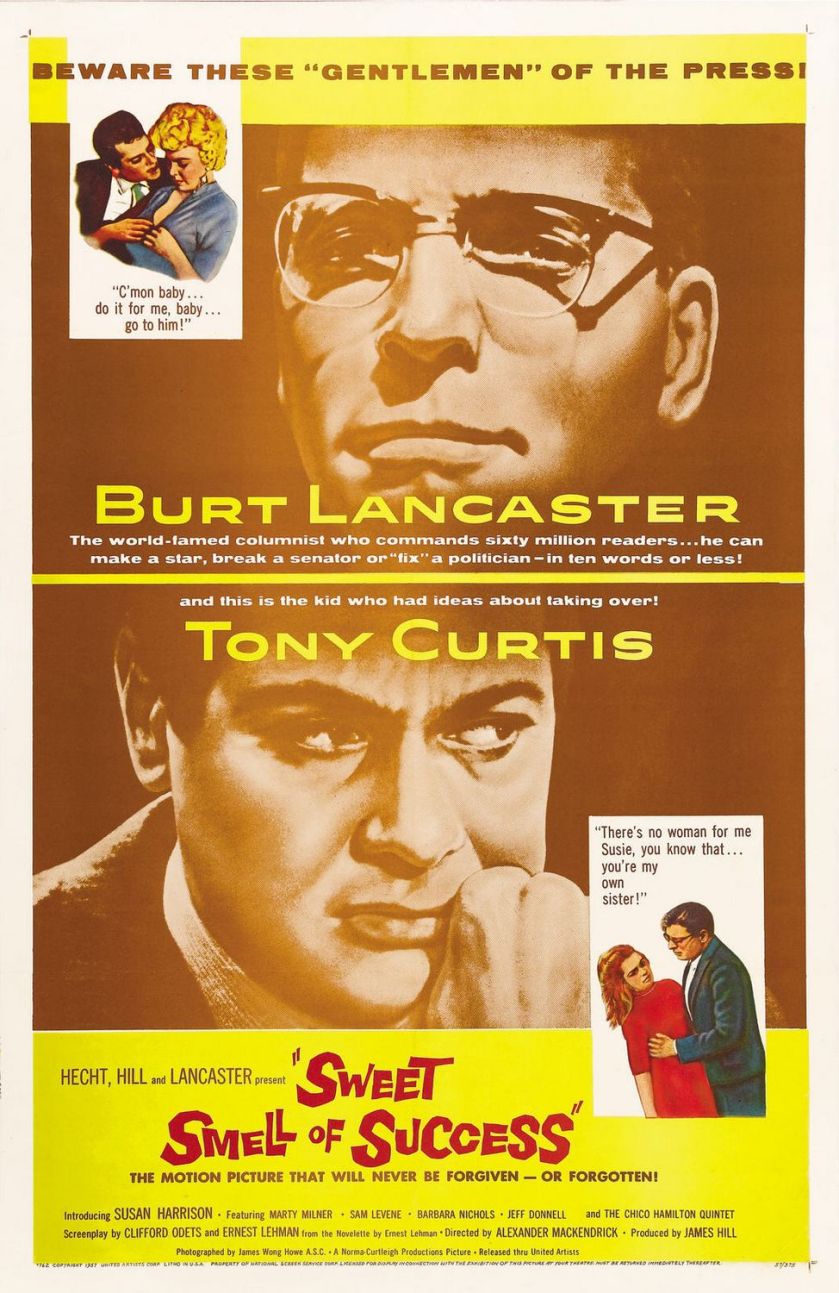
#232) Sweet Smell of Success (1957)

sweet_smell_of_success_ver2_xlg

#232) Sweet Smell of Success (1957)

OR “Winchell While You Work”

Directed by Alexander Mackendrick

Written by Clifford Odets and Ernest Lehman. Based on the novelette “Tell Me About It Tomorrow!” by Lehman.

Class of 1993

The Plot: Sidney Falco (Tony Curtis) is an unscrupulous publicity agent in the seedy Manhattan of the late ‘50s. Sidney’s clients keep dropping him because he can’t get them a mention in the newspaper column of J.J. Hunsecker (Burt Lancaster), a nationally syndicated columnist and TV personality who can make or break careers. Hunsecker is blacklisting Falco and his clients because Falco has failed to break up the relationship between Hunsecker’s kid sister Susan (Susan Harrison) and young jazz musician Steve Dallas (Martin Milner). Falco knows that Hunsecker is the connection he needs to be a successful press agent and will bribe or betray anyone to get there, no matter the price.

Why It Matters: Weirdly enough, the only people who get specific praise for this film are Alexander Mackendrick and cinematographer James Wong Howe. They mention Lancaster, Curtis, and the screenwriters, but Mackendrick and Howe are the ones who “capture[d] the pre-Beat Generation era”. There’s also a loving (albeit brief) essay by UCLA Archive programmer Andrea Alsberg.

But Does It Really?: I really wanted to like “Sweet Smell of Success”. I like these actors, and I like the world this film inhabits, but I just couldn’t get into it. Lancaster and Curtis are both clearly enjoying playing against-type as two very despicable characters, and the writing is filled with some terrific dialogue (“You’re a cookie full of arsenic.”). Even Marty Milner’s good in this! I enjoyed each of the individual elements of “Sweet Smell of Success”, but for me they didn’t come together to make a successful whole. Perhaps the film’s less-than-ideal production hindered things from the start (see “Other notes”). Regardless, this film has enough pros for me to label it a “minor classic” and still recommend it to you, the random internet masses.

Everybody Gets One: Susan Harrison was a Broadway actress making her film debut in “Sweet Smell” as J.J.’s sister Susan. She only made one other film (1960’s “Key Witness”) before leaving acting entirely to raise a family. One of her children married a “multi-millionaire” on a FOX reality show. Also making their sole NFR appearance are Broadway’s original Nathan Detroit Sam Levene and future “Route 66”/“Adam-12” star Martin Milner.

Wow, That’s Dated: A newspaper columnist with that kind of clout? Not anymore! Also dated are the occupations of cigarette girl and jazz flutist.

Seriously, Oscars?: Despite critical praise, audiences didn’t warm up to Lancaster and Curtis playing such lowlifes, and “Sweet Smell” was more or less forgotten. The BAFTAs acknowledged Tony Curtis with a Best Foreign Actor nomination, but that’s about it.

Other notes

  • Ernest Lehman based his original novelette on his experience with Hollywood Reporter columnist Irving Hoffman. Hoffman didn’t care for the depiction, but did give Lehman a shoutout in his column, saying he would make a great screenwriter (and he was on to something!). There’s also a story that Hunsecker is based on Walter Winchell, easily the most influential columnist of the time. There’s some debate over which man is the real inspiration, but I don’t see why Hunsecker can’t be a little from Columnist A and a little from Columnist B. Thank you!
  • Production for “Sweet Smell” was by all accounts an unpleasant one. Alexander Mackendrick was only assigned to direct because his previous project fell through and he couldn’t get out of his contract with Hecht-Hill-Lancaster. Lehman left the project right before shooting started (illness, potentially caused by production stress), and his replacement, playwright Clifford Odets, took so long with rewrites some scenes were filmed only hours after being written. On top of all this, producer/star Burt Lancaster was an intimidating presence both on and off-screen. The only person who seemed to enjoy himself was Tony Curtis, who vehemently lobbied for the role of Sidney to go against his pretty-boy persona.
  • Shoutout to Chico Hamilton and Fred Katz, more or less playing themselves as Dallas’ bandmates. The two wrote the original score for the film, but it was rejected for being “too esoteric”, and replaced by a more orchestral score by Elmer Bernstein.
  • “Match me, Sidney.” may be the most loaded line in the entire screenplay. It’s one of those “classic film quotes” that really only works in its proper context.
  • That’s David White (aka Larry Tate) as Hunsecker’s rival Otis Elwell. By the way, “My friends call me Otis.” may be the worst pick-up line I’ve ever heard.
  • A jazz musician who uses recreational marijuana? Quel Scandale! That being said, “flyer” is my new favorite euphemism for being a drug addict.
  • I know it’s a movie, but in what universe are Burt Lancaster and Susan Harrison siblings?
  • Also noteworthy is how much of Lancaster’s face is obscured by his glasses and the shadows they create. It’s as if Lancaster is saying “Don’t look at my face, focus on the performance.” It works, for the most part.
  • This is the first of two movies I’m covering this week with implied incest (see my next entry for the other one). It’s a good thing psychoanalysis came along around this time. All screenwriters on the couch, please!
  • I severely underestimated Susan Harrison. She seems one-note for most of the movie, but really gets to show her colors in the final few scenes. It’s a shame we never got more of her work.

Legacy

  • A musical stage version of “Sweet Smell of Success” by Marvin Hamlisch & Craig Carnelia came and went on Broadway in the spring of 2002. It expands the plot greatly (the film’s story doesn’t start until Act II) and garnered John Lithgow a Tony for his performance as Hunsecker. Among the Broadway producers were Ernest Lehman and Harvey Weinstein, and the parallels between Weinstein and Hunsecker just write themselves.
  • Barry Levinson pays tribute to “Sweet Smell” in two of his films: “Diner” and “Rain Man”.
  • The teleplay “The Comedian” is also based on a short story by Lehman, centers on a dangerously influential TV personality, and features the character of columnist Otis Elwell, this time played by Whit Bissell.
  • “Breaking Bad” creator Vince Gilligan has cited the film as one of his favorites and named two episodes of “Breaking” after a line from the film: “Cat’s in the Bag” “And the Bag’s In the River”.

#231) Salesman (1969)

SALESMAN, 1968

#231) Salesman (1969)

OR “Jesus Shlept”

Directed by Albert Maysles, David Maysles, and Charlotte Zwerin

Class of 1992

The Plot: Hi, my name is Tony. How are you today? Have you ever heard the word of the Maysles Brothers? They’ve made this wonderful documentary about door-to-door bible salesmen. You don’t seem interested, but what if I told you that the film’s direct cinema approach provides you with new insight to a thankless profession? And wait until you see these salesmen; there’s Paul “The Badger” Brennan, who’s having a bit of a slump. But he’s aided by Charles “The Gipper” McDevitt, Jamie “The Rabbit” Baker, and Raymond “The Bull” Martos. Their stories of struggle and survival are truly inspirational, especially in times like these. You still seem on the fence, is it okay if I leave some literature with you?

Why It Matters: The NFR quotes Vincent Canby, who wrote in his review “the Maysles Brothers transcend superficiality with compassion by showing that ‘the salesmen are no less vulnerable than their customers.’”

But Does It Really?: Perhaps “Grey Gardens” set the bar too high for me in terms of Maysles documentaries, but I just couldn’t get into this one. The subject matter is fascinating, the business tactics are interesting to watch, and like a lot of direct cinema, it’s an important time capsule of a specific era, but there was a barrier between me and the movie that I just couldn’t break. Direct cinema is known for letting the viewer fill in their own blanks, so perhaps what I brought to the viewing prevented me from connecting with it. Regardless, I still respect the film for what it brings and the time it represents, so let’s label “Salesman” as “historically significant” and move on.

Shout Outs: McDevitt gets his nickname “The Gipper” from “Knute Rockne, All American”. The Badger sees the “Casablanca” hotel in Miami and references the movie and “Humphrey Bogie”, which coincidentally is my favorite Bowie album.

Everybody Gets One: We get more of the Maysles with their follow-up film “Grey Gardens”, and co-director Charlotte Zwerin with the recently inducted “Thelonious Monk: Straight No Chaser”. This is, not surprisingly, the only NFR appearance for the four salesmen. Despite what Pauline Kael claimed, these were actual salesmen, not actors.

Wow, That’s Dated: Door-to-Door salesmen: is there anything else to say?

Seriously, Oscars?: Definitely no Oscar nod for a documentary that couldn’t even get a proper distribution deal (the Maysles had to pay for it themselves). The 1969 Best Documentary winner was “Arthur Rubinstein – The Love of Life”. I’m sure he’s a great guy, but a documentary about a concert pianist? Yawn. (NOTE: If “Rubinstein” makes the Registry I will immediately retract this disdain). The Maysles’ only Oscar nomination came in 1974 with their short subject “Christo’s Valley Curtain”.

Other notes

  • The Maysles were the ones doing the actual filming, sending footage back to Charlotte Zwerin, who would edit and offer feedback. Zwerin’s contributions in forming “Salesman” in the cutting room led to her receiving a directing credit.
  • If $50 sounds steep for a bible, remember that that’s in 1967 money. Today that would be over $350.
  • Did having a camera crew standing there pressure any of the customers to buy a bible?
  • Paul looks like a cross between Burgess Meredith and Sterling Hayden.
  • The salesman’s boss Kennie Turner pops up throughout the film to encourage sales. He’s no Alec Baldwin.
  • Lots of jabs at the Irish and Italians in this one, especially from Paul Brennan. If I were closer to my roots I’d be offended.
  • There are a lot of thick New England accents in this movie. I may need subtitles for this one.
  • Melbourne I. Feltman, the bible consultant featured in the film, may have the greatest name of anyone in a movie ever.
  • What I wouldn’t give for these guys to try a peddle a bible at “Grey Gardens”. The first connective tissue in the Maysles Cinematic Universe.
  • There’s a painting of the Immaculate Conception? Ewwww….
  • Watching unpolished improv always gives me second-hand embarrassment. Can we please get a suggestion for a profession other than salesman?
  • My favorite scene is the movie is when The Badger ends up in a “Muslim district” by mistake. In reality, he was driving through Opa-locka, Florida, which, despite its Arabic-inspired aesthetic, has a more diverse population than Brennan would assume. He couldn’t find his leads, but The Badger did find out how to get, how to get to Sesame Street.
  • The film’s greatest irony is when the salesmen blaspheme in frustration. Thanks for keeping that footage in the final cut!
  • The Badger says that all of their nicknames are derived from animals. Who can tell me what kind of animal is a Gipper?
  • The Rabbit’s the young one? Man, that generation was built tough.
  • I cannot get over that we as a society used to let door-to-door salesmen into our homes. We were so trusting back then.
  • There’s something about this movie that almost feels like they’re in a different time period. For something filmed in 1967 the movie feels very late ‘50s. Perhaps hippies hadn’t made it to New England.
  • “That’s where I sign my John Henry.” So close.
  • Don’t play a Beatles song! We can’t afford that, especially not “Yesterday”!
  • This may be the only movie where the end credits are narrative text. It reads like something Orson Welles would recite.

Legacy

  • The Maysles followed up with legendary Rolling Stones documentary “Gimme Shelter”. The brothers continued working together until David’s death in 1987. Charlotte Zwerin stopped working with the Maysles when they wouldn’t let her produce their films. Zwerin went on to direct noted documentaries about Thelonious Monk and Ella Fitzgerald.
  • “Salesman” was spoofed in the “Documentary Now!” episode “Globesman”. Written by Seth Meyers, the episode captures the film’s aesthetic perfectly.
  • “Glengarry Glen Ross” would eventually eclipse “Salesman” in the “Desperate Salesman” subgenre. If only The Badger used more colorful profanity.

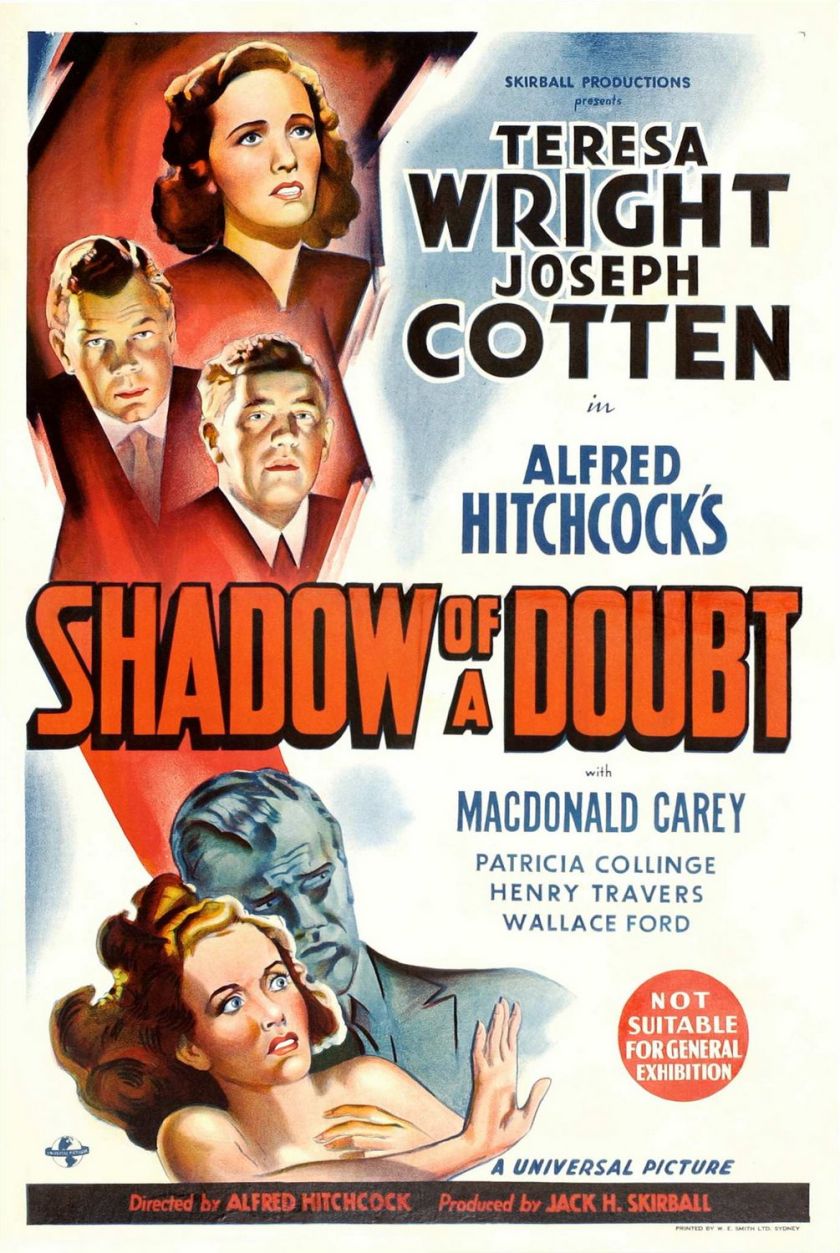
#230) Shadow of a Doubt (1943)

shadow_of_a_doubt_xlg

#230) Shadow of a Doubt (1943)

OR “The Wright Man”

Directed by Alfred Hitchcock

Written by Thornton Wilder & Sally Benson & Alma Reville. Story by Gordon McDonnell.

Class of 1991

The Plot: The Newton family of Santa Rosa, California is surprised by a visit from Uncle Charlie (Joseph Cotten). Family matriarch Emma (Patricia Collinge) is delighted to see her younger brother, but niece/namesake Charlie (Teresa Wright) notices something off about Uncle Charlie. He gives Charlie a pawned ring, he clips stories out of the newspaper, and he goes nuts when his photo is taken. The younger Charlie tries to put it together when two reporters (Macdonald Carey & Wallace Ford) show up wanting to interview everyone in the family. Are the reporters what they appear to be? Is Uncle Charlie who he appears to be? There’s a lot of mystery in the air, but if you’re a fan of classical music, the clues are right in front of you.

Why It Matters: The NFR praises Hitchcock, and calls the film “intense” with “underscores that are incredibly dark, even for Hitchcock.” There’s also an essay by Thomas Leitch, Hitchcock expert and teacher of something called “Wikipedia U”.

But Does It Really?: It’s quite surprising that “Shadow of a Doubt” made the NFR before the likes of “Psycho”, “Rear Window” or “North by Northwest”, but on its own merits the film does not disappoint. Hitch had a grasp on well-plotted suspense from the get-go, and “Shadow” creates its drama not from its chases and murders, but rather from a purely psychological place. I’ll argue that Hitch’s later films are better paced, but “Shadow” is the springboard that takes Hitch to bigger and better movies. Perhaps Hitch’s reputation precedes this film too much for its own good, but “Shadow of a Doubt” is still a well-crafted suspense thriller that continues to shock 75 years later. Definitely worth a watch if you’re looking for terrific underrated Hitchcock.

Everybody Gets One: Playwright Thornton Wilder (whose “Our Town” helped give this film its small town quality), actor Hume Cronyn, and future soap opera star Macdonald Carey. And while she provided feedback on many Hitchcock films, this is the only credited appearance for screenwriter Alma Reville, aka Mrs. Alfred Hitchcock.

Wow, That’s Dated: This film’s main story points hinder on such now-dated things as telegrams, newspapers, and passenger trains.

Seriously, Oscars?: 1943 was a weird year for the Oscars. Very few of the films honored that year would be considered “classic” today, but the Academy did manage to give “Casablanca” its due as Best Picture. Despite critical praise, “Shadow of a Doubt” only received a single nomination: Best Story for Gordon McDonnell. He lost to William Saroyan for adapting his own novel “The Human Comedy”.

Other notes

  • “Shadow of a Doubt” was filmed on location in Santa Rosa (though I’m here to tell you the city has changed quite a bit). A few scenes had to be reshot months later at Universal Studios, and those sequences stick out like a sore thumb.
  • It’s fair to say that Teresa Wright would one day evolve into Eva Marie Saint.
  • Charlie’s bookworm sister Ann is played by Santa Rosa native Edna May Wanacott, who went on to write “Little Women” if I’m not mistaken.
  • Without planning to do so, I have now watched all five of Henry Travers’ NFR appearances within a span of only seven months. This is the movie where he discusses hypothetically murdering Hume Cronyn. Atta boy, Clarence!
  • Ann doesn’t want anyone to speak ill of the government. What a cute little nationalist you are.
  • Our director makes his cameo playing bridge on the train. Hitch’s appearance impedes on the scene that’s happening, something he was careful not to do in his later cameos.
  • Putting a hat on a bed is bad luck? We have too many superstitions.
  • There’s some weird chemistry going on between Cotten and Wright. You’re related!
  • Here’s my question: If you’re Joseph Cotten and you’ve got a newspaper clipping you don’t want your host family to see, why would you throw it away in a wastebasket in their house? Why not throw it away in a public trashcan, or set it on fire, or literally anything else?
  • This is one of the rare Hitchcock films where he doesn’t let the audience in on the secret before the main character finds out. Not that there should be any shock; Charlie is giving red flags left and right!
  • Does anyone else notice that Mom occasionally flubs a line, but just keeps going?
  • How old is the younger Charlie supposed to be? Teresa Wright was 24 when they filmed this, but it’s implied that Charlie is a teenager. That being said, she goes to a bar and several older men make eyes at her. What am I missing?
  • An off-screen Hitchcock trope: somewhere on the east coast is a man who may or may not be wrongfully accused.
  • It helps that Charlie’s parents are both conveniently myopic. Especially Mom, she’s so happy Uncle Charlie is back you can get her to go along with anything. Are we sure a streetcar didn’t hit her too?
  • My new favorite film character is Louise Finch, Charlie’s classmate/the waitress at the bar, as played by Janet Shaw in a thoroughly unenthusiastic performance. One can only imagine what she’s like when it’s a customer’s birthday.
  • At first I was grossed out by Macdonald Carey hitting on Teresa Wright, but then I learned that he’s only five years her senior. He looks way older and she looks way younger.

Legacy

  • Of the over 50 films Hitchcock directed, he repeatedly called “Shadow of a Doubt” his favorite.
  • Hitch enjoyed working with Hume Cronyn so much, he cast him in his next picture: “Lifeboat”. Cronyn also penned the screenplays for two Hitchcock films: “Rope” and “Under Capricorn”.
  • While watching this I suspected this movie was overdue for a shitty remake, and it’s got two! 1958’s “Step Down to Terror” and the 1991 TV movie namesake with Mark Harmon.
  • The 2013 “Stoker” takes its inspiration from “Shadow of a Doubt”, but then goes in a very different direction.

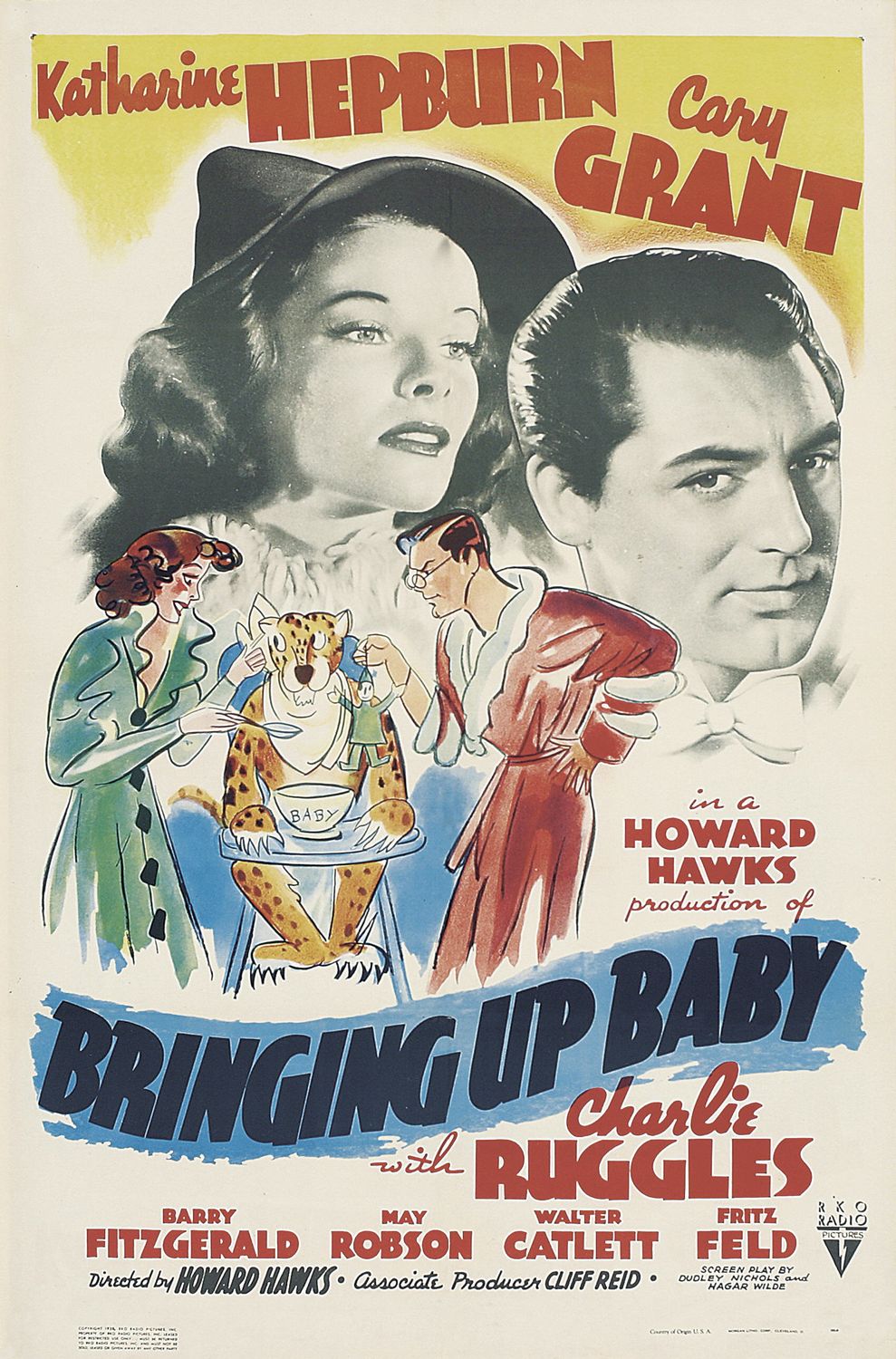
#229) Bringing Up Baby (1938)

bringing_up_baby_ver4_xlg

#229) Bringing Up Baby (1938)

OR “Hawksian Days”

Directed by Howard Hawks

Written by Dudley Nichols & Hagar Wilde. Based on the short story by Wilde.

Class of 1990

The Plot: Paleontologist David Huxley (Cary Grant) is one day away from completing a full brontosaurus skeleton and marrying his joyless fiancée Alice (Virginia Walker). On the day the “intercostal clavicle” is set to arrive, David meets Susan Vance (Katharine Hepburn), a free-spirit whose Aunt Elizabeth (May Robson) happens to be the donor David needs to impress to get his museum a grant. The more time David spends with Susan, the more destruction she brings into his life, starting with the arrival of a leopard named Baby (Nissa). There’s mistaken identity, fast-paced overlapping dialogue, plenty of pratfalls, and an inexplicable love story in this comedy classic.

Why It Matters: The NFR calls the film a “fast-paced screwball comedy” and gives some backstory to the production and its eventual standing as a classic

But Does It Really?: I’ve covered the beginning and the end of Hawks’ legendary run of screwball comedies, but with “Bringing Up Baby” we finally see the apex. The screwball comedy as a genre has been long gone, but this film lives on thanks to its simple premise and expert comic timing. Grant and Hepburn are wonderfully cast against type, Hepburn in particular is relishing a role that would help craft her spirited, independent persona. Aided by a murderer’s row of character actors and an inspired screenplay, Hawks and his team have made quite possibly the definitive film comedy of the early sound era.

Shout Outs: David’s alias from Susan is “Jerry the Nipper”, the nickname Cary Grant’s character was given in “The Awful Truth”.

Everybody Gets One: Australian stage actress May Robson, and comic actor Fritz Feld, who sadly does not get to do his trademark pop sound in the film.

Wow, That’s Dated: The phrase “behind the eight ball”, travelling circuses, and the ability to start any car you come across.

Seriously, Oscars?: The oft-quoted story of “Bringing Up Baby” being snubbed at the Oscars due to its status as a box-office bomb is misleading. The film was successful in most markets, but didn’t recoup its budget in its initial release. It was also a rough year for RKO Pictures; only one of its over 40 releases received an Oscar nod (“Vivacious Lady”). Katharine Hepburn bought out her contract with RKO in 1938, so it makes sense that the studio wouldn’t invest money in an Oscar campaign for a star no longer on the payroll. Chalk up the lack of recognition for “Bringing Up Baby” to bad timing.

Other notes

  • This seems like a movie that should have had an animated opening credits sequence.
  • Is Susan the first manic pixie dream girl? Or was that just the next evolutionary step for the Hawksian Woman?
  • I know that Cary Grant’s film career was just taking off in 1938, so he didn’t quite have the sophisticated persona we associate with him, but it’s a fun change of pace to see him play awkward and stiff.
  • Once Baby shows up, be on the lookout for shots where the leopard is separate from the actors. There’s an obvious pane of glass between David and Baby when he first sees it, and there are several shots where the actors are filmed separately, with Baby being added in optically. Only Katharine Hepburn was brave enough to work alongside Nissa, with handler Olga Celeste saying that Hepburn could have been an animal trainer.
  • Shoutout to Walter Catlett, a vaudeville performer brought in by Hawks to coach Katharine Hepburn on her comedy scenes. Hepburn appreciated his tutelage so much she convinced Hawks to cast Catlett as Constable Slocum, a role that he plays in an expertly befuddled manner.
  • And then we get to the infamous scene where, when asked why he’s wearing a woman’s negligee, David declares in exasperation, “Because I just went GAY all of a sudden!” It may be the first instance of the term “gay” being used in a homosexual context. No one knows for sure if this was intentional (the phrase, while known as early as the ‘20s, didn’t become commonplace until the late ‘60s). Allegedly, the line was ad-libbed by Cary Grant, though he never confirmed this in his lifetime, and the camera tracks the leap he makes in the take very well. The true meaning/origin is anyone’s guess.
  • Like many a farce, the events of this film rely on a lot of coincidence.
  • If David and Susan want to know where George went, all they have to do is follow the tracks the camera dolly is making in the dirt!
  • Everybody’s great, but I particularly enjoyed Charles Ruggles as the easily confused Major Applegate.
  • I had never heard of Squat Tag before this movie. Apparently it’s a real thing.
  • Baby can be tamed by singing “I Can’t Give You Anything But Love”, which was a popular song about a decade earlier. If the film were remade today the song would be…I don’t know, “Hey There Delilah”?
  • And then Baby gets in a fight with Asta the dog. Where was PETA during all of this?
  • Katharine Hepburn and Cary Grant harmonizing is just delightful.
  • The ending is the right amount of ridiculous, but I can only imagine the real-world ramifications of what happened to the museum and its grants.

Legacy

  • As previously mentioned, “Bringing Up Baby” was successful, but – thanks to the film going over-budget due to production delays from Hawks, Hepburn and Grant – never made its money back. The Independent Theatre Owners of America had already labeled Katharine Hepburn “box office poison”, and this film’s underperformance solidified that standing. Hepburn left RKO, went back to Broadway, and returned to Hollywood two years later (with Cary Grant in tow) for the film version of her stage hit, “The Philadelphia Story”.
  • “Bringing Up Baby” finally made a profit upon a re-release in the early ‘40s (no doubt to cash in on the success of “The Philadelphia Story”). Frequent television airings in the ‘50s helped improve the film’s reputation, and ultimately made it a classic.
  • Howard Hawks’ made a self-homage 25 years later with the Rock Hudson/Paula Prentiss comedy “Man’s Favorite Sport?”
  • Filmmaker/longtime Hawks admirer Peter Bogdanovich made a spiritual remake in 1972 with “What’s Up, Doc?” The story goes that an apprehensive Bogdanovich showed the screenplay to Howard Hawks, who had one problem with it: Bogdanovich didn’t steal the leopard or the dinosaur bone.

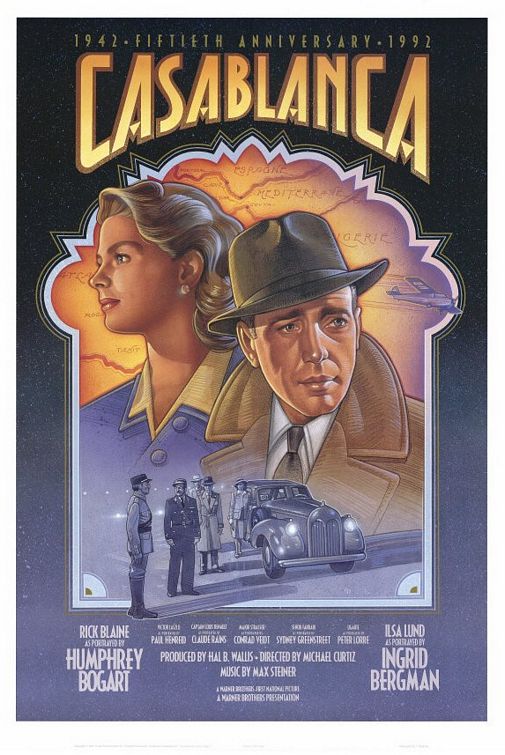
The Legacy of “Casablanca”

casablanca_ver3

Click here for Part 1!

There’s a lot to unpack with the cultural ripple effect “Casablanca” started 75 years ago. This is just a small sampling. Keep reading for a few surprises.

Legacy

  • This is another one of those movies that started off as a hit and became a classic over time. Its regular airings on television, as well as the annual screenings of the film at Harvard (and other colleges) throughout the ‘70s helped boost the film’s standing as a classic, to the point where Francois Truffaut cited these showings when refusing to direct a potential remake.
  • Warner Bros. originally planned on making a sequel shortly after the film’s release. “Brazzaville” would have followed Rick and Louis as they travelled to the Congo to join the Free French. It never happened, but Bogie in the Congo, now there’s an idea…
  • The film did receive an official sequel in novel form with 1998’s “As Time Goes By”. It tried to give “Casablanca” the “Godfather Part II” treatment by being both prequel and sequel, but failed on both counts. The Britcom is spawned, however, is a delight.
  • Unproduced for decades, the play “Everybody Comes to Rick’s” made its West End premiere in 1991; a run that lasted 3 weeks. I mean, we’re not making “Casablanca” here.
  • There have been two attempts to turn “Casablanca” into a TV series, one in the ‘50s that acted as a prequel, and one in the ‘80s that was set a year after the events of the movie. When will Hollywood leave well enough alone?
  • Perhaps the greatest misquote in film history comes from “Casablanca”. Ilsa says, “Play it, Sam”, but no one says, “Play it again, Sam”. But that hasn’t stopped generations of misattribution, as well as a Woody Allen movie.
  • Speaking of quotes, “Round up the usual suspects” inspired Christopher McQuarrie to write a crime thriller called…uh…
  • Though not written for the film, the song “As Time Goes By” became a popular standard thanks to “Casablanca”. A few bars are sampled during the current Warner Bros. Studios logo.
  • You Must Remember This” is the name of easily the best podcast for film buffs. Karina Longworth (that’s her) consistently proves there is no substitution for thorough research.
  • Sooooo many spoofs, too many to mention. Let’s go with easily the weirdest: The 1995 Bugs Bunny cartoon “Carrotblanca”. Someone really liked the bizarre casting of Tweety Bird as Peter Lorre.
  • Okay one more spoof; one of my favorite underrated SNL skits. There’s just something about the way Kate McKinnon says “Noooooo, Rick, noooooo”.
  • Julius Epstein tried on two separate occasions to turn “Casablanca” into a stage musical. He could never make it happen, but we did get a Japanese all-female musical in 2009. And how many films on this list can say that?
  • My mandatory shout-out to the late “Great Movie Ride”.
  • “Never show a good movie in the middle of your crappy movie.”
  • Last spoof, I promise.


This write-up had several “Other notes” that I had great difficulty cutting. So rather than kill my darlings, I’ve relocated a few to a new segment: Other Other notes

  • Fun Fact: I share a birthday with the Epstein Brothers! The greatest screenplay ever was written by either Leos or Virgos (depending on which horoscope you subscribe to).
  • Louis spends a lot of time complimenting Ilsa on her appearance. It’s good practice for when Claude Rains obsesses over Ingrid Bergman four years later.
  • One of filmdom’s more bizarre debates is whether or not one of the background waiters is Jack Benny in a gag cameo. One theater even held a contest to see who could spot him. Do I believe this story?


I’M THINKING IT OVER!