The Plot: Through the use of collages and stop-motion animation, “The Red Book” is an experimental film about a…red book and a…nude woman and a…house? I think?
Why It Matters: The NFR’s official write-up consists of an explanation of who Janie Geiser is, followed by Gesier’s description of the film. An essay by film scholar Dr. Holly Willis tries to clarify some of the film’s qualities, but just left me more confused.
But Does It Really?: The NFR has made it clear that “The Red Book” is on the list as a representation of Janie Geiser, and that’s good enough for me. The film is not my cup of tea, but hey, when I’m in the right mood “RocketMan” is a hilarious movie, so I don’t think Geiser’s losing any sleep over my opinion.
Everybody Gets One: After getting a degree in visual arts at University of Georgia, Jane Geiser got a part-time job at Atlanta’s Center for Puppetry Arts. In addition to puppetry, she started making short experimental films. Her puppetry earned her a Guggenheim fellowship in 1992, which lead to focusing more on her films. “The Red Book” is Jane Geiser’s first major film.
Wow, That’s Dated: I can’t put my finger on it, but the film has a ‘90s vibe to it. Like something I’d see on a scrambled cable channel late at night.
Seriously, Oscars?: As best I can figure, “The Red Book” didn’t hit theaters until 1996. Whether or not it was eligible for an Oscar I don’t know. Regardless, the winner for Best Animated Short in 1996 was a film called “Quest”.
Other notes
“The Red Book” is primarily in black & white, with splashes of red for emphasis. In other words, the same color scheme as “Schindler’s List”.
I was not expecting this film to have full frontal nudity (albeit animated).
The male figure featured throughout kinda looks like young Conan O’Brien.
What is it with experimental films and falling keys?
There are a few moments of Terry Gilliam-esque animation in this. Fortunately no animator suffered a fatal heart attack during production.
Hey, that’s a just a live-action clock being filmed! Flag on the play, 15-yard penalty.
Backwards singing: very David Lynch-ian.
I didn’t realize Guggenheim’s full name is John Simon Guggenheim. For a second I was worried that critic/misogynistic garbage John Simon was involved in this.
Legacy
Janie Geiser is still going, making films and puppetry. Her most recent film is 2013’s “Kriminalistik”. (PS: These videos are on her official Vimeo channel, because she’s too cool for YouTube).
Written by Budd Schulberg. Based on his short story “Your Arkansas Traveler”.
Class of 2008
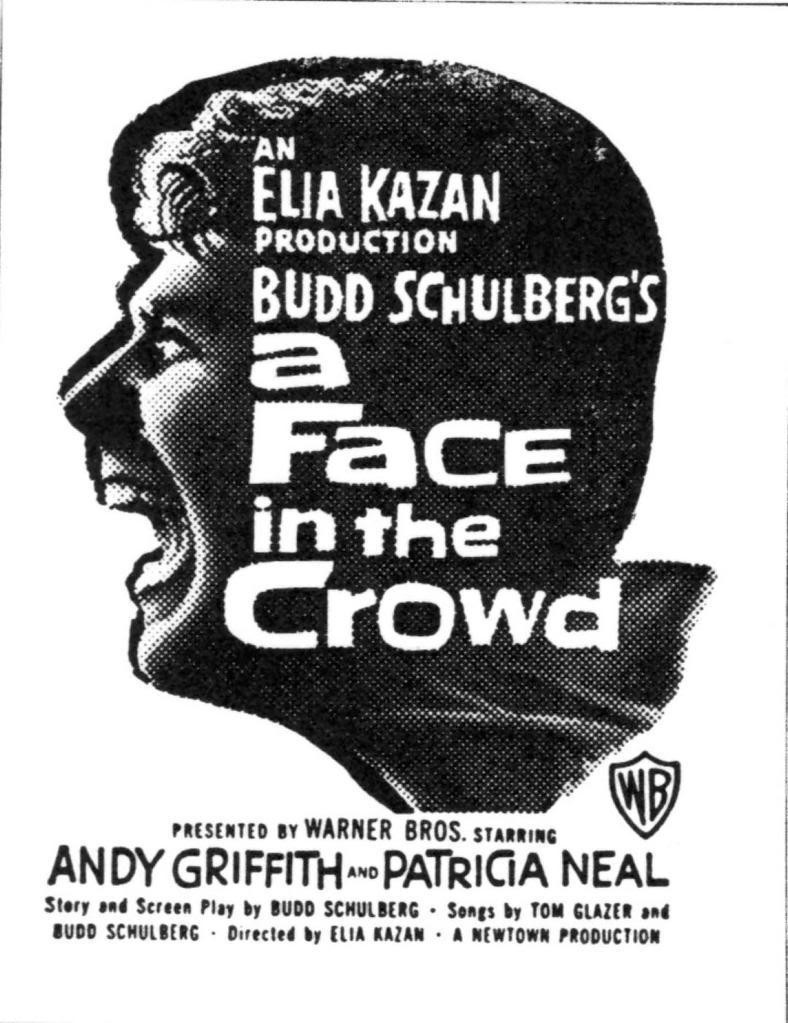
The Plot: While doing a profile on local prisoners for a radio program, Marcia Jeffries (Patricia Neal) meets Larry Rhodes (Andy Griffith) who, despite his drunken and uncouth demeanor, comes across as warm and personable over the airwaves. Dubbed “Lonesome” Rhodes by Marcia, he becomes the hit of Arkansas, even influencing a mayoral election with his opinions. This leads to a national television program, and instant fame. But is Lonesome Rhodes ready to be the voice of the masses? And with a presidential election looming, just how much influence should one person have?
Why It Matters: No major superlatives, but the NFR calls the film a “dark look at the corruptibility of sudden fame and power.”
But Does It Really?: Holy crap Kazan, you and Schulberg had your fingers on the fucking pulse! This film is about the seismic influence television’s “style over substance” M.O. can have on America, and Schulberg and Kazan absolutely nail it. Like “Network”, “A Face in the Crowd” is ahead of its time, and just keeps getting more and more accurate. Budd Schulberg has a lot to say and Elia Kazan knows exactly how to get that message across. Throw in a star-making turn by Andy Griffith and you’ve got a film that deserves a second viewing, especially right now.
Everybody Gets One: This is Andy Griffith’s film debut! He was a stand-up and a Broadway star when Hollywood came a-callin’. It’s a shame he never had another film role as impressive as this one (except of course for “Spy Hard”).
Wow, That’s Dated: This film is a pretty detailed look at how television operated in the ‘50s, mixed with frequent sexism and sporadic racism. On a less depressing note, there’s a “This is Your Life” parody and a look at pre-Power Point presentations (“Next chart, please.”)
Seriously, Oscars?: Reception was mixed on “A Face in the Crowd” upon its release and as a result, no Oscar love. Its only precursor attention was a DGA nomination for Kazan, losing to David Lean’s “Bridge on the River Kwai”.
Other notes
Larry Rhodes is allegedly based on a few similar TV personalities of the day, most notably Arthur Godfrey, with a dash of Tennessee Ernie Ford and Will Rogers (who gets name-dropped a few times).
It is lovely to see Andy Griffith succeed in a role outside his good-natured straight man Andy Taylor. For starters, we meet him in a local jail. HE’S the Otis!
Rhodes is essentially what Stanley Kowalski would be like if he could sing.
Kazan earns points for including African-Americans in several (albeit minor) roles throughout the film. It almost makes up for him ratting out all of his colleagues to HUAC. Almost.
Selling a mattress sucks, but at least Rhodes doesn’t have to hawk the Garden Weasel. PS: Is this how the Mattress Wars began?
Patricia Neal never gets the credit she deserves. In a film dominated by a very flashy central figure, Neal gives Marcia a wonderful, subtle character arc. For me, she’s the most tragic figure in all of this. All she wanted was to highlight real Americans; she got that and more than she bargained for.
Love that Vitajax montage. This movie predicted Viagra/advertising specifically to erectile dysfunction.
Shout-outs to the supporting cast. Walter Matthau is great in a performance that predates his typecasting as a “grumpy old man”, Anthony Franciosa is excellently despicable as Rhodes’ agent, and Kay Medford nails her one scene as something other than a Jewish stereotype.
To add to the realism, Kazan had several news and entertainment personalities cameo as themselves. Among them: Mike Wallace, Faye Emerson, Mitch Miller, Walter Winchell, and Burl Ives, no doubt a favor to his “East of Eden” director, Elia Kazan.
That’s Lee Remick in one hell of a film debut! Though I’m pretty sure that’s a double in some of the long shots of her baton twirling.
And then we get to Rhodes helping Senator Fuller with his campaign and we start getting such prescient lines as “people want capsule slogans”. It gets a bit eerie. Well done, Schulberg.
Side Note: “A Face in the Crowd” was added to the Registry in December 2008, shortly after the presidential election of Barack Obama over John McCain. This is the election that gave us nationwide exposure to Sarah Palin, whose meteoric rise to fame is not without its similarities to this movie.
Shout-out to then-Vice President Richard Nixon, and Checkers too!
Blink and you’ll miss a young uncredited Rip Torn as “country boy” Barry Mills.
Legacy
“A Face in the Crowd” started getting reappraised in the years following its initial release. One of its key early champions was French auteur Francois Truffaut.
Matlock! Maaaaaaatloooooock!
Keith Olbermann occasionally refers to fellow pundit Glenn Beck as “Lonesome Rhodes”, a reference that certainly doesn’t help Olbermann shake off his smug liberal persona.
Timing is everything: When I picked this as my next film I was not expecting Kazan to be tangentially in the news again.
A Brief Editorial (With Spoilers): I don’t get on my political soapbox too often, but I felt I needed to address something connected to this film. Recently there have been comparisons made between Larry Rhodes and Donald Trump. There are similarities to be sure (both capitalize on mass media, both appeal to the blue-collar public, both antagonize the press, etc.), but the key difference is public and private persona. Rhodes was presenting a wholesome “aw shucks” southern boy to his public, while privately despising them. With Trump, what you see is what you get. When Rhodes is exposed, it’s a betrayal to his adoring public. When Trump brags about sexually assaulting women on the “Access Hollywood” bus, it should be shocking, but it’s not too much of a stretch for a man with Trump’s track record. The parallels are enough to revive interest in “A Face in the Crowd” (TCM played the film on Trump’s Inauguration Day), but it’s not a direct allegory, just a really painful reminder of what we’re willing to accept from our public figures.
Written by William A. Drake. Based on his play and the novel “Menschen im Hotel” by Vicki Baum.
Class of 2007
The Plot: Berlin’s luxurious Grand Hotel oversees the intersecting lives of five guests over two days. There’s the bankrupt Baron Felix von Geigern (John Barrymore) whose attempt to rob the reclusive ballerina Grusinskaya (Greta Garbo) finds the two falling in love. There’s Flaemmchen (Joan Crawford), the model/aspiring actress who has to avoid passes by her temporary boss Preysing (Wallace Beery). And there’s Otto Kringelein (Lionel Barrymore), Preysing’s former employee, whose dying wish is to truly live. The hotel’s resident doctor, war veteran Otternschlag (Lewis Stone) sums up the Grand Hotel with, “people coming, people going, nothing ever happens”. Clearly he’s not paying attention.
Why It Matters: The NFR cites “Grand Hotel” as “arguably the first use of the all-star formula”, singles out Garbo’s iconic line, and praises Edmund Goulding for handling the egos off his all-star cast.
But Does It Really?: It’s definitely on the historical side of significance, but I had a good time at “Grand Hotel”. The combined star power of the five principals helps move things along, and Goulding keeps them all in check without any one star walking away with the picture. On top of being a well-crafted film, there’s an aura of star quality that radiates from the screen. “Grand Hotel” is a perfect example of the kind of all-star affair that could only be made in the studio system.
Everybody Gets One: This being a studio film, most of the creatives will be back in other entries. The only major holdout is screenwriter/playwright William A. Drake. On a more technical scale, this is Edmund Goulding’s only film as a director on the list, and Wallace Beery’s only sound film to make the cut.
Wow, That’s Dated: There’s a lot of sexual harassment aimed at Joan Crawford through the whole film. Heck, she meets Preysing in his hotel room while he’s in a towel. Run, Joan, Run!
Seriously, Oscars?: A blockbuster hit in 1932, “Grand Hotel” won the Oscar for Best Picture and…that’s it. Not only did “Grand Hotel” not win any other Oscars, it wasn’t nominated in any other categories. The Academy was still working out the kinks in its fifth ceremony, and there were fewer categories and fewer nominees than there are now. Had the Supporting categories existed back then, surely the likes of Lionel Barrymore and Joan Crawford would have been nominated. Wallace Beery didn’t get nominated either, but he did win Best Actor that year for “The Champ”.
Other notes
“Grand Hotel” was produced by MGM’s boy-wonder Irving Thalberg. Studio policy of the time dictated that only one or two of your stars could appear in the same film, but Thalberg had the revolutionary idea to put five of MGM’s stars in one film, bringing in five fanbases to one picture. His gamble paid off handsomely.
The opening sequence is a fun setup, plus it’s a precursor to “The Telephone Hour”.
Brothers John & Lionel Barrymore share the screen in “Grand Hotel”. This is one of five films the brothers did together while under contract at MGM. In addition to sister Ethel Barrymore, you are probably familiar with John’s granddaughter Drew.
For those of you who only know Lionel Barrymore as Mr. Potter, his performance as Kringelein is a delightful 180. It’s as if Lionel is channeling Burgess Meredith in “Time Enough at Last”.
I’m enjoying what I’ve dubbed the “French braid shots”: characters from one scene walking past the characters in the next scene. It helps with the ensemble atmosphere.
“You’re a little stenographess.” Oy.
It’s nice to see Joan Crawford in a performance before the “Mommie Dearest” persona overshadowed everything.
Garbo’s continuity is way off in this film. And it looks like she was the only one allowed to have movie star close-ups.
Was a movie about an elegant hotel in Europe’s cultural capital escapism or insulting for a Depression-era audience?
It’s really saying something when Greta Garbo and John Barrymore share a scene together and he’s the subtle one.
Wallace Beery gets the weakest plotline. Beery was worried his character was too unsympathetic, and he was right. That being said, his eyebrow raise is quite impressive.
Shoutout to Lewis Stone, Judge Hardy himself, for his dramatic turn as Harvey Dent.
Nice lighting effect for the elevators.
I love that Garbo is a world-famous ballerina that we never actually see dance. I was hoping for at least a body double.
Here’s how good this ensemble is: It wasn’t until after the movie was over that I realized there is no scene with all five stars.
Legacy
Five words: “I vant to be alone”. Garbo hated when the line was applied to her intensely private life, but if the shoe fits…
MGM followed this film up with the first all-star comedy: 1933’s “Dinner at Eight”, also starring Wallace Beery and the Barrymores!
“Grand Hotel” was remade as 1945’s “Week-End at the Waldorf”. [Footage not available]
Speaking of remakes, MGM released a musical short in 1933 called “Nothing Ever Happens”, that condenses the film down to 18 minutes, and I’m pretty sure uses the same sets. It’s weird, but it’s proof that “Grand Hotel” lends itself naturally to the musical genre.
Composers Robert Wright and George Forrest attempted to musicalize the material in 1958 as “At the Grand”. The show closed out-of-town, but was resurrected 30 years later with new songs by Maury Yeston and direction/choreography by Tommy Tune. The renamed “Grand Hotel: The Musical” was a hit on Broadway, launching the careers of Jane Krakowski and the late great Michael Jeter.
Bonus Clip: The Forbidden Broadway parody of “Grand Hotel”. People come, people go, people move chairs.
Directed & Written by Dudley Murphy. “St. Louis Blues” by W.C. Handy.
Class of 2006
The Plot: Bessie (Bessie Smith) comes home to find her no-good gambler boyfriend Jimmy (Jimmy Mordecai) with another woman (Isabel Washington). Distraught, she goes to a local nightclub to sing the blues, in what would turn out to be Bessie Smith’s only film appearance.
Why It Matters: Most of the NFR’s description is devoted to a quote from film historian Donald Bogle, who praises Bessie Smith’s performance, though admits the film is “marred by its white director’s overstatement”. There’s an essay by “jazz on film” preservationist Mark Cantor that calls the film, among other things, a “flawed masterpiece”.
But Does It Really?: It’s the only existing footage of Bessie Smith. Done. Preserve it. Next!
Everybody Gets One: After a childhood I’ll understatedly call “troubled”, Bessie Smith got her start as part of a traveling troupe that included Ma Rainey. Her career took off when her first record “Down Hearted Blues” became a number one hit (see “Listen to This” below). She spent most the ‘20s at the top of her game, eventually earning the nickname “Empress of the Blues”.
Wow, That’s Dated: The Mark Cantor essay goes into detail about how many negative African-American stereotypes are in this film, and the ripple effect this and other films of the era had on this country’s history of racism.
Title Track: Now THAT’S a title song! Though now that I think about it, do they ever reference being in St. Louis in this film?
Other notes
The story goes that this was shot concurrently with Dudley Murphy’s other music short/NFR entry: “Black and Tan” with Duke Ellington. I’m pretty confident that’s the same apartment set in both films.
The film “St. Louis Blues” is produced by the same person who wrote the song: W.C. Handy. Nicknamed “The Father of the Blues” (I don’t know how that compares to “Empress of the Blues”), Handy didn’t invent the blues, but he combined it with a folk music sound to give it the form we recognize today. William Christopher gets a shout-out during the “Seventy-Six Trombones” number in “The Music Man”.
I know it’s early sound, but this movie is miked like an Altman film; I have no idea what anyone is saying.
Speaking of sound, Jimmy has one of the most grating voices in film. I suspect he didn’t make the transition to talkies.
Oooh, prohibition era drinking. Very risky.
Sure Bessie Smith is giving the definitive version of “St. Louis Blues”, but she’s no Minnie Mouse.
Apparently the harmonizing choir and orchestral backing was Dudley Murphy’s idea. The Cantor essay stresses how out of place it sounds against Bessie’s singing.
Jimmy the character is reprehensible, but Jimmy Mordecai sure can dance!
Legacy/Further Viewing: There’s a lot about Bessie Smith we didn’t get to in this post, and a lot of art has been created to honor her. I recommend starting with that HBO movie Queen Latifah did a few years back. It’s standard biopic stuff, but it gets Bessie’s story across.
Written by Fred Guiol and Ivan Moffat. Based on the novel by Edna Ferber.
Class of 2005
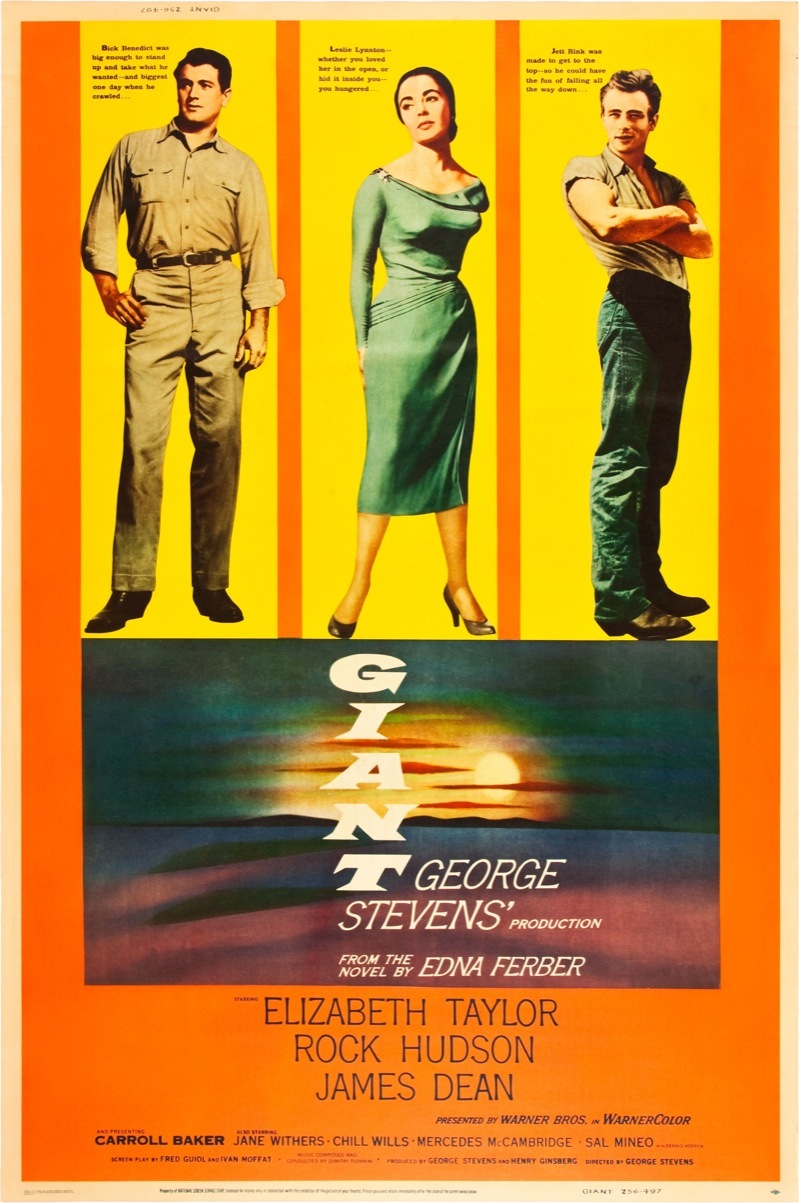
The Plot: “Giant” spans 25 years in the life of Jordan “Bick” Benedict (Rock Hudson), and his wife Leslie (Elizabeth Taylor). When purchasing a horse for his ranch, Bick meets Leslie and the sparks fly immediately. They marry and she moves into his ranch in Texas with him and his controlling sister Luz (Mercedes McCambridge). There’s multi-generational family squabbles, a contemplation of white Texans’ subtle and not-so-subtle racism towards Mexicans, and increased tension when ranch hand Jett Rink (James Dean) strikes oil and becomes Bick’s professional (and personal) rival overnight.
Why It Matters: The NFR praises this one to the hilt, calling it “a breathtaking example of the American film as spectacle” and singling out George Stevens and the cast.
But Does It Really?: Well I’m not as crazy about this one as the NFR is. I’ll chalk this film’s induction up to “historical significance”/”minor classic”. It’s James Dean’s last film, and was quite the hit in its day. “Giant” is still entertaining, but definitely doesn’t pack the punch it used to, and the slow first half makes this 200-minute epic seem longer. The film is one of those NFR entries that is on here primarily by its reputation.
Everybody Gets One: Most of the main cast show up elsewhere on the list. The only major exception is Fran Bennett as Judy, the Benedict’s least interesting child. Bennett got her role thanks in part to having the same agent as Rock Hudson. She left showbusiness in her mid-20s and is still with us, occasionally recollecting publicly about her time on “Giant”.
Wow, That’s Dated: Given the film’s ongoing plot thread of bigotry, lots of references to “wetbacks” in this one.
Title Track: Characters use synonyms like “big” and “huge” throughout the film, but no one says the secret word.
Seriously, Oscars?: One of the biggest hits of 1956, “Giant” led the Oscars that year with 10 nominations, including Best Picture. It managed only one win, but it was a major one: Best Director for George Stevens. “Giant” lost in most of its other categories to “Around the World in 80 Days” and “The King and I”. James Dean received his second posthumous Best Actor nomination, but he and co-star Rock Hudson lost to Yul Brynner in “The King and I”.
Other notes
The exteriors of “Giant” were filmed on location in Marfa, Texas. George Stevens encouraged the townspeople to watch the shoot, participate as background extras, and help out the crew (which surely must have violated some teamster union rules).
James Dean’s fatal car accident occurred only a week after he completed shooting this film. Thanks to George Stevens’ extended editing process, the final film was released 14 months after Dean’s death. Fellow up-and-coming actor Nick Adams was brought in to dub a handful of Dean’s extra-mumbly lines.
The opening credits are over a shot of the ranch’s cattle. I guess you could call it “stock footage”. Thank you!
Shout out to Mercedes McCambridge, who is playing essentially Texan Mrs. Danvers. She doesn’t have a lot of screentime, but she makes the most of it, and managed an Oscar nomination for her troubles.
Among this film’s many character actors are Chill Wills (four years before his way-too-eager Oscar campaign for his performance in “The Alamo”), former Shirley Temple foil Jane Withers, Robert Nichols (aka “Wienie Man” from “This Island Earth”), and Sheb Wooley, two years before his surprise hit single “The Purple People Eater”.
James Dean is the broodiest wallflower ever. Speaking of, Method Acting plus Texan drawl equals I have no idea what Jett’s saying. This may be the second movie this week where I need subtitles.
Side Note: The role of Jett is more of a prominent supporting role, but sympathy for the late James Dean (and I’m sure studio politics) put him in the Lead Actor category.
This is one of those movies where the piece as a whole outweighs any of the individual parts. Rock Hudson, Elizabeth Taylor, and James Dean are giving good performances, but they are all somehow overshadowed by the scope of everything.
Today in Code era profanity substitution: “no-good wildcatting so-and-so” and “you stinking sons of Benedicts”. Nice workaround.
Like its Texas backdrop, this film’s first half is big and spacious. Perhaps maybe too spacious. Things really don’t pick up until Jett strikes oil and the kids grow up to become better actors.
It just doesn’t feel right seeing James Dean in old-age makeup.
Dennis Hopper! Sal Mineo! Did everyone from “Rebel Without a Cause” catch the next flight to Marfa?
Carroll Baker must have been pissed when Lee Remick became a thing.
Apparently “I’ve Been Working on the Railroad” is the only song any band in this movie knows how to play. Did Warner Bros. have a falling out with its own music department? [Update: It’s been brought to my attention that the bands are playing the UT Austin fight song “The Eyes of Texas”, which has the same tune. That makes a lot more sense.]
A weird thing I noticed: Throughout the film there are several shots where Elizabeth Taylor delivers her lines with her back towards the camera. Not monumental, but consistent enough to catch my eye.
James Dean’s last line in his last film is some drunken mumbling that was probably looped by Nick Adams.
When you think about it, everything that happens in this movie is the horse’s fault.
Legacy
The main takeaway is James Dean’s final performance. His death and its connection to this film is a major plot point in “Come Back to the 5 and Dime, Jimmy Dean, Jimmy Dean.”
The characters in the 1985 film “Fandango” visit the remains of the original set of the “Giant” mansion in Marfa.
Here’s a weird one: during the climactic fight at the diner, the Mitch Miller cover of “Yellow Rose of Texas” is playing in the background. Thanks to its appearance in “Giant”, that recording became a hit. I think you missed the point, 1956 America.
“Giant” was adapted into a musical in 2012. It skews closer to the original novel. I hear good things.




 The Horse's Head