#209) The Ten Commandments (1956)

TheTenCommandments

#209) The Ten Commandments (1956)

OR “Moses Proposes”

Directed by Cecil B. DeMille

Written by Aeneas MacKenzie & Jesse Lasky Jr. & Jack Gariss & Fredric M. Frank. Adapted from “Prince of Egypt” by Dorothy Clarke Wilson, “Pillar of Fire” by Rev. J.H. Ingraham, and “On Eagle’s Wing” by Rev. A.E. Southon. Also the Bible.

Class of 1999

Even the trailer is epic!

The Plot: Moses (Charlton Heston) is a Hebrew slave whose mother (Martha Scott) gave him up to save him from death. He is adopted by Bithiah (Nina Foch) and raised in the palace of the Pharaoh (Cedric Hardwicke) alongside Rameses II (Yul Brynner). As an adult, Moses learns his true heritage and is banished to the desert. He encounters a burning bush and vows to use the word of God to free the Hebrews of Egypt. Rameses has ascended the throne and won’t let his people go that easily. Stay tuned at the end for a handy shortcut through the Red Sea.

Why It Matters: The NFR calls it Cecil B. DeMille’s “most epic” film and praises the special effects.

But Does It Really?: Oh sure. It’s bloated and not without its flaws, but “The Ten Commandments” is iconic enough to earn a spot on the NFR. Their write-up correctly points out that the real star is the special effects, and while dated compared to today’s technology, they really do steal the show. “The Ten Commandments” is a textbook example of the kind of epic filmmaking Cecil B. DeMille was known for, as well as the type of spectacles Hollywood made throughout the ‘50s to lure people away from their newfangled televisions. It’s still a massively impressive feat of filmmaking.

Everybody Gets One: Most of the supporting cast, notably Yvonne “Lily” DeCarlo, and the screenwriters (Surprisingly, Hollywood never took notice of the writings of Philo and Josephus).

Wow, That’s Dated: With the exception of the chariot drivers (actually filmed on location in Egypt), no one in this movie is Egyptian. Brownface, lots of brownface.

Title Track: In the “Guffman/Godot” category: The actual 10 Commandments don’t show up until 3 ½ hours into the film. The title is spoken later, about 10 minutes before the end.

Seriously, Oscars?: The highest grossing film of 1956 and the biggest hit of Cecil B. DeMille’s career, “The Ten Commandments” received seven Academy Award nominations, including Best Picture. It lost in six of those categories to either “The King and I” or Best Picture winner “Around the World in 80 Days”. The film did, however, take home the prize for Visual Effects, beating out fellow NFR entry “Forbidden Planet”.

Other notes

  • This film is a partial remake of DeMille’s 1923 “The Ten Commandments”. Weirdly, only the first part of that film is about Moses and the Exodus. The bulk of it is a modern day parable about the commandments. Huh.
  • An overture, an on-camera introduction by Cecil B. DeMille, and THEN the opening credits. When will this movie get started?
  • I’m not the first person to make this point, but the beginning of this movie is very similar to the beginning of “Superman”.
  • Yul Brynner with hair? Clearly this is a work of fiction.
  • Anne Baxter as Nefretiri is giving what may be the worst performance on this list. Take it down a notch, Eve. In fact, take it down several notches.
  • Moses was the Norma Rae of his time. ומןםמ
  • A mini-“Laura” reunion: among the ensemble are Judith Anderson and Vincent Price. Coincidentally, both films were added to the Registry in 1999.
  • It’s hard to watch Edward G. Robinson in a movie and not do a Chief Wiggum impression.
  • The juxtaposition from on location shooting and in-studio blue screen is really jarring.
  • He Who Has No Name? Voldemort? Clint Eastwood? Dewey Bunnell?
  • Many have claimed to be the voice of God in this film over the years. For my money, He sounds like Charlton Heston with the track slowed down.
  • Nice early morphing effect for the staff/snake. You earn that Oscar, John P. Fulton!
  • If Moses can’t sway Rameses, perhaps he should send over Deborah Kerr.
  • “They’ve been plagued by frogs, by lice, by flies, by sickness, by boils. We can’t show any of these on screen, but just take my word for it!”
  • Moses would have been an excellent meteorologist.
  • Just a reminder that Charlton Heston and Edward G. Robinson would work together again in “Soylent Green”.
  • The actual Exodus scene is astonishing to watch. There’s your cast of thousands.
  • That parting of the Red Sea is iconic for a reason. It still looks great.
  • My main question with the actual Ten Commandments is what their definition of “neighbor” is. Two of the commandments involve your neighbor. Do they mean the literal person next door? What kind of beef did God have with His neighbor? George Carlin answers all other questions I have about the commandments.

Legacy

  • “The Ten Commandments” continued the trend of biblical epics in Hollywood, most notably the other Charlton Heston convert movie: “Ben-Hur”.
  • Many other adaptations over the years, including the 1998 DreamWorks film “The Prince of Egypt” which tells the same story in literally half the time.
  • In another case of my film education crumbling around me, Edward G. Robinson never actually says “Where’s your Messiah now?” in this film. Billy Crystal coined the phrase while impersonating Robinson in his stand-up routine, and it stuck.
  • As a publicity stunt for the film, large replicas of the Ten Commandments were placed in major U.S. cities. Many of them stayed up for years and caused no public outcry whatsoever.
  • The shot of the slaves raising the obelisk was put to good use in “Naked Gun 2 ½”.
  • And of course, “History of the World Part I”.

Further Viewing: My favorite from the “recut trailer” craze of the mid ‘00s: biblical epic/teen comedy “10 Things I Hate About Commandments”.

#208) Gun Crazy (1950)

6252a112f932a327b4acf2c8e2f871e5

#208) Gun Crazy (1950)

OR “The Robber Bride & Groom”

Directed by Joseph H. Lewis

Written by MacKinlay Kantor and Millard Kaufman Dalton Trumbo. Based on the short story by Kantor.

Class of 1998

No trailer, but here’s the one scene you have to watch.

The Plot: Bart Tare (John Dall) is a man with a gun obsession. He doesn’t like killing anyone, but he enjoys being a perfect marksman. One night Bart and his friends visit a travelling carnival where he meets and is instantly attracted to Annie Laurie Starr (Peggy Cummins), the carnival’s resident sharpshooter. The sparks fly, so these two get married and do what every newlywed couple does: resort to a life of crime. Bart and Laurie drive around the country robbing banks and gas stations. But their reckless living takes a toll on their relationship. If only they weren’t so…Gun Crazy.

Why It Matters: The NFR calls the film a “quintessential ‘B movie’” and praises “its bold, stylized look”. There’s also an essay by film critic Richard T. Jameson.

But Does It Really?: More B-movies on this list, please! It’s definitely a product of its time, but “Gun Crazy” is proof that some B-movies are better than the main feature. Joseph H. Lewis and company don’t let a shoestring budget get in the way of creativity, and this film is brimming with taught direction, stunning cinematography, and outstanding lead performances by Dall and Cummins. “Gun Crazy” is a perfect example of the excellent work being done just outside the Hollywood studio system.

Shout Outs: I can’t prove it, but I’m pretty sure one of the flashbacks needle-drops the main theme from “Now, Voyager”.

Everybody Gets One: Director Joseph H. Lewis, and actor Peggy Cummins (who attended many a “Gun Crazy” screening in her later years). This is also the only film on the list for B-movie studio King Brothers Productions. They made “Gorgo”!

Wow, That’s Dated: Gun issues aside for one second, we get the exciting world of pre-digital cops & robbers. Cops get bulletins through teleprinters, while robbers don’t have to worry about security cameras. Simpler times indeed.

Other notes

  • The original short story of “Gun Crazy” was published in 1940 in “The Saturday Evening Post”. One wonders what the Norman Rockwell cover painting looked like that week. Something like “Freedom from Want” but with guns.
  • Hey Hollywood! Remember how you eradicated all Communists from your industry? Surprise! Millard Kaufman is a front for Dalton Trumbo! Not only is this film written by a blacklisted screenwriter, it’s written by THE blacklisted screenwriter!
  • On the one hand, this film doesn’t condone or sensationalize gun violence like the similarly themed “Badlands”. On the other hand, this movie pushes the Freudian aspect of guns to its sexiest. Either way, I squirmed a lot because of this movie’s stance on guns.
  • Young Bart is played by Russ Tamblyn, credited here as “Rusty Tamblyn”.
  • This all started when young Bart got a BB gun for Christmas. Are we sure his real name isn’t Ralphie?
  • John Dall seems to have been born with a permanent smirk. He looks like the kind of man who would kill a college friend with his gay lover as an experiment.
  • For those of you wondering about Peggy Cummins’ accent, she’s of Irish descent, born in Wales, raised in Dublin, and studied in London. Put it together and it kinda sounds like Grace Kelly.
  • Kids, the moral of the movie is “play with guns and you end up a carny”.
  • Packett kinda looks like middle-aged Orson Welles. Not quite “Third Man”, not quite “Moby Dick”.
  • If “Gun Crazy” is remembered for one scene, it’s the 3 ½ minute single take of Bart and Laurie robbing a bank in real time. The camera never leaves the backseat of their car. It’s quite impressive. Kudos to cinematographer Russell Harlan and everyone involved.
  • Bart and Laurie survive the roadblock thanks to everyone’s Clark Kent syndrome. No one recognizes them with their glasses on.
  • This film would make a great double feature with “The Hitch-Hiker”.
  • Surprise cameo by Lassie!
  • Bart and Laurie want to pull off one last job. What could possibly go wrong?
  • Laurie gets tsk-tsked for wearing slacks at the office. Where’s that revolutionary Laura Petrie when you need her?
  • This meat packing plant’s security team is one guy?
  • Say what you will about the finale, at least they’re visiting a state park. This film is to the San Gabriel Mountains what “Rebel Without a Cause” is to the Griffith Observatory.
  • Worst. Honeymoon. Ever.

Legacy

  • While not an immediate hit, the reputation of “Gun Crazy” grew over time and its influence can be sensed in such later films as “Bonnie and Clyde”.
  • “Gun Crazy” was loosely remade as 1992’s one-word “Guncrazy” starring a post-rehab Drew Barrymore.

#207) Czechoslovakia 1968 (1969)

fae5bdd505cf001d7a8d7468b74aa3d0

#207) Czechoslovakia 1968 (1969)

Directed by Denis Sanders & Robert M. Fresco

Class of 1997

NOTE: This post contains a brief history of Czechoslovakia and the Prague Spring of 1968 that is a massive oversimplification of what actually happened. I’m no history buff, and this should not be your go-to for information on that revolution. At the very least there’s like eight Wikipedia pages on the subject.

The Plot: Presented with no narration and a score by Charles Bernstein, “Czechoslovakia 1968” is a whirlwind overview of Czechoslovakia from its founding in 1918 to the Soviet-Russian invasion and eventual revolution (known as Prague Spring) of 1968. Brought to you by your friends at the United States Information Agency.

Why It Matters: The NFR gives no specific reason, but does go into the history behind the making of the film, including the use of amateur footage that was smuggled out of Czechoslovakia. There’s also a fascinating essay by…the film’s co-director Robert M. Fresco! I didn’t know the actual filmmakers could write their own NFR essays. And here I’ve been reading works by film historians when I could have been getting information straight from the horse’s mouth (so to speak).

But Does It Really?: I give this film a pass as a representation of post-WWII government propaganda, albeit artful, well-crafted government propaganda. The film’s lack of narration gives it a universality that helps it survive better than other similar films. This is one of those movies where the history behind it – as well as the actual events being documented – outweigh any artistic merit, but Sanders & Fresco do a great job showcasing Czechoslovakian history through images, and the film holds up well enough to be worth a watch.

Everybody Gets One: We’ll see more of Denis Sanders when we cover “A Time Out of War”. Not a lot is known about Robert M. Fresco, other than he was a documentarian and screenwriter, including for a film called “Tarantula!” Composer Charles Bernstein met Denis Sanders at UCLA, and this composition was his first film score.

Wow, That’s Dated: The entire film is seemingly presented on a carousel slide projector. Somewhere Don Draper is smiling.

Seriously, Oscars?: “Czechoslovakia 1968” won the Academy Award for Documentary Short Subject. Typically, government films aren’t allowed to compete at the Oscars, but “Czechoslovakia 1968” played in theaters all over the world to commemorate the one-year anniversary of Prague Spring, and evidently one week in L.A. for Oscar eligibility.

Other notes

  • Created in 1953, The United States Information Agency (USIA) had several objectives regarding diplomacy; one of the main ones was to distribute films to foreign countries that portrayed American policies in a positive light, as well as educating the American government on foreign policy. This film is one of the latter.
  • This film is occasionally presented under the title “Czechoslovakia 1918-1968”. All information I could find indicate that “Czechoslovakia 1968” is the original title.
  • My favorite bit of revolution by the Czech citizens during Prague Spring: they painted over street signs and renamed their towns to create confusion. In the pre-GPS world of 1968, Soviet soldiers were occasionally misdirected out of the country.

Legacy

  • Czechoslovakia survived Prague Spring with nonviolent resistance, but found itself under strict Communist rule for the next 20 years. The Velvet Revolution of 1989 led to the fall of the Soviet Union, and therefore its rule over Czechoslovakia. The former Czechoslovakia is now two countries: The Czech Republic and Slovakia.
  • The USIA dissolved in 1999 and parts were lumped into the State Department and the Broadcasting Board of Governors. Don’t worry; they’re still creating propaganda and mischief, leading to their chairman not being allowed in Russia in 2016.
  • Robert M. Fresco only has a handful of post-“Czechoslovakia” film credits to his name, and one aforementioned essay. Among Denis Sanders’ later achievements was directing “Invasion of the Bee Girls”!
  • Charles Bernstein’s music career was primarily for television, but he did compose the score for “A Nightmare on Elm Street”.
  • Prague Spring has inspired several pieces of fiction over the years, most notably the novel and subsequent film “The Unbearable Lightness of Being”.

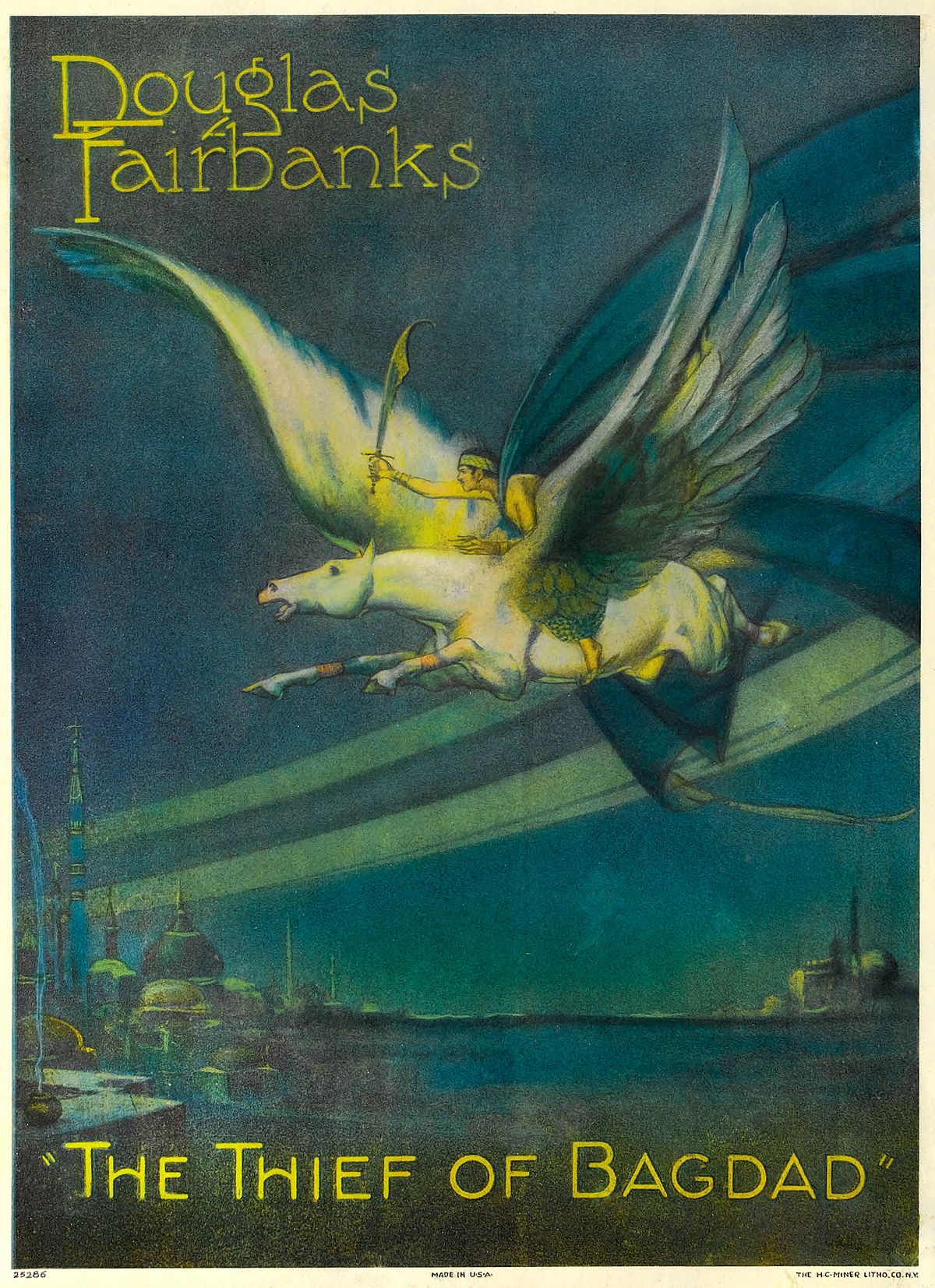
#206) The Thief of Bagdad (1924)

1200px-The_Thief_of_Bagdad_(1924)_-_film_poster

#206) The Thief of Bagdad (1924)

OR “Arabian Splendor”

Directed by Raoul Walsh

Written by Lotta Woods and Elton Thomas (aka Douglas Fairbanks). Based on stories from “One Thousand and One Nights”.

Class of 1996

The Plot: Douglas Fairbanks is the Thief of Bagdad, a man who takes what he wants with no regard to Bagdad or its citizens. His plans to rob the palace change when he glimpses the princess (Julanne Johnston) asleep in her room and falls in love. She is expected to choose her future husband the next day, but the Thief’s attempt to pose as a prince is thwarted by fellow suitor the evil Prince of the Mongols (Sojin Kamiyama). While the princess stalls the other suitors with a quest to find rare treasures, the Thief goes on a quest to become a prince. There are monsters, magic carpets, and so much cultural appropriation in this classic silent fantasy.

Why It Matters: The NFR calls the film “imaginatively awe-inspiring” and praises Fairbanks and the sets. There’s also a loving essay by Joe Morgenstern, film critic and former Mr. Piper Laurie.

But Does It Really?: It’s longer than it needs to be, but ultimately I had a lot of fun watching “The Thief of Bagdad”. This film really takes its time getting started, but Faribanks’ natural charm and impressive stunt work keep the first half interesting while the fantasy elements help carry you through the second half. “Thief” is the quintessential Douglas Fairbanks epic, and one of the few silent films that still works today. No argument here for its NFR inclusion.

Everybody Gets One: Practically everyone that isn’t Douglas Fairbanks. The transition from silent to sound was a real slaughterhouse.

Wow, That’s Dated: No one in this movie is anywhere near Arabic. Hell, even the “Aladdin” remake can’t get it 100% right.

Other notes

  • This film doesn’t seem to be based on any particular Arabian Nights tale. There are elements of “Aladdin”, but if you had to come up with 1001 stories you’d have some overlap too.
  • Star, co-writer, AND copyright holder? Now that’s a Muscle.
  • The film’s overall moral is “Happiness must be earned”. Tell that to millennials.
  • Fairbanks is playing to the back of the house, but it works for a fantasy. He also has a very fluid physicality that lends itself well to the action.
  • I love me some practical silent film effects. The magic rope in particular is some great “how did they do that” trickery.
  • I’m pretty sure Rhoda Morgenstern had the exact same pair of pantaloons the Thief has.
  • Speaking of, I now know what religion Douglas Fairbanks was.
  • It’s whitewashed as hell, but that’s still more American screentime devoted to Muslims than we’ll see for a while.
  • Douglas, stop making that grabbing gesture. We know he’s a thief. It’s in the title!
  • I know there’s some matte paintings involved, but Jesus those sets are amazing.
  • That’s Anna May Wong as the princess’ Mongol slave girl who is in cahoots with Cham Shang. As a Chinese-American, she comes the closest to playing the correct nationality.
  • “Nizzy noodle. He’s turned love-bird!” Is that a direct translation from the original Arabic?
  • Actor Mathilde Comont plays the Prince of Persia in drag. Still not quite sure what that’s about. Could be worse, could be Jake Gyllenhaal.
  • For an ancient patriarchy, it’s nice that they let the princess choose her own suitor. And the rose gives the whole thing a “Bachelorette” quality.
  • That is one giant fucking ape.
  • Fairbanks is looking for a magic chest? If you ask me he’s already got one…
  • What poor animal was forced to play the monster?
  • I thought Ernest Hemingway was “The Old Man of the Midnight Sea”.
  • Surprise cameo by the Tristar logo!
  • I don’t care that you can see the strings, that magic carpet effect still looks cool. I also enjoy the proto-“E.T.” shot of them flying across the moon.
  • My main question about Douglas Fairbanks: How did he do such fantastic stunts…with such little feet?

Legacy

  • Douglas Fairbanks solidified his place as a swashbuckling movie star with “Thief of Bagdad”. He followed up by co-founding United Artists (alongside his wife Mary Pickford), co-founding the Motion Picture Academy, and hosting the first Academy Awards ceremony. And then…sound happened.
  • This film also boosted the career of Anna May Wong, although due to the lack of other Asian-American actors (and good roles for any of them), she spent most of the ‘20s playing variations on the “dragon lady” character she portrays here.
  • “The Thief of Bagdad” was remade in sound and color in 1940. It’s very different, but also fun.

#205) The Band Wagon (1953)

the_band_wagon-669013880-large

#205) The Band Wagon (1953)

OR “Cyd and Fancy”

Directed by Vincente Minnelli

Written by Betty Comden & Adolph Green. Score by Arthur Schwartz & Howard Dietz.

Class of 1995

The Plot: Musical movie star Tony Hunter (Fred Astaire) has hit a dry spell and heads to New York to make his return to Broadway. His composer friends Lily & Lester Marton (Nanette Fabray & Oscar Levant) create a fun musical revue for him to star in, but director Jeffrey Cordova (Jack Buchanan) turns it into an extravagant Faustian spectacle. Tony also takes issue with his leading lady, ballet dancer Gabrielle Gerard (Cyd Charisse), but it’s a ‘50s MGM musical so I think you see where they’re going with this.

Why It Matters: The NFR calls it a “sophisticated backstage toe-tapper” and “one of the greatest movie musicals of all time”.

But Does It Really?: This one gets a “minor classic” designation from me. It’s not the best Fred Astaire movie, nor the best MGM “Freed Unit” musical, but it is still very entertaining. The film seems to be going for a balance between character development and solid production numbers, and partially succeeds on both fronts. Some numbers are more memorable than others, as are some characters. But this is the film that gave us “That’s Entertainment!” so who am I to say no?

Shout Outs: Quick allusions to Fred’s earlier films “Top Hat” and “Swing Time”, plus be on the lookout for a poster for “The Proud Land”, the film featured in “The Bad and the Beautiful” directed by…Vincente Minnelli!

Everybody Gets One: Arthur Schwartz & Howard Dietz don’t have a lot of songs on their resume that are remembered today, but the one they wrote specifically for this film is the one that counts: “That’s Entertainment!” Also along for the ride in this film are supporting players Nanette Fabray and Jack Buchanan.

Wow, That’s Dated: “The New Tony Hunter 1953!” is your first clue. This film is also from that time when a musical revue could succeed on Broadway.

Title Track: No one says the title, but “The Band Wagon” is the name of the show within the film.

Seriously, Oscars?: Not as popular as the other MGM musicals of the era, “The Band Wagon” still managed three Oscar nominations: Scoring of a Musical Picture, Costume Design, and Screenplay for Comden & Green. The film lost to, respectively, “Call Me Madam”, “The Robe” and “Titanic” (no, not that one). For those of you keeping score, “That’s Entertainment!” did not receive a Best Song nomination.

Other notes

  • Despite the title, this is not a movie about my friends who became huge Golden State Warriors fans overnight.
  • Quick side note: This film is related to the 1931 stage version of “The Band Wagon” in name only. The only other holdovers are some of the songs, and Fred Astaire.
  • Surprise Guest Star Ava Gardner! She is doing what appears to be the ‘50s version of the “Weird Al’s on the plane” joke from “Naked Gun”.
  • Lily & Lester Marton are based on the film’s screenwriters: Betty Comden & Adolph Green (who in real life were not a married couple). Jeffrey Cordova appears to be based on actor-director-producer Jose Ferrer who, in the spring of 1952, did have four shows running on Broadway at the same time.
  • I was introduced to “Shine on My Shoes” by its appearance in “That’s Dancing!”. I’ve always found it a delightfully infectious number.
  • There’s some lovely, subtle cinematography happening throughout the film by Harry Jackson. Coincidentally, he was the DP for “Dancing in the Dark”, the other film based on “The Band Wagon”.
  • Hans Conried must have been pissed that he wasn’t cast as Cordova. This seems right up his alley.
  • My favorite part of “That’s Entertainment!” is when Oscar Levant simply walks off-screen as the others start to tap dance. He knows his limitations.
  • Fred has a lovely low-key charm about him throughout this film, but it’s easy for him to get overshadowed by the more, well, theatrical characters he’s surrounded by.
  • Fun Fact: Cyd Charisse was coincidentally married to a guy named Tony during all of this: singer Tony Martin.
  • For a brief moment the production montage turns into the opening of “All That Jazz”.
  • You gotta love a time when people got dressed up for a rehearsal. Not a single pair of sweatpants in sight.
  • The scene of Tony trashing his hotel room is notable for breaking all kinds of records. Thank you!
  • The best line in the film: “Leave it to the horse.”
  • “Dancing in the Dark”. What can I say? It’s damn beautiful.
  • So many production setbacks. “Band Wagon” was the “Spider-Man: Turn Off the Dark” of its day.
  • This is pretty much how most theater parties go down.
  • Today on the Michael Douglas Scale: Fred Astaire is 23 years older than Cyd Charisse.
  • And now the “Best of the Rest” montage for all the Schwartz/Dietz songs they couldn’t shoehorn into the plot.
  • Is Louisiana known for its hayrides?
  • “Triplets” is by far the weirdest number. There’s even the super-meta lyric “MGM has got a Leo”.
  • Shoutout to The Vampire by Rudyard Kipling.
  • I stand corrected: This is one of two appearances on the NFR for Julie Newmar. She’s one of the dancers in the “Girl Hunt” ballet. Next stop, “Seven Brides”!
  • Unless I missed something, the Martons never patch up their quarrel. So much for happy endings.

Legacy

  • Two words: “That’s Entertainment!”
  • Fred Astaire and Cyd Charrise reunited for 1957’s “Silk Stockings”, aka “Ninotchka: The Musical!”
  • The original stage version of “The Band Wagon” is only tangentially connected to this film, but a more faithful stage adaptation of the film played New York in 2014.
  • Michael Jackson referenced this film in a few of his music videos, most notably “Smooth Criminal”.
  • The film’s best homage/spoof came in 1978 when Steve Martin and Gilda Radner did their own rendition of “Dancing in the Dark” on “Saturday Night Live”.