#73) Miracle on 34th Street (1947)

poster-miracle-on-34th-street

#73) Miracle on 34th Street (1947)

OR “The Sanity Clause”

Directed & Written by George Seaton. Based on the story by Valentine Davies.

Class of 2005

Possibly my favorite trailer ever. They released the film in June, so they had to come up with a trailer that didn’t mention Christmas at all. The result is positively “groovey”.

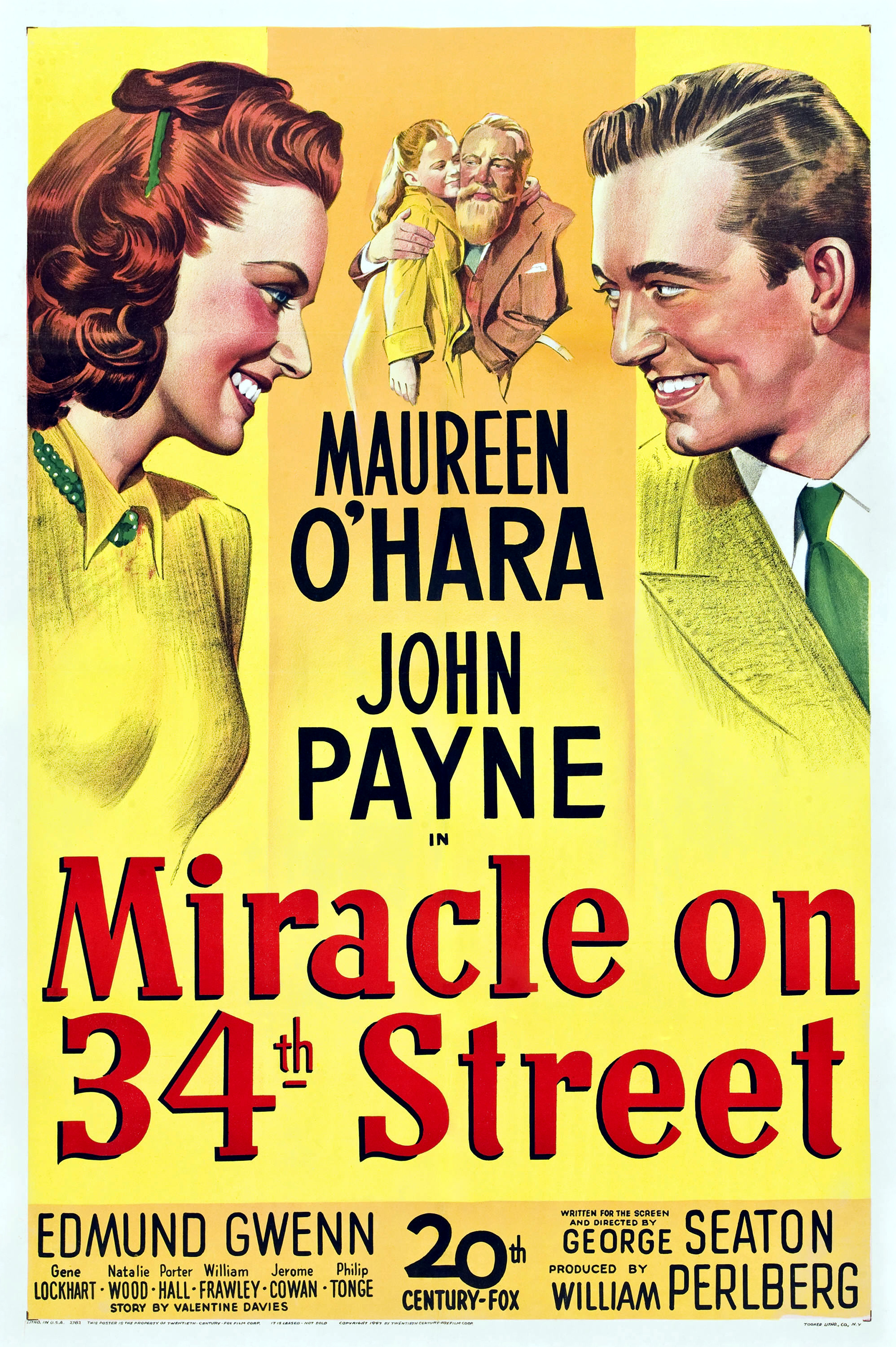
The Plot: Macy’s manager Doris Walker (Maureen O’Hara) hires a man named Kris Kringle (Edmund Gwenn) to play Santa Claus in their store. It turns out the old man believes that he is the real Santa Claus. After an incident involving the store’s psychologist (Porter Hall), Kris is sent to Bellevue. Lawyer/Doris’ neighbor Fred Gailey (John Payne) sets out to legally prove that Kris is Santa. They are aided by Doris’ daughter Susan (Natalie Wood), who has been raised without faith but needs something to believe in.

Why It Matters: The NFR calls it a “holiday favorite” and then explains the entire plot. Geez NFR, I know it’s a classic but it still has spoilers.

But Does It Really?: Full disclosure: This is my favorite Christmas movie. It’s just so infectious. Between an expertly structured screenplay and the most endearing Kris Kringle ever put on film, “Miracle on 34th Street” is wonderfully imbued with the Christmas spirit, with a cast of cynical New Yorkers thrown in for fun.

Everybody Gets One: Amazingly this is the only NFR credit for prolific writer/director George Seaton.

Wow, That’s Dated: Basic psychology tests, paper mail, smoking in bed, a shout-out to the B-29 bomber. But most importantly: Gimbels is gone. Long gone. You’re Gimbels.

Seriously, Oscars?: The film won three Oscars; Best Supporting Actor for Edmund Gwenn (Who said, “Now I know there’s a Santa Claus.”), Best Adapted Screenplay for George Seaton and Best Story for Valentine Davies (still not quite sure how you successfully judge that award). The film lost Best Picture to “Gentleman’s Agreement”, which I don’t see on this list anywhere**.

Other notes

  • That’s right, this perennial Christmas story was written by a guy named Valentine.
  • Isn’t having a complete stranger take over a parade float a major liability issue?
  • Boy, the Macy’s Thanksgiving Parade sure was different in 1947. Where are all the teen pop stars I’ve never heard of? And the performance from Broadway shows that will close in January if this doesn’t boost ticket sales?
  • Dear Natalie Wood, I know you hated being a child actor, but you are damn good in this film. P.S.: You have the best side-eye.
  • Fred’s kind of a creep at the beginning, but he’s charming so it’s okay!
  • Shout-out to Alvin Greenman as Alfred. He really was only 17 when he filmed this, and he is the last surviving cast member.
  • That’s Thelma Ritter in her first film role!
  • This film has perhaps the greatest use of the Dutch language in movie history.
  • Kris listed the reindeer as his next of kin? I guess he and Mrs. Kringle are having a rough patch.
  • I just want to point out that Susan chews gum all through the first part of the film, but then they do the bit where Kris gets gum in his beard and we never see her chewing gum again. That’s a long walk for a little bit.
  • Notice they don’t make Santa swear on the Bible. I suppose the universe would have imploded on itself.
  • Nope, just ignore the giant camera shadow on the pillar of the courtroom.
  • Oh Fred Mertz, you sarcastic buzzard.
  • Susan misspelled “beleeve” in her letter to Kris, but it’s still better than the spelling on most tweets.
  • Let the record show that this film (and Christmas) is saved by Jack Albertson’s character. Hooray for Grandpa Joe-ex-machina!
  • I had always heard that Edmund Gwenn’s final words were “Dying is easy, comedy is hard.” While we may never know the truth, this website’s research shows that he may have said words along those lines to “Miracle” director George Seaton.

Legacy

  • The film has been remade four different times!
  • “The 20th Century Fox Hour” remade the film in 1955 as “The Miracle on 34th Street” starring Thomas Mitchell as Kris. Plus it’s got Hans Conried!
  • Ed Wynn took the reins in a live 1959 TV Special (footage not available).
  • A 1973 TV version unsuccessfully modernized the story with Sebastian “Mr. French” Cabot. And they made him sing!
  • “Miracle” got a big budget theatrical remake in 1994. It stars Richard Attenborough as Kris and makes the story more commercial. Because that’s what it’s all about!
  • In addition to the remakes, Meredith “Music Man” Willson turned “Miracle” into the 1963 Broadway musical “Here’s Love”. The only memorable song in the score is the one he wrote 12 years earlier.

**2017 Update: Oh wait, never mind. There it is.
#72) Duck and Cover (1952)

6665010523_578f0fe029_o
#72) Duck and Cover (1952)

OR “A Nuclear and Present Danger”

Directed by Anthony Rizzo

Written by Raymond J. Mauer

Class of 2004

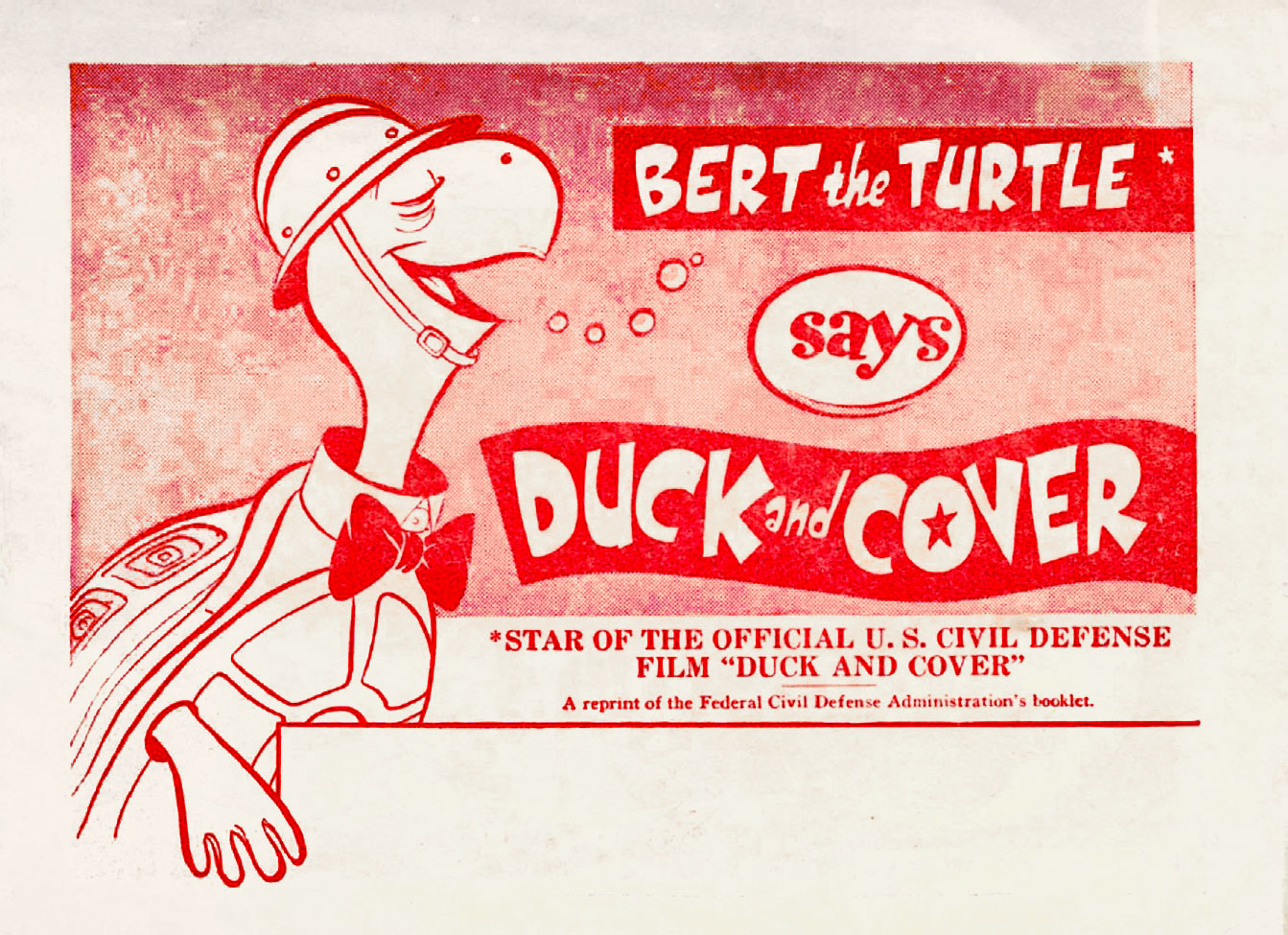
The Plot: An educational short in which Bert the Turtle (voiced by Carl Ritchie) and a disembodied voice (Robert Middleton) teach children that in the event of an atomic bomb, the best thing to do is “duck and cover”.

Why It Matters: The NFR calls the film a “landmark…seen by millions of schoolchildren in the 1950s.” An essay by civil defense film expert Jake Hughes gives a detailed history of the film, as well as more historical context.

But Does It Really?: We can laugh about it now and write films like these off as propaganda, but the threat of nuclear war was very real and permeated America’s entire post-war era. “Duck and Cover” is one of many films that taught safety during an attack, but this is easily the best known and most-watched of them all. The film is included on the Registry with a stronger historical significance than most other films.

Wow, That’s Dated: Ummm…the entire thing?

Take a Shot: Oh no, please don’t make “Duck and Cover” a drinking game. For God’s sake it’s got a jingle!

Seriously, Oscars?: How that jingle didn’t even get a Best Song nomination is beyond me. I still got the damn thing stuck in my head.

Other notes

  • Archer Productions? Well any area attacked by the bomb would be considered a “danger zone”.
  • This is the film that dares to ask the question; Who gave that monkey a stick of dynamite?
  • “People who are walking”. Did they honestly think grade school kids wouldn’t know the word “pedestrian”?
  • Yes, just ask any older person to help you. They’re all qualified to do so, don’t ever question it!
  • So according to this film, protecting myself from the bomb is almost identical to protecting myself from an earthquake. Got it.

Legacy

  • According to Jake Hughes, “Duck and Cover” stopped being circulated to schools around 1957, though many schools and churches with their own purchased copy continued screening the film well into the Cold War’s resurgence in the 1980s.
  • The team that made “Duck and Cover” also worked on another Nuclear-era warning film; the more adult-oriented, noir-esque “Our Cities Must Fight”.
  • Bert the Turtle went into quiet retirement, occasionally being bothered by children asking about Tootsie Pops.
  • Sam Beckett used “Duck and Cover” to save a ‘50s family on an episode of “Quantum Leap”. But even that leap wasn’t the leap home.
  • In 2015, “Duck and Cover” got the Rifftrax treatment.
  • “Duck and Cover” shares a title with my rejected buddy cop screenplay. Frank Cover is a no-nonsense, by-the-book detective paired up with… a duck. I never got further than that.
  • So it turns out that even if you do “duck and cover” during a nuclear attack, you would still probably be killed. So if the bomb ever drops on me, I’m just gonna crank up the Vera Lynn and kiss my sorry butt goodbye.

#71) Patton (1970)

patton_xlg

#71) Patton (1970)

OR “Ol’ Blood and Guts Is Back”

Directed by Franklin J. Schaffner

Written by Francis Ford Coppola and Edmund H. North. Based on the biography “Patton: Ordeal and Triumph” by Ladislas Farago and the autobiography “A Soldier’s Story” by Omar N. Bradley.

Class of 2003

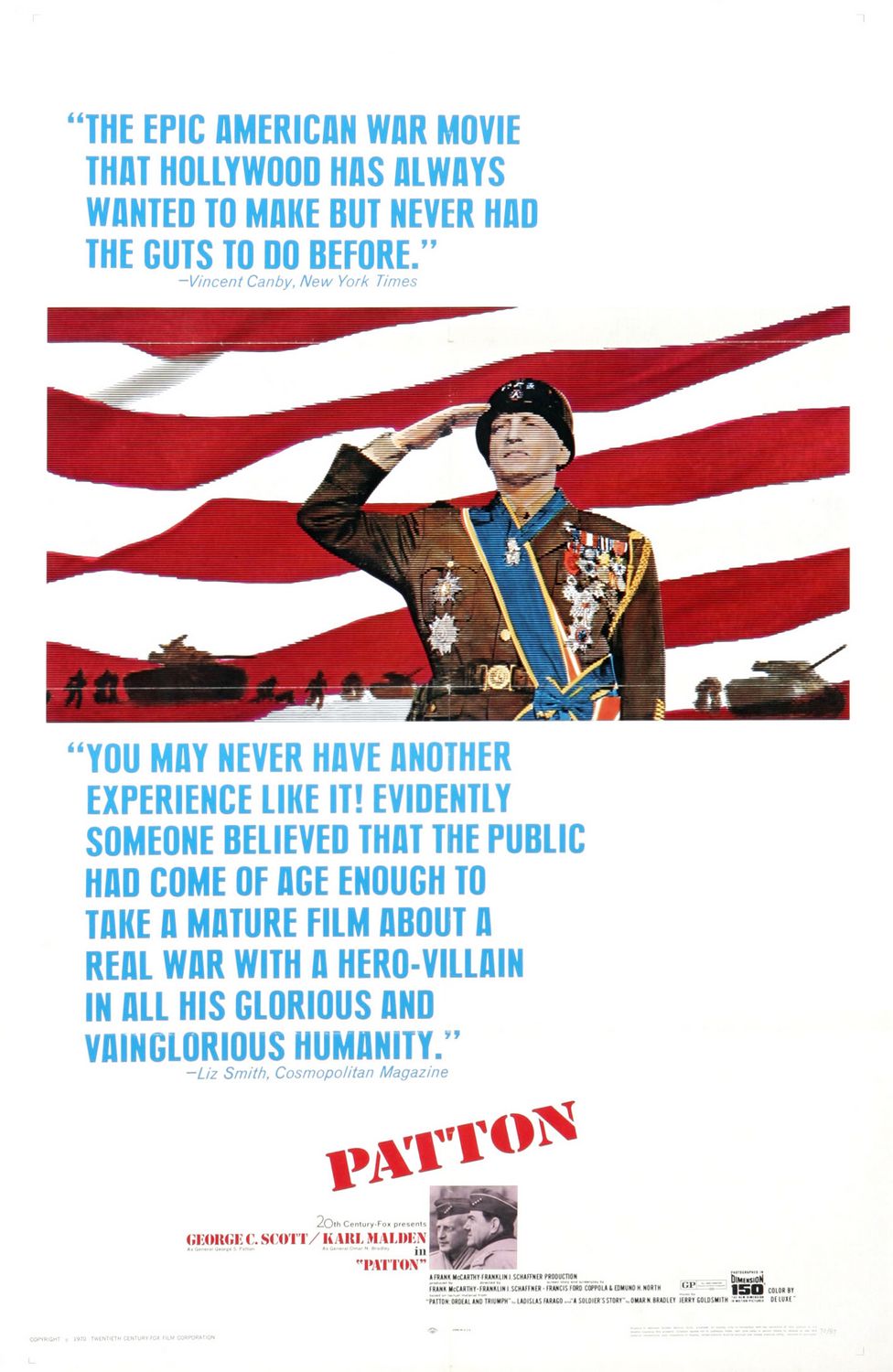
The Plot: The true story of General George S. Patton (George C. Scott) as he spends World War II trying to lead his men into a battle worthy of his idea of war. Along the way he earns the respect of his men and his country, but ends up irritating his colleagues; among them General Omar Bradley (Karl Malden), British Field Marshal Bernard Montgomery (Michael Bates) and the always unseen Commander General “Ike” Eisenhower.

Why It Matters: The NFR calls it “one of Hollywood’s most enduring screen biographies” and praises the work of Schaffner, Scott, Malden, Coppola and North.

But Does It Really?: As an iconic piece of filmmaking “Patton” is top-notch. The main attraction is George C. Scott’s wonderfully layered, complex performance, but underneath that is a genuinely well-crafted film. What could have been a standard biopic that bordered on propaganda has been turned into a surprisingly insightful war epic. It may have lost some of its luster over time (the AFI kicked it off their revised 100 Films list), but “Patton” is a true piece of work that offers a unique perspective of a man who could only thrive in times of war.

Everybody Gets One: That’s Tim Considine from the old “Spin and Marty” show as the solider that Patton slaps in the medical tent. And special mention to Abraxas Aaran as Patton’s dog Willy. What kind of dog name that is I have no idea.

Wow, That’s Dated: “Patton” is one of only two films shot in the curved Cinerama process called Dimension 150. Interestingly enough, the other film, “The Bible: In the Beginning”, also stars George C. Scott.

Take a Shot: For a film whose title is the main character, they don’t say “Patton” as often as you’d think. Most people just call him “George” or “Sir”.

Seriously, Oscars?: At a time when America was divided over the Vietnam War, the Academy firmly embraced a film that, while showing a complexity about war, showcased the glory of a war that could be won. “Patton” took home seven Oscars, including Picture, Director and Original Screenplay (even though it’s based off of two different books. I just don’t understand these things.). George C. Scott won a well-deserved Best Actor Oscar, which he famously declined, telling the Academy he refused to participate in competition among actors. The film’s producer Frank McCarthy gracefully accepted the award, but returned it to the Academy the next day. The Academy held no hard feelings: they nominated Scott again the following year for “The Hospital”.

Other notes

  • For those of you curious about Coppola’s participation in this film, he had written a “Patton” screenplay draft in the mid-60s that got shelved. When Fox wasn’t completely satisfied with Edmund North’s draft, they brought back Coppola’s version and used enough to get him a co-writing credit. The two writers did not work together at any point during this film.
  • Where does one get an American flag that big?
  • The WTF on the side of Patton’s vehicle stands for “Western Task Force”. Nothing else.
  • I appreciate a war movie were the Germans actually speak German.
  • It takes a while for George C. Scott to give us one of his classic explosive line readings, but it finally shows up in “You magnificent bastard I read your BOOK!”
  • Listen carefully for legendary voiceover actor Paul Frees dubbing a handful of minor characters throughout the film.
  • No wonder George C. Scott is perfect casting; Patton plays this war like it’s a chess game, and Scott loved him a good chess game.
  • Is anyone else seeing the bits of hair occasionally stuck in the camera lens?
  • Shoutout to cinematographer Fred Koenekamp. Camera hair aside, there’s some lovely one-take scenes at play here. Also worth mentioning is Jerry Goldsmith’s minimal, but effective score, which has been used and reused many times over the years. Sadly, no Oscar for either of them.
  • Karl Malden successfully sneaks in Sekulovich, his birth name, into one of the battle scenes.
  • I assume there will be a scene where Patton slaps his dog for being too cowardly.
  • If Patton believed in reincarnation, then swearing something upon your life has little to no meaning. Kind of an empty promise.
  • It’s a shame that Franklin J. Schaffner never again reached the same directorial peaks he did with “Patton”. “Papillion” and “The Boys from Brazil” have their supporters, but you’d think the man who helmed this and “Planet of the Apes” would have become the Ang Lee of the ‘70s.

Legacy

  • George C. Scott reprised his most famous role 16 years later for the TV Movie “The Last Days of Patton”, a sequel/prequel.
  • “Patton” was one of Richard Nixon’s favorite films. He viewed it several times during his years at the White House, especially while facing tough decisions regarding the Vietnam War. Spoilers: It didn’t help.
  • There was so much extra battle footage left out of “Patton”, a lot of it was reused for the 1972 TV Movie “Fireball Forward”.
  • Everyone has stood in front of a giant American flag and done a “Patton” parody, but the only one I could get a hold of (The Carson spoof costs money) is this teaser for “Smokey and the Bandit 3” back when it was going to be “Smokey IS the Bandit”. I was not expecting to reference this film on this blog…ever.

Listen to This: He received zero screen time in “Patton”, so listen to Dwight Eisenhower give a radio speech to European citizens regarding the D-Day invasion, preserved by the National Recording Registry in 2002.

#70) Lady Windermere’s Fan (1925)

MV5BNTQ3Yjg5YmItMjQyOC00ZDA2LTk4MzUtYzExNTkyOWZkOTA5XkEyXkFqcGdeQXVyMDI2NDg0NQ@@._V1_SY500_CR0,0,720,500_AL_

#70) Lady Windermere’s Fan (1925)

OR “Wilde Abandon”

Directed by Ernst Lubitsch

Written by Julien Josephson. Based on the play by Oscar Wilde.

Class of 2002

The Plot: Stay with me folks. Lord Windermere (Bert Lytell) is married to Lady Windermere (May McAvoy), who is being secretly wooed by Lord Darlington (Ronald Colman). Meanwhile Lady W. thinks Lord W. is having an affair with Mrs. Erlynne (Irene Rich). In reality, Erlynne is Lady Windermere’s mother, presumed dead after abandoning her family. Lord Windermere is being blackmailed by Erlynne to keep her secret from her daughter. At the same time Erlynne is being pursued by Lord Augustus Lorton (Edward Marindel) who knows nothing about what’s going on. Everything comes to a head at Lady Windermere’s birthday party, where a certain fan plays a key role.

Why It Matters: The NFR praises Ernst Lubitsch’s ability “to translate Wilde’s witty play into a successful silent film”. There’s also an essay by silent film expert and UC Davis professor Scott Simmon. Go Aggies!

But Does It Really?: As much as I enjoyed this film, its NFR inclusion gets a “meh” from me. The film is very impressive as an exercise in translating a very wordy play into a much more visual film, but a classic worth preserving? I don’t know. We’ll see more of Lubitsch throughout this list. In the meantime I’m staying on the fence about all this.

Everybody Gets One: Screenwriter Julien Josephson made a career out of adapting plays and novels into films, earning an Oscar nomination in 1930 for his film translation of the play “Disraeli”. He also wrote the screenplay for the Shirley Temple version of “Heidi”. With the exception of Ronald Colman, most of this cast did not survive the end of the silent era.

Wow, That’s Dated: I don’t think I’ll ever truly understand English high society of the 1890s, er…1920s. Make up your mind, movie!

Other notes

  • Not only does the film eliminate all of Wilde’s dialogue, it reveals that Mrs. Erlynne is the mother almost immediately. You had to wait until the end of the second act to find that out in the play. On top of this, the first half hour of the film isn’t even in the play!
  • Pretty gutsy to call your film a “Classic of the Screen”. I’ll be the judge of that, thank you.
  • Hey, no means no, Darlington!
  • You can’t sign a letter “Yours Very Truly” when you’re blackmailing someone.
  • Mom kinda looks like Diana Rigg.
  • The version of this film that I saw openly samples “Ascot Gavotte” from “My Fair Lady” during the horse race scene. Lerner & Lowe expect a royalty check.
  • Speaking of, when did horseracing go from the sport of the upper class to a place where deadbeats go to have their dreams crushed?
  • No fair Lubitsch, you can’t fade to another shot while in binocular mode! What kind of “Lubitsch Touch” is that?
  • I appreciate how much of this film I understand without having to rely on title cards. Everything I need to know is being told visually.
  • May McAvoy does wide-eyed stare very well. It’s like she’s a deer in the headlights, and she’s pissed about it.
  • Erlynne strikes me as the mom who would try to pass her and her daughter off as sisters. It probably helps that in real life, these two actresses are only eight years apart.
  • This film perfectly showcases how farce on film is all about perspective. We need to see what each character sees and how that specific point of view misconstrues the situation. We have to understand the misunderstandings.
  • Are all the doors in Darlington’s house huge or is everyone just really small?

Legacy

  • “Lady Windermere’s Fan” has been adapted for film on several occasions, most notably 1949’s “The Fan” and 2004’s “A Good Woman”.
  • That other great British wit Noel Coward turned this play into the 1954 musical “After the Ball”.
  • This mathematical nonsense.
  • Had Oscar Wilde lived to see this adaptation throw away all of his dialogue, he probably would have said “I have nothing to declare except, ‘This blows!’”

#69) The Tell-Tale Heart (1953)

tell-tale_002

#69) The Tell-Tale Heart (1953)

OR “UPA: Unique Poe Adaptation”

Directed by Ted Parmelee

Written by Bill Scott and Fred Grable. Based on the short story by Edgar Allan Poe.

Class of 2001


The Plot: James Mason lends his voice to this Edgar Allan Poe classic about an unreliable narrator who murders “the old man” due to his obsession with the man’s slightly deformed eye. He has committed the perfect murder, but will his conscience let him get away with it?

Why It Matters: The NFR mentions Ted Parmelee’s directorial work, as well as the animation of Paul Julian and Pat Matthews, and James Mason’s narration. Interestingly, there are no superlatives (good or bad) regarding any of the work done by the aforementioned. The description just says they worked on the film. Weird.

But Does It Really?: “The Tell-Tale Heart” is a young animation studio proving that it can not be pigeonholed as the studio of “Gerald McBoing-Boing” and “Mr. Magoo”. The film succeeds in not only being a new style of animation for UPA, but also in being very creepy. I give it a pass, and cite it as the reason I’m not sleeping tonight.

Wow, That’s Dated: The whole film has a surrealistic, moving storyboard feel to it. Very ‘50s.

Seriously, Oscars?: “The Tell-Tale Heart” was nominated for Best Animated Short, losing to Walt Disney’s significantly less scary cartoon “Toot, Whistle, Plunk and Boom”. This was one of four Oscars Walt Disney won that night, which is still the record for a single night.

Other notes

  • Even the credits are unsettling.
  • Is there a better marriage between actor and text than James Mason and The Tell-Tale Heart? This performance is a serious example of why the Oscars need a voice-over category.
  • Anyone know who the other voices in this short are?
  • Did you know that Edgar Allan Poe wrote the original “Tell-Tale Heart” on a dare? That’s not true, but wouldn’t it be amazing if it were?

Legacy

  • The Tell-Tale Heart has been adapted for film many times, but any version longer than this one is just Padding City.
  • This diorama;

Further Viewing: This is as good an excuse as any to mention Eddie Izzard as James Mason as God. It’s towards the end of this clip, but it always makes me laugh.