November 16th, 1999: Before everything shuts down for Y2K, it’s time to add more movies to the NFR. Here’s the 1999 roster that brought the National Film Registry to a total of 275 films, plus a pull-quote or two from my write-ups:
Civilization (1916):“an Important Movie of its time that has all but disappeared in the last century”
The Docks of New York (1928):“the third and god-willing final installment of my ‘Maybe I Just Don’t Get von Sternberg’ trilogy.”
Lambchops (1929):“[on the NFR] mainly as a representation of Burns & Allen”
The Emperor Jones (1933):“stands out…with its progressive casting…but the increasingly uneasy racial discussions make for an uncomfortable modern viewing.”
Woman of the Year (1942): “If you’re going to have one Tracy-Hepburn comedy on the list, ‘Adam’s Rib’ is the correct choice, with ‘Woman of the Year’ a distant second.”
Laura (1944): “still packs quite the punch”, “the perfect murder mystery”.
Do the Right Thing (1989): “Yes! Dear God Yes!”, “[the film] is here to wake you up, shake you, and remind you that all is not right with the world.”
Other notes
The Class of 1999 is a slight improvement over the Class of 1998; still a lot of second-tier movies on here for what they represent, but also plenty of iconic no-brainers. We also have a continued dedication by the NFR to include non-narrative features, with a variety of documentaries and shorts. And while diversity was never a major factor in the first decade or so of the NFR’s existence, we do get the first Spike Lee film on the list; only the second film to make the NFR immediately upon hitting its 10-year eligibility after “Raging Bull”.
Also interesting, many of these 25 films have some sort of major romantic element to them, or at least center around a couple with some tension between them. What does that say about that year’s National Film Preservation Board?
One interesting thing mentioned by Dr. James Billington in his 1999 announcement is a “Candidates for the National Film Registry” screening series at the Library of Congress. While I couldn’t find a full list of movies in this series, I found a schedule for Summer 1999, which included future inductees “Raiders of the Lost Ark” and “Do the Right Thing”. Also noteworthy are several titles screened that still haven’t made the NFR over 25 years later, including “The Smiling Lieutenant”, “Written on the Wind”, and “Paris, Texas”. I know this will never happen, but I would love to find out which NFR-less movies have been in the running over the years, or at the very least which one holds the Peter O’Toole/Glenn Close record for most nominations without induction.
When the class of 1999 was announced, the Denzel Washington/Angelina Jolie thriller “The Bone Collector” was number one at the US box office. “Fight Club”, “Being John Malkovich”, and “The Sixth Sense” were also playing in theaters, as were future NFR entries “Boys Don’t Cry” and “Buena Vista Social Club”.
Among this year’s double dippers: Actors Judith Anderson, Ruby Dee, Albert Dekker, Charlton Heston, Strother Martin, and Vincent Price, producer/director Joseph L. Mankiewicz, director George Stevens, cinematographer Joseph H. August, visual effects artist John P. Fulton, and Classic Hollywood mainstays Cedric Gibbons and Edith Head.
Thematic double-dippers: kisses (both “deadly” and “non-deadly”), exotic locales, “cast of thousands” epics, the year 1936, love interests who initially dislike each other, detectives hooking up with suspects, divine intervention, non-professional filmmakers, watershed moments of violence, Depression-era politics, and the Ten Commandments (think about it…). We also get two entries this year with the Wilhelm scream.
Favorites of My Own Subtitles: At Faith Value, I Can’t Believe It’s Not Butler!, Love at First Draft, Veni Vidi Vespa, Moses Proposes, Brains Supreme, The Dirty Half-Dozen, and Long Day’s Heat Wave Into Night.
Oh man, now I got “Livin’ la Vida Loca” stuck in my head and I have no one to blame but myself. I’m also having a weird case of déjà vu.
And with that, I have watched every film inducted into the NFR in the 20th century. Well…technically the 20th century ended on January 1st, 2001, so I guess I have a few more movies to go. Whatever, I’m celebrating now. Thanks for reading; see you next week!
Written by Peckinpah and Walon Green. Story by Green and Roy N. Sickner.
Class of 1999
The Plot: On the Tex-Mex border in 1913, a group of aging outlaws led by Pike Bishop (William Holden) pull one last job robbing a railroad payroll office. After a violent showdown, Pike and his surviving men (Ernest Borgnine, Warren Oates, Ben Johnson, Jaime Sánchez) return to their hideout, only to learn the robbery was a set-up and that the “silver” they stole are worthless washers. Needing one more job to retire, the bunch, along with the crotchety Freddie Sykes (Edmond O’Brien) head to Mexico and strike a deal with General Mapache (Emilio Fernandez) to rob a train transporting U.S. Army ammunition so the General can continue his fight against Pancho Villa and the Mexican Revolution. All the while, Pike and his men are being pursued by bounty hunters led by Pike’s former partner Deke Thornton (Robert Ryan). Released just as Old Hollywood was dying out, “The Wild Bunch” showcases a Wild West in its final days, mixed with some of the bloodiest action sequences ever filmed.
Why It Matters: The NFR write up for “The Wild Bunch” is brief but flattering, calling it no less than “a true American classic”, praising Peckinpah, the cast, the cinematography, and the editing. An essay by film critic Michael Wilmington is equally effusive.
But Does It Really?: “The Wild Bunch” is one of the last “established classics” on the Registry that I had never seen before, and I enjoyed it. The film succeeds as the next evolutionary step for the western, with a realism and grittiness that would have been unthinkable just a few years earlier. Yes, the violence is intense, but it’s reserved for a handful of sequences, and the rest of the film is filled out with great performances by the entire ensemble and a script with much to say about loyalty and morality at the end of a lawless era. “The Wild Bunch” isn’t the greatest movie ever made, but it should absolutely be considered among the greats, and its NFR inclusion is a no-brainer.
Everybody Gets One: The original story of “The Wild Bunch” came from Roy N. Sickner, a stuntman who had doubled for the likes of Marlon Brando and Richard Harris. Sickner conceived the role of Pike for his friend Lee Marvin, who agreed to play the part, but bowed out for a bigger paycheck in “Paint Your Wagon”. The initial screenplay was written by documentarian Walon Green before being fleshed out by Sam Peckinpah. “The Wild Bunch” was Green’s first produced screenplay and Sickner’s sole writing credit.
Seriously, Oscars?: Despite its controversy, “The Wild Bunch” received two Oscar nominations: Best Original Screenplay and Best Original Score, losing both to “Butch Cassidy and the Sundance Kid”. Sam Peckinpah’s screenplay nod was the only Oscar nomination of his entire career.
Other notes
When we last saw Sam Peckinpah, he had parlayed the success of “Ride the High Country” to direct “Major Dundee”, but that film was recut by the studio, and stories of Peckinpah’s difficult on-set behavior got him fired from his next project, “The Cincinnati Kid”. Desperate for work, Peckinpah returned to TV, receiving critical praise for his adaptation of the short novel “Noon Wine”. This got the attention of Kenneth Hyman and Phil Feldman at Warner Bros., who courted Peckinpah to direct the African adventure film “The Diamond Story”. Peckinpah agreed and proposed “The Wild Bunch” as a backup project. Warner Bros. noticed the similarities between “Wild Bunch” and “Butch Cassidy” (in pre-production at 20th Century Fox) and let Peckinpah go ahead with “Wild Bunch” to have it released before “Butch Cassidy” (“The Diamond Story” was never produced).
With “The Wild Bunch”, Peckinpah wanted to make a western with more realistic gun violence in the wake of the Production Code’s dissolution in favor of the MPA rating system. He was inspired by the brief but unflinching violence in “Bonnie and Clyde”, as well as the gruesome imagery of the ongoing Vietnam War being broadcast on the nightly news. Peckinpah more than succeeds at creating the film’s unforgettable violence, aided by the cinematography of Lucien Ballard, who experimented with various frame rates to draw out the bloodshed for maximum impact. Bonus shoutout to editor Lou Lombardo; at a time when the average movie had less than 1000 cuts, “The Wild Bunch” contains anywhere from 1800 to 3600, including some that last a fraction of a second. These quick cuts enhance the overall chaos of the film’s action.
This movie hooked me in the opening credits as the bunch make their way to the train office posing as Cavalry men. It’s a lovely display of tension, mixed with Jerry Fielding’s excellent score and some interesting freeze-frame negative images over the credits. It’s all capped by Pike’s order of “If they move, kill ‘em”, followed by Peckinpah’s directing credit.
This opening shootout has a lot going for it, and I’m sure in 1969 it was an intense sensory overload. Even amid the bedlam, Peckinpah establishes some key character dynamics and story elements, an incredible feat in and of itself. Also, even though Peckinpah avoided using Warner Bros.’ stock sound effects for this movie, listen closely for a Wilhelm.
If you were a classic Hollywood star in the late 1960s as New Hollywood started taking over, your options were A) embrace the change, B) resist and decry the change, or C) retire. The likes of Holden and Borgnine were about 15 years past their movie star prime by 1969, but they clearly went with option A, relishing the chance to play more nuanced characters and mutter things like “son of a bitch” and “you lazy bastard”. As leader of the bunch, Holden is the glue keeping everything together, and can convey all you need to know about Pike with a simple look or a raise of his eyebrow. Holden’s understated work is nicely balanced by Borgnine’s bigger performance as Dutch. He’s not at a “Poseidon Adventure” level of hamminess, but he’s very explosive and emotive by comparison, crucially never crossing the line into overacting.
The rest of the bunch is…also there. As the Gorch brothers, Ben Johnson and Warren Oates are fine, but thankfully they have more noteworthyperformances in their near future. Jaime Sánchez does okay as the hotheaded young buck Angel, and Edmond O’Brien is having fun as the kind of Walter Brennan-type comic relief these movies are required to have.
My viewing of “The Wild Bunch” was of the “Director’s Cut”, which features 10 minutes of sequences cut after the film’s premiere without Peckinpah’s input or approval. Amazingly, it wasn’t the carnage that was initially excised, but rather quieter scenes that served as supplemental character development. Among those cuts: a flashback explaining Pike’s falling out with Deke Thornton. Why would you cut that? We need that!
Robert Ryan is playing a much more internal character than his other NFR work, but he’s always a welcomed sight, speaking volumes with his permanent hangdog look. Among the members of Deke’s posse are Peckinpah go-to L. Q. Jones, and Strother Martin in one of his more grating performances.
“The Wild Bunch” was filmed entirely in Mexico, which means that at long last we have an NFR movie where the Mexican characters are played by actual Mexicans! The one exception is Puerto Rican Jaime Sánchez, who Peckinpah cast after seeing his performance in “The Pawnbroker”.
General Mapache is played by Emilio Fernandez, who longtime readers may remember as the director of “La Perla”. Is it me or does he kinda look like Adolphe Menjou?
Yeah, Peckinpah had issues with women. Every woman in this movie is either a literal whore or is treated as such, and several of them have violent on-screen deaths. Men would rather create a watershed revisionist western than go to therapy.
The next big action sequence – the bunch’s train robbery – isn’t until the movie’s halfway point, and is another compelling sequence, played out with almost no dialogue. The subsequent chase scene is another reminder of how much easier crossing the US/Mexico border used to be.
Thanks to my viewing of “La Venganza de Pancho Villa” for this blog, I had a general idea of where the Mexican Revolution fit into all of this. While Pancho Villa doesn’t make an appearance here, he gets name-dropped a few times, and his troop attacks Aqua Verde in yet another scene cut from the theatrical release.
In addition to all the action this movie has, it contains a healthy dose of juicy dialogue, most of it mumbled in a way that, while appropriate for these characters, doesn’t give you the time to fully appreciate it. My favorite exchange (and one of the film’s main theses) is between Dutch and Pike about Deke: “He gave his word to a railroad.” “It’s his word.” “That ain’t what counts! It’s who you give it to!”
The film’s most iconic non-violent scene is a shot of Pike, Dutch, and the Gorch brothers, weapons in hand, walking down a street en route to rescue Angel from Mapache. It’s a simple moment that does an excellent job of ramping up the tension in anticipation of the inevitable showdown. Most remarkably, the sequence wasn’t in the script, with Peckinpah creating it on the day.
The final shootout is what I assume the ending of “Butch Cassidy” could have been. Most remarkably, it doesn’t last that long. Maybe five minutes? In any other movie it would have been 20 minutes minimum. And no spoilers, but the last line of this movie is Edmond O’Brien’s cackling. Always leave ‘em laughing, I guess.
Legacy
“The Wild Bunch” opened in June 1969, three months before “Butch Cassidy and the Sundance Kid”. While “Wild Bunch” ultimately trailed behind “Butch” at the box office, it was still a financial hit, recouping its budget with a profit of about $3 million. Critics at the time were mixed on “Wild Bunch”, with its violence serving as the major dividing line. Since 1969, “The Wild Bunch” has received near-universal acclaim, frequently popping up in lists and polls of the Greatest Movies Ever Made (it is tied at #136 on the 2022 Sight & Sound Greatest Films poll).
Sam Peckinpah followed up “The Wild Bunch” with the significantly less violent “The Ballad of Cable Hogue”. Subsequent Peckinpah films include “Straw Dogs”, “The Getaway”, and “Bring Me the Head of Alfredo Garcia”, most if not all of which generated some form of controversy around the film’s content or Peckinpah’s behavior. Sam Peckinpah died in 1984 at age 59 from heart failure.
Walon Green has a handful of post-“Wild Bunch” screenplays to his name, including “Sorcerer” and “Eraser”, but his primary writing has been for such TV shows as “NYPD Blue” and “Law & Order”. Green also directed the documentary “The Hellstrom Chronicle”, for which he won an Academy Award. And because I have nowhere else to put this: Walon Green is the man with a millipede crawling over his face during the weird tunnel scene in “Willy Wonka”.
“The Wild Bunch” continues to get referenced, or at least alluded to, in practically any movie with a violent standoff. More overt references popped up on “Buffy, the Vampire Slayer”, which featured characters named Angel and Lyle & Tector Gorch. As for direct parodies, it begins and ends with Jim Reardon’s “Bring Me the Head of Charlie Brown”.
Hollywood has been threatening us with a remake on-and-off for the last 20 years, at times attaching such names as Tony Scott, Will Smith, and Mel Gibson (!), but thankfully it has stayed in development hell where it belongs.
And finally, Peckinpah’s goal with the excessive violence of “The Wild Bunch” was to so overwhelm the audience that they never wanted to see on-screen violence again. Unfortunately, moviegoers loved the violence, and the movies have spent the last 50-plus years out-goring themselves. Not every great movie’s legacy is what the filmmakers intended.
Further Viewing: Even this film’s making-of documentary is good! Consisting of 16 mm footage of the film’s production in Mexico, Paul Seydor’s “The Wild Bunch: An Album in Montage” was released in 1996 and nominated for the Best Documentary Short Oscar.
Wow, 750 movies. How the time flies. Thanks as always to you for reading this. Onward!
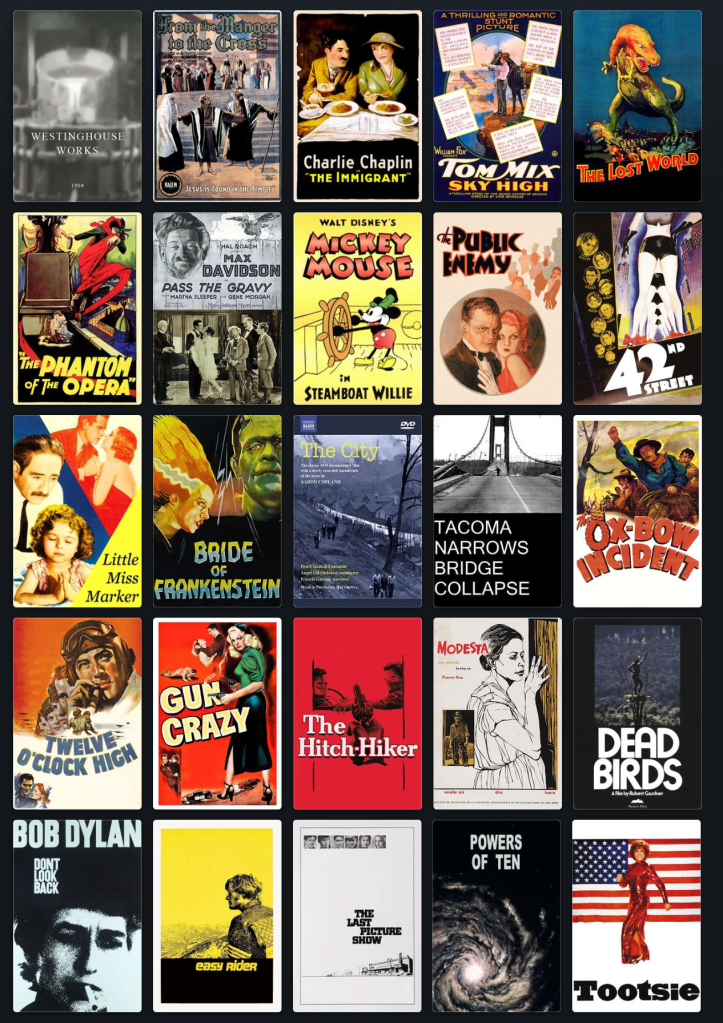
November 16th, 1998: The National Film Registry celebrates 10 years of adding movies to a list by adding 25 movies to their list, making it an even 250 for the Registry. Here’s the Class of 1998, along with snippets from my write-ups on these films:
We don’t have any footage of the official NFR announcement (perhaps they learned their lesson from the previous year), but we do have an article from the Library of Congress newsletter telling us that Librarian of Congress Dr. James Billington headed west and made the 1998 announcement at the Academy of Motion Pictures Arts and Sciences library in Los Angeles. Among those in attendance were several National Film Preservation Board members including Alan Bergman, Fay Kanin, and Leonard Maltin, as well as “Twelve O’Clock High” star Gregory Peck. It’s interesting to see the NFR trying to figure out what exactly the announcement is, dipping their toe into a bigger event a la the Oscar nominations. Ultimately, their current practice of a press release and a corresponding video works best.
While the Class of 1997 featured plenty of big, iconic movies, the Class of 1998 primarily consists of films that live in the shadow of movies already on the Registry. We have the stepping stone films of directors already on the list, films that represent stars that are important but not essential figures in movie history, plus one that is the sequel to another NFR movie (iconic in its own right, but still a sequel). What this list lacks in heavy hitters, however, it makes up for with its eclecticism: actuality footage, a comedy short, an animated short, amateur disaster footage, New Deal propaganda, several independent productions, an ethnographic film, a concert documentary, and whatever the hell “Powers of Ten” is. We even get one entry produced by and filmed in a U.S. territory, which is still a rarity on the list.
There seem to be a disproportionate number of my write-ups on this year’s movies that I tackled in the first year of the blog, before I had settled on the blog’s more informative than irreverent tone. I have dogeared most of these for a re-write in the future. Stay tuned.
When the Class of 1998 was announced, the number one movie at the US box office was the Adam Sandler comedy “The Waterboy”. Also in theaters that week was future NFR entry “Saving Private Ryan”, and a re-release of “The Wizard of Oz”. Other notable films in release include “Rush Hour”, “Pleasantville”, and “Practical Magic”; all of which, and I can’t stress this enough, were outgrossed that weekend by “The Waterboy”.
Also worth noting that five months earlier “Easy Rider” and “Tootsie” were included on the AFI’s list of 100 greatest American films, along with 66 other NFR entries (with another 29 to come).
This year’s creative double dippers: Producers Carl Laemmle Jr. and Darryl F. Zanuck, actors Morris Carnovsky and Frank Conroy, songwriter Bob Dylan, director William A. Wellman, and editor Donn Cambern (though it is debated how much Cambern contributed to the editing of “The Last Picture Show”). This list also gives us three generations of Fondas: Henry, Peter, and a brief appearance by Bridget. Still no Jane anywhere on this list, but that’s another story.
Thematic double dippers: Universal monsters, animal abuse (most of it directed at chickens), angry mobs, films shot outside the United States, extra-marital affairs, border crossings, westerns with ineffectual threats, overall disregard for a film’s leading lady, cars/motor vehicles as a primary setting, films that premiered at a World’s Fair, and disputed screenplay credits.
Favorites of my own subtitles: Steel This Movie, Savior the Moment, The Land During Time, Why the Lon Face?, Word of Mouse, The Very Model of a Modern Major Capital, and The Robber Bride and Groom.
I can admit now that I was high while watching “Easy Rider” for this blog. Nothing crazy, just a brownie. I thought it would help!
And of course, it bares repeating that “Steamboat Willie” was inducted into the NFR just a few weeks after Congress had passed the Copyright Term Extension Act, which pushed the film’s copyright expiration from 2003 to 2024. Disney strongly pushed for this extension and similar proposals in the past, to the point that the ’98 act was called the Mickey Mouse Protection Act by critics. Since my initial write-up in 2017, “Steamboat Willie” finally lapsed into the public domain, though it has unfortunately joined the growing list of public domain titles that immediately receive a cheap horror movie.
That’s too depressing to end this post on, so let’s revisit a favorite of mine from the “Dont Look Back” post: “Sebastian Cabot, Actor. Bob Dylan, Poet.” Let’s see you pursue that kind of greatness, Timothée Chalamet!
The Class of 1999 recap is coming very soon, as is this blog’s 750th movie! And if you’re following along, you should be able to guess what it is…
Written by Doniger, Luis A. Maisonet, and René Marqués. Story by Domingo Silas Ortiz.
Class of 1998
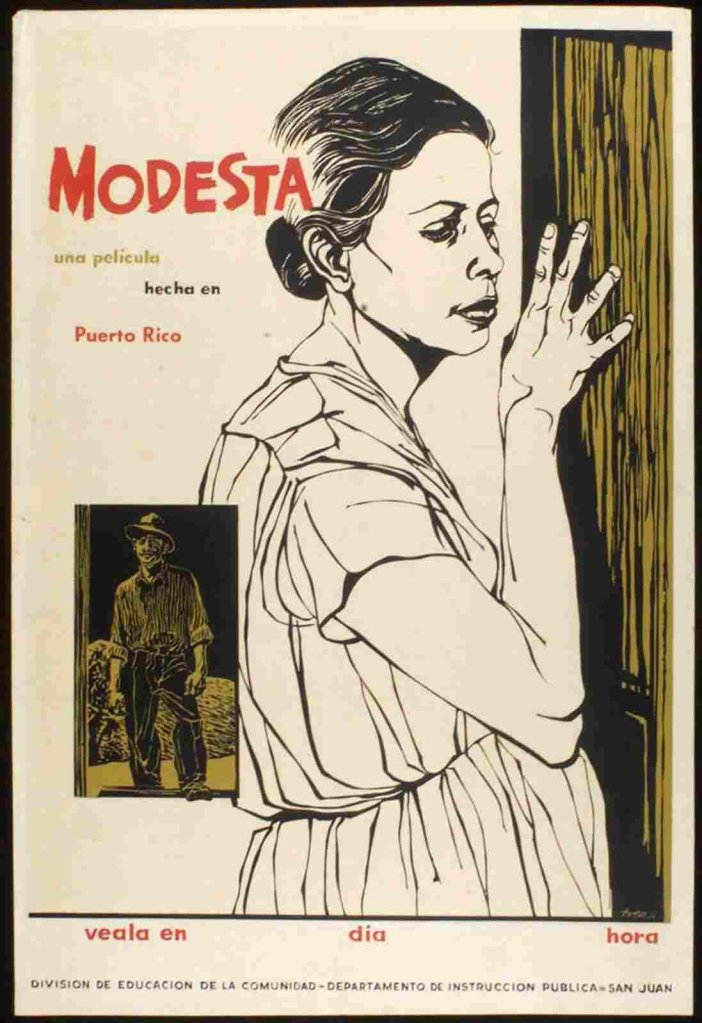
The Plot: Modesta (Antonia Hidalgo) is a housewife in a Puerto Rican barrio looking after her husband (Juan Ortiz Jiménez) and their three children with a fourth along the way. One day Modesta’s husband orders her to kill one of their chickens and cook it for dinner while he’s at work. Modesta fails to capture the chicken, and when her husband comes home and berates her for it, Modesta picks up a nearby large stick and hits him over the head with it. News of this spreads quickly in the barrio, and Modesta is soon joined by the neighboring housewives to form the League of Liberated Women, demanding equal status in their marriages, and equal responsibilities from their husbands regarding housekeeping and childcare. Brought to you by Puerto Rico’s División de Educación de la Comunidad, aka the Division of Community Education.
Why It Matters: The NFR write-up is primarily historical background on Puerto Rico’s Division of Community Education and the films they produced throughout the 1950s and 1960s. “Modesta” is singled out for being “[f]eminist at its heart”, and director Doniger gets a shout out. An essay by NFR aficionado Daniel Egan is pretty much all the information we have about “Modesta” and its production.
But Does It Really?: There aren’t a lot of NFR movies filmed in U.S. territories (the only one I can think of is “The Chechahcos” in the then-territory of Alaska), so “Modesta” automatically achieves a unique status on the NFR thanks to its Puerto Rican production. The film itself is a simple fable handled decently if not remarkably, but it goes by quickly enough that it’s hardly worth griping about the film’s shortcomings. Of the dozens of films produced by the Division of Community Education, I don’t know why “Modesta” was the one chosen to represent them on the NFR, but I’m glad it was.
Everybody Gets One: Not a lot of information about Benjamin Doniger or why and how this native New Yorker ended up making movies in Puerto Rico. Prior to his work in Puerto Rico, Doniger served as cinematographer and/or camera operator on a few shorts including “The Cummington Story” and “Journey Into Medicine”. Some sources (including the NFR write-up) state that Doniger was the cinematographer on fellow NFR film “Louisiana Story”, though his only on-screen credit on that film is for sound (the credited cinematographer for “Louisiana” is Richard Leacock). Doniger’s entire directorial filmography consists of films made in Puerto Rico from 1953 to 1959, with “Modesta” being his second film as director.
Title Track: Modesta roughly translates to “humble woman”, which as we see is a very ironic title. “Modesta” should not be confused with Modesto, the California city near my hometown of Stockton. Modesto is the city Stocktonians make fun of to feel better about ourselves.
Seriously, Oscars?: No Oscar nod for “Modesta”. For the record, the 1956 Oscar for Best Live Action Short Subject, Two-Reel went to “The Bespoke Overcoat”, which is one of the most British titles I’ve ever come across. Some sources claim that “Modesta” won a prize at the 1956 Venice Film Festival, but I can’t find anything official to back that up.
Other notes
I can’t get into the rich and complex history of Puerto Rico in this write-up, but for our purposes here we’ll begin in 1898 when Puerto Rico became a U.S. territory following the Spanish-American War (Puerto Rico had been part of the Spanish Empire up to that point). Recognition of Puerto Rico as part of America has been slow-going; Puerto Ricans weren’t recognized as U.S. citizens until 1917 and didn’t officially become a self-governed territory until the early 1950s. Although Puerto Rico has a Governor and other elected officials, it does not have statehood or representatives in the House or Senate, and Puerto Ricans cannot vote in federal elections (such as the U.S. Presidential elections). On the plus side, very few Puerto Ricans are subject to federal taxes. Anything else I know about Puerto Rico comes from “Progress Island, U.S.A.” Progress!
Although Puerto Rico had been producing films since the 1910s, almost all their early efforts have been lost to time. Following the election of Luis Muñoz Marín in 1949 (Puerto Rico’s first elected governor), the Division of Community Education was established to promote social reform through radio, books, and yes, film. Between 1950 and 1975, 65 shorts and two features were produced by the Division of Community Education, all filmed in Puerto Rico using locals as actors.
“Modesta” was filmed in Sonadora, a barrio in Guaynabo. To the best of my knowledge, both Antonia Hidalgo and Juan Ortiz Jiménez were locals, and while this is Hidalgo’s only film credit, Jiménez had a few others over the years. Outside of our two leads, the only other acting credit goes to the catch-all credit for the “los vecinos del barrio Sonadora de Guaynado” (roughly translated to “the Barrio Sonadora community”). I could not find any credit for the narrator, who does a good job of establishing the film’s fable sensibility; he even says “habia una vez” (“Once upon a time”).
Obviously, “Modesta” is entirely in Spanish, so once again I resorted to an auto-translate of YouTube’s Spanish subtitles. It wasn’t perfect, but it did the job. It helped that everyone in this movie speaks deliberately and a little stilted, which makes the dialogue clearer and therefore gives me a better chance at an accurate translation.
As pointed out in the NFR write-up, the cinematography highlights the natural beauty of Puerto Rico, while simultaneously glossing over its poverty. Of course, the film isn’t here to address the territory’s poverty issues, but its optimistic message gives you hope that conditions will improve (and they have). Incidentally, the cinematographer for “Modesta” was the film’s co-writer Luis A. Maisonet, a native Puerto Rican.
Something I never expected to see in an NFR short: cockfighting! Nothing too graphic, thank goodness, but it still feels illegal to be watching this footage.
The husband is pretty dickish from the start, so I very much enjoyed watching Modesta finally hit him with that stick. Right on, woman!
This is followed by what I call the “Pick-a-little talk-a-little” section, where all the local housewives spread the word of Modesta’s defiant act against her husband. It’s a fun sequence, but please movie, no more close-ups of people’s mouths as they’re talking.
The film’s second half is mostly the newly formed League of Liberated Women meeting and discussing their agenda with the men of the neighborhood. It’s a lot like the local access broadcast of your city council meeting; a whole lot of talking about taking action without actually taking action. It’s a bit of a chore to get through, but the point of the movie is an emphasis on these ideals and not necessarily the entertainment factor.
Legacy
While their film production slowed down in the 1970s, the Division of Community Education continued commissioning other forms of art until its closure in 1989.
In recent years, more efforts have been made to grant Puerto Rico statehood. A majority of Puerto Rican citizens support statehood, as does their recently elected Governor Jenniffer González-Colón. Unfortunately, statehood is granted by the U.S. Congress, which, as previously mentioned, has no representatives from Puerto Rico and therefore no urgent reason to consider statehood.
Outside of its initial release in 1956 and its NFR designation in 1998, “Modesta” has more or less disappeared from the public film forum, though thankfully its spot on the Registry guarantees the film a write-up from dweebs like me every couple of years. Puerto Rico wouldn’t get a visible spot in pop culture until a certain Broadway musical made by very White creatives came into being.
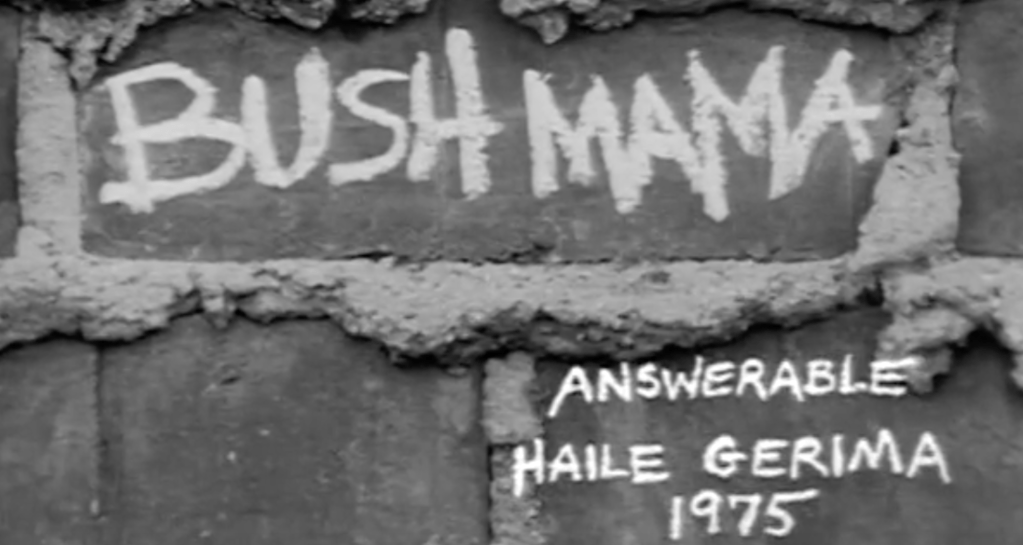
As of this writing, “Bush Mama” can be viewed on Internet Archive.
The Plot: Dorothy (Barbara O. Jones) is a Black woman living in L.A’s Watts neighborhood with her husband TC and their daughter Luann (Johnny Weathers and Susan Williams). TC is a Vietnam vet that has had difficulty finding work, and when a promising new job finally appears, TC is arrested before his first day for a crime he didn’t commit. Now an unemployed single mother with a second child on the way, Dorothy navigates the complicated world of welfare living, while simultaneously being radicalized by her husband’s prison letters and the ongoing political unrest in her neighborhood.
Why It Matters: The NFR gives a rundown of the film and Haile Gerima, stating that the film “resonates as a haunting look at inner city poverty”. The write-up also erroneously lists the film’s release date as 1967.
But Does It Really?: Oh I am very out of my element with this movie. Admittedly, “Bush Mama” is operating on a number of levels I can’t fully comprehend on a first viewing, and tackling such massive issues as race, welfare, and police violence that are far beyond the scope of this little film blog. Still, I appreciated the opportunity to watch a movie so drastically different from almost anything else on this list: marrying a realistic depiction of a struggling woman with some artistic flourishes throughout. I’ll add “Bush Mama” to the list of NFR movies I respected more than I enjoyed, though obviously this film isn’t aiming to be a piece of entertainment but rather something more contemplative. In addition to its inherent uniqueness, “Bush Mama” makes the NFR cut as representation of truly independent filmmaker Haile Gerima, an unsung figure of the L.A. Rebellion.
Everybody Gets One: Born and raised in Ethiopia, Haile Gerima grew up watching Hollywood movies, but had no idea that filmmaking was a career option. As a young adult, Gerima moved to Chicago to study theater, though after a few years moved to California and studied film at UCLA. Gerima quickly became part of the L.A. Rebellion, a group of Black filmmakers focusing on a more realistic and political depiction of Black life as counterpoint to the rise of Blaxploitation movies. The idea for “Bush Mama” came to Gerima a few years earlier in Chicago, when he witnessed a Black woman getting evicted from her house in the middle of winter. Gerima filmed “Bush Mama” in 1975 as his thesis project, though it would not get an official release until 1979.
Other notes
We’re off to a promising start with a cacophony of social workers asking the same standard questions over and over, mixed with Dorothy walking through Watts, culminating with footage of a Black man receiving a “stop and search” from the LAPD. This opening is even more interesting when you learn that the man being searched is director Haile Gerima, who was actually stopped by the LAPD when they declared the film shoot “suspicious”. Not exactly a Hitchcock cameo.
As with many other NFR films by the L.A. Rebellion, different members supported each other’s productions. In this case, the legendary Charles Burnett served as cinematographer for “Bush Mama”.
Longtime readers may remember Barbara O. Jones (later known professionally as Barbara-O) as part of the “Daughters of the Dust” ensemble. As Dorothy, Jones grounds the film, and does a great job of looking forlornly off into the distance, something her character seems to do every five minutes. Fellow “Daughters” cast member Cora Lee Day also makes a strong impression in this film as Molly the social worker.
There were a lot of things I enjoyed visually about “Bush Mama”, from its semi-improvised one take scenes (a hallmark of any low-budget production), to its photo negative transitions. In a film that could easily have been people sitting around and talking, Gerima (and cinematographers Charles Burnett and Roderick Young) keeps things visually engaging. Also keeping things interesting is the film’s non-linear (or is it?) story structure.
The film features a very ‘70s score from Onaje Kareem Kenyatta, their only credited film as a composer (and their only credited film, period.) My one gripe is the very on-the-nose lyrics to a sequence of Dorothy walking the streets alone: “woman walking the streets alone”, etc. They even sing the name of the movie! “Welfare sister, hey Bush Mama”. It reminded me of the Randy Newman bit on “Family Guy” (“Left foot, right foot…”).
The second half of “Bush Mama” definitely takes a turn. As the film starts to focus more on Dorothy’s pregnancy and whether or not she should have the baby, its visual language shifts from its established neorealism to something more experimental and theatrical (I guess that was inevitable from a former theater major and the son of a famous Ethiopian playwright). Side note: The close-up shots of Dorothy’s pregnant belly gave me “All My Babies” flashbacks, and I was convinced I was going to see another live birth.
Technically this movie has an uplifting ending, but it’s presented in the bleakest way possible. No spoilers, but Dorothy is ultimately broken by the system, which completes her radicalization and motivates her to fight back. While I got the gist of it, a lot of the details went over my head and the ending didn’t deliver the way I think Gerima intended. Still, the last few minutes of this movie have stuck with me in a way not a lot of other NFR movie endings have, so “Bush Mama” is doing something right.
Legacy
Fully aware that his options in Hollywood were practically nonexistent, Haile Gerima and his wife Shirikiana Aina focused on financing their own films outside of the studio system with money from teaching jobs (Gerima taught film at Howard University for many years). Gerima’s filmography is limited, but in 1993 he made what is widely considered his masterpiece, “Sankofa”, about a Black model who travels back in time and experiences the horrors of the African Slave Trade. Sankofa is also the name of the bookstore and café the Gerima’s own in Washington D.C., which is still around, by the way.
Upon its initial release, “Bush Mama” received some critical praise, but quickly disappeared. Even within the niche filmography of the L.A. Rebellion, “Bush Mama” has been underrepresented; not receiving any major physical media release and often being excluded from lists of noteworthy L.A. Rebellion films. It has only been in very recent years that “Bush Mama” has started getting its due acclaim, thanks not only to its NFR induction, but also to its 2021 screening at the Academy Museum after being championed by Ava DuVernay, a longtime admirer of Haile Gerima.