
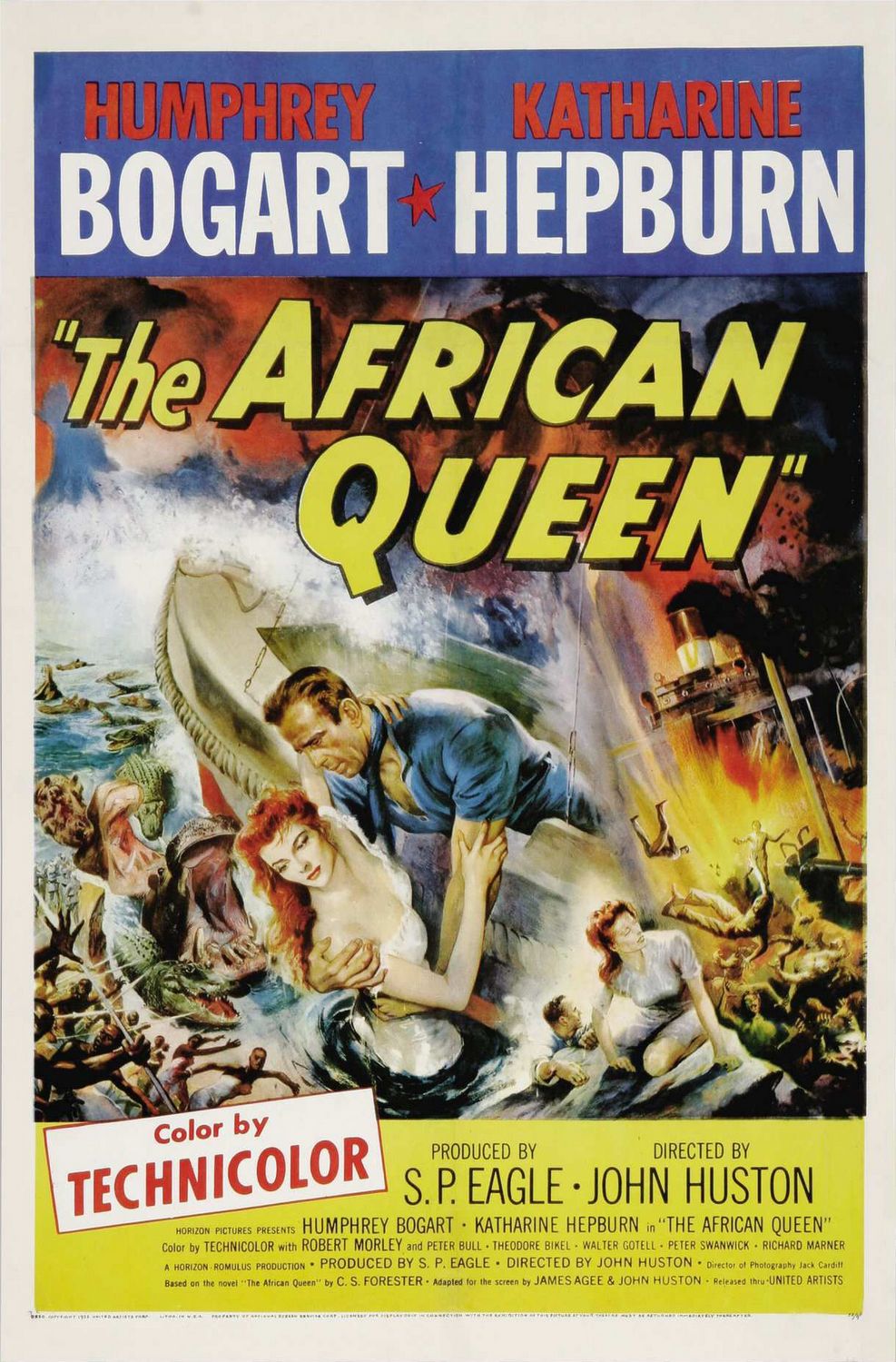
#34) The African Queen (1951)

african_queen_ver2_xlg

#34) The African Queen (1951)

OR “Crocs & Krauts”

Directed by John Huston

Written by Huston & James Agee. Based on the novel by C.S. Forester.

Class of 1994

The Plot: Rose Sayer (Katharine Hepburn) is a British missionary with her brother (Robert Morley) in 1914 German East Africa. While delivering mail to them, boat captain Charlie Allnut (Humphrey Bogart) reveals that Britain has entered into war with Germany. No sooner does the news get to them that German soldiers arrive and burn their village. Rose escapes with Charlie aboard his boat, the “African Queen” of the title, and starts sailing down the Ulanga River. When they learn of a German gunboat blocking their only way to freedom, Rose hatches a plan to full-on MacGyver the African Queen into a torpedo boat and sink the Luise. Charlie is hesitant at first, but along their journey the two learn to respect and, dare I say, love each other.

Why It Matters: Interestingly, the official NFR entry for this film only gives us the plot and mentions how difficult the on-location shooting in Uganda and the Congo was.

But Does It Really?: I’m calling this one a “minor classic”; not nearly as iconic as some of the cast or crew’s other works, but memorable and enjoyable nonetheless. The film’s major pro is that they actually filmed in Africa, and it looks breathtaking in Technicolor. Bogart and Hepburn are both lovely, and ultimately I found myself caring about what happened to them. While “African Queen” might not rank as high as some other classics, it deserves a place in the Registry. Besides, a trip down the rivers of Africa with two of Hollywood’s greatest is a fun way to spend two hours.

Everybody Gets One: Professional Englishman Robert Morley and future Tevye Theodore Bikel (though I suspect Bikel has a few more up his sleeve++). Interestingly, this is the only film on the Registry for either Bogart or Hepburn to be filmed in color**.

Wow, That’s Dated: Umm…those aren’t flies. Those are animated arrowheads. You did so well faking everything else.

Take a Shot: This is also a good drinking game movie. The African Queen is referenced occasionally, but consistently, throughout the film.

Seriously, Oscars?: The film received only four Oscar nominations; Director, Screenplay, Actor and Actress. Humphrey Bogart won his only Oscar for this film. Hepburn gives the better performance, but Bogie was overdue and is serviceable at playing one of the era’s favorite pieces of Oscar bait; an alcoholic who redeems himself. The film lost in its other categories to fellow NFR entries “A Place in the Sun” and “A Streetcar Named Desire”. “The African Queen” missed out on a Best Picture nomination because the Academy needed to make room for this swords and sandals crap.

Other notes

  • It was during filming in Uganda that John Huston learned that his wife Enrica gave birth to their second child together; a daughter named Anjelica.
  • This has got to be one of the rare movies where Hepburn sings. Next stop, Coco!
  • It’s a shame the sound guy didn’t get a nomination for making Bogie’s weird stomach noises.
  • HE’S CANADIAN!? In what universe is Bogie Canadian?
  • I don’t know how I feel about Allan Gray’s score in this film. When they first embark on the river, we get music that’s a little too jaunty for two characters fleeing the Germans. Then in the next scene Rose sees Charlie’s gin bottle and the score gets way too dramatic. What is happening?
  • Even when Bogie shaves he has a five o’clock shadow.
  • How did neither of them get shot while passing the German fort? There were about 10 guys shooting them down. Where they all former Imperial Stormtroopers?
  • Sorry Charlie, gaffer’s tape wasn’t a thing back then.
  • And then they embrace and suddenly the film has more innuendo than a Hitchcock picture.
  • During the scene where Bogie is imitating the hippos and monkeys, I really wanted them to flash across the screen “Academy Award Winning Performance”.
  • I’d like to point out that during filming Bogart was 51 and Hepburn was 44. If you remade it today neither of them would be a day over 25.
  • While the ending is a huge deus ex machina, I must admit it is still quite satisfying.
  • Unless I missed something, this is one of the rare films set in a jungle that doesn’t include this sound.

Legacy

  • While designing Disneyland, Harper Goff used this film as the main inspiration for Adventureland’s Jungle Cruise attraction. Now if only that ride had a scene where you get shot at by German soldiers.
  • Uncredited co-writer Peter Viertel turned his experience on location into the somewhat fictionalized novel “White Hunter Black Heart”. In 1990, the book became a film, starring Clint Eastwood attempting (and failing) to imitate John Huston.
  • The film spawned a 1977 TV sequel/potential pilot starring Warren Oates and Mariette Hartley. It’s so obscure I couldn’t even find a clip of it on the internet. All I could find were these promo photos on eBay, one of which had zero bids.
  • As for the African Queen herself, the boat used during filming was recently refurbished and is a fully operational tourist attraction in Key Largo, Florida.

** 2017 Update: Ms. Hepburn has one other color film now: “Guess Who’s Coming to Dinner“.

++2018 Update: And so he does. Theodore Biel also appears in “My Fair Lady“.

#33) The March of Time: Inside Nazi Germany (1938)
Screen Shot 2017-03-23 at 8.15.29 PM#33) The March of Time: Inside Nazi Germany (1938)

Directed by Jack Glenn

Written by James L. Shute

Class of 1993

I’ll keep this one short. “The March of Time” was a newsreel series that started in the 1930s and was essentially the pre-television version of “60 Minutes”. In 1938 they turned their cameras on Germany five years into the Nazi regime of Adolf Hitler. What follows is a startling (though, admittedly, somewhat manipulated) view of a country run by fascism. The film covers Germany’s persecution of Jews, the Hitler Youth program, and the German-American Bund setting up camp in New York City, among many other topics. Given the times we currently live in, it’s not too difficult to spot the parallels between what happened then and what’s happening now (For example: Germany’s newspapers only printed the stories the government wanted them to). The inclusion of “Inside Nazi Germany” in the Registry is an important one and should not be underestimated. Please watch this film and, as we say nowadays, Stay Woke.

“All propaganda must be confined to a few slogans…repeated over and over…until the last man understands what they mean.” – Adolf Hitler, “Mein Kampf”

#32) Psycho (1960) [Original 2017 Post]

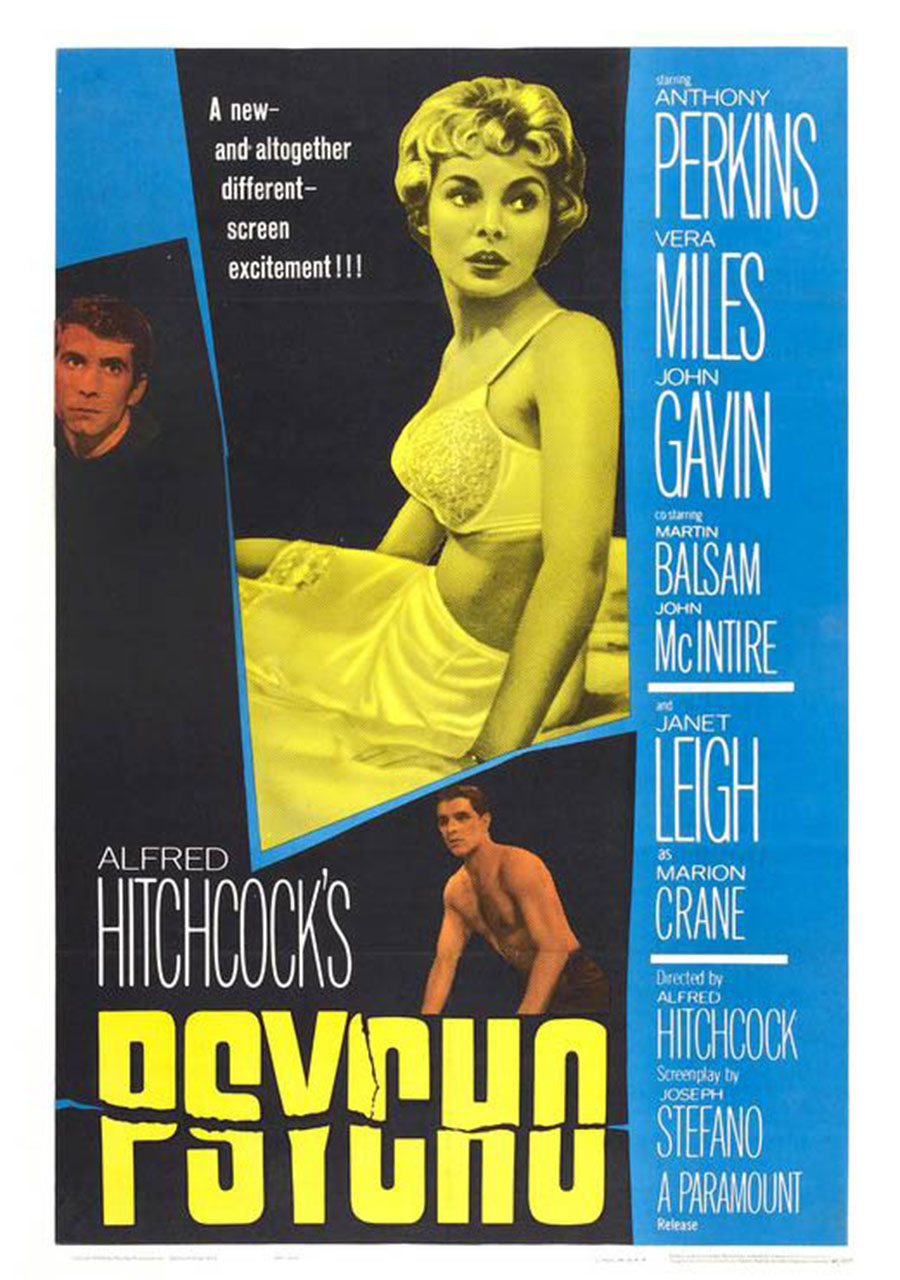
psycho-1960-movie-poster

#32) Psycho (1960)

OR “Motherboy ‘60”

Directed by Alfred Hitchcock

Written by Joseph Stefano. Based on the novel by Robert Bloch.

Class of 1992

Perhaps the longest trailer in film history. And it doesn’t give anything away!

This is my original “Psycho” write-up, but wouldn’t you rather read the revised, expanded version instead?

The Plot: Marion Crane (Janet Leigh) doesn’t have enough money to marry her boyfriend Sam (John Gavin). When her boss (Vaughn Taylor) asks her to make a $40,000 deposit in the bank, Marion takes the money and runs (well, drives). She ends up staying the night at the Bates Motel, keeping company with the manager Norman (Anthony Perkins), who tells her about his domineering mother. When Marion disappears, her sister Lila (Vera Miles) investigates.

Why It Matters: The NFR hails the film’s enduring shock value, and praises Perkins and Leigh as well as Bernard Herrmann’s score. An essay by film journalist Charles Taylor praises the film’s ability to still be suspenseful despite the fact that everyone knows the film’s major spoilers.

But Does It Really?: “Psycho” is my vote for the best Hitchcock film. After a career of big budget, elegant looking films like “Vertigo” and “North by Northwest”, Hitch proved he could get down and dirty with a low-budget gritty film that supplies plenty of edge-of-your seat thrills. “Psycho” is like a good roller coaster; the first time is exhilarating, and every time after that is just as much fun, even if you know where the twists are. Why this film had to wait until the NFR’s fourth go-round to make the cut is beyond me.

Everybody Gets One: Oh, Anthony Perkins. He’s very, very good in this film. So much so that he was typecast for the rest of his life, despite being capable of so much more (I personally love him in “Evening Primrose”). Perkins eventually gave in and reprised the role of Norman later in life (see Legacy below). Amazingly, practically everyone else in this film has at least one more NFR entry on their resume.

Wow, That’s Dated: You mean besides the chronic sexism? It’s quick but, in traditional Hitchcock fashion, it’s definitely there.

Seriously, Oscars?: “Psycho” received four Oscar nominations, and won none of them. Hitchcock lost his fifth and final bid for Best Director, Janet Leigh missed out on her only acting nomination, and the film’s art direction and cinematography lost to, respectively, “The Apartment” and “Sons and Lovers” (the latter being a good alternate title for this film). For those of you paying attention, that’s no nominations for Anthony Perkins, Bernard Herrmann or Joseph Stefano, and no Best Picture nod.

Other notes

  • This movie got the green light when Audrey Hepburn bowed out of Hitch’s proposed courtroom drama “No Bail for the Judge” due to pregnancy. So congratulations, Sean Hepburn Ferrer, you are indirectly responsible for one of the greatest American films ever!
  • This is my first Saul Bass credits sequence on the Registry. I can’t think of an opening credit scene that has so much impact with so little actually happening. They’ll be more to come from Mr. Bass.
  • Oh yeah, I always forget how uninteresting Sam/John Gavin is. It’s the one thing the remake (barely) has over the original.
  • Why the cowboy hat, Hitch?
  • That’s Hitch’s daughter Patricia as Mr. Lowery’s other secretary. Her acting career was pretty much limited to her father’s films and episodes of “Alfred Hitchcock Presents”.
  • Geez, Tom Cassidy is almost as gross towards Marion as Norman is.
  • Speaking of, Frank Albertson (the actor playing Tom Cassidy) is Sam Wainwright from “It’s a Wonderful Life”. Hee-haw!
  • Ladies and gentlemen, California Charlie.
  • I feel like Norman gives Marion plenty of red flags during their dinner. Taxidermy as a hobby, his obvious mother issues; Marion, you in danger girl.
  • When all is said and done, that shower scene is still effectively chilling.
  • My favorite shot in the film is right after the shower scene, when the camera pans back into Marion’s room, as if it too isn’t quite sure what to do next.
  • After watching Norman’s step-by-step process, I now feel fully qualified to clean up a murder in a motel room.
  • Why such an intense close-up on Martin Balsam when he enters the film?
  • I do love that the first big scene involving Norman’s backstory features two characters in their bathrobes.
  • Shout-out to Simon Oakland as the psychiatrist at the end. It’s a little long (even Roger Ebert thought it could’ve been edited), but Oakland is clearly relishing the chance to go full Poirot in his one scene.
  • That’s future “Mary Tyler Moore” star Ted Knight as the policeman outside of Norman’s cell. And here I thought it all started for him at a 5000-watt radio station in Fresno, California.
  • So based on the film’s timeline, the first scene is on December 11th, Marion checks into the Bates Motel on the 12th, Arbogast investigates on the 19th, and Lila and Sam check in on the 20th. The holidays must have been tough for the Crane family after that.

Legacy

  • Oh, where to begin? Let’s start with Perkins and Universal’s attempt to franchise “Psycho” in the ‘80s.
  • Don’t worry; Gus Van Sant did a scene-for-scene, shot-for-shot remake in 1998. I have seen it, and it hurts my soul.
  • A 1987 “Bates Motel” pilot that never made it to series, and a 2013 “Bates Motel” reboot/prequel series that recently wrapped up with the events of the film.
  • This is one of the rare films to inspire another film about its creation. 2012’s “Hitchcock” proves that even the making of a film classic can be bogged down by obvious Biopic 101 trappings.
  • Brian De Palma’s “Dressed to Kill” owes a thing or two to “Psycho”.
  • 24 Hour Psycho”, which answers the question; What if “Psycho” had been directed by Andy Warhol?
  • “That kid gets no tip.”

Further Viewing: A look at how meticulously Hitch promoted the film, right down to his strict “No Late Seating” policy.


#31) The Blood of Jesus (1941)

edc3d29251525f224410ed70f25c053b

#31) The Blood of Jesus (1941)

OR “The Devil Went Down to Texas”

Directed & Written by Spencer Williams

Class of 1991

Watch the whole film below, and download it for free courtesy of the Southern Methodist University Central University Libraries.

The Plot: Sister Martha (Cathryn Caviness) is baptized by her local church. Her newlywed husband Razz (Spencer Williams) is not very religious and does not attend the ceremony, opting to go hunting instead. When he arrives home, his gun accidentally discharges, the bullet hits Martha and her chances of survival do not look good. While bedridden, an angel (Rogenia Goldthwaite) appears and leads Martha to the crossroads between Heaven and Hell. The angel makes a case for Heaven, but Martha is tempted by the Devil (Jas. B. Jones) and his assistant, Judas Green (Frank H. McClennan). Martha’s faith is put to the ultimate test, with a gospel choir soundtrack that can’t be beat.

Why It Matters: The film’s significance as a long-lost “race film” is mentioned by the NFR. An essay by University of Texas Professor Dr. Mark S. Giles puts the film in its proper historical context. “The Blood of Jesus” was the first film made entirely by African-Americans to be included on the Registry.

But Does It Really?: As entertainment, I think it could have used some trimming, but its cultural and historical importance cannot be denied. Films like these always fascinate me; the kind of film made by a small town working together. One wonders what it must have been like for Spencer Williams to convince everyone to make this. The result is a bit rough around the edges, but ultimately “The Blood of Jesus” is a well-meaning and at times touching expression of a community’s strong Christian faith. Take that, “The War of the Worlds”.

Everybody Gets One: Spencer Williams is best remembered as Andy on the TV version of “Amos ‘n’ Andy”, but his life prior to that is much more interesting. “The Blood of Jesus” was the first of 12 films he directed and produced. Prior to that he helped write “The Melancholy Dame” (considered by many to be the first all-black talkie) and served as a Sergeant Major during World War I. Sadly, virtually nothing is known about the rest of the cast, all of who were non-actors who lived in Texas at the time of production. Tragically, cast member Frank H. McClennan died at the age of 28 in 1940, just prior to the release of this film.

Wow, That’s Dated: Mainly the idea that any sort of urban living is a sin.

Other notes

  • Man, that cast list credit stays on screen for a long time. Is there going to be a test on it?
  • The major thing this film has that I missed in my own religious upbringing is the concept of harmonizing.
  • When Sister Ellerby comes to visit Sister Jenkins, a hand reaches out and closes the door behind her. Who is that? Is it God? Does that mean He’s opening a window somewhere else?
  • Even Spencer Williams isn’t safe from the Chekhov’s gun principle.
  • So the gun fell on the floor, discharged, shot Martha in what appears to be the ribs, went “clean through her” and symbolically hit the picture of Jesus located at a different angle in the room? Now that’s a magic bullet.
  • Why are they surprised that Razz is taking this so hard? He accidentally shot his newlywed wife. You’d be distraught too.
  • The footage of heaven is taken from a silent film (allegedly 1911’s “L’Inferno”). If you look closely, you can see the attempt to mask the title cards at the bottom of the frame.
  • Of course The Devil utilizes door-to-door salesmen for his bidding.
  • I get the feeling there isn’t a single frame of film that got cut from any of this.
  • The film doesn’t make that bad a case for Hell. Just don’t work for Rufus Brown and it seems to be a lot of fun.
  • Cool, the director knew an acrobat!
  • More films should include a flatbed truck with a jazz combo on it.
  • I can’t imagine it was pleasant for Cathryn Caviness to spend part of her day being filmed lying on rocks with blood dripping onto her face. You wanted to be in a picture, didn’t you?

Legacy

  • Julie Dash cites this film as partial inspiration for her film (and future NFR entry), 1991’s “Daughters of the Dust”.

Further Viewing: Spencer Williams followed up “The Blood of Jesus” with several “race films” throughout the ‘40s, though none as successful as this one. Many of his films have been archived and can be found on the internet for free. I’ll start you off with one that’s a slightly different tone than “The Blood of Jesus”; 1946’s “Dirty Gertie from Harlem U.S.A.”

#30) Fantasia (1940) [Original 2017 Post]

Fantasia-poster-1940

#30) Fantasia (1940)

OR “Highbrowski by Stokowski (an actual proposed title for the film!)”

Directed by Ben Sharpsteen (as well as many many sequence directors)

Written by Joe Grant & Dick Huemer (and, again, many many sequence writers)

Class of 1990

This is my original post on “Fantasia”. You can read the greatly revised and expanded version here.

A trailer that makes way too many promises.

NOTE: The version I watched was a restoration of the original film with two noticeable differences; one character was deleted from “The Pastoral Symphony” (see Other Notes section), and, because of audio issues involving restored footage, Deems Taylor is re-dubbed by Disney voiceover go-to Corey Burton. It’s not that distracting once you’re into the film, but anyone looking for Mr. Taylor’s actual voice will have to hunt down an earlier print.

The Plot: A complete departure from his previous two features, Walt Disney’s “Fantasia” is a concert of classical music brought to life by animation. Performed by The Philadelphia Orchestra conducted by Leopold Stokowski, and introduced by music critic Deems Taylor, the program features eight pieces of music; Bach’s “Toccata and Fugue in D Minor”, Tchaikovsky’s “The Nutcracker Suite”, Dukas’ “The Sorcerer’s Apprentice”, Stravinsky’s “The Rite of Spring”, Beethoven’s “Symphony No. 6” (The Pastoral Symphony), Ponchielli’s “Dance of the Hours”, Mussorgsky’s “Night on Bald Mountain” and Schubert’s “Ave Maria”.

Why It Matters: The NFR calls it “Disney studios’ most ambitious animated feature”, though declares some of the pieces “kitschy” and deems their take on Beethoven “an irreverent treatment”.

But Does It Really?: Oh yes. I can only imagine what audiences made of this back in 1940. “Fantasia” is way ahead of its time. Animation had just evolved to feature-length; the jump from “Snow White” to “Fantasia” must have felt like crawling out of the water and immediately walking upright. For its unique and revolutionary approach to what the animated medium could be, “Fantasia” earns a place on the Registry.

Everybody Gets One: Leopold Stokowski was a rarity; a conductor who crossed over into the mainstream. He left the Philadelphia Orchestra in 1941 but kept conducting until the age of 93. At the time of “Fantasia”, Deems Taylor was known for his work as a music critic, and for providing commentary during the New York Philharmonic’s radio broadcasts. And that’s Walt Disney himself providing the voice of Mickey Mouse immediately following “The Sorcerer’s Apprentice”.

Wow, That’s Dated: Deems Taylor mentions that “The Nutcracker Suite” is not very well-known and is rarely performed today (“Nutcracker” would not become a holiday tradition until the 1960’s). During “Rite of Spring”, the extinction of dinosaurs is referred to as a “gigantic dust bowl”. Also, the xylophone as a jazz instrument.

Seriously, Oscars?: While not nominated in a single competitive category, “Fantasia” did receive two honorary Oscars at the 1941 ceremony; one for Walt Disney, William E. Garity and J.N.A. Hawkins for their creation of “Fantasound” (a precursor to Surround Sound), and another for Leopold Stokowski for his work on the film.

Other notes

  • Stokowski conducts that same way I dry my hands in a bathroom when there’s no paper towels left.
  • There’s a shot in “Toccata and Fugue” that looks like someone’s tooth is walking away.
  • Pretty gutsy to do selections from “The Nutcracker Suite” but not the main march theme.
  • The ending of “The Sorcerer’s Apprentice” always gives me chills.
  • I can only imagine what theaters in Alabama would make of “The Rite of Spring” if Disney tried to release it today.
  • Just a reminder that every effect you see in this film is drawn by hand. No computers, just sheer manpower.
  • “Rite of Spring” was animated before the “giant meteor” theory of dinosaur extinction, which would not be first theorized until 1953, and not become commonly accepted until the 1990s.
  • My brother and I always got a kick out of the “soundtrack” as kids, especially when it replicates a bassoon sound.
  • And now we arrive at Sunflower. Sunflower is the incredibly racially insensitive black centaurette that primps all the other centaurettes for their dates. She is digitally removed from all commercial copies of the film, but her original footage is still out there.
  • My six degrees of separation from this film is that I am friends with the grandson of the woman who was one of the physical inspirations for the centaurettes – specifically this one. She was dating Disney animator X. Atencio at the time. Oh you crazy kids.
  • While the pieces in “Fantasia” have no unifying theme, a lot of the animation tells stories of light overcoming darkness, especially in the second half. I guess it’s Disney’s subconscious continuation of the good vs. evil story they’ve always been best at.
  • “Dance of the Hours” is Disney animation returning to its Silly Symphony roots, utilizing everything they learned from “Snow White” and “Pinocchio”. It is, for me, a highlight.
  • This film ends with Satan worshipping! No way it would get made today!
  • I always felt sorry for the people who live in the town at the base of Bald Mountain. That can’t be fun.

Legacy

  • A continuation 60 years later, “Fantasia 2000” is not without its charm, but I always thought it tried just a little too hard.
  • Sorcerer Mickey appears throughout Disney culture, most notably in Fantasmic!
  • There is a very, very loose adaptation of “The Sorcerer’s Apprentice” starring Nicolas Cage.
  • Countless parodies over the years, most notably Merry Melodies’ “A Corny Concerto” and Art Clokey’s “Gumbasia”
  • My favorite bit of tie-in for the 1990 rerelease; a “Fantasia” video game for SEGA.
  • And finally, “Dance of the Hours” got some long overdue lyrics in 1963 by Allan Sherman.

Listen to This: Igor Stravinsky was the only one of the film’s composers still living when “Fantasia” was released, and he did not like what Disney had done to his composition. The same year “Fantasia” came to theaters, the New York Philharmonic recorded their own version of Stravinsky’s “Rite of Spring”. They not only presented the piece uncut (Disney’s version is about 8 minutes shorter), but they let the composer himself conduct it!