#410) Salt of the Earth (1954)

image-asset

#410) Salt of the Earth (1954)

OR “Black & White and Red All Over”

Directed by Herbert J. Biberman

Written by Michael Wilson

Class of 1992

The Plot: Based on a true story, “Salt of the Earth” is a fictional retelling of the zinc miner’s strike of New Mexico in the early ‘50s. Fed up with their unsafe working conditions and prejudiced treatment by their white or “Anglo” counterparts, the Mexican-American members of the miners union go on strike. The union leader Ramon (Juan Chacón) is met with hostility from his management as well as city officials, and an impasse is reached. As the months drag on Ramon’s wife Esperanza (Rosaura Revueltas) starts to take more of a leadership position, and joins her fellow housewives at the picket line. It’s a progressive tale of the struggles of women, minorities, and blue-collar workers in America, but unfortunately this is the height of the Red Scare, and this movie smells like a big Commie rat.

Why It Matters: The NFR gives a rundown of the film’s troubled history, and mentions “its influence on independent filmmakers”.

But Does It Really?: I knew nothing about “Salt of the Earth” before this viewing, so imagine my surprise when I learned that I was watching the only blacklisted movie in film history. As a historical document, “Salt of the Earth” is not to be ignored. As a film, it’s alright. Yes, its pro-union message can be quite preachy at times, but the earnest performances by the film’s non-actors help make it much more palatable. “Salt of the Earth” is a representation of the times and circumstances that forged this movie into being, with a message that still rings true almost 70 years later. No argument here for “Salt of the Earth” joining the NFR.

Every Independent Film Company Gets One: The Hollywood Blacklist of the 1950s is far too grand a topic to cover here, but suffice to say that a lot of very talented individuals in the entertainment industry were denied work because they may or not have been involved with America’s Communist Party two decades earlier. Independent Productions Corporation was founded by Herbert J. Biberman (one of the Hollywood Ten) and Paul Jarrico to create job opportunities for blacklisted filmmakers. “Salt of the Earth” was the only film produced by the company amidst a lot of backlash. The House Un-American Activities Committee deemed the film “a new weapon for Russia”, New Mexican citizens protested by setting local union halls on fire, and lead actress Rosaura Revueltas was deported back to Mexico during production. An anti-trust suit against various company’s “illegal conspiracy” against the film dragged out for a decade, and IPC folded shortly thereafter.

Wow, That’s Dated: Why everything, obviously. There’s nothing timeless at all about the systemic oppression of women and minorities, or the threats that workers face from management while unionizing. Nope, all relics of the past. [Nervous laughter]

Title Track: Esperanza says the title once at the end of the film. Turns out the “salt of the earth” are the children who will one day inherit the world their parents have made for them. At long last, someone is thinking of the children.

Seriously, Oscars?: Surprise, surprise, a pro-union movie released at the height of McCarthyism and ignored by Hollywood was completely shut-out of the Oscars. The 1954 Best Picture winner was “On the Waterfront”, a movie in which the union is the corrupt force and the man who testifies against them is the hero. Nice try, Kazan.

Other notes

  • The real life Empire Zinc strike of 1951 served as this film’s inspiration. Many of the details are the same, but the film is still a fictionalized account of the strike. “Salt of the Earth” was filmed on location in Grant County, New Mexico (site of the actual strike), and the film’s cast is made up mostly of local, non-professional actors.
  • Not only were many of the creatives involved in production victims of the blacklist, but so was the film’s sponsor. The International Union of Mine, Mill and Smelter Workers had ties to the Communist party that it refused to denounce, causing the union to be expelled from the Congress of Industrial Organizations in 1950. The IUMMSW’s involvement was more fuel for the fire of those in Washington and Hollywood trying to prevent “Salt of the Earth” from being made.
  • Herbert Biberman originally planned on casting his wife, the definitely-not-Mexican Gale Sondergaard, as Esperanza, as well as a white actor as Ramon. Once he realized his own subconscious prejudice against Mexican actors in leading roles, Biberman cast Rosaura Revueltas and Juan Chacón. Revueltas was an up-and-coming star in Mexican cinema, while Chacón was a union local president involved with the real strike.
  • If the town’s sheriff looks familiar, that’s Will Geer, aka Grandpa Walton. Like his fellow cast and crew, Geer was deemed a “hostile witness” by HUAC and blacklisted from Hollywood for a time.
  • As previously mentioned, Rosaura Revueltas was deported during production, allegedly because her passport had not been stamped properly upon arrival. The remainder of her close-ups (as well as her narration) were recorded separately in Mexico City.
  • I don’t have much to say about the film itself; the behind-the-scenes story is infinitely more fascinating than the on-screen one. That being said, Rosaura Revueltas is your MVP, giving Esperanza a very powerful character arc. Her non-professional co-stars more than hold their own, though it helps that they are telling their own story.

Legacy

  • “Salt of the Earth” was purposefully ignored upon its initial US release (some projectionists flat-out refused to even screen it), and received one screening in New York. The film did, however, have a successful European release, winning the grand prize at the Czech Republic’s Karlovy Vary International Film Festival.
  • “Salt” eventually made it back to the states in the mid-60s, playing in union halls and film schools across the country. The film’s reappraisal from Americans was greatly helped in 1982 when the film lapsed into public domain.
  • As expected, few of the film’s blacklisted creatives found work in Hollywood after “Salt of the Earth”. Producer Paul Jarrico and Screenwriter Michael Wilson both moved to Europe and continued their film careers there, while Herbert Biberman didn’t work again until 1969’s “Slaves”, shortly before his death.
  • The making of “Salt of the Earth” was made into a documentary with 1984’s “A Crime to Fit the Punishment”. Online clips are hard to come by, but you can find it on archive.org! Thanks internet nerds!
  • The film’s production is also a major plotline in the 2000 movie “One of the Hollywood Ten”, starring Jeff Goldblum as Herbert Biberman.
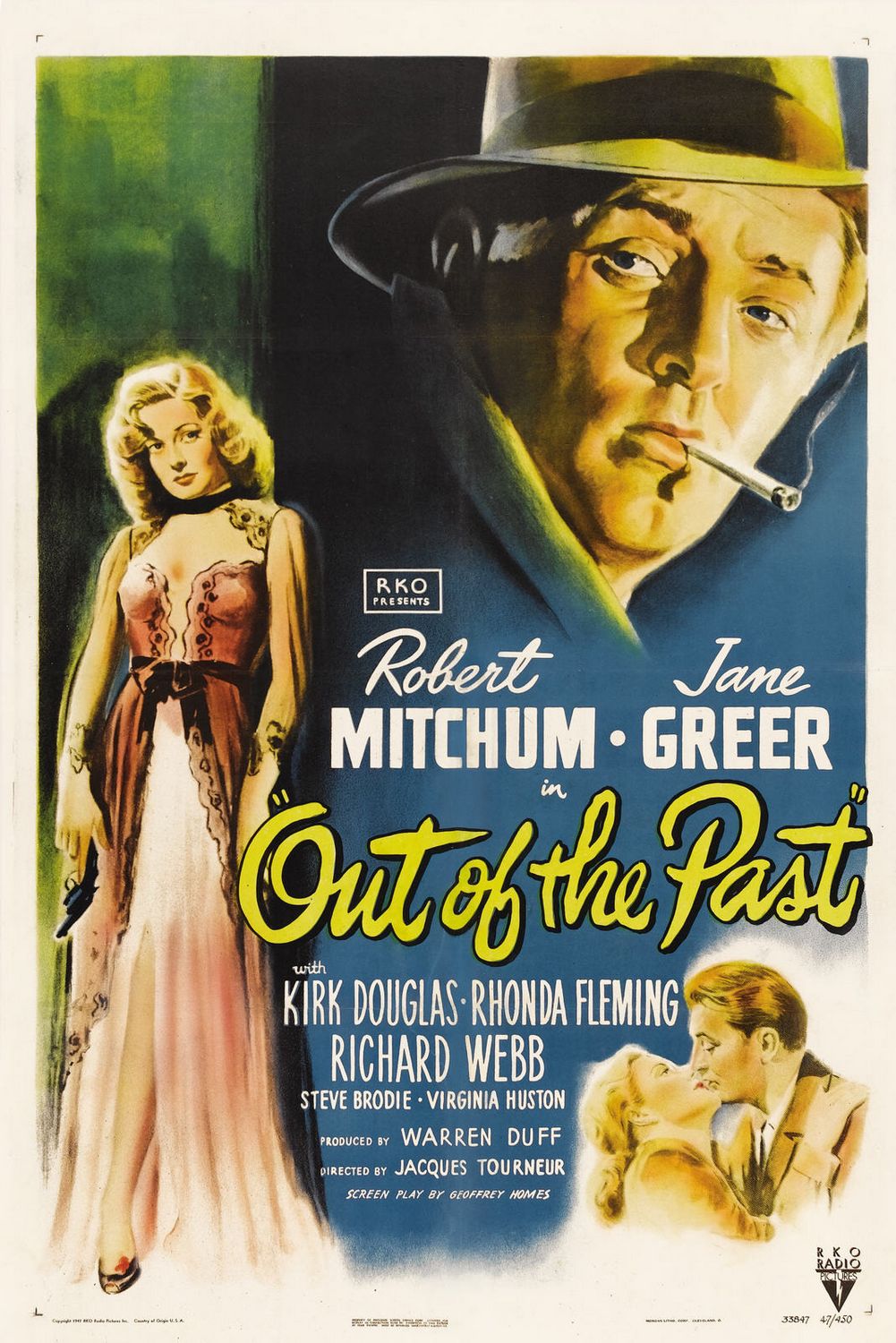
#409) Out of the Past (1947)

MV5BMDE0MjYxYmMtM2VhMC00MjhiLTg5NjItMDkzZGM5MGVlYjMxL2ltYWdlL2ltYWdlXkEyXkFqcGdeQXVyNjc1NTYyMjg@._V1_

#409) Out of the Past (1947)

OR “Won’t You Come Home, Jeff Bailey?”

Directed by Jacques Tourneur

Written by Geoffrey Homes (aka Daniel Mainwaring). Based on his novel “Build My Gallows High”.

Class of 1991

No original trailer, but here’s a re-creation.

The Plot: Jeff Bailey (Robert Mitchum) runs a gas station in the small town of Bridgeport, California, and has settled down with the lovely young Ann (Virginia Huston). When a former business associate (Paul Valentine) arrives in town, Jeff confesses to Ann his past life as a private investigator, specifically the case in which he tracked down Kathie Moffat (Jane Greer), the girlfriend of businessman/gambler Whit Sterling (Kirk Douglas). Jeff and Kathie have an affair, but eventually split up to avoid further trouble with Whit and his associates. Back in the present day, Whit has become aware of Jeff’s past with Kathie, and hires Jeff for one final job. Will Jeff be able to return to his simple life in Bridgeport, or will his relationship with Kathie return…out of the past?

Why It Matters: The NFR calls the film a “classic example of 1940s film noir” and throws superlatives at Tourneur, Homes, Mitchum, Greer, and cinematographer Nicholas Musuraca. An essay by film critic Stephanie Zacharek is equally effusive, and a dissection of the film’s two female leads.

But Does It Really?: “Out of the Past” is one of those movies that I always knew was a designated classic, but couldn’t tell you anything else about it. The film is well-crafted on each front, and has all the hallmarks of the great film noirs, but it’s lacking that extra “je ne sais quoi” that possesses a “Double Indemnity” or a “Touch of Evil”. “Out of the Past” may be reserved for the film buffs nowadays, but it is respected and referenced enough to earn its NFR designation.

Everybody Gets One: Jane Greer’s film career got started when Howard Hughes spotted her modeling in Life Magazine. Greer made a slew of movies for RKO and MGM (“Past” was at the former), but she blamed studio politics for the lack of momentum in her career. And as always, shoutout to Ken Niles as Leonard Eels, aka “the vic”.

Wow, That’s Dated: Standard ‘40s stuff, but this movie got me to wondering: can ridesharing ever replace cabs in the movies? First off, no one can make a quick getaway if your driver isn’t showing up for 6 minutes, and the old “follow that cab” sequence could never happen. And don’t even get started on the huge insurance risk a chase sequence entails.

Title Track: No one says “out of the past”, but Bailey does utter the novel’s title – “Hang My Gallows High” – near the end of the film.

Seriously, Oscars?: “Out of the Past” was successful in its day, but RKO still considered it a B-Picture, and focused their campaigning on two of their A-Pictures: “The Bishop’s Wife” and “Crossfire”, both of which got Best Picture nominations.

Other notes

  • The opening credits, shot around Lake Tahoe, made me legitimately wonder if I was watching the wrong movie. Quintessential noir never leaves the dark alleyways of the big city. This movie is already throwing me.
  • Wait, Jeff’s girlfriend is named Ann Miller? The Hollywood dancer of the same name was already making movies at that point; wouldn’t this have led to some confusion?
  • Kirk Douglas was still a Hollywood newcomer when he was cast as the heavy in “Out of the Past”. This is also your reminder that as of this writing, Kirk Douglas is still alive at 103! He’s lived in 12 different decades!
  • Robert Mitchum is one of those stars who has never done it for me. I don’t have anything against him, but I don’t have anything for him either. I try to not let that interfere with my viewings for this blog, but overall Mitchum in this movie is…fine.
  • It’s a shame Jane Greer’s career never took off, she’s very good in this. She’s a good match for Mitchum, and hits both aspects of “femme fatale” quite effectively. My favorite shot in the movie is Kathie’s restrained joy while watching Jeff and Fisher fight each other. It’s wonderfully subtle shading to an already dimensional character.
  • It’s thoughtful of Jeff to open up to Ann about his past, but he fails to remember one of life’s most important truths: No one wants to hear about your ex.
  • “Out of the Past” was filmed partially on location in the cities mentioned throughout the film; either for the full sequence or for background projections. The shot of Jeff’s cab arriving in San Francisco is on Broadway Street, not too far from the North Beach neighborhood Jeff and Kathie briefly lived in. Everyone in this movie could probably recommend a good Italian restaurant.
  • “That’s one way to be clever: look like an idiot.” Ooh, that’s a good line, I’ll have to remember that one.
  • It’s around the point where Kathie tells Jeff about his set-up that this film started to lose me. Did the plot become too convoluted? Was I not in the right frame of mind for this movie? Who’s to say? The point is I did not take a lot of notes during the third act for fear of missing something.
  • Like “Stranger Than Paradise”, “Out of the Past” has enough diverse locales that its black and white cinematography is imperative. A color film set in Tahoe, Mexico, and San Francisco would have been too much of a travelogue.
  • Knowing that crime can never pay in a Code-era movie, you can more or less deduce how a film like “Out of the Past” is going to end, but I appreciated that the final few scenes try to subvert expectations and keep things interesting. Points deducted for the obvious model cars used in the climactic crash.

Legacy

  • Robert Mitchum’s film persona as the stoic, somewhat cryptic tough guy was cemented in this film. He branched out for such films as “Night of the Hunter”, but he more-or-less played this guy for the rest of his career.
  • “Out of the Past” was remade in 1984 as “Against All Odds” with Jeff Bridges and Rachel Ward. Worth noting is Jane Greer’s appearance as Kathie’s mother, and the title song by Phil Collins.
  • In 1987, Robert Mitchum hosted “Saturday Night Live”, and appeared in a short film called “Out of Gas”, directed by his daughter Trina, and reuniting him with Jane Greer. I can’t find a single clip from this episode that hasn’t been blocked by NBC, so here’s a track from Robert Mitchum’s calypso album instead.

Bonus Clip: Here’s Ann Reinking performing “Against All Odds (Take a Look at Me Now)” at the Oscars. Phil Collins was not invited to perform his own song at the ceremony, and….just watch.

How to Get Your Movie Into the National Film Registry

these-amazing-shadows

This week marks the 3rd anniversary of “The Horse’s Head”! Instead of celebrating movies already on the list, let’s look at what it takes for your movie to get inducted into the National Film Registry.

First of all, let’s make sure your film is eligible. To be on the National Film Registry your movie must be:

At Least 10 Years Old: The 10-year waiting period ensures that your film continues to be remembered long after its initial release. Only a handful of movies make the cut after exactly 10 years (“Raging Bull”, “Goodfellas”, other non-Scorsese pictures). As of this writing, the movies of 2010 are freshly eligible, meaning you could legitimately nominate “Despicable Me” if you so choose. Think about it: Haven’t those creepy little Minions proven their cultural endurance?

Culturally, Historically, or Aesthetically Significant: Is your movie quotable and prone to parody years later? Is it an encapsulation of a specific era in American and/or film history?  Did it introduce the world to those unsettling sentient Twinkies known as Minions? If you can prove that your movie stands on a unique piece of ground, that’s half the battle right there.

Does your movie meet the above qualifications? Excellent, let’s continue (NOTE: I assume you said yes. If the answer is no, please stop reading this).

The first step is to Nominate Your Movie. Since 1997, the public has been able to submit up to 50 film titles for consideration via the Library of Congress website. It’s easy! Their website even gives you a comprehensive guide to movies not yet on the Registry (updated to include “Despicable Me”). Literally thousands of movies are submitted every year, and roughly 75 percent of the final list (18 or 19 movies) will come from these public recommendations.

After the submission deadline has passed (typically mid-September), the proposed films are then compiled and a preliminary ballot with 200-400 of the highest-polling titles is sent to the National Film Preservation Board. The board is comprised of 44 members: filmmakers, historians, critics, industry insiders, and drifters from all walks of life. Every October, these members meet to determine which movies will be seriously considered for inclusion. The first day of these meetings is typically reserved for films that are in serious need of preservation (i.e. your recently discovered silent movies). The following days are an open forum in which anyone can suggest any movie. Movies that receive a strong showing of public support are prioritized for consideration (“Back to the Future”, “Hoosiers”, and “Ghostbusters” all got on the list thanks to devoted fan campaigns). For the more obscure titles, many board members go the extra mile with their presentations, including screenings. On a related note, shoutout to Wendy Shay of the Smithsonian Institution for her tireless yet unsuccessful campaigning to get “Jane Fonda’s Workout” on the list. Keep fighting the good fight, Wendy!

The board’s goal is to create an eclectic roster of movies from a diverse group of filmmakers. In recent years, emphasis has been placed on including films by women and people of color (who collectively make up 11% of the Registry).  On occasion, subcommittees are appointed to find student films worthy of NFR recognition. This is how we got such obscure yet preservation-worthy titles as “Time and Dreams” and “Growing Up Female”.

After much deliberation, each board member votes for their top 25 choices, ranked by preference. A short list of the biggest vote getters is presented to the head Librarian of Congress, who hand picks the final 25 behind closed doors. That’s right: one person is ultimately responsible for inducting your movie into film history. Currently, the Librarian of Congress is Carla Hayden, the first woman and African-American to hold the title. Appointed by President Obama in 2016, Carla is a lifelong librarian, meaning she is presumably more inclined to select films by people who speak quietly and have no outstanding late fees. Hayden’s librarian career was primarily in Chicago, so if you’re looking to sway Carla’s opinion, perhaps a Bears game or a deep-dish pizza will do the trick. Once the Librarian makes their decision, the final 25 are officially announced in mid-December.

Now that your movie has been selected, the Library of Congress will obtain the best possible print of the film for preservation in their vaults at the National Audio-Visual Conservation Center in Culpeper, Virginia. For the better-known titles, it’s most likely that the Library of Congress already has a print from when the film was originally submitted for copyright approval (such is the case with “Star Wars”, despite what the rest of the internet has told you). If that print is not in good condition, a request is made to the copyright holder to donate a better print. For the more obscure titles, archives and private collections are scoured for the best possible print. Registry films must be preserved in their original format and in their original unaltered versions, so the extended Blu-ray cut of “Despicable Me” will be bypassed for the inferior theatrical release.

If you, the filmmaker, are still alive when your movie makes the cut, all you receive are bragging rights, as well as permission to use the official NFR logo when promoting your movie (designed by no less than Saul Bass!).

featured2_170111_031836

So there you have it, the quick and easy way to ensure the legacy of your movie. All you have to do is make a technologically innovative or zeitgeist capturing film, add a few Minions, wait 10 years, and presto! You’re on the list! What are you waiting for? Go make your classic I’ll be forced to watch sometime in the 2030s.

Happy Filmmaking,

Tony

Interested in learning more about the process? I found these articles to be incredibly helpful in my research:

Film Comment: Choosing the National Film Registry

Hollywood Reporter: National Film Registry: The Politics Behind It

Refinery29: How to Get Women Directors on the National Film Registry

The New York Times: Which Movies are the Best? The Library of Congress Has a List

Mental Floss: What Happens to Films Selected for Preservation by the Library of Congress?

And don’t forget “These Amazing Shadows”, aka “National Film Registry: The Motion Picture”!

#408) Dodsworth (1936)

MV5BNTIzOWU0NWUtN2Y2ZC00N2U2LTliMzQtZWNjNmZkNTc4YTU3L2ltYWdlL2ltYWdlXkEyXkFqcGdeQXVyNjc1NTYyMjg@._V1_

#408) Dodsworth (1936)

OR “Huston, We Have a Problem”

Directed by William Wyler

Written by Sidney Howard. Based on the novel by Sinclair Lewis and the stage adaptation by Howard.

Class of 1990

No trailer, but here’s a clip.

The Plot: Sam Dodsworth (Walter Huston) retires as head of his motor company in a small Midwestern town, and agrees to take his wife Fran (Ruth Chatterton) on an extended vacation through Europe. The down-to-earth Sam is interested in seeing the common tourist spots, while the vain, youth-obsessed Fran is more focused on becoming a socialite and leaving her boring home life behind. The Dodsworths’ marriage is put to the test when Fran begins flirting with a trio of young European men (David Niven, Paul Lukas, Gregory Gaye), and Sam connects with an American divorcée (Mary Astor) living in Naples. Can their marriage be saved!?

Why It Matters: The NFR calls the film “highly acclaimed”, but offers no other superlatives, opting instead for a detailed (and spoiler-ridden) plot synopsis, as well as a rundown of the film’s Oscar stats.

But Does It Really?: “Dodsworth” is just shy of a minor classic. On the plus side, it’s a well-made, impeccably acted character piece, but through no fault of its own, its status as one of the greatest films continues to wane. The movie rarely gets referenced nowadays (even by classic film buffs), and over the years has been overshadowed by William Wyler’s later, superior films (“The Best Years of Our Lives” and “Ben-Hur”, to name just two). Like many movies whose cultural significance has diminished, the inclusion of “Dodsworth” on this list is welcomed, though far from essential.

Everybody Gets One: Ruth Chatterton was one of Paramount’s biggest stars in the late ‘20s, and found fame in the ‘30s as an aviator! Unfortunately, her time making “Dodsworth” was not pleasant, as she and Wyler frequently clashed over their interpretations of Fran. This is also the only NFR appearance for dashing leading man Paul Lukas, just a few years shy of his Oscar winning turn in “A Watch on the Rhine”.

Wow, That’s Dated: Mostly the film’s depiction of international transportation methods (the Dodsworths travel to Europe on the still operational Queen Mary, and are wary of aeroplanes). There’s also a “hilarious” joke about spousal abuse. The ‘30s!

Seriously, Oscars?: A critical hit, “Dodsworth” received seven Oscar nominations, including Best Picture. The film tied for most nominations with “The Great Ziegfeld” and “Anthony Adverse”, both of which beat out  “Dodsworth” in several categories, but “Dodsworth” picked up one win for Richard Day’s Art Direction.

Other notes

  • Walter Huston reprises his role from the Broadway production, and does an excellent job of reigning in his work for film. He’s a charming, relatable leading man; a full 180 from his more famous turn as a grizzled prospector.
  • Easily the film’s most cited production note: While shooting “Dodsworth”, Mary Astor was going through a very public divorce and custody battle with second husband Franklyn Thorpe. To avoid being hounded by the press during production, Astor slept at the studio (some sources say in her bungalow, others say on the “Dodsworth” set). Ultimately, Astor was granted the divorce, as well as custody of her daughter Marylyn. By court ruling, Astor’s diary (which contained details of her affair with playwright George S. Kaufman) was dismissed as evidence, impounded, and eventually destroyed. Any personal stress that Astor was going through does not come through in the final film.
  • I’m always surprised when David Niven shows up on this list. I guess I wasn’t expecting him to have so many classic films on his resume. Speaking of, when’s “Candleshoe” making the cut?
  • With the exception of specially filmed background projections, the entire movie was shot at Goldwyn Studios, including replicas of Paris, Vienna, and Naples. Richard Day earned the hell out of his Art Direction Oscar.
  • I appreciate that this is a movie about a long-married couple who are recognizing their relationship troubles for the first time. It’s a very adult premise, done without the kind of melodramatics I expect from studio films of the era. The excellent acting overcompensates for the somewhat static staging. Despite its impressive sets and occasionally liberating cinematography, “Dodsworth” is still very much a filmed play.
  • “Dodsworth” is the film debut of John Payne, seen here as Dodsworth’s son-in-law, and about a decade away from legally proving the existence of Santa Claus.
  • This is the second movie from the ‘30s I’ve covered that has a sad farewell scene at a train station. I didn’t realize what a trope that was. “Airplane!” was on to something.
  • Maria Ouspenskaya gives what I can only describe as a “Beatrice Straight/Judi Dench turn”. In less than five minutes of screentime – most of it sitting down – Ouspenskaya schools Ruth Chatterton in the Stanislavsky Method. She even got an Oscar nomination in the brand new category of Best Supporting Actress.
  • [Spoilers] As much as I was disengaged from this movie, I came around at the end. Huston and Astor have a natural chemistry that made me root for them to get together. And can we talk about how this is a ‘30s movie in which a couple gets divorced and doesn’t reunite at the end? Talk about groundbreaking.

Legacy

  • The stage version of “Dodsworth” has not been seen on Broadway since its initial 1934 engagement, and there has only been one other major adaptation: a 1956 teleplay with Fredric March, Claire Trevor, and Geraldine Fitzgerald.
  • Various remakes have been announced over the years, with such stars as Rock Hudson, Grace Kelly, Elizabeth Taylor, Gregory Peck, and Harrison Ford attached to headline. None of these came to fruition, but something about a William Wyler movie in which Gregory Peck finds love in Italy sounds familiar…

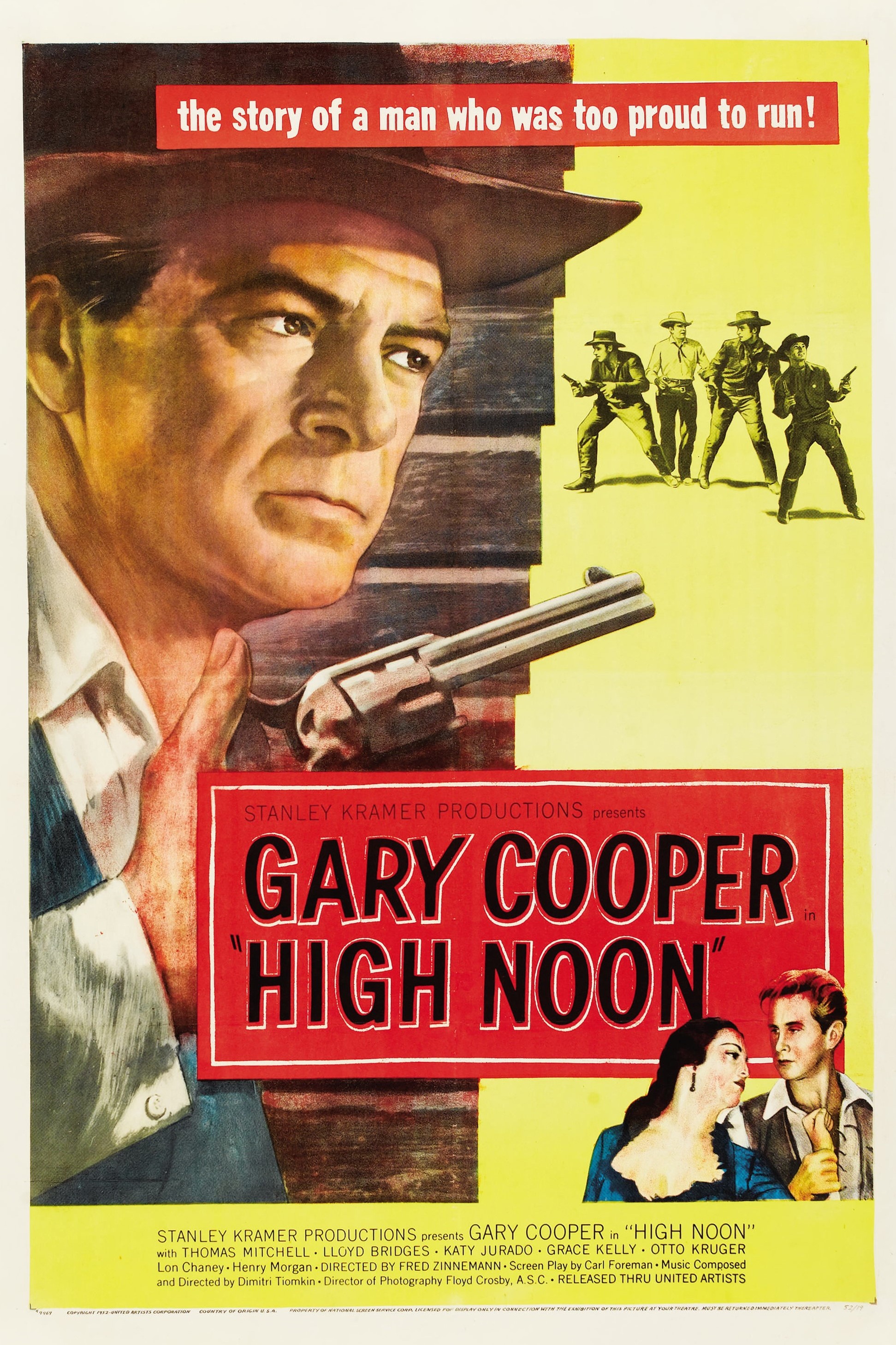
#407) High Noon (1952)

MV5BOWIzZGUxZmItOThkMS00Y2QxLTg0MTYtMDdhMjRlNTNlYTI3L2ltYWdlXkEyXkFqcGdeQXVyNjc1NTYyMjg@._V1_

#407) High Noon (1952)

OR “Twelve O’Clock Nigh”

Directed by Fred Zinnemann

Written by Carl Foreman. Kinda sorta but not really based on the short story “The Tin Star” by John W. Cunningham.

Class of 1989

The Plot: Marshall Will Kane (Gary Cooper) is ready to retire and move to another town with his new wife Amy (Grace Kelly). Shortly after the wedding, Kane learns that Frank Miller (Ian MacDonald), a criminal he convicted five years prior, has been released from prison and vows revenge. With less than 85 minutes before Frank’s train arrives, Will opts to stay and face his foe, despite protests from his wife, his Deputy Marshall Harvey Pell (Lloyd Bridges), and his fellow townspeople. Can Kane convince the town to help him, or will he stand alone when Frank comes at…high noon?

Why It Matters: The NFR gives a brief overview, praises Gary Cooper’s “taut” performance, and suggests that the film’s “most unforgettable element” is the title song. Umm…no?

But Does It Really?: I’m afraid this film’s reputation as one of the indisputable classics has built it up too much for me. I liked “High Noon”, but wasn’t blown away by it. It’s a well-crafted Western with an emphasis on brain over brawn, and Cooper is giving the best performance of his career, but overall “High Noon” didn’t connect with me. Perhaps the film’s political subtext is a requirement to fully understand the film. Regardless, “High Noon” has had enough of a cultural impact for me to not question its NFR inclusion, but I’ll be curious to see how well “High Noon” holds up to future film buffs.

Title Track: “The Ballad of High Noon” (aka “Do Not Forsake Me, O My Darling”) is sung over the opening credits by Tex (father of John) Ritter. The theme appears throughout Dimitri Tiomkin’s score as a motif for Will Kane. It also has to be one of the rare movie title songs that references specific plot points in its lyrics (Frank Miller gets two mentions).

Seriously, Oscars?: In a very packed year for nominees, “High Noon” tied “The Quiet Man” and “Moulin Rouge” (not that one) for most Oscar nominations of the year: seven. “Noon” took home four: Score, Song, Editing, and a second Best Actor prize for Gary Cooper. Perhaps due to the film’s political controversy, Carl Foreman’s screenplay lost to “The Bad and the Beautiful”, while the film lost Best Picture to the more conventional “The Greatest Show on Earth” by Hollywood veteran Cecil B. DeMille.

Other notes

  • The real star of this movie is screenwriter Carl Foreman. First off, after Foreman finished his initial four-page outline, he learned it was very similar to the John Cunningham short story “The Tin Star”. In order to avoid the inevitable cries of plagiarism, Foreman bought the film rights to “Tin Star”. But the main story is Foreman being blacklisted during production. A former member of the Communist party in the late ‘30s, Foreman was summoned to testify in front of HUAC. His refusal to name names led to him being blacklisted from working in Hollywood. As a result, many critics – then and now – view “High Noon” as a parable for standing up against the Red Scare. Ironically, Gary Cooper had been a “friendly witness” for HUAC, though he too did not name names.
  • We have a major readout on the Michael Douglas scale. Cooper was 50 during filming, Grace Kelly was 21. Sure that kind of age gap was period appropriate, but still. And while we’re on the subject, rumors of Cooper and Kelly having an affair during filming are unsupported.
  • Another victim of the Hollywood blacklist was co-star Lloyd Bridges, who was “graylisted” for being a member of the Communist-adjacent Actors’ Laboratory Theatre. Looks like he picked the wrong week to join a politically progressive theater troupe.
  • As I’ve said before, Cooper’s very good in this. Will Kane is the perfect combination of Cooper’s established screen personas: rugged cowboy and heroic everyman. You buy Kane’s convictions immediately. Like Fonda in “12 Angry Men”, this man will stand steadfast for his beliefs even when everyone around him tells him otherwise.
  • Shoutout to Katy Jurado, a Mexican-born actor playing a Mexican-born character who is devoid of stereotypes and actually influences the plot of the movie. We won’t see their likes again until “Stand and Deliver”.
  • My favorite shot in the entire movie is when the children are asked to leave the church, and they all very excitedly run outside and play in the field. It’s a lovely moment of levity in an otherwise very serious film.
  • Speaking of the church scene, I’m pretty sure this is the scene “Blazing Saddles” is riffing on for their “Howard Johnson is right!” sequence.
  • When Kane goes to the stable as he considers leaving town, a chicken can be heard clucking in the background. Get it?
  • Fun Fact: The fight between Will and Harvey had to be reshot because Lloyd’s son/future actor Beau Bridges was hiding in the hayloft watching the shoot, and couldn’t stop laughing when his father was doused with water.
  • If you’ve seen any shot from “High Noon”, it’s the shot of Will Kane standing alone as the camera pans back to reveal a deserted town. It’s still a very powerful moment almost 70 years later.
  • No spoilers, but the final shootout (as well as the denouement) does not disappoint. Though now that I think about it, “Dirty Harry” totally rips off this ending.

Legacy

  • Every movie, western or otherwise, that involves a showdown between two characters at high noon is taking their cue from this movie. Now that’s a legacy.
  • Everyone’s career benefited from the success of “High Noon”. Fred Zinnemann followed up with “From Here to Eternity”, Gary Cooper’s career got a resurgence, and Grace Kelly became…Grace Kelly. Although Carl Foreman moved to England to avoid the blacklist, he maintained a successful career as a screenwriter/producer, penning a draft of “The Bridge on the River Kwai”.
  • “High Noon” received the unnecessary sequel treatment twice! 1966’s “High Noon: The Clock Strikes Noon Again” starred Peter Fonda as Will Kane Jr. and Katy Jurado returning as Helen Ramirez. 1980’s “High Noon, Part II: The Return of Will Kane” ignored the previous sequel’s continuity and featured Lee Majors as Will Kane, but this time better than he was before: better, stronger, faster…
  • Adding insult to injury, “High Noon” got the unnecessary remake treatment in 2000 with a TV Movie for TBS starring Tom Skerritt.
  • 1981’s “Outland” starring Sean Connery might as well be called “High Noon…In…Spaaaaaace”.
  • “Well this time John Wayne does not walk off into the sunset with Grace Kelly.” “That’s Gary Cooper, asshole.”
  • And finally, 1989 was a good year for “High Noon”. Three months before making the inaugural roster of NFR films, the film’s Polish poster was modified to promote the Solidarity party in Poland’s first partially free elections under Communist rule. Looks like “High Noon” helped fight Communism after all!
lowHighNoon1