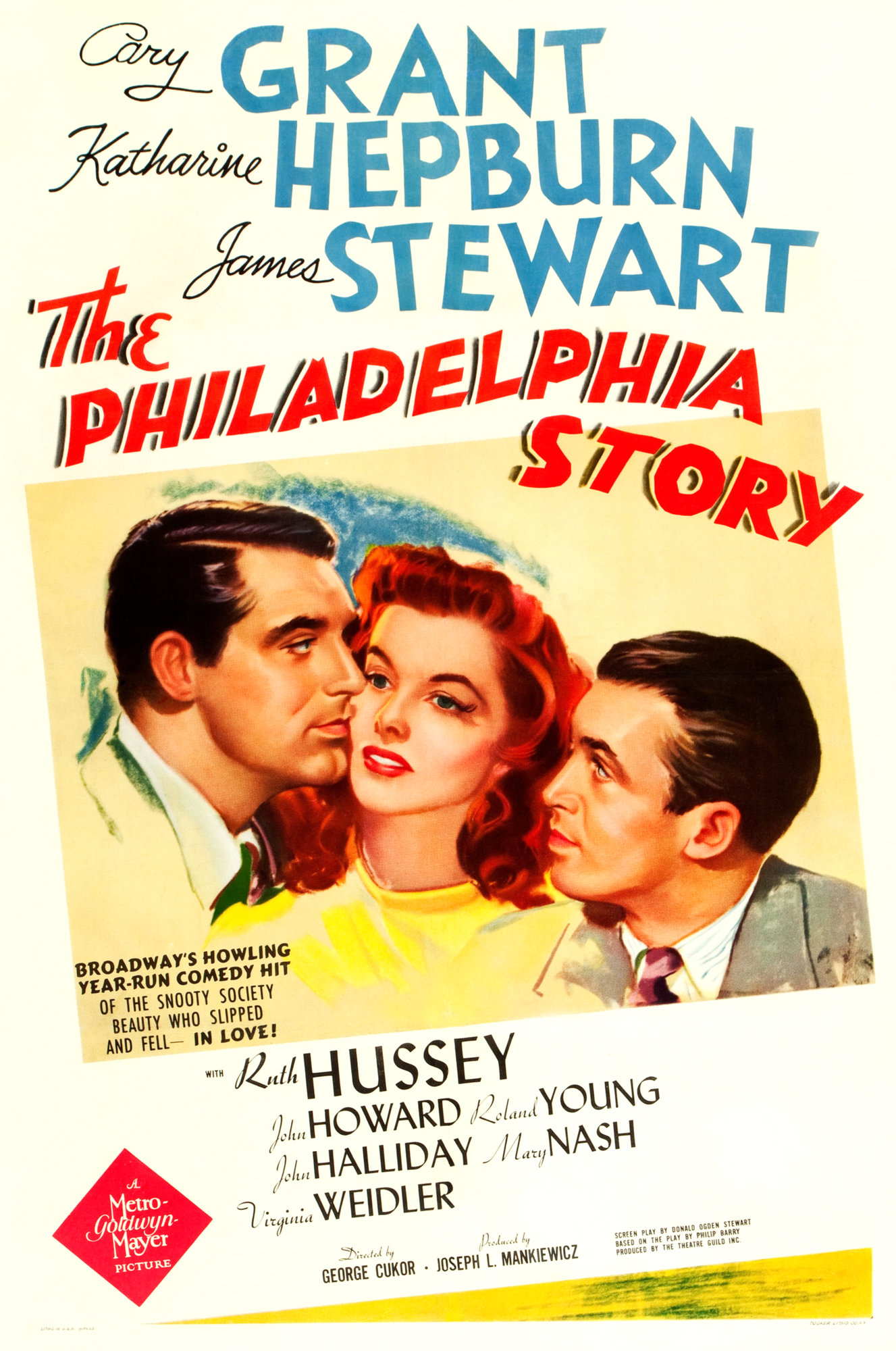
#292) The Philadelphia Story (1940)

The-Philadelphia-Story-(1940)

#292) The Philadelphia Story (1940)

OR “Save the Kate”

Directed by George Cukor

Written by Donald Ogden Stewart (and Waldo Salt). Based on the play by Philip Barry.

Class of 1995

The Plot: Two years after her divorce from yacht designer C.K. Dexter Haven (Cary Grant), Main Line socialite Tracy Lord (Katharine Hepburn) is engaged to fellow blue blood George Kittredge (John Howard). Tabloid-precursor Spy magazine uses its connections with Haven to get journalist Mike Conner (James Stewart) and photographer Liz Imbrie (Ruth Hussey) over to the Lord mansion, where the wedding is being held. Tracy objects, but Haven blackmails her into letting them stay. On the eve of the wedding, Tracy starts to get cold feet, but will she rekindle her romance with Dexter? Or start something new with Mike?

Why It Matters: There’s a plot recap, as well as references to the film’s two Oscar wins and Hepburn’s performance in the stage version. The only person the NFR gives a superlative to is George Cukor, who “elegantly directs” the proceedings.

But Does It Really?: “The Philadelphia Story” is the kind of romantic comedy that could only have come out of the studio system. Half the fun is watching three honest-to-God movie stars going head to head, bringing out the best in each other. The film sags a bit in the middle, and while its ending sticks the landing, it never recaptures the quick energy of the first half. Pacing problems aside, “The Philadelphia Story” is an entertaining comedy of a by-gone era, and a must-watch for classic movie lovers.

Shout Outs: Mike drunkenly sings “Someday over the rainbow”. I guess it wasn’t a classic yet.

Everybody Gets One: Ruth Hussey was the star of many an MGM “B” picture in the late ‘30s. “The Philadelphia Story” was one of her few forays into an “A” picture, and she received an Academy Award nomination for her performance. Hussey’s film career never took off, but she found continued success on radio and television.

Wow, That’s Dated: The dated gender politics I’ve come to expect from romantic comedies of the day, plus playful jokes about suicide, alcoholism, sexual harassment and spousal abuse. Another classic from the Dream Factory!

Take a Shot: Henry Daniell (as Spy editor Sidney Kidd) says the title once as a potential name for the article covering Tracy’s wedding.

Seriously, Oscars?: One of the biggest hits of 1940, “The Philadelphia Story” received six Oscar nominations, including Best Picture. The big winners that year were “Rebecca” and “The Grapes of Wrath”, but “Philadelphia” still managed two wins. Donald Ogden Stewart won Best Adapted Screenplay, and James Stewart took home Best Actor. Even Stewart eventually admitted that the award was a make-up win after he lost for “Mr. Smith Goes to Washington”. Stewart’s performance is lovely – and award-worthy – but is it really better than Henry Fonda’s Tom Joad?

Other notes

  • After being dubbed “box office poison” in Hollywood, Katharine Hepburn was lured back to Broadway when Philip Barry wrote “The Philadelphia Story” specifically for her. The play was a smash hit, and Hepburn immediately accepted the film rights from Howard Hughes, who purchased them as a gift for her.
  • Hepburn’s first choices for Dexter and Mike were, respectively, Clark Gable and Spencer Tracy. Both were already committed to other projects, so the historic first pairing of Tracy and Hepburn would have to wait another two years.
  • This movie starts off strong with one of the greatest film pratfalls ever. Added bonus: Grant and Hepburn did their own stunts.
  • Everyone in this movie is so sassy. Special mention to Ruth Hussey, as well as Virginia Weidler as Tracy’s smart-alecky sister Dinah. Where’s her Oscar nod?
  • It’s fascinating to see how much Katharine Hepburn’s comic timing evolved in the two short years since “Bringing Up Baby”. Not that she’s awful in “Baby”, Tracy is just a much more refined, dimensional character than Susan, so the comedy styling is more sophisticated. Performing this role eight times a week on Broadway obviously did Hepburn some good.
  • Jimmy Stewart is best remembered today as the kind of heroic everyman he played in “Mr. Smith” and “It’s a Wonderful Life”, so it’s a delight watching him play a more cynical character. Stewart felt he was miscast as Mike, and perhaps he is, but it works.
  • Cary Grant is very good in a role that, on the surface, is not very interesting. But when you get a movie star to play a co-lead, it definitely elevates the material.
  • Shoutout to John Howard as Tracy’s fiancé George. A lesser movie would have made him either a total loser or a jerk. George is neither of those things; he’s just not a match for Tracy.
  • This movie tries really hard to make “yare” a thing. The problem is you can’t make one word mean all of that, unless you’re Humpty Dumpty.
  • Three words: Drunk Jimmy Stewart. I’ll give him the Oscar right now.
  • Was Katharine Hepburn ever sexier than she is in this movie?
  • The whole “You’re lit from within, Tracy” scene is lovely, it’s just a shame the word “holocaust” took on a new meaning a few years later.
  • Oooh, implications of premarital sex. How scandalous back now.
  • Today in Code-era Profanity: “Class, my eye” and “Oh, my sainted aunt!”
  • At first I was opposed to the film’s ending, but the more I thought about it, the more I realized that’s the only way it could have ended. Damn you, Production Code!

Legacy

  • “The Philadelphia Story” was as popular in theaters as it was on stage, and not only succeeded as Katharine Hepburn’s comeback vehicle, but also cemented James Stewart’s status as a leading man with staying power.
  • Cary Grant immediately followed up this film with another romantic comedy about fast-talking, wise-cracking exes: “His Girl Friday”.
  • “The Philadelphia Story” was remade as a musical with 1956’s “High Society”. Grant, Stewart, and Hepburn are updated with Bing Crosby, Frank Sinatra, and Grace Kelly (in her final film). All this, plus Louis Armstrong!
  • Cukor and Hepburn reunited several times over the years, including two of the Tracy-Hepburn vehicles: “Adam’s Rib” and “Pat and Mike”.
  • The stage version of “The Philadelphia Story” has only been revived on Broadway once: in 1980 as a vehicle for Blythe Danner and Edward Herrmann. As best I can tell the only good to come from this revival was the Broadway debut of the actor playing Dinah: Cynthia Nixon. And now you know the rest of the story!
#291) A MOVIE (1958)

bruce-conner_a-movie_1958

#291) A MOVIE (1958)

OR “Less-Than-Precious Images”

Directed by Bruce Conner

Class of 1994

The Plot: Edited down from hours of stock footage, B-movies, and newsreels, “A MOVIE” is 12 minutes of seemingly random clips set to three of the four movements of Respighi’s “Pines of Rome”. As the film progresses (albeit with a few false endings), the clips seem to take on a narrative, or possibly an examination of how and why we watch movies. And for those of you with no interest in ‘50s experimental film, stick around for some brief nudity.

Why It Matters: The NFR write-up is primarily a regurgitation of the film that, thanks to a presumed typo, refers to the director as “Brucer” Conner. Clearly they are fans. There’s also a more detailed (and orthographically accurate) essay by art history professor Kevin Hatch.

But Does It Really?: It’s short and represents a director not found elsewhere on the list, so this checks out for me. Added bonus: “A MOVIE” is the kind of experimental film you are encouraged to add your own layers to. PLUS you get to watch all kinds of cool clips from other movies! There’s something for everyone!

Shout Outs: Among the clips featured are two tragic events turned NFR inductees: “Hindenburg Disaster Newsreel Footage” and “Tacoma Narrows Bridge Collapse”. On a significantly lighter note, Bruce Conner was partially inspired to make this film by the comic use of stock footage in “Duck Soup”.

Everybody Gets One: An up-and-comer in the San Francisco underground art scene, Bruce Conner was known for his assemblages: art pieces using found objects. He wanted to create a similar experience using film, but quickly learned how expensive and time-consuming it is to do your own filming. One trip to the bargain bin later, Conner started editing stock footage while listening to classical music on the radio (hence the inclusion of “Pines of Rome”). “A MOVIE” is Bruce Conner’s first film.

Seriously, Oscars?: Unsurprisingly, there was no Oscar nomination for the avant-garde “A MOVIE”. The Live-Action Short winner of 1958 was the Disney nature film “Grand Canyon”, which is as different a movie from “A MOVIE” as you can get.

Other notes

  • If you don’t know who made this film, the first thirty seconds have got you covered. I legitimately thought my computer froze on me.
  • I never went to film school, so sometimes this blog experience can turn into a significantly cheaper alternative. Case in point: While researching “A MOVIE” I learned that the countdown at the beginning of a film reel is called a “film leader”. Thanks, internet!
  • We begin as all movies should: with naughty footage from a ‘50s stag film. To the best of my knowledge, that’s Marilyn Monroe look-a-like Arline Hunter, whose footage Conner reused in 1973’s “Marilyn Times Five”.
  • Among the titles Conner purchased for this film are such names as “Thrills and Spills” and “Headlines of 1953”. There’s also an indeterminate Hopalong Cassidy movies, which I believe is the closest Hopalong will ever get to the Registry.
  • This whole thing is giving me very strong “Decasia” flashbacks. Though this footage is in much better condition; I would label it as “Pretty OK-sia”.
  • The most highlighted section of the film: footage from a submarine mixed with the aforementioned stag clip, plus an atomic bomb. The onslaught of innuendos would make Hitchcock proud.
  • All of this footage with motorcycles and car crashes leads to the obvious question: Where’s that fat guy taking a cannonball to the stomach? And while we’re at it, what about those clips of people testing out their flying machines?
  • Surprise guest star Teddy Roosevelt. Bully!
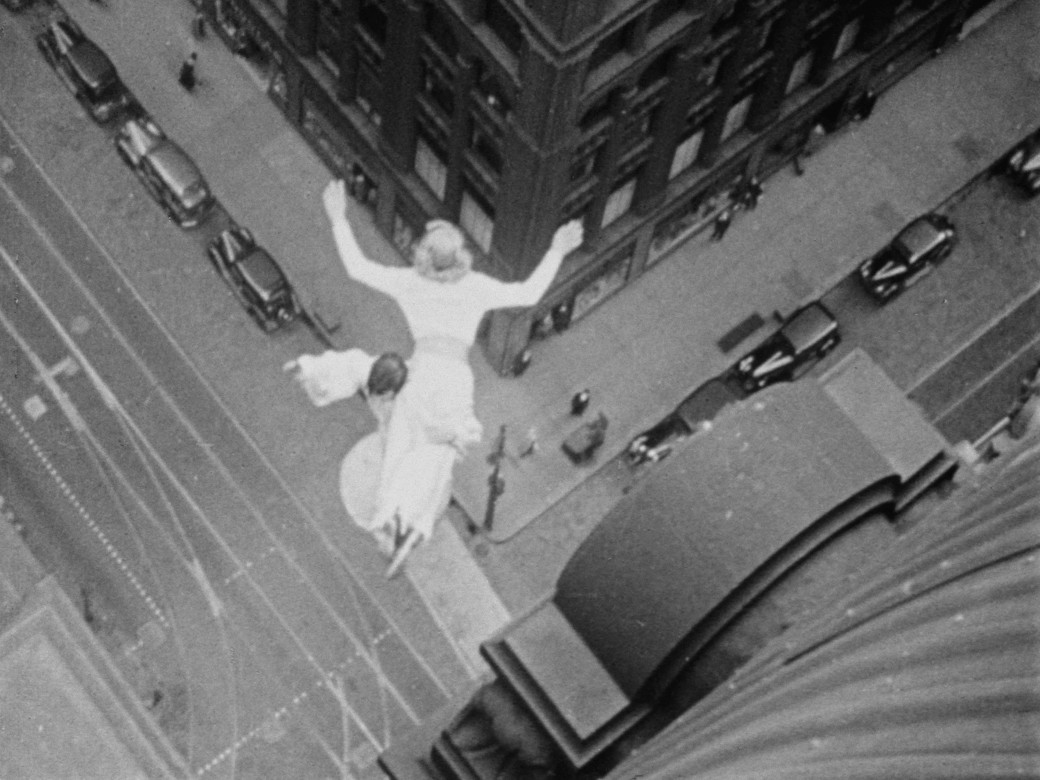
  • The third movement is when things get a bit dark. We got the Hindenburg and Tacoma, followed by plane crashes, firing squads, and malnourished children. It’s a real downer.
  • The last shot is a scuba diver at a shipwreck. If that’s not a metaphor for the kind of found art that Bruce Conner makes, I don’t know what is.

Legacy

  • Bruce Conner continued making all kinds of art up until his death in 2008, primarily repurposed found footage that deconstructs the movie-viewing experience. Most notable of his later work is “Report”, a meditation on news coverage following the JFK assassination.
  • I’m still in a Muppet state of mind, so I’ll use this as an excuse to play “Hey, A Movie!” from “The Great Muppet Caper”.
  • If “Pines of Rome” sounds familiar, you’re thinking of the flying whales from “Fantasia 2000”.

Further Viewing: “A Movie by Jen Proctor” is a 2010 shot-for-shot remake using YouTube clips. Be warned: This update contains 9/11 footage.

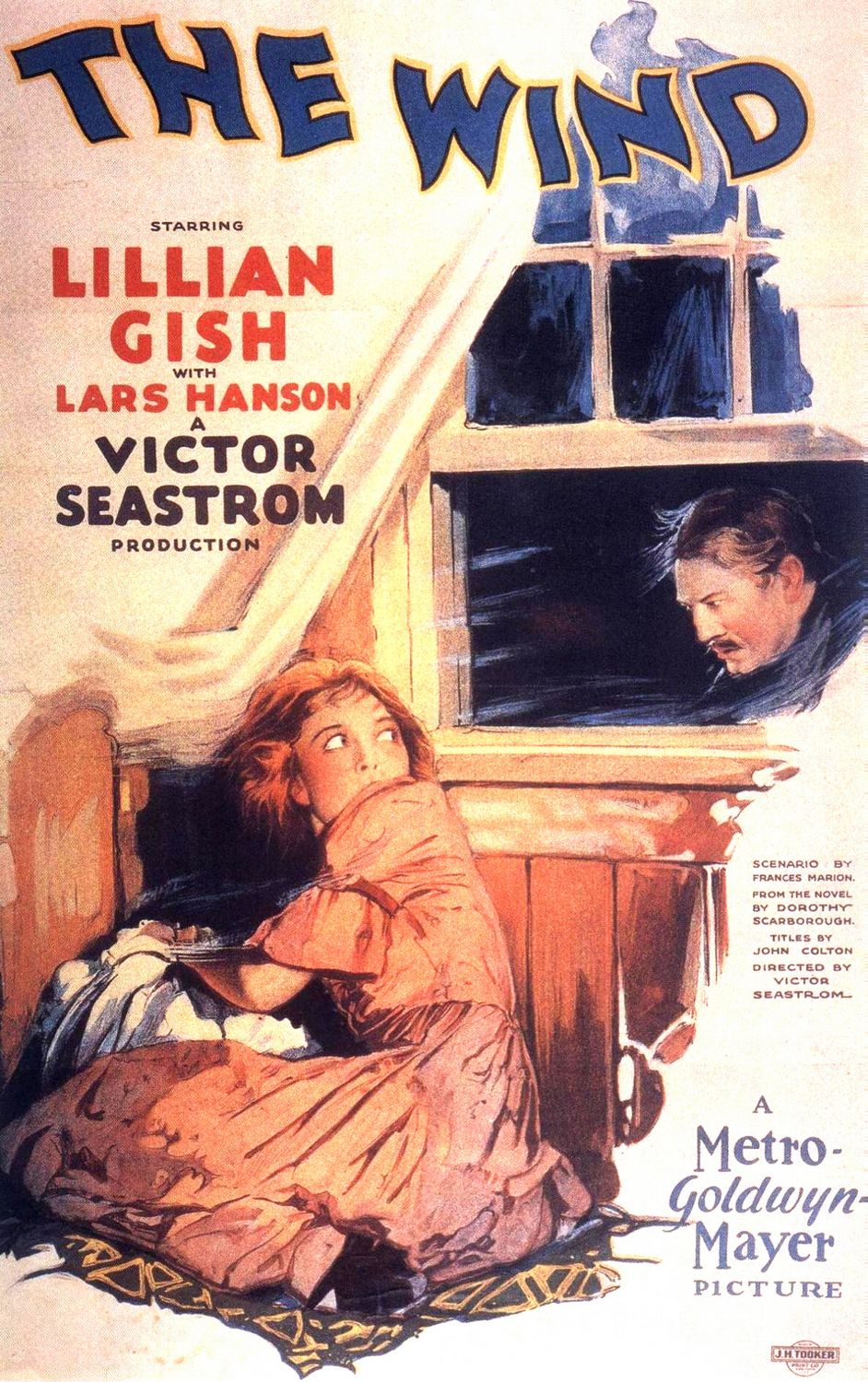
#290) The Wind (1928)

wind_xlg

#290) The Wind (1928)

OR “Wuthering Plains”

Directed by Victor Sjöström

Written by Frances Marion. Based on the novel by Dorothy Scarborough.

Class of 1993

Not the original trailer, but a nice little snippet.

The Plot: Letty Mason (Lillian Gish) travels from Virginia to the Sweetwater, Texas of the 1880s to live with her cousin Beverly (Edward Earle). Beverly’s wife Cora (Dorothy Cumming) does not warm up to Letty and wants her out. At the same time, cattle buyer Wirt Roddy (Montagu Love), as well as neighbors Lige (Lars Hanson) and Sourdough (William Orlamond) vie for Letty’s affection, despite her protests. But Letty’s main problem isn’t with any of Sweetwater’s citizens, but rather its weather. Upon their first meeting, Wirt warns Letty that the wind has been known to drive women insane. Will Letty survive her new surroundings?

Why It Matters: No superlatives in the NFR write-up, just a rehash of the film’s plot and historical significance. An essay by silent film expert Fritzi Kramer is much more loving.

But Does It Really?: “The Wind” is one of the last silent films produced by MGM, and features Lillian Gish’s final (and perhaps most iconic) silent performance. So historically this movie was going to make the NFR sooner or later. As a film, it’s fine. Gish is a solid lead, and like many of the latter silent films, “The Wind” has an overall higher quality than most silents. The gender politics don’t hold up, but there are still a lot of pros to outweigh the cons. A pass from me for “The Wind”.

Wow, That’s Dated: The aforementioned gender politics. Also, for the love of God, everyone please stop saying “injun”! There aren’t even any Native Americans in this film! You’re making it worse!

Seriously, Oscars?: The 2nd Academy Awards have no official listing for nominees, and there is no record that “The Wind” was under consideration by the Academy. Despite this, MGM still won Best Picture with one of their talkies, the all-singing “The Broadway Melody”. Lillian Gish would not be nominated for an Oscar until 1946, for her supporting turn in the Selznick Oscar-bait “Duel in the Sun”. The Academy finally gave Gish an Oscar in 1970, an honorary award for lifetime achievement.

Other notes

  • This was a passion project for Lillian Gish. She knew that playing Letty would allow her show more range as an actor, and convinced MGM to produce it. She hand-selected Victor Sjöström as her director and Lars Hanson as her co-star, having worked with both of them on the 1926 film version of “The Scarlet Letter”.
  • Research has confirmed my suspicion that with this much wind and sand blowing, it could not have been a fun shoot. Shooting on location in the Mojave desert was unbearable, with the cast and crew not only dealing with the constant wind, but also with the heat, with the temperature (according to various sources) ranging from 90 to 110 degrees.
  • Nice of them to translate the intertitles into actual old-timey prospector talk. Now if only I had any idea what they were saying…
  • Dorothy Cumming looks a lot like Anjelica Huston. Fun Fact: Cumming was also the evil queen in the 1916 silent version of “Snow White”.
  • A woman driven insane while living with relatives? What is this, “A Stagecoach Named Desire”?
  • I’m enjoying the special effects and model work throughout, especially during the cyclone scene. And this predates “Wizard of Oz” by a decade. Well done, uncredited effects team!
  • Must Lige and Sourdough settle every dispute with guns? What if the dispute is over which gun to use?
  • Oh crap, Lillian Gish is kind of hot. I’m attracted to a woman 94 years my senior. I’ve been watching too many silent movies.
  • Nice staging of the scene between Letty and Lige that focuses solely on their feet. Very Tarantino-esque.
  • This is one of the rare movies with singing intertitles. Sourdough croons “Bury Me Not on the Lone Prairie” (aka “The Cowboy’s Lament”), and the lyrics are italicized on the cards. This adds to some confusion later when select words in dialogue are italicized for emphasis. Are they singing those words?
  • At this point, I’m just going to assume the book is better.
  • Gish claimed that the studio forced her to reshoot the original ending after poor test screenings, but all available resources show the “happy” ending was always a part of the script.

Legacy

  • Sjöström only directed a handful of films after “The Wind”, but continued work as an actor on the stage in his native Sweden. He eventually acted on film, and is perhaps best remembered for his performance in Ingmar Bergman’s “Wild Strawberries”.
  • Sweetwater, Texas is very real and still going strong. Interestingly enough, Sweetwater is one of the leaders in wind energy and wind generators.
  • Say what you will about this movie, it’s definitely better than “The Happening”.

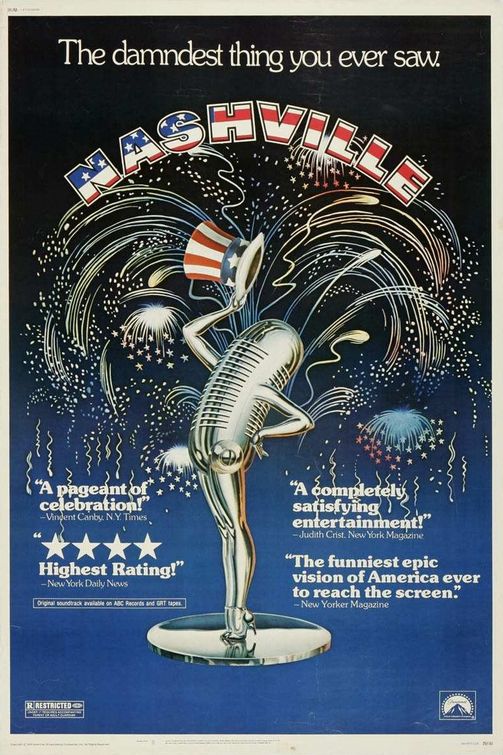
#289) Nashville (1975)

c4c3391e43289898da4ac8909e5c024d276bac73

#289) Nashville (1975)

OR “Can’t Stop the Music City”

Directed by Robert Altman

Written by Joan Tewkesbury

Class of 1992

The Plot: The country music capital of the world gets the Altman treatment as Nashville is portrayed through his trademark extended zoom shots and overlapping dialogue. 24 separate storylines weave in and out of each other, all centered on the town’s country stars and wannabes gearing up for a performance at a political rally. Among the ensemble are Grand Ole Opry star Haven Hamilton (Henry Gibson), BBC reporter Opal (Geraldine Chaplin), the talented yet extremely vulnerable Barbara Jean (Ronee Blakley), womanizing folk singer Tom Frank (Keith Carradine), lawyer Del Reese (Ned Beatty), his neglected wife Linnea (Lily Tomlin), and aspiring singer Winifred (Barbara Harris). All this, plus Jeff Goldblum as The Tricycle Man.

Why It Matters: The NFR calls the film a “funny and poignant series of vignettes” and praises the film’s “ability to be sarcastic, hopeful, and revelatory all at once”. A handful of performers, as well as the song “I’m Easy”, also get a shoutout. An essay by film critic David Sterritt puts “Nashville” in its contextual place in Altman’s filmography.

But Does It Really?: Having now watched all three of Robert Altman’s NFR entries (and several of his non-entries) I can conclusively say that I respect Altman’s films more than I enjoy them. There’s nothing wrong with his movies, they’ve just never done it for me, yet I keep coming back for more. Altman is truly one of the unique visionaries of film, and even when I wasn’t fully engaged with “Nashville”, I admired its fly-on-the-wall unfolding of the organized chaos that is life. While the meandering pace of “Nashville” is a bit slow by today’s standards, there are enough dynamic characters and performances to hold your interest. Altman is one-of-a-kind, and “Nashville” is the apex of a film career that will never be replicated. I give “Nashville” a pass on the historical and artistic fronts, but I do so more as an admirer than as a fan.

Shout Outs: Quick references to “The Wizard of Oz” and “Easy Rider”.

Everybody Gets One: Writer Joan Tewkesbury (a longtime Altman script collaborator), cinematographer Paul Lohmann, and most of the cast, including: Ronee Blakley, Geraldine Chaplin, Barbara Harris and Lily Tomlin.

Wow, That’s Dated: Many of the characters are inspired by such then-current country or folk singers as Roy Acuff, Loretta Lynn, Charley Pride, Lynn Anderson, and Peter, Paul and Mary. Throw in a Bicentennial reference and the abomination that is white afros and you got yourself 1975.

Seriously, Oscars?: “Nashville” initially received very high critical praise that was immediately followed by backlash (the word “overrated” was thrown around a lot). This, mixed with good-but-not-great box office and Altman’s outsider status in Hollywood, led to “Nashville” only receiving five Oscar nominations, albeit in major categories. The film lost Picture and Director to “One Flew Over the Cuckoo’s Nest”, while Ronee Blakely and Lily Tomlin split the Best Supporting Actress vote in favor of overdue veteran Lee Grant for “Shampoo”. “Nashville” did, however, win Best Original Song for Keith Carradine’s “I’m Easy”.

Other notes

  • Altman loves his fourth-wall breaking. The opening credits present the movie as a late-night commercial for an album by the cast, which actually sets up the whole movie quite well.
  • The lynchpin of the movie is the campaign of Hal Phillip Walker for the Replacement Party. We never see him, but he is voiced by Thomas Hal Phillips; novelist and producer of Altman’s “Thieves Like Us”.
  • Just a reminder that this film has two stars from “Laugh-In”. Both Henry Gibson and Lily Tomlin excel at flexing their hereto-unknown dramatic muscles.
  • Very interesting that one of the characters is a documentarian, and a potential imposter. Even Altman’s characters blur the line between reality and fiction. Geraldine Chaplin is just perfect in the role, and helped turn the Chaplin family into an acting dynasty.
  • So Jeff Goldblum has always been quirky on film? Fun Fact: Goldblum has two movies on the AFI Top 100, and only one line.
  • Car crashes! That’s what Altman’s movies are missing! For a second I thought Hal Needham guest directed the car pile-up.
  • I love Barbara Harris, but that accent is all over the place. Harris was dissatisfied with her performance and offered to pay for re-shoots. Altman refused.
  • Kenny Frasier looks like Stephen King. Unfortunately the ending of his subplot is tipped a little too early.
  • Surprise guest stars/former Altman leads Elliott Gould and Julie Christie! Apparently both actors happened to be in Nashville during production.
  • In true Altman authenticity, the actors wrote their own songs. Ronee Blakely had contributed several songs before being cast in the film last-minute. Tomlin, Carradine, and Gibson also helped pen a few songs, but special mention to Karen Black, who wrote a country song that sounds like the real thing.
  • When Lady Pearl talks about her affection for the Kennedys, she mentions Robert Kennedy taking his presidential campaign to Stockton, California. That’s absolutely true: Robert Kennedy stumped in my hometown by train just six days before his assassination.
  • “Since You’ve Gone” (the song performed by Bill, Mary, and Tom) was written by…Gary Busey? How did he get mixed up in all of this?
  • I can see why “I’m Easy” is a highlight: it’s the only song that comes from an emotional place for the character and comments on those emotions. You earn that Oscar, Carradine! The song also simultaneously advances the development of five characters, culminating with the slow close-up on Lily Tomlin.
  • “It Don’t Worry Me” is a good finale, if Altman movies are allowed to have finales. Another winner from Keith Carradine. Side Note: Did anyone else notice that the final camera move is a bit jerky?
  • For the record: Nashville hated “Nashville”. Altman believed that their local talent didn’t appreciate being passed over for the film in favor of Hollywood people.

Legacy

  • “Nashville” was Altman at his peak. His immediate follow-up was the somewhat muddled “Buffalo Bill and the Indians”, and while “3 Women” and “A Wedding” are not without their supporters, Altman would have to wait until 1992’s “The Player” to make a comeback.
  • In an unfortunate connection, some cited “Nashville” as one of the films that may have inspired Mark David Chapman to assassinate John Lennon.
  • Altman’s swan song was a return to country music, as well as many of the same themes from “Nashville”: “A Prairie Home Companion”.

#288) King Kong (1933)

Kingkongposter

#288) King Kong (1933)

OR “Ape Fear”

Directed by Merian C. Cooper and Ernest B. Schoedsack

Written by James Creelman and Ruth Rose. Based on an idea by Cooper and Edgar Wallace.

Class of 1991

No original trailer, but here’s one from a 1938 re-release!

The Plot: Adventurous filmmaker Carl Denham (Robert Armstrong) casts young Ann Darrow (Fay Wray) to star in his next picture. They board a ship bound for the mysterious Skull Island, and Ann falls for the ship’s first mate Jack (Bruce Cabot). Once they arrive on the island, the natives choose Ann as a sacrifice to “Kong”, a giant ape that rules the island. Kong appears to take a liking to Ann and protects her throughout a series of attacks from the island’s prehistoric creatures. Denham makes a plan to capture Kong and showcase him on Broadway, but Kong won’t go without a fight, or at the very least scaling the Empire State Building with Ann in tow while fighting off airplanes.

Why It Matters: The NFR calls it “an audience favorite” and praises “Willis O’Brien’s spectacular stop-motion effects”. There’s also an essay by Kong expert Michael Price.

But Does It Really?: I will not argue the legacy of “King Kong” or its status as a classic, but I will argue that it has not aged as well as you’d hope. The dialogue and characterizations are dated, which makes for a slow first half, but once Kong shows up, you’re in for a very fun ride. The special effects are the main highlight here, and are still exciting to watch 85 years later. It’s not one of the untouchables on this list, but “King Kong” is a bona-fide classic.

Everybody Gets One: Robert Armstrong had worked with Cooper and Schoedsack on their previous RKO picture, “The Most Dangerous Game”, and was an early favorite for the role of Carl Denham. Armstrong is one of the few actors to reprise his role in hastily produced sequel “Son of Kong”, which he actually preferred over the original.

Wow, That’s Dated: Soooooo much sexism and racism in this one. In terms of dialogue, the pièce de résistance is Denham’s declaration that there’s “something on that island no white man has ever seen.” More non-verbal stop-motion, please!

Seriously, Oscars?: “Kong” executive producer David O. Selznick unsuccessfully lobbied to get the movie a special Oscar for its visual effects (that category didn’t exist until 1939). The Academy did, however, give out a technical award to Sidney Saunders and Fred Jackman for their development of rear screen projections for several films, including “Kong”.

Other notes

  • There is a lot of material out there about the creation of “King Kong”. A good place to start is the film’s original laserdisc commentary by film historian Ronald Haver, notable for being the very first audio commentary.
  • Right from the start, this movie hits you over the head with the “beauty and the beast” motif. Fun Fact: The “Old Arabian Proverb” at the beginning is made up.
  • Fay Wray kinda looks like if Meryl Streep played Brie Larson. Along the same lines, Bruce Cabot seems like a proto-Charlton Heston we tried out in the ‘30s.
  • It takes so long for this movie to get to the island. How much more sexism and coolies do I have to sit through?
  • Kong lives at the entrance of Jurassic Park? Hold on to your butts.
  • Thank god Kong finally shows up. At this point the only thing that could possibly save this movie is a stop-motion ape.
  • The fight sequences can get pretty gruesome in a few spots, and many of these scenes were deleted from subsequent re-releases. That being said, it really isn’t too far-fetched to imagine Kong fighting Godzilla.
  • All the men in this movie scream like Slim Pickins in “Dr. Strangelove”.
  • Okay, the effects in this movie are awesome. The scene of Kong shaking the men off of the fallen tree is still really impressive to watch. Can we get Willis O’Brien a retroactive Oscar?
  • Most historians ignore the movie’s most influential dialogue exchange: “Roar!” “Ahhhhh!”
  • And then this movie slips into the moral gray area of Kong removing Ann’s clothing. Naiveté or harassment? You make the call.
  • Every time Kong defends Ann from one of the monsters I want him to yell, “That’s my wife, you bastard!”
  • I call shenanigans on Jack and Ann surviving a fall that high.
  • Why do they keep toting Kong as “the eighth wonder of the world”? The other seven are all man-made, where does a giant ape fit into this?
  • Cooper and Schoedsack always denied that the film had any metaphorical implications, but I must say the film historians who make the slavery argument have a solid case.
  • One patron complains that tickets to see Kong are $20, roughly $388 today. By comparison, mezzanine tickets for “Hamilton” currently start at $330.
  • How many times do I have to tell you people: you get better pictures by turning the flash off!
  • The Empire State Building was less than two years old when Kong scaled it. The equivalent today would be if he came to San Francisco and climbed our god-ugly Salesforce Tower.
  • “It wasn’t the airplanes. It was Beauty killed the Beast.” No, it was definitely the airplanes.

Legacy

  • “Kong” was a runaway hit when released in March 1933. It was so popular that work immediately began on a sequel. “Son of Kong” was rushed to theaters only nine months after the original.
  • The character of Kong has been the subject of a few copyright claims over the years, and his current ownership is split between a few companies. The trouble started in 1962 when Merian C. Cooper learned that RKO was licensing Kong to the Japanese studio Toho for “King Kong vs. Godzilla”. Cooper filed suit in a case presumably called “Cooper v. ‘King Kong vs. Godzilla’”.
  • The original “King Kong” has been remade twice (so far): The 1976 Dino De Laurentiis version gave us newcomer Jessica Lange, and the 2005 Peter Jackson version proved there was life after “Lord of the Rings” (sort of).
  • Kong’s current film incarnation is as part of Legendary Entertainment’s “MonsterVerse”. 2017’s “Kong: Skull Island” was the launching pad for Kong’s rematch with Godzilla in 2020.
  • And all of the above are just the official entries. There are countless rip-offs and Kong-esque gorillas throughout film history. Plus a Japanese cartoon show!
  • “King Kong Encounter” was a part of the Universal Studios Hollywood tour until a fire destroyed it in 2008. An updated “King Kong: 360 3-D” segment is now in its place.
  • At long last, Kong has made it to Broadway. From what I can tell, their opening night went better than Denham’s.
  • The pop-culture references to “King Kong” are so numerous they have their own Wikipedia page. So I will leave you, as I often do, with a “Simpsons” reference.
  • No wait, “Donkey Kong”. Let’s end with “Donkey Kong”.