#287) Top Hat (1935)

#287) Top Hat (1935)

OR “Venice Match”

Directed by Mark Sandrich

Written by Dwight Taylor and Allan Scott. Based on the plays “Scandal in Budapest” by Sandor Farago and “A Girl Who Dares” by Aladar Laszlo. Songs by Irving Berlin.

Class of 1990

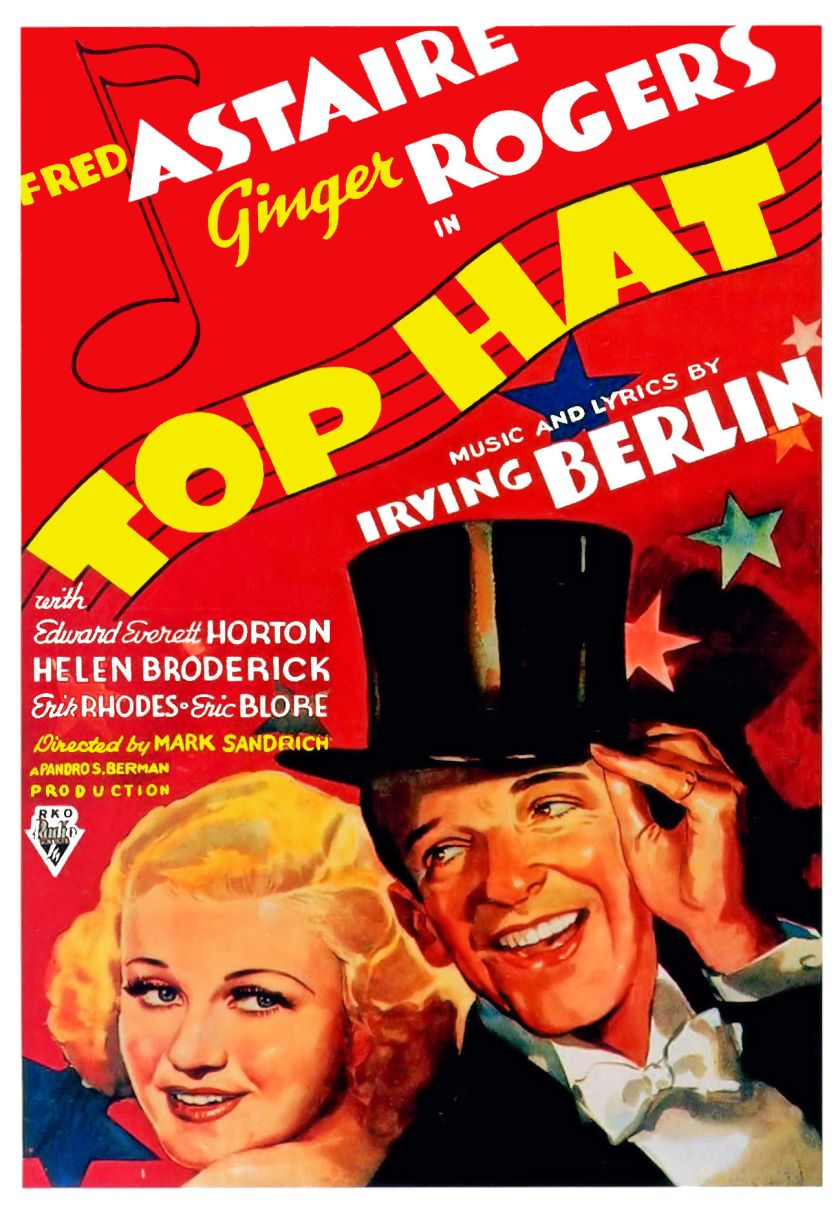
The Plot: Celebrated dancer Jerry Travers (Fred Astaire) meets designer model Dale Tremont (Ginger Rogers) at a fancy hotel in London. Despite some initial friction, they find themselves attracted to each other. In a case of mistaken identity, Dale thinks that Jerry is Horace Hardwick (Edward Everett Horton), a theatrical producer known for his skirt-chasing. This all comes to a head in a bridal suite in Venice, where Dale’s Italian designer friend Beddini (Erik Rhodes), Hardwick’s wise-cracking wife Madge (Helen Broderick), and his effete valet Bates (Eric Blore) are thrown into the mix. But all this plot still leaves plenty of room for some classic Irving Berlin standards.

Why It Matters: The NFR calls the film “the quintessential Astaire-Rogers musical”, though admits that “Top Hat” is just a retread the pair’s previous outing, “The Gay Divorcee”. There’s also an essay by film critic Carrie Rickey.

But Does It Really?: If I have to pick one Astaire-Rogers movie for the vault, it’s “Top Hat” (Oh “Swing Time”, if only you didn’t have that Bojangles routine). There aren’t a lot of musical numbers, but the ones they have are among the duo’s best, and in the interim are fun performances by a cast you enjoy spending time with. On top of its expected musical attributes, “Top Hat” is surprisingly funny. I chuckled pretty consistently throughout the film, which speaks to how well “Top Hat” has aged. Do yourself a favor and watch “Top Hat” at least once in your life.

Everybody Gets One: Mark Sandrich directed five of the ten Astaire-Rogers musicals, despite allegedly not getting along with Rogers. Sandrich would go on to direct Astaire in “Holiday Inn”, which gave us the classic song “White Christmas”.

Wow, That’s Dated: Lots of gender politics in this one. Nothing too groan inducing, but it’s definitely there. And as always, I’ll pour one out for the gone-but-not-forgotten RKO Pictures.

Seriously, Oscars?: One of the biggest hits of 1935, “Top Hat” was nominated for four Oscars, winning none. Among its defeats: Best Song entry “Cheek to Cheek” lost to “Lullaby of Broadway” from “Gold Diggers of 1935”, and Best Picture went to the only movie that out-grossed “Top Hat”: “Mutiny on the Bounty”. Side note: How is “Mutiny” not on the NFR yet?

Other notes

  • While “Top Hat” was the fourth pairing of Astaire and Rogers at RKO, it was the first of their movies with a screenplay tailored specifically for them.
  • Even without dialogue, Astaire’s effortless charm shines through.
  • Oh yeah, Hardwicke and Bates are so gay for each other. How did no one at the Hays Office catch that one?
  • Speaking of, Bates always refers to himself in first-person plural form (“We are Bates.”). There’s no way America was ready to even conceive of non-binary pronouns.
  • The Flower Clerk at the beginning is played by a young RKO contract player named Lucille Ball. And now you know the rest of the story!
  • Nice pun involving the word “dam”, as in the mother of a horse. This is followed by a “horse power” joke that…. [Deep exhale].
  • There’s nothing I can say about Fred and Ginger dancing that hasn’t already been covered. Both had their own unique star quality, but together they formed a third property. One never upstaged the other when they danced; they became one cohesive unit. It is always a joy to watch.
  • I don’t know where I stand with the Jerry/Dale courtship. It’s one of those “he’s a jerk but she’s okay with it” deals, but they’re both so charming. For a black and white movie, this is more shades of gray than I care for.
  • Beddini is one spicy Italian stereotype! Apparently this greatly offended Italian Prime Minister/Fascist Benito Mussolini, which led to “Top Hat” being banned in Italy.
  • Shoutout to Gertrude Stein, whose 15 minutes of fame were just starting when this film was released.
  • “Top Hat, White Tie and Tails” is great, but why does Fred have so many backup dancers? Does he need to shoot all of them?
  • Helen Broderick is great as the kind of sardonic supporting character she always played in these movies. Fun Fact: She’s Broderick Crawford’s mother!
  • I can see how this film got an Art Direction nomination: the Venice set is huge! It even has a canal going through it!
  • Bow down to Edward Everett Horton and his perfect comic timing. He is the Astaire-Rogers of the comic take.
  • If you take out the musical numbers, “Top Hat” has the same structure as many of the best “Frasier” episodes.
  • And then we get to “Cheek to Cheek”. It’s lovely, although slightly overshadowed by the behind-the-scenes stories involving Ginger Rogers’ problematic feather dress. You can see a bit of molting going on in the final cut.
  • This movie’s wardrobe is so elegant. Did the crew have to wear tuxes too?
  • Some articles about “Top Hat” mention an excised scene where Bates tells off an Italian police officer. I’m not quite sure when it was cut, but it seems to have been restored in the print I watched (and hilarious).
  • Looks like Hermes Pan is going for some Busby Berkeley-esque dance formations in “The Piccolino”. Sadly, he can’t quite pull it off.
  • My last note simply reads: “That’s just delightful”. This whole post could have just been those three words. In fact…

Legacy

  • Every song in this movie became a standard, and I’m pretty sure Ella Fitzgerald and Louis Armstrong recorded all of them.
  • The “Feathers” incident inspired a sequence in the Fred Astaire/Judy Garland vehicle “Easter Parade”, as well as Fred’s endearing nickname for Ginger.
  • “Top Hat” was adapted for the stage in the early 2010s, with a score filled out by additional Irving Berlin material. The show has toured the UK and Ireland, but I don’t see it coming to the states anytime soon.
#286) Singin’ in the Rain (1952)

Singin-in-the-Rain_poster_goldposter_com_17

#286) Singin’ in the Rain (1952)

OR “The Music of Sound”

Directed by Stanley Donen and Gene Kelly

Written by Betty Comden & Adolph Green. Songs by Nacio Herb Brown and Arthur Freed.

Class of 1989

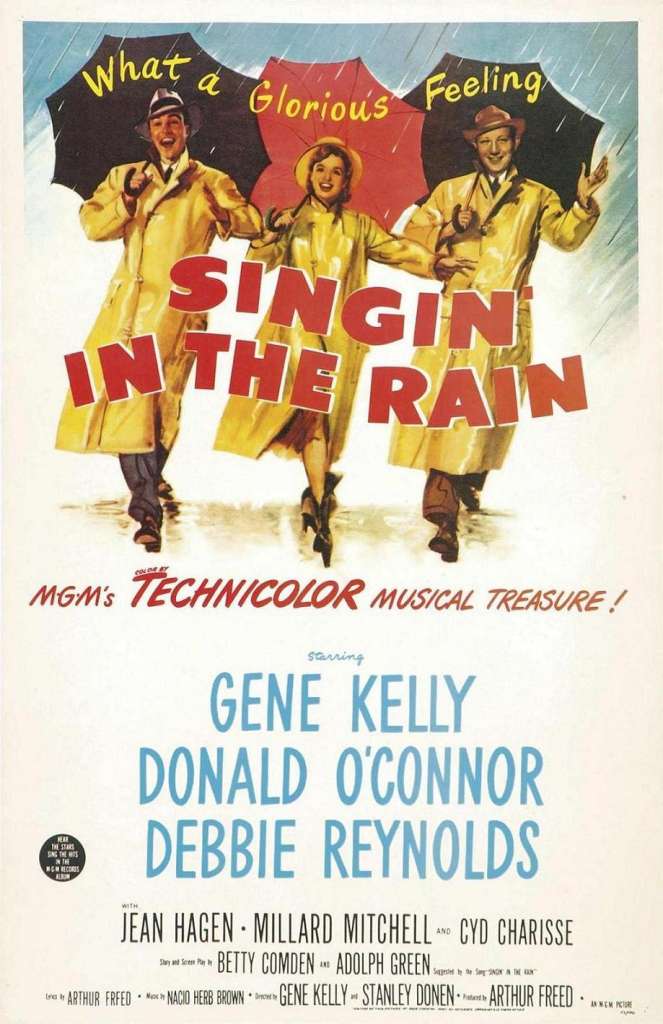
The Plot: It’s 1927 Hollywood and talkies have exploded onto the scene. Silent film leading man Don Lockwood (Gene Kelly) is convinced it’s a fad, but studio head R.F. Simpson (Millard Mitchell) insists on reshooting Don’s latest vehicle, “The Dueling Cavalier”, with sound. The transition is a bumpy one, exasperated by leading lady Lina Lamont’s (Jean Hagen) pronounced Queens accent. After a disastrous preview, Don thinks his career is over, but his best friend Cosmo (Donald O’Connor) and chorus girl Kathy (Debbie Reynolds) convince him to play to his strengths and turn “Cavalier” into a musical. What follows is sheer perfection set to the Brown/Freed song catalog.

Why It Matters: The NFR calls it “one of the greatest musicals ever filmed” and praises Kelly, Donen, the main cast, and the title number.

But Does It Really?: Case closed: “Singin’ in the Rain” is the greatest musical ever made. Many come close, but none can match this movie for its sheer joy (Doctors should start prescribing it as an anti-depressant). You can tell there’s something special going on right from the start. The combination of talent from Donen and Kelly on down makes this the rare grand-slam home run of films. “Singin’ in the Rain” is at the top of my preservation-worthy list, and I hope every future generation has the privilege of watching it.

Shout Outs: A few historical references to “The Jazz Singer” throughout. I’m sure Warner Bros. appreciated the free publicity.

Everybody Gets One: Most of these players appear throughout the other “Freed Unit” musicals on this list, but the main standout is Donald O’Connor, on loan from Universal, running up the walls of film immortality as Cosmo Brown.

Seriously, Oscars?: While successful in its day, “Singin’ in the Rain” faced unavoidable comparisons to “An American in Paris”, which was re-released in 1952 after its Best Picture win. “Singin’ in the Rain” received two Oscar nominations, and lost both. Best Scoring of a Musical Picture went to the Jane Froman biopic “With a Song in My Heart”, and, most conspicuously, Jean Hagen lost Best Supporting Actress to Gloria Grahame’s brief performance in “The Bad and the Beautiful”.

Other notes

  • That’s a pretty gutsy move to be the head of your own movie studio unit and then propose a film comprised entirely of your own songs. You got lucky this time, Arthur Freed.
  • Future EGOT winner Rita Moreno plays the disappointingly minor role of Zelda Zanders. Don’t worry Rita, “West Side Story” isn’t too far away.
  • We’re only at “Fit as a Fiddle” and I’m already exhausted watching this choreography. The precision leaves me speechless.
  • The nice thing about Lina Lamont is that she’s allowed to be more dimensional than your traditional comic foil. She’s shrewish, yet shrewd.
  • Donald O’Connor is a well-oiled comedy machine. His timing throughout the film is remarkable, and “Make ‘Em Laugh” is a tour-de-force. While we’re on the subject, I hope Cole Porter sued.
  • My favorite line in the movie: “Hey Joe, get me a tarantula!”
  • Shoutout to costumer Walter Plunkett, who not only had to design ‘20s clothing for everyone, but also wardrobe for a variety of film genres. Where was his Oscar nod?
  • The stories of this film’s difficult production are legendary – even Kelly himself said he was too hard on Reynolds and O’Connor – but amazingly, none of that comes through the final film. It looks like everyone’s having the time of their lives.
  • Character actor Kathleen Freeman spent most of her seven decade career playing everyone’s sassy maid/mom/secretary, but here she’s wonderfully against-type as unflappable dialect coach Phoebe Dinsmore (“And I cahn’t stahnd him.”)
  • Moses supposes his toeses were roses? Man, wandering the desert will mess you up.
  • How many people over the years have wrecked their furniture trying to reenact the last shot of “Good Morning”?
  • And now the main attraction: the title number is one of those perfect moments captured on film. Unlike the other songs, “Singin’ in the Rain” stems organically from the character. Don is so happy, he can no longer speak, so he sings. The entire scene is powered by Kelly’s infectious energy. I’m getting chills just writing about it.
  • You know what tainted Jean Hagen’s performance for me? Judy Holliday in “Born Yesterday”. Holliday was the first choice for Lina (Comden & Green wrote the role for her), but she was unavailable, so her stage understudy Hagen got the part. Don’t get me wrong, Hagen is flawless in the role, but I suspect the Holliday comparison is one of the reasons Hagen didn’t win the Oscar. Holliday won for “Born Yesterday” two years earlier, and a vote for Hagen must have felt like “been there, done that” to the Academy.
  • Filmdom’s Greatest Irony: Debbie Reynolds is dubbed when Kathy is looping Lina for “Would You?”.
  • Filmdom’s Second Greatest Irony: Jean Hagen dubbed some of Lina’s speaking lines in “The Dancing Cavalier” using her natural voice.
  • Most of these numbers are so good you don’t care how lazily shoehorned into the film they are, but “Broadway Melody” really stretches that hospitality. It’s good, but Gene Kelly is clearly trying to out-“American in Paris” himself. That being said, Cyd Charisse is worth the trip out.
  • Debbie Reynolds doesn’t get as much screen time as you remember, and the love story is just there because it’s a musical comedy, but I’ll be damned if I didn’t tear up when Don wins Kathy back. Damn you two and your star quality!
  • The more I watch this movie, the more I’m disappointed in “La La Land”.

Legacy

  • Gene Kelly reached his musical apex with “Singin’ in the Rain”, but a few business conflicts with MGM, mixed with the slow decline of the movie musical, caused Kelly to never again reach those same cinematic heights.
  • Stanley Donen went on to direct “Seven Brides for Seven Brothers”. They can’t all be winners.
  • Debbie Reynolds became a bona fide star thanks to this movie, leading to her Oscar-nominated turn in “The Unsinkable Molly Brown”.
  • “Singin’ in the Rain” got its inevitable stage adaptation in the ‘80s. With the right cast it’s charming, but why mess with perfection?
  • Countless parodies and allusions over the years, but will anything surpass “A Clockwork Orange”?
  • Whenever a Pittsburgh Pirates home game is rained out, the ballpark plays a clip of native son Gene Kelly.
  • Oh my god we made him break dance.
  • And of course, the Great Movie Ride.

Further Viewing: The earliest performance of “Singin’ in the Rain” from “Hollywood Revue of 1929”, sung by Cliff “Ukulele Ike” Edwards.

#285) The Sinking of the Lusitania (1918)

maxresdefault

#285) The Sinking of the Lusitania (1918)

Directed & Written by Winsor McCay

Class of 2017

But first – an Oversimplified History Lesson: World War I had been going on for less than a year in Europe when Germany announced that their U-boat invasion of Allied vessels would now include passenger ships. On May 7th 1915, a German U-boat fired a torpedo at the ocean liner RMS Lusitania, a British ship returning from a trip to New York City. The ship sank off the coast of Ireland, with 1198 killed, including 128 Americans. Although it would be another 2 ½ years before America officially entered the war, this event did start to turn public opinion away from neutrality. Among those opposed to American involvement was newspaper magnate William Randolph Hearst, who forced his newspapers to downplay the sinking and to create anti-war editorial cartoons. This did not sit well with one of his cartoonists, Winsor McCay, who spent two years of his own time and money to make “The Sinking of the Lusitania”.

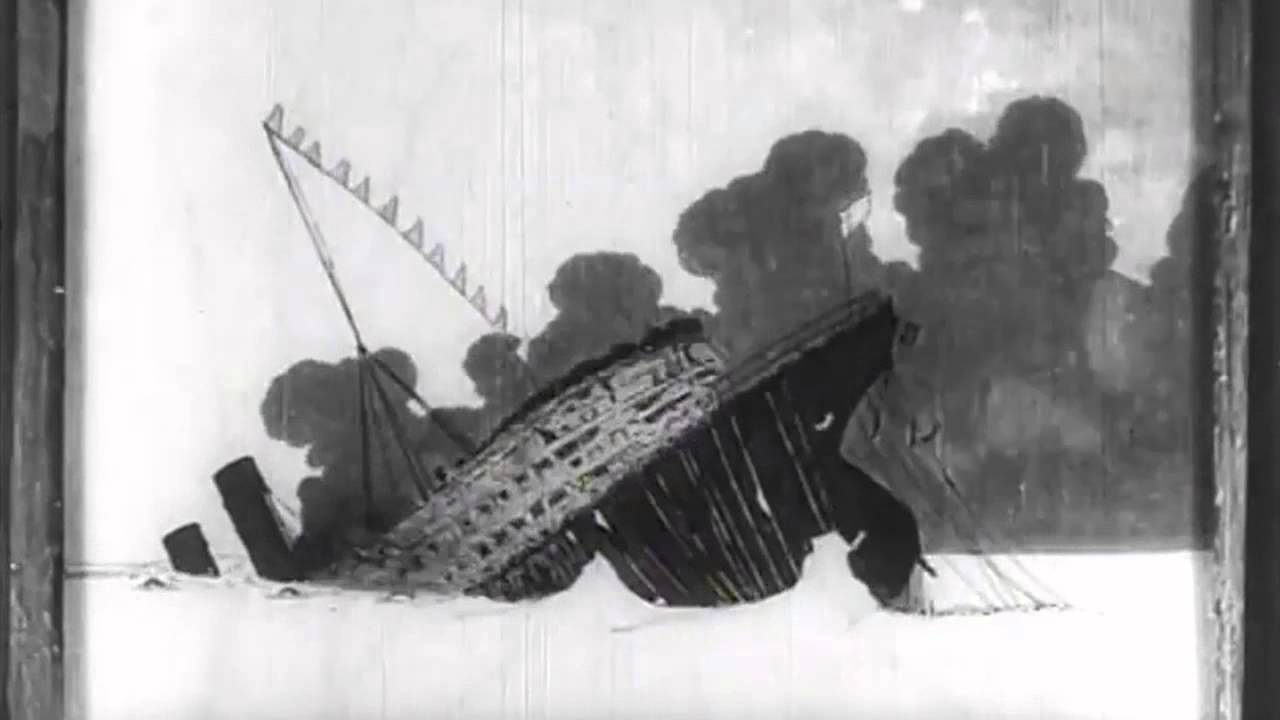
The Plot: After a brief prologue highlighting the manpower required by Winsor McCay to make this film (including 25,000 individual drawings), “The Sinking of the Lusitania” is an animated recreation of the tragic event. Through painstakingly detailed animation, and with no newsreel footage or photographs to use as reference, McCay and his team show the torpedoes hitting the Lusitania, the ensuing explosions, and the innocent passengers abandoning ship and drowning, all while reminding you that the Germans are the real enemy and that America must take action.

Why It Matters: The NFR chalks this film up to historical significance, calling it “a notable early example of animation being used for a purpose other than comedy.” The write-up also devotes space to a quote from film expert William K. Everson, who calls the film “a fascinating and seldom-repeated experiment.”

But Does It Really?: A historical yes. The animation has a very surreal quality that makes for a tantalizing viewing experience, and the historical significance helps push it over into the “preservation-worthy” category. Like a lot of people with multiple films on the Registry, “Sinking” isn’t the most essential Winsor McCay film, but it is a must-watch for anyone interested in his work.

Shout Outs: None, which is surprising considering how much Winsor McCay liked to toot his own horn. Perhaps he didn’t want his passion project to be associated with Gertie or Little Nemo.

Everybody Gets One: I’ll give a shoutout to August F. Beach. He was the first reporter at the actual sinking, and shared his recollections with McCay. If this film had any actual credits I’m sure he’d be listed as a “historical consultant” or something.

Wow, That’s Dated: The last intertitle refers to the “Hun”, the slang term for Germans used during the war. It’s a not-favorable comparison to Attila.

Other notes

  • From what I can gather, “Sinking” premiered in the summer of 1918. The German armistice that ended the war was signed in November of that year, so this was one of the final bits of propaganda for the war effort.
  • A “Moving Pen Picture”? Surely the word “animated” existed back then.
  • McCay loves his stats. He is more than happy to tell you how much work he put into any of these shorts.
  • This is the first of the McCay shorts to rely on a background layer with celluloid animation (cels) placed over. Prior to this, McCay had the background drawn with the main action for each individual frame. Cartoonist Earl Hurd created animation cels in 1914, and it quickly became the industry norm.
  • Let the record show that although there were two explosions aboard the Lusitania, only one torpedo hit the ship. McCay added the second torpedo for this film. Historians still aren’t sure what exactly caused the second explosion.
  • The short also features an “In Memoriam”-type section for notable figures that were lost on the Lusitania. Most notable among them, Broadway producer Charles Froham, whose last words were allegedly “Death is but a beautiful adventure of life”, a paraphrase of a line from one his biggest hits: a stage production of “Peter Pan”.

Legacy

  • As you can imagine, Hearst was not happy that McCay was devoting more time to his animation than his newspaper cartoons, and shortly after the release of “Lusitania” forced McCay to give up animation. McCay relented, and a groundbreaking film career was over.

#284) A Walk in the Sun (1945)

MV5BMGQ1OGRhMTItYjUxOC00OGE0LTlmNDMtZmJhN2EwYTdhNmE4L2ltYWdlL2ltYWdlXkEyXkFqcGdeQXVyNjc1NTYyMjg@._V1_

#284) A Walk in the Sun (1945)

OR “The Italian Job”

Directed by Lewis Milestone

Written by Robert Rossen. Based on the novel by Harry Brown.

Class of 2016

The Plot: “A Walk in the Sun” is a fictional account of the 36th Infantry Division during the Allied Invasion of Italy in September 1943. With a sudden overturn in leadership, the platoon lands on a beach in Salerno with one objective: to capture a farmhouse taken over by Nazis. Among the men are de facto leader Sgt. Tyne (Dana Andrews), Sgt. Potter (Herbert Rudley), who is on the verge of a complete breakdown, seen-it-all Pvt. Archimbeau (Norman Lloyd), mid-west farmer Sgt. Ward (Lloyd Bridges), and a complex group of men who know that this “walk in the sun” will forever define their wartime experience.

Why It Matters: The NFR praises the “excellent” script, particularly its emphasis on character over action, thus separating it from other war movies of the era.

But Does It Really?: I…don’t know. The NFR make a good case, but I’m not sure about “A Walk in the Sun”. Like “Twelve O’Clock High”, this is one of the first war movies that emphasized character over action. Also like “Twelve O’Clock High”, this movie is a bit of a slog. There’s some lovely character work throughout, and this film’s non-propaganda stance on the war must have been revolutionary in 1945, but there have been so many war movies in the last 70 years that have eclipsed “A Walk in the Sun” on the character study front. I’m glad the film is being rediscovered, but is it really preservation worthy in the same class as “The Birds” or “Funny Girl”?

Everybody Gets One: The main one here is the film’s original producer Samuel Bronston who, due to financial issues, had to give up the film rights to “A Walk in the Sun” and hand them over to Lewis Milestone’s Superior Productions. But one lawsuit later, Bronston still managed to receive 21% of the film’s profits. Bronston was eventually taken down by three little words: Swiss bank account.

Wow, That’s Dated: Lots of ‘40s jargon in this one, and plenty of slurs against the “Eye-ties”.

Take a Shot: This is another movie I was not expecting to have a title song. Sung by opera bass-baritone Kenneth Spencer, the song “A Walk in the Sun” serves as a common thread throughout the film, commenting on these men and their actions.

Seriously, Oscars?: “A Walk in the Sun” was completed just before World War II ended, and was shelved until 1946. The film received zero Oscar nominations, probably due to its lack of a solid studio to campaign it, as well as competition from that other Dana Andrews introspective war movie: “The Best Years of Our Lives”.

Other notes

  • Director Lewis Milestone is perhaps best remembered for his take on World War I: 1930’s “All Quiet on the Western Front”.
  • This is one of the weirdest opening credits of any movie. That being said I’d like Burgess Meredith to narrate my life.
  • Lloyd Bridges! Looks like I picked the wrong week to quit making lazy “Airplane!” references.
  • “A Walk in the Sun” was shot on location at the 20th Century Fox Movie Ranch. You know it best from “Planet of the Apes” and the “M*A*S*H” TV series.
  • I don’t trust a war movie where the soldiers don’t curse.
  • As the platoon’s first aid man Pvt. McWilliams, this may be Sterling Holloway’s finest live-action performance. Or at least the one where he gets the most screen time.
  • Shoutout to Norman Lloyd, character actor/director/living centenarian (He turns 104 this week!). It’s crazy to think that one of the actors in this movie is also in “Trainwreck” with Amy Schumer.
  • Weirdly enough, this movie predicted smell-o-vision. And to an extent, AromaRound.
  • Archimbeau predicts that in 1956 we’ll be fighting a war in Tibet. Off by a few years and 2400 miles.
  • Never say “over my dead body” in a war movie.
  • Oh those are some very obvious studio reshoots. It’s the only rear projection in a movie filmed entirely on location.
  • During the climax, one of the soldiers exclaims, “Mary and Joseph!” You forgot one.

Legacy

  • Nothing too much in terms of a legacy, but shortly after “A Walk in the Sun”, screenwriter Robert Rossen pivoted towards directing, helming future NFR entries “All the King’s Men” and “The Hustler”.

#283) Ghostbusters (1984)

81Pz44xom+L._SL1500_

#283) Ghostbusters (1984)

OR “Zuul Me Once, Shame On You”

Directed by Ivan Reitman

Written by Dan Aykroyd and Harold Ramis

Class of 2015

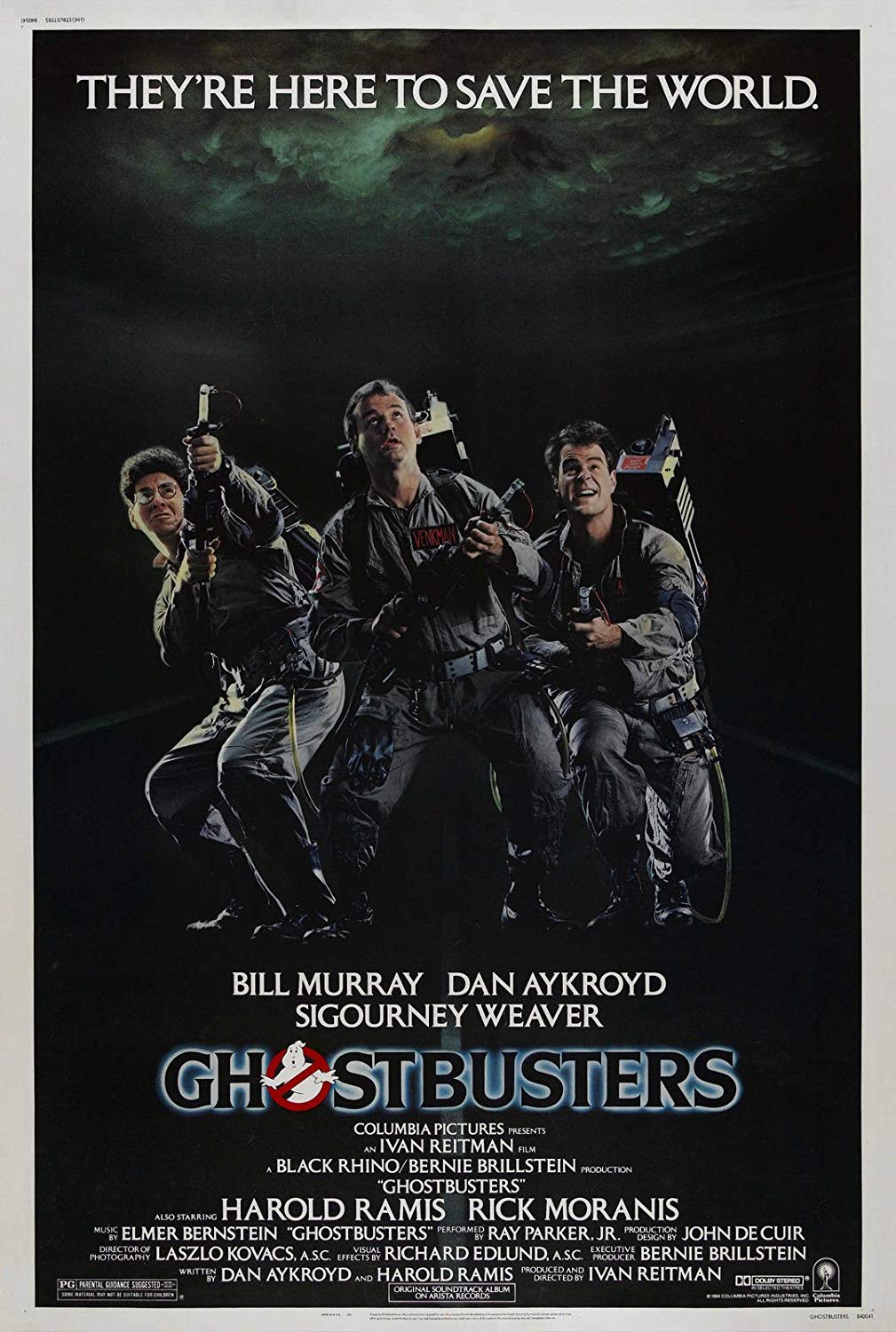
The Plot: New York City is swarming with ghosts, and only disgraced scientists Peter Venkman, Raymond Stantz, & Egon Spengler (Bill Murray, Dan Aykroyd, & Harold Ramis, respectively) can stop them. After being evicted from Columbia University, the trio rent an abandoned firehouse and creates the “Ghostbusters” business. Peter tries to woo client Dana (Sigourney Weaver), who is at risk of being possessed by ancient demigod Zuul and signaling the end times (“Dogs and cats living together, MASS HYSTERIA!”). Joined later by the severely underwritten Winston Zeddemore (Ernie Hudson), this team ain’t afraid of no ghosts.

Why It Matters: The NFR calls the film “One of the most popular, quotable films from the past three decades” and praises Murray as well as the film’s “infectious insanity”. There’s also a reverential essay by filmmaker Adam Bertocci, whose webpage “Overthinking Ghostbusters” ultimately led to the film’s NFR inclusion. Truly, Adam is the change he wants to see in the world.

But Does It Really?: Readers, it’s time you learned the truth: I like but don’t love “Ghostbusters”. It’s funny – at times even hilarious – and I am 100% behind its NFR inclusion, but overall the movie just doesn’t click for me. Dan Aykroyd wrote an overcomplicated ghost movie that Harold Ramis had to drastically edit, and Bill Murray was given free rein to Bill Murray all over it. In fact, I’ll argue that the movie wouldn’t work without Murray as the audience surrogate. I can hear your cries of heresy already, so I’ll conclude by saying that “Ghostbusters” is a good movie and deserving of preservation, it’s just not a personal favorite. See, internet? Sometimes other people don’t like the same movies you do, and that’s okay.

Everybody Gets One: Dan Aykroyd, Rick Moranis, songwriter Ray Parker Jr., Casey (and Jean) Kasem, and #MyTwoCents author Larry King.

Wow, That’s Dated: The non-Elmer Bernstein parts of the soundtrack are very ‘80s. Plus, this is a movie that showed just how far visual effects could go without computers. Matte paintings, stop motion, this movie throws in everything.

Title Track: Four words: Who ya gonna call?

Seriously, Oscars?: Second only to “Beverly Hills Cop” at the box office, “Ghostbusters” was nominated for two Oscars. The film lost Special Effects to “Indiana Jones and the Temple of Doom”, and the title number lost Original Song to “I Just Called to Say I Love You” from…you can’t name the movie can you? I bet you didn’t even know it was from a movie.

Other notes

  • This opening scene at the New York Public Library is a good reminder: Please support your local library. In this post-FilmStruck world I’m forced to live in, the DVD/Bluray selection of my library is indispensable.
  • Is the title “Ghostbusters” or “Ghost Busters”? Am confused. But hey, at least they’re not tacking on “Answer the Call” after the fact.
  • “Back off, man. I’m a scientist.” That line kills me every time.
  • Dana and Louis reside at New York’s famous Matte Painting Towers.
  • Dear Rick Moranis, I know you don’t like making movies anymore, but you are missed.
  • Oh god, Venkman and Dana have one of those “He’s stalking me but we’ll still end up together” romances. Ugh.
  • I appreciate that this film doesn’t fall into the “there’s no such thing as ghosts” cliché. While they may not believe in ghosts, most of their clientele admit that the apparitions are real.
  • So there’s plenty of paranormal activity in New York, but the Ghostbusters are the only business in town? Surely rival ghost businesses would follow shortly. Why couldn’t “Ghostbusters II” have been about that?
  • Shoutout to Annie Potts as receptionist Janine Melnitz. That may be the best line reading of “Whaddya want?” in any movie.
  • Keep your hands where I can see them, Zuul! Don’t you be feeling up Sigourney Weaver!
  • The scene where Dana levitates was an on-set practical effect that Ivan Reitman picked up from directing the Broadway musical “Merlin”. Some good came from that train wreck after all.
  • William Atherton as Peck is the kind of movie douchebag that only existed in the ‘80s. He is perfection, much to that actor’s future detriment.
  • That Zuul theme sounds like Elmer Bernstein is getting ready for “The Black Cauldron”.
  • Everyone loves the Stay-Puft Marshmallow Man, but they couldn’t get an actual food mascot for this scene? Was the Pillsbury Doughboy too expensive?
  • You know what? I would have given this movie the Special Effects Oscar. The effects never get in the way of the comedy, and they hold up surprisingly well. Hats off to Richard Edlund, John Bruno, Mark Vargo, Chuck Gaspar, and the whole effects team that Columbia didn’t credit to save money.
  • Wow, this movie really doesn’t give a shit about Winston. His screentime was greatly reduced once Eddie Murphy turned the part down, and Ernie Hudson gets 8th billing in the credits. 8th! And he’s a Ghostbuster! That’s gotta hurt.
  • I must confess that at the end of the day, bustin’ makes me feel good.

Legacy

  • “Ghostbusters” was an instant hit in summer 1984, with merchandise sprouting up everywhere. The film’s classic status has only grown over the years, with hardcore fans dubbing themselves…“Ghostheads”. Side note: Like “-gate” in a scandal, not every fandom needs the suffix “-head”. It worked for The Grateful Dead because, you know, it rhymed.
  • While the filmmakers initially refused to do a sequel, they eventually relented with 1989’s “Ghostbusters II”. It’s…the first movie again.
  • A third movie has been stuck in Development Hell for almost 30 years. The plotline was eventually recycled into the “Ghosbusters” 2009 video game.
  • There have been two animated series based on the movie. The immediate follow-up “The Real Ghostbusters” made a star out of Slimer, while “Extreme Ghostbusters” lasted three months in 1997.
  • Not every movie on this list inspires an Improv Everywhere stunt. Just this and “The Deer Hunter”.
  • “Who ya gonna call? Someone else.”
  • Firehouse, Hook & Ladder Company 8 has become a popular destination for Ghostheads (still sounds weird). It was saved from closure in 2011, and is currently undergoing a two-year renovation.
  • And last but not least, an all-female reboot in 2016 that DID. NOT. RUIN. ANYONE’S. CHILDHOOD. Get a life, you damn misogynists!

Further Viewing: Another premake! This one takes its cue from the countless, largely forgotten ghost comedies that preceded “Ghostbusters”.