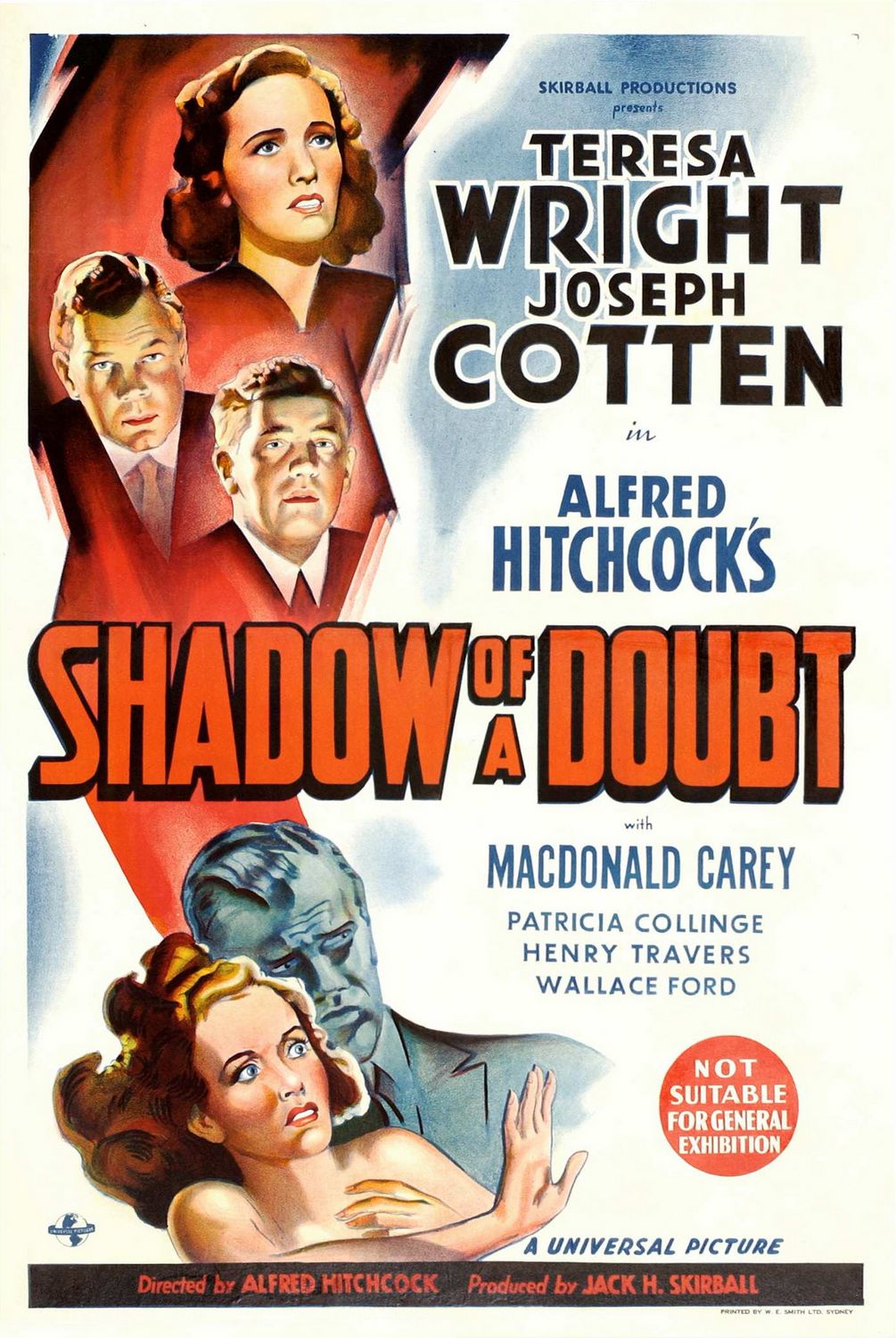
#230) Shadow of a Doubt (1943)

shadow_of_a_doubt_xlg

#230) Shadow of a Doubt (1943)

OR “The Wright Man”

Directed by Alfred Hitchcock

Written by Thornton Wilder & Sally Benson & Alma Reville. Story by Gordon McDonnell.

Class of 1991

The Plot: The Newton family of Santa Rosa, California is surprised by a visit from Uncle Charlie (Joseph Cotten). Family matriarch Emma (Patricia Collinge) is delighted to see her younger brother, but niece/namesake Charlie (Teresa Wright) notices something off about Uncle Charlie. He gives Charlie a pawned ring, he clips stories out of the newspaper, and he goes nuts when his photo is taken. The younger Charlie tries to put it together when two reporters (Macdonald Carey & Wallace Ford) show up wanting to interview everyone in the family. Are the reporters what they appear to be? Is Uncle Charlie who he appears to be? There’s a lot of mystery in the air, but if you’re a fan of classical music, the clues are right in front of you.

Why It Matters: The NFR praises Hitchcock, and calls the film “intense” with “underscores that are incredibly dark, even for Hitchcock.” There’s also an essay by Thomas Leitch, Hitchcock expert and teacher of something called “Wikipedia U”.

But Does It Really?: It’s quite surprising that “Shadow of a Doubt” made the NFR before the likes of “Psycho”, “Rear Window” or “North by Northwest”, but on its own merits the film does not disappoint. Hitch had a grasp on well-plotted suspense from the get-go, and “Shadow” creates its drama not from its chases and murders, but rather from a purely psychological place. I’ll argue that Hitch’s later films are better paced, but “Shadow” is the springboard that takes Hitch to bigger and better movies. Perhaps Hitch’s reputation precedes this film too much for its own good, but “Shadow of a Doubt” is still a well-crafted suspense thriller that continues to shock 75 years later. Definitely worth a watch if you’re looking for terrific underrated Hitchcock.

Everybody Gets One: Playwright Thornton Wilder (whose “Our Town” helped give this film its small town quality), actor Hume Cronyn, and future soap opera star Macdonald Carey. And while she provided feedback on many Hitchcock films, this is the only credited appearance for screenwriter Alma Reville, aka Mrs. Alfred Hitchcock.

Wow, That’s Dated: This film’s main story points hinder on such now-dated things as telegrams, newspapers, and passenger trains.

Seriously, Oscars?: 1943 was a weird year for the Oscars. Very few of the films honored that year would be considered “classic” today, but the Academy did manage to give “Casablanca” its due as Best Picture. Despite critical praise, “Shadow of a Doubt” only received a single nomination: Best Story for Gordon McDonnell. He lost to William Saroyan for adapting his own novel “The Human Comedy”.

Other notes

  • “Shadow of a Doubt” was filmed on location in Santa Rosa (though I’m here to tell you the city has changed quite a bit). A few scenes had to be reshot months later at Universal Studios, and those sequences stick out like a sore thumb.
  • It’s fair to say that Teresa Wright would one day evolve into Eva Marie Saint.
  • Charlie’s bookworm sister Ann is played by Santa Rosa native Edna May Wanacott, who went on to write “Little Women” if I’m not mistaken.
  • Without planning to do so, I have now watched all five of Henry Travers’ NFR appearances within a span of only seven months. This is the movie where he discusses hypothetically murdering Hume Cronyn. Atta boy, Clarence!
  • Ann doesn’t want anyone to speak ill of the government. What a cute little nationalist you are.
  • Our director makes his cameo playing bridge on the train. Hitch’s appearance impedes on the scene that’s happening, something he was careful not to do in his later cameos.
  • Putting a hat on a bed is bad luck? We have too many superstitions.
  • There’s some weird chemistry going on between Cotten and Wright. You’re related!
  • Here’s my question: If you’re Joseph Cotten and you’ve got a newspaper clipping you don’t want your host family to see, why would you throw it away in a wastebasket in their house? Why not throw it away in a public trashcan, or set it on fire, or literally anything else?
  • This is one of the rare Hitchcock films where he doesn’t let the audience in on the secret before the main character finds out. Not that there should be any shock; Charlie is giving red flags left and right!
  • Does anyone else notice that Mom occasionally flubs a line, but just keeps going?
  • How old is the younger Charlie supposed to be? Teresa Wright was 24 when they filmed this, but it’s implied that Charlie is a teenager. That being said, she goes to a bar and several older men make eyes at her. What am I missing?
  • An off-screen Hitchcock trope: somewhere on the east coast is a man who may or may not be wrongfully accused.
  • It helps that Charlie’s parents are both conveniently myopic. Especially Mom, she’s so happy Uncle Charlie is back you can get her to go along with anything. Are we sure a streetcar didn’t hit her too?
  • My new favorite film character is Louise Finch, Charlie’s classmate/the waitress at the bar, as played by Janet Shaw in a thoroughly unenthusiastic performance. One can only imagine what she’s like when it’s a customer’s birthday.
  • At first I was grossed out by Macdonald Carey hitting on Teresa Wright, but then I learned that he’s only five years her senior. He looks way older and she looks way younger.

Legacy

  • Of the over 50 films Hitchcock directed, he repeatedly called “Shadow of a Doubt” his favorite.
  • Hitch enjoyed working with Hume Cronyn so much, he cast him in his next picture: “Lifeboat”. Cronyn also penned the screenplays for two Hitchcock films: “Rope” and “Under Capricorn”.
  • While watching this I suspected this movie was overdue for a shitty remake, and it’s got two! 1958’s “Step Down to Terror” and the 1991 TV movie namesake with Mark Harmon.
  • The 2013 “Stoker” takes its inspiration from “Shadow of a Doubt”, but then goes in a very different direction.

#229) Bringing Up Baby (1938)

bringing_up_baby_ver4_xlg

#229) Bringing Up Baby (1938)

OR “Hawksian Days”

Directed by Howard Hawks

Written by Dudley Nichols & Hagar Wilde. Based on the short story by Wilde.

Class of 1990

The Plot: Paleontologist David Huxley (Cary Grant) is one day away from completing a full brontosaurus skeleton and marrying his joyless fiancée Alice (Virginia Walker). On the day the “intercostal clavicle” is set to arrive, David meets Susan Vance (Katharine Hepburn), a free-spirit whose Aunt Elizabeth (May Robson) happens to be the donor David needs to impress to get his museum a grant. The more time David spends with Susan, the more destruction she brings into his life, starting with the arrival of a leopard named Baby (Nissa). There’s mistaken identity, fast-paced overlapping dialogue, plenty of pratfalls, and an inexplicable love story in this comedy classic.

Why It Matters: The NFR calls the film a “fast-paced screwball comedy” and gives some backstory to the production and its eventual standing as a classic

But Does It Really?: I’ve covered the beginning and the end of Hawks’ legendary run of screwball comedies, but with “Bringing Up Baby” we finally see the apex. The screwball comedy as a genre has been long gone, but this film lives on thanks to its simple premise and expert comic timing. Grant and Hepburn are wonderfully cast against type, Hepburn in particular is relishing a role that would help craft her spirited, independent persona. Aided by a murderer’s row of character actors and an inspired screenplay, Hawks and his team have made quite possibly the definitive film comedy of the early sound era.

Shout Outs: David’s alias from Susan is “Jerry the Nipper”, the nickname Cary Grant’s character was given in “The Awful Truth”.

Everybody Gets One: Australian stage actress May Robson, and comic actor Fritz Feld, who sadly does not get to do his trademark pop sound in the film.

Wow, That’s Dated: The phrase “behind the eight ball”, travelling circuses, and the ability to start any car you come across.

Seriously, Oscars?: The oft-quoted story of “Bringing Up Baby” being snubbed at the Oscars due to its status as a box-office bomb is misleading. The film was successful in most markets, but didn’t recoup its budget in its initial release. It was also a rough year for RKO Pictures; only one of its over 40 releases received an Oscar nod (“Vivacious Lady”). Katharine Hepburn bought out her contract with RKO in 1938, so it makes sense that the studio wouldn’t invest money in an Oscar campaign for a star no longer on the payroll. Chalk up the lack of recognition for “Bringing Up Baby” to bad timing.

Other notes

  • This seems like a movie that should have had an animated opening credits sequence.
  • Is Susan the first manic pixie dream girl? Or was that just the next evolutionary step for the Hawksian Woman?
  • I know that Cary Grant’s film career was just taking off in 1938, so he didn’t quite have the sophisticated persona we associate with him, but it’s a fun change of pace to see him play awkward and stiff.
  • Once Baby shows up, be on the lookout for shots where the leopard is separate from the actors. There’s an obvious pane of glass between David and Baby when he first sees it, and there are several shots where the actors are filmed separately, with Baby being added in optically. Only Katharine Hepburn was brave enough to work alongside Nissa, with handler Olga Celeste saying that Hepburn could have been an animal trainer.
  • Shoutout to Walter Catlett, a vaudeville performer brought in by Hawks to coach Katharine Hepburn on her comedy scenes. Hepburn appreciated his tutelage so much she convinced Hawks to cast Catlett as Constable Slocum, a role that he plays in an expertly befuddled manner.
  • And then we get to the infamous scene where, when asked why he’s wearing a woman’s negligee, David declares in exasperation, “Because I just went GAY all of a sudden!” It may be the first instance of the term “gay” being used in a homosexual context. No one knows for sure if this was intentional (the phrase, while known as early as the ‘20s, didn’t become commonplace until the late ‘60s). Allegedly, the line was ad-libbed by Cary Grant, though he never confirmed this in his lifetime, and the camera tracks the leap he makes in the take very well. The true meaning/origin is anyone’s guess.
  • Like many a farce, the events of this film rely on a lot of coincidence.
  • If David and Susan want to know where George went, all they have to do is follow the tracks the camera dolly is making in the dirt!
  • Everybody’s great, but I particularly enjoyed Charles Ruggles as the easily confused Major Applegate.
  • I had never heard of Squat Tag before this movie. Apparently it’s a real thing.
  • Baby can be tamed by singing “I Can’t Give You Anything But Love”, which was a popular song about a decade earlier. If the film were remade today the song would be…I don’t know, “Hey There Delilah”?
  • And then Baby gets in a fight with Asta the dog. Where was PETA during all of this?
  • Katharine Hepburn and Cary Grant harmonizing is just delightful.
  • The ending is the right amount of ridiculous, but I can only imagine the real-world ramifications of what happened to the museum and its grants.

Legacy

  • As previously mentioned, “Bringing Up Baby” was successful, but – thanks to the film going over-budget due to production delays from Hawks, Hepburn and Grant – never made its money back. The Independent Theatre Owners of America had already labeled Katharine Hepburn “box office poison”, and this film’s underperformance solidified that standing. Hepburn left RKO, went back to Broadway, and returned to Hollywood two years later (with Cary Grant in tow) for the film version of her stage hit, “The Philadelphia Story”.
  • “Bringing Up Baby” finally made a profit upon a re-release in the early ‘40s (no doubt to cash in on the success of “The Philadelphia Story”). Frequent television airings in the ‘50s helped improve the film’s reputation, and ultimately made it a classic.
  • Howard Hawks’ made a self-homage 25 years later with the Rock Hudson/Paula Prentiss comedy “Man’s Favorite Sport?”
  • Filmmaker/longtime Hawks admirer Peter Bogdanovich made a spiritual remake in 1972 with “What’s Up, Doc?” The story goes that an apprehensive Bogdanovich showed the screenplay to Howard Hawks, who had one problem with it: Bogdanovich didn’t steal the leopard or the dinosaur bone.

The Legacy of “Casablanca”

casablanca_ver3

Click here for Part 1!

There’s a lot to unpack with the cultural ripple effect “Casablanca” started 75 years ago. This is just a small sampling. Keep reading for a few surprises.

Legacy

  • This is another one of those movies that started off as a hit and became a classic over time. Its regular airings on television, as well as the annual screenings of the film at Harvard (and other colleges) throughout the ‘70s helped boost the film’s standing as a classic, to the point where Francois Truffaut cited these showings when refusing to direct a potential remake.
  • Warner Bros. originally planned on making a sequel shortly after the film’s release. “Brazzaville” would have followed Rick and Louis as they travelled to the Congo to join the Free French. It never happened, but Bogie in the Congo, now there’s an idea…
  • The film did receive an official sequel in novel form with 1998’s “As Time Goes By”. It tried to give “Casablanca” the “Godfather Part II” treatment by being both prequel and sequel, but failed on both counts. The Britcom is spawned, however, is a delight.
  • Unproduced for decades, the play “Everybody Comes to Rick’s” made its West End premiere in 1991; a run that lasted 3 weeks. I mean, we’re not making “Casablanca” here.
  • There have been two attempts to turn “Casablanca” into a TV series, one in the ‘50s that acted as a prequel, and one in the ‘80s that was set a year after the events of the movie. When will Hollywood leave well enough alone?
  • Perhaps the greatest misquote in film history comes from “Casablanca”. Ilsa says, “Play it, Sam”, but no one says, “Play it again, Sam”. But that hasn’t stopped generations of misattribution, as well as a Woody Allen movie.
  • Speaking of quotes, “Round up the usual suspects” inspired Christopher McQuarrie to write a crime thriller called…uh…
  • Though not written for the film, the song “As Time Goes By” became a popular standard thanks to “Casablanca”. A few bars are sampled during the current Warner Bros. Studios logo.
  • You Must Remember This” is the name of easily the best podcast for film buffs. Karina Longworth (that’s her) consistently proves there is no substitution for thorough research.
  • Sooooo many spoofs, too many to mention. Let’s go with easily the weirdest: The 1995 Bugs Bunny cartoon “Carrotblanca”. Someone really liked the bizarre casting of Tweety Bird as Peter Lorre.
  • Okay one more spoof; one of my favorite underrated SNL skits. There’s just something about the way Kate McKinnon says “Noooooo, Rick, noooooo”.
  • Julius Epstein tried on two separate occasions to turn “Casablanca” into a stage musical. He could never make it happen, but we did get a Japanese all-female musical in 2009. And how many films on this list can say that?
  • My mandatory shout-out to the late “Great Movie Ride”.
  • “Never show a good movie in the middle of your crappy movie.”
  • Last spoof, I promise.


This write-up had several “Other notes” that I had great difficulty cutting. So rather than kill my darlings, I’ve relocated a few to a new segment: Other Other notes

  • Fun Fact: I share a birthday with the Epstein Brothers! The greatest screenplay ever was written by either Leos or Virgos (depending on which horoscope you subscribe to).
  • Louis spends a lot of time complimenting Ilsa on her appearance. It’s good practice for when Claude Rains obsesses over Ingrid Bergman four years later.
  • One of filmdom’s more bizarre debates is whether or not one of the background waiters is Jack Benny in a gag cameo. One theater even held a contest to see who could spot him. Do I believe this story?


I’M THINKING IT OVER!

#228) Casablanca (1942)

casablanca

#228) Casablanca (1942)

OR “Citizen Blaine”

Directed by Michael Curtiz

Written by Julius J. Epstein and Philip G. Epstein and Howard Koch. Based on the play “Everybody Comes to Rick’s” by Murray Burnett and Joan Alison.

Class of 1989

There’s no way I could condense “Casablanca” down to 1000 words, so buckle up for a Horse’s Head Super-Sized Two-Parter!

The Plot: It’s December 1941 and Casablanca, Morocco is a wartime limbo for those seeking escape from the Nazis while awaiting passage to the still-neutral United States. Most of these European refugees spend their days at Rick’s Café Américain, owned by jaded expat Rick Blaine (Humphrey Bogart). He keeps his politics to himself, but will serve drinks to anyone, and keeps corrupt Vichy police captain Louis Renault (Claude Rains) on his payroll. One eventful day at Rick’s sees the appearance of two “letters of transit” stolen by criminal Ugarte (Peter Lorre) that can guarantee safe passage to America, as well as the arrival of Resistance leader Victor Laszlo (Paul Henried) and his wife Ilsa (Ingrid Bergman), whom Rick had a lost weekend with in Paris during the Battle of France. Will Rick use the papers to aid the Allied cause for Victor and Ilsa? Or will he rekindle his feelings for Ilsa and run off with her? And will someone please let Sam (Dooley Wilson) play a different song?

Why It Matters: The NFR calls it “[o]ne of the most beloved of American films”, though admits that the script is “often lacking logical cohesion”. An essay by film critic Jay Carr isn’t so much an appreciation of “Casablanca”, but rather an examination of the power that movies have on our lives and our culture.

But Does It Really?: “Casablanca” has something for everyone, and is the rare film that succeeds on each front. It’s the prime example of a movie that favors emotions over logic: the plot has a few holes in it (there’s no such thing as a “letter of transit”), but who cares when Bogart and Bergman look into each others’ eyes while Max Steiner’s score swells in the background? Like so many of the greats, “Casablanca” defies its own genre; labeling it as good drama would deny the script’s brilliantly funny dialogue, and hailing it as a classic romance would ignore the film’s dark look at two continents escaping Nazi persecution. For a film that deals with a very specific time in world history (they had to change the timeframe once America entered the war), “Casablanca” is effortlessly timeless. It’s the perfect doomed romance, mixed with a crucial historical backdrop, eye-pleasing locales, and some of the greatest characters committed to celluloid. To call “Casablanca” overrated or unworthy of recognition is downright un-American.

Everybody Gets One: Julius and Philip Epstein were twin brothers from New York hoping to make it as Hollywood screenwriters. They clashed with Jack Warner (who didn’t?), but when assigned to adapt an unproduced play set in a Moroccan nightclub, they solidified their place in film lore, although Julius always said they were just “making a living”. The brothers left halfway through writing to work with Frank Capra on his “Why We Fight” films, leading to production delays.

Wow, That’s Dated: Ilsa calls 56-year-old Sam “the boy”. Even the all-time classics have their unfortunate signs of the time.

Title Track: Not only is Casablanca referenced throughout the movie, but Louis even manages to sneak in the play’s original title, telling Major Strasser “Everybody comes to Rick’s”.

Seriously, Oscars?: Although released in late 1942 to capitalize on the recent Allied invasion of French North Africa, “Casablanca” didn’t play Los Angeles until January 1943, and was therefore eligible for the 1944 Oscars. The film didn’t receive the most nominations or win the most awards (both of those distinctions went to “The Song of Bernadette”), but “Casablanca” took home the three big ones: Adapted Screenplay, Director, and Best Picture. Bogart’s iconic performance lost Best Actor to Paul Lukas in the more personal wartime film “Watch on the Rhine”, while Claude Rains’ morally ambiguous work lost to the more lovable Charles Coburn in “The More the Merrier”. When “Casablanca” was announced as Best Picture, producer Hal Wallis started to get up, but Jack Warner rushed the stage and accepted the award. This led to Wallis’ resignation from Warner Bros. after 21 years with the studio.

Other notes

  • One of the things I enjoy most about this blog is researching famous Hollywood stories to see if they actually happened. More often than not, the claims are half-truths that depend on perspective rather than out-right falsehoods. Ronald Reagan may have been considered for Rick, but Humphrey Bogart was everyone’s first choice. And although the script was being rewritten throughout production, the ending (which is faithful to the original play) was established in early drafts, so it’s more likely that Ingrid Bergman was confused over who Ilsa truly loved rather than who she would ultimately end up with.
  • There’s something special about “Casablanca” from the very beginning. The film is neither groundbreaking nor revolutionary, it just had the right people in the right roles at the right time. A+ talent, mixed with serendipity.
  • The best line no one ever quotes, “I like to think you killed a man. It’s the romantic in me.”
  • Also making his sole appearance on the NFR is Conrad Veidt as Major Strasser. Veidt was a silent film star in his native Germany and, like many “Casablanca” cast members, fled to America to escape the Nazis.
  • In addition to this movie’s mix of genre, it has a perfect blend of romanticism and cynicism. The love story is romantic and emotional, but Rick’s general wryness helps keep things grounded.
  • Like you need me to tell you how good Bogart and Bergman are in this film. He’s wonderfully complex and she’s masterfully cryptic. Both of them inhabit their characters so naturally is it any wonder they are forever associated with Rick and Ilsa?
  • Shoutout to Paul Henried, fresh off his romantic turn in “Now, Voyager”, playing filmdom’s greatest third wheel. He knew he was playing a “stiff” and he allegedly didn’t get along with anyone, but Henried successfully lobbied for above-the-title billing and received film immortality for his troubles.
  • The Blue Parrot is the “Gary’s Old Towne Tavern” to Rick’s “Cheers”.
  • Speaking of, Sydney Greenstreet is not very convincing as an Italian who has embraced the Moroccan culture. Anyone can wear a fez.
  • Rick is a perfect example of a character that is defined by his actions rather than his words. There’s the occasional piece of expositional dialogue (like his pseudo-catchphrase “I stick my neck out for nobody.”) but the key moments of understanding Rick’s character come in moments of silence; his non-reaction to Ugarte’s arrest, his nod to the band, etc.
  • Oh no, it’s the “Le Marseillaise” scene. I’m not crying you’re crying.
  • This happens every once in a while: the same character actor appears in two films I’ve covered in the same week. This time it’s jolly Hungarian actor S.Z. Sakall (erroneously credited here as S.K. Sakall) as Rick’s headwaiter Carl. He’s one of the professors in “Ball of Fire”.
  • I forgot how many of the iconic lines come in the last 10 minutes; “We’ll always have Paris.”, “Here’s looking at you, kid”, “Louis, I think this is the beginning of a beautiful friendship”, “I drink your milkshake!” You’d think these lines would be distracting due to their oversaturation, but if anything, hearing them again in their proper context makes them stronger.
  • They should never end up together and there should never be a sequel. There, I said it.

Click here for Part 2 and the Legacy of “Casablanca”!

#227) Field of Dreams (1989)

field_of_dreams_xlg

#227) Field of Dreams (1989)

OR “Eight Men In”

Directed & Written by Phil Alden Robinson. Based on the novel “Shoeless Joe” by W.P. Kinsella.

Class of 2017

The Plot: Native New Yorker Ray Kinsella (Kevin Costner) lives on a farm in Iowa with his wife Annie (Amy Madigan) and their daughter Karin (Gaby Hoffmann). He’s an avid baseball fan who never made peace with his late father John (Dwier Brown). One day in the cornfield Ray hears a mysterious voice telling him “if you build it, he will come”. He decides the “it” is a baseball diamond, and the “he” is the ghost of disgraced White Sox player “Shoeless” Joe Jackson (Ray Liotta). Soon the ghosts of Jackson’s teammates come to the field, but the voice keeps giving Ray more instructions. After encounters with reclusive author Terence Mann (James Earl Jones) and former Major League-hopeful “Moonlight” Graham (Burt Lancaster), Ray learns the true reason why he had to build the field…of dreams. 

Why It Matters: Too lazy to come up with their own justification, the NFR cribs from Leonard Maltin, who says “Field of Dreams” is “in the tradition of the best Hollywood fantasies with moments of pure magic.”

But Does It Really?: Despite a father who loved baseball and a mother who loves movies, I’ve never seen “Field of Dreams” until now. And for obvious, perhaps genetically ingrained, reasons, I liked it quite a bit. Its iconic status was going to place it on here sooner or later, and I feel that’s justified. Yes, the film is sentimental and a bit hokey, but it’s all done in such a masterful way you don’t really care. In fact, it’s these slightly outdated factors that help the film age well. “Field of Dreams” is a baseball movie that isn’t just for baseball fans, and the rare successful modern-day fantasy.

Shout Outs: Brief references to “The Wizard of Oz”, “Citizen Kane” and “The Godfather”.

Everybody Gets One: Almost everyone, most notably Phil Alden Robinson, Amy Madigan, and thirtysomething Timothy Busfield.

Wow, That’s Dated: A quick joke about Shirley MacLaine’s New Age beliefs (a go-to punchline throughout the ‘80s) and something called a “home computer”.

Seriously, Oscars?: A hit with critics and audiences, “Field of Dreams” snagged three Oscar nominations. The film lost Picture and Adapted Screenplay to “Driving Miss Daisy”, while James Horner’s score lost out to “The Little Mermaid”. That being said, “Field of Dreams” is the first of the five 1989 Best Picture nominees to make the Registry.

Other notes

  • This is one of those movies where the poster really doesn’t tell you anything about the actual film. But it’s got Kevin Costner and baseball, and you liked “Bull Durham” didn’t you?
  • Ray says that until he built the diamond he had “never done a crazy thing in [his] whole life.” Moving across the country to Berkeley and marrying someone you have zero in common with are both pretty crazy if you ask me.
  • It’s not that Kevin Costner’s a bad actor, it’s just that his range is a bit limited. When the film gives him moments that play to his natural charisma, he’s very charming on-screen. Anything else just kind of sits there, especially when the likes of James Earl Jones and Burt Lancaster show up.
  • You see their adorable daughter Karin? That’s Gaby Hoffmann from “Girls” and “Transparent”. Cool, right?
  • Who is The Voice? The internet seems to believe it’s Ed Harris (Amy Madigan’s husband), but I like the mystery.
  • Shoutout to “Harvey”, a classic movie yet to make it on the Registry.
  • “Crazy”? Really, movie? Weirdly, it’s not the Patsy Cline version, but rather the Beverly D’Angelo as Patsy Cline version from “Coal Miner’s Daughter”. Both films are Universal pictures.
  • Thanks to one brief shot, this film makes my “Die Hard” not-Christmas movie list.
  • Presumably all those baseball players were teleported to the cornfield by a young Billy Mumy.
  • Ah yes, the ghosts can’t leave the diamond due to Arbitrary Ghost Rules.
  • Kudos to Amy Madigan (as well as Phil Adlen Robinson). Unlike most movie wives, Annie is immediately supportive of Ray and continues to be so through the whole film.
  • In the original novel, Ray tracks down real-life reclusive author J.D. Salinger. To avoid Salinger’s litigious wrath, the part was rewritten to the fictional Terence Mann: author and outstanding Javert.
  • James Earl Jones is just lovely in this film. He should have gotten an Oscar nod for his delivery of “piss off” alone.
  • Among the extras at the Fenway Park game are young Ben Affleck and Matt Damon. Damon’s also in “Saving Private Ryan”, so technically this is Affleck’s “Everybody Gets One”. Anyone know if you can see them in the final film?
  • Burt Lancaster is perfectly cast as “Moonlight” Graham. His status as a Hollywood icon lends itself well to the emotional weight this brief role requires. Plus I always get a kick out of his very crisp delivery.
  • Ray is impressed with Archie’s knowledge of when towns would get aspiring baseball players day jobs. Check out the big brain on the guy who played Brett.
  • Robinson loves his dolly zooms. I see where he’s going, but I found them all a bit distracting.
  • Slam on Ty Cobb outta nowhere (The Georgia Peach, not the other one).
  • Timothy Busfield is Richard Dreyfuss-ing all over the place in this film.
  • It’s fitting that the last shot of Burt Lancaster in his final Hollywood film is him walking off into the cornfield. I’m not crying, you’re crying.

Legacy

  • “Field of Dreams” is responsible for one of the most misquoted lines in film history. “If you build it, he will come” is referenced throughout popular culture as “If you build it, THEY will come.” So close.
  • Phil Alden Robinson has been steadily writing and directing over the last 30 years. Among his post-“Field” credits are “Sneakers” and “The Sum of All Fears”, starring extra-turned-leading man Ben Affleck.
  • The state of Iowa used “Is this Heaven? No, it’s Iowa.” as a slogan for its tourism in the early ’90s.
  • James Earl Jones would appear as another reclusive baseball fan in 1993’s “The Sandlot”. Art LaFleur (Chick Gandil) makes a cameo as Babe Ruth, and has the best line in the movie.
  • The actual baseball diamond built for the film in Dubuque County, Iowa is still in operation to this day. My parents visited the field in 2006 (back when the land was split between two separate families) and Mom took the obligatory photo of Dad walking into the cornfield.
DSC00244
Photo courtesy of Ann Cirimele. Thanks Mom!