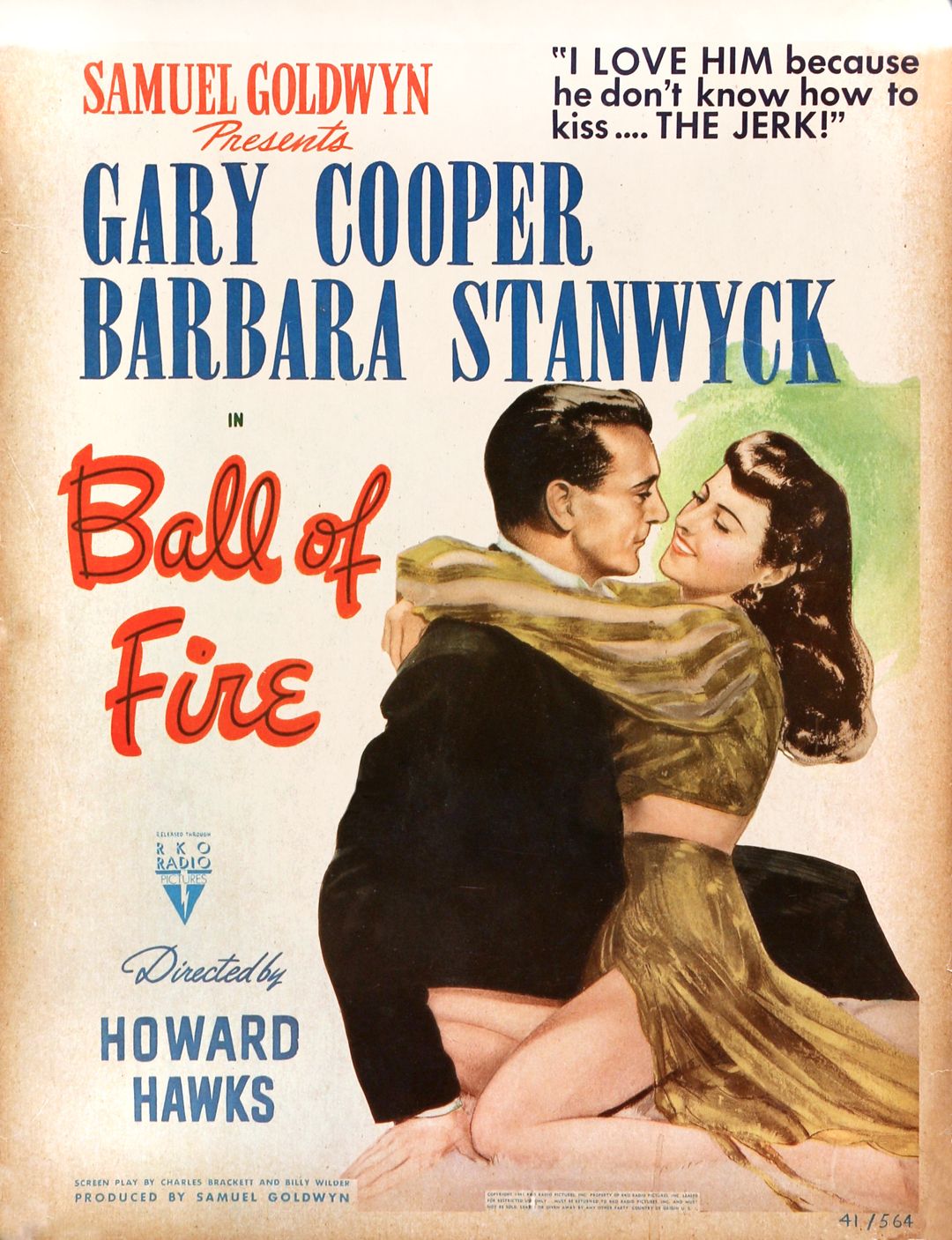
#226) Ball of Fire (1941)

7268ec658d39ee3b2bb948294803b5d5

#226) Ball of Fire (1941)

OR “Trying Hard to Book Like Gary Cooper”

Directed by Howard Hawks

Written by Charles Brackett and Billy Wilder. Based on the story “From A to Z” by Wilder and Thomas Monroe.

Class of 2016

The Plot: Nightclub singer Sugarpuss O’Shea (Barbara Stanwyck) has to hide out while her mobster boyfriend Joe Lilac (Dana Andrews) is under investigation. She ends up in a Manhattan residence with Professor Bertram Potts (Gary Cooper) who, along with his seven colleagues (Oskar Homolka, Henry Travers, S.Z. Sakall, Tully Marshall, Leonid Kinskey, Richard Hayden, Aubrey Mather) is editing an encyclopedia and could use Sugarpuss’ expertise on modern slang. Potts and O’Shea start to fall for each other, but Lilac isn’t too far away to spoil the fun. It’s “Snow White” with a boogie rhythm.

Why It Matters: The NFR says the film “captures a pre-World War II lightheartedness” and praises Hawks, Wilder and Brackett. They also call Gene Krupa’s cameo a highlight. Nothing about Stanwyck or Cooper, but how about that Gene Krupa?

But Does It Really?: This is definitely a “minor classic”. Cooper and Stanwyck have better movies from 1941 alone (“Sergeant York”, “The Lady Eve”, and non-entry “Meet John Doe”), and Wilder has his whole career following this movie. “Ball of Fire” can be fun at times, but it’s never quite the comedy bull’s-eye it should be. Nevertheless, the film has historical significance for igniting Wilder’s transition to directing, and it has a reputation as the last great screwball comedy, so it was going to make this list eventually.

Shout Outs: The film is of course a modern update of “Snow White and the Seven Dwarfs”. There’s also a quick allusion to “Sergeant York”, and Sugarpuss’s concern that Potts has “a slight case of Andy Hardy”.

Everybody Gets One: Screenwriter Thomas Monroe doesn’t have a lot of credits to his name, but he was the man who helped Billy Wilder translate and Americanize his story “From A to Z” from its original German.

Wow, That’s Dated: It’s about encyclopedia writers trying to decipher boogie-woogie slang; this thing is 1941 down to its marrow.

Title Track: Legendary character actor Charles Lane says the title about 90 minutes in, as part of a newspaper headline regarding Sugarpuss.

Seriously, Oscars?: “Ball of Fire” got four Oscar nominations, but got lost in the shuffle of a lineup that included “Citizen Kane”, “How Green Was My Valley”, and “Sergeant York” (the latter of which garnered nominations for Hawks and Cooper). Stanwyck lost Best Actress to Joan Fontaine in Hitchcock’s “Suspicion”, and Wilder & Monroe lost Original Story to “Here Comes Mr. Jordan”.

Other notes

  • Wow, look at those credits! Hawks, Wilder, producer Sam Goldwyn, cinematographer Gregg Toland, composer Alfred Newman, costumer Edith Head; all of the heavy hitters came out for this one.
  • Richard Haydn was 36 when he played the elderly Professor Oddley. Whether you know him as the Caterpillar in “Alice in Wonderland” or Max Detweiler in “The Sound of Music”, you can clock that voice in a second.
  • Sooooo much ‘40s slang. What is everyone saying?
  • I don’t know how I feel about Barbara Stanwyck in this film. Of course she’s incapable of giving a bad performance, but I would argue she’s miscast as Sugarpuss. Stanwyck is many things as an actress – tough yet vulnerable, a confident combination of sultry and wisecracking – but is she more hip than Gary Cooper? Original choices Carole Lombard and Ginger Rogers would have been better options.
  • For those of you keeping score, that’s two movies written by Billy Wilder that feature a singer named Sugar.
  • There are several “pan-and-scan” shots throughout. Toland recognized the difficulty of getting eight or more people in the same shot.
  • Speaking of, Gregg Toland photographed “Ball of Fire” immediately following his work on “Citizen Kane”.
  • Sudden slam on “The Daily Worker”.
  • This film is not without its faults, but Cooper and Stanwyck do have excellent chemistry together. Cooper in particular is quite good playing a reserved intellectual in love.
  • Sugarpuss’ nickname for Potts is “Potsie” after, of course, Potts’ favorite “Happy Days” character.
  • Before starting this blog, Dana Andrews wasn’t really on my radar. I have now seen four of his movies and I gotta say he’s severely underrated. He can be the relatable lead in “The Best Years of Our Lives” and the heavy in this, both effectively.
  • This film takes a while to get started, but like so many of the great film comedies, the first half is set-up, and the second half’s payoff more than makes up for lost time.
  • While never on anyone’s list of greatest movie quotes, the best line in the movie is Sugarpuss’ mini-monologue about Potts: “I love him because he doesn’t know how to kiss, the jerk.”
  • The script is filled with the kind of smart one-liners we associate with Billy Wilder (as well as Charles Brackett), but Hawks likes his lines coming fast and furious, so a lot of the dialogue gets thrown away, a Wilder no-no. Is it any wonder he wanted to direct?
  • Look out, Clarence has a gun! He will earn his wings if he has to take everyone with him!

Legacy

  • This film’s main takeaway was Billy Wilder deciding he needed to direct his own scripts to ensure minimal studio interference. Hawks allowed Wilder to study his directing style on the set, and Wilder took the wheel for his next screenplay, “The Major and the Minor”. Wilder remembered Barbara Stanwyck’s ability to handle ‘40s slang when he wrote “Double Indemnity”.
  • Samuel Goldwyn remade “Ball of Fire” with 1948’s “A Song is Born”. The leads were Goldwyn favorites Danny Kaye and Virginia Mayo, but both films have the same producer, director, cinematographer, and Miss Totten.

#225) Portrait of Jason (1967)

poj023_wide-307ee14b01e14512643614694cc1e6c93a7a94f8-s900-c85

#225) Portrait of Jason (1967)

OR “Carrying the Torch Song”

Directed by Shirley Clarke

Class of 2015

A modern trailer of the film’s restored print

The Plot: Filmed over the course of one 12-hour night in Shirley Clarke’s penthouse at the Hotel Chelsea, “Portrait of Jason” is an extended interview with Jason Holliday, a Black, openly gay hustler and would-be performer. With drink and joint in hand, Jason recounts his life, personal struggles, romantic past, showbiz dreams, and everything in between. As the night turns into morning, Jason becomes more revealing, and the off-screen assistance from Shirley Clarke and actor Carl Lee gets a bit hostile.

Why It Matters: The NFR calls the film “one of the first LGBT films widely accepted by general audiences” (and by “general” they mean New York film festival attendees). The write-up also describes the film’s production and later restoration.

But Does It Really?: “Portrait of Jason” has been earning its indie film street cred thanks to its recent restoration, and for the most part it is deserving. If you have the patience to watch a movie that is just one man talking for two hours, it pays off. Jason Holliday can be engaging, and the backdrop he paints is a pivotal one for both Black and gay history. It’s also fascinating to watch him peel away more layers as the night wears on. The film gets a pass on its historical merit, but I will recommend you do a little research before watching “Portrait of Jason”. Read up on Jason himself, Shirley Clarke, and the circumstances that led to this film to give you more context and (hopefully) more entertainment value. (See “Other Notes” below for a good starting point)

Shout Outs: Among the films Jason references in his nightclub act are NFR entries “Gone with the Wind” and “Carmen Jones”. He also quotes the “Bar None” line from “Gilda”. Honorable Mention: Jason sings “The Music That Makes Me Dance”, a song from the stage version of “Funny Girl” that didn’t make it to the film.

Everybody Gets One: Very little is known about Jason Holliday’s early life, other than he was born Aaron Payne and met Shirley Clarke through her partner Carl Lee, who studied at the American Academy of Dramatic Arts alongside Holliday. Jason and Shirley had not seen each other in a while, when a chance meeting on the streets of New York led to Clarke choosing Jason as her next subject. We’ll see more of Shirley Clarke and Carl Lee in their earlier film, “The Cool World”.

Wow, That’s Dated: All kinds of hip ‘60s slang from Jason like “cats” and “flunkie” and “hang-up”.

Seriously, Oscars?: No LA release for “Jason”, so it wasn’t eligible for the Oscars that year. Can you imagine the 1967 Academy voting for a film with an openly gay Black lead? They were still warming up to “Guess Who’s Coming to Dinner”, baby steps please.

Other notes

  • If you want to know anything (and I mean anything) about the making of this film, look no further than this press release for the film’s 2013 restoration. It even comes with a handy glossary of all the slang Jason uses.
  • It took me a while to get accustomed to the film’s use of going out of focus for transitions. I was convinced it was the crew’s first time handling the equipment, which I suspect was one of the many ways Shirley Clarke tried to make this seem like discarded footage.
  • Jason spent some time in San Francisco, and it’s a treat to get brief recollections of the city from 50-plus years ago. He mentions Aquatic Park, which is still a lovely, quiet spot in San Francisco, and one of the few that isn’t swarming with hipsters or techies.
  • Jason is very candid about his homosexuality on camera. Pretty ballsy for the pre-Stonewall Riots era.
  • Jason seems pleased with being recorded, stating; “This is a picture I can save forever.” The NFR had the same idea, apparently.
  • Jesus, that is some strong weed. He gets incredibly stoned in about three minutes. Pass that around, man.
  • Jason has no problem saying “fuck”, “cunt” and “twat” multiple times, but tiptoes around directly mentioning his genitalia, referring to the area only as “it”.
  • The Mae West/Victor McLaglen film Jason is thinking of is 1936’s “Klondike Annie”. Mae’s “peel me a grape” line is from “I’m No Angel”.
  • Don’t think I didn’t catch you reversing the film to elongate that pause, Shirley! The smoke going back into the joint is the giveaway.
  • Are there any other NFR entries that mention “golden showers”? I can only think of this and “Bambi”.
  • Who were Shirley Clarke’s downstairs neighbors during all of this? I don’t know why but I hope it was William S. Burroughs. Or Eloise.
  • Rare is the documentary where one of the filmmakers is outwardly antagonistic towards the subject. Carl grilling Jason about a time he was rude to Shirley is up there with Michael Moore’s awkward Charlton Heston interview in “Bowling for Columbine”.
  • Overall this film reminded me of all the great, candid late night conversations I’ve had while drunk and sleep deprived. Good times.
  • Among those who helped fund this film’s restoration are director/choreographer Jo Andres, and her husband, that one guy. You know, the guy who’s in everything.

Legacy

  • After the success of “Portrait of Jason” in the New York film festival circuit, Jason Holliday…stayed pretty much where he was. Nothing life-changing happened to Jason due to this film, and he continued to languish in obscurity up to his death in 1998.
  • The original print was deemed lost until it showed up at the Wisconsin Center for Film and Theater Research in 2013. This lead to a thorough restoration from UCLA.
  • The making of “Portrait of Jason” is fictionalized in the 2015 film “Jason and Shirley”. I think it was filmed on my dad’s camcorder from the ‘90s.

#224) The Power and the Glory (1933)

MV5BZDAzZWFlOTctMzk2Mi00NjYxLWI4MzYtNWJjOWNlMTA4ODU3XkEyXkFqcGdeQXVyMjUxODE0MDY@._V1_

#224) The Power and the Glory (1933)

OR “A Rosebud By Any Other Name”

Directed by William K. Howard

Written by Preston Sturges

Class of 2014

Wow, a historic first: I can’t find a single clip of this movie on YouTube. There’s a bunch on TCM’s website, but I like embedding something, so here’s a YouTube video that is the film’s Wikipedia article made audible for the visually impaired.

The Plot: Railroad magnate Tom Garner (Spencer Tracy) has died, and many speak ill of his life decisions. But Tom’s oldest friend Henry (Ralph Morgan) defends him by telling Tom’s life story with the help of some inventive flashback techniques. In no particular order we see Tom and Henry’s childhood meeting, Tom’s courtship with schoolteacher Sally (Colleen Moore), his rise to prominence in the railroad industry, his estranged relationship with Tom Jr. (Philip Trent), and the union dispute that almost ended his career. It’s a movie about the life of a cryptic tycoon told through flashback and other creative devices which, now that I think about it, sounds a lot like another, exponentially more famous movie on this list…

Why It Matters: The NFR calls the film “a haunting tragedy” and cites the film’s main talking points: It was Preston Sturges’ first screenplay and it may or may not have influenced “Citizen Kane”. The essay by Fox expert Aubrey Solomon says more or less the same thing.

But Does It Really?: The Sturges and “Kane” connections are pretty much what this film has going for it. “The Power and the Glory” isn’t bad, it’s merely fine. The revolutionary use of flashback seems tame by today’s standards, and Spencer Tracy is good, but you’ve seen him (and Preston Sturges) do better. “The Power and the Glory” is essentially what “Citizen Kane” would have been with half the budget and no “Rosebud” mystery. I would be much more agreeable to this movie’s NFR inclusion if there was proof that Orson Welles was influenced by it, or heck, if he even saw it at all. If anything, this induction is more a point in favor of “Citizen Kane”, whose reputation is stringing “The Power and the Glory” along 80 years later.

Everybody Gets One: Technically, director William K. Howard has 1½ entries in the NFR. He directed this, and was the original director on “Knute Rockne, All American”, before being replaced following a disagreement with Warner Bros. His career never recovered and he directed B pictures for the rest of his life.

Wow, That’s Dated: Look no further than Henry’s narration during the first flashback: “When I was a kid, we didn’t have radio or moving pictures or automobiles and all those like the kids have today.”

Title Track: Ever the devout Catholic, Spencer Tracy says the title while reciting the Lord’s Prayer following the birth of his son.

Seriously, Oscars?: No nominations for “The Power and the Glory”. Fox’s main Oscar contender that year was “Cavalcade”, which consistently ranks among the least memorable Best Picture winners in Oscar history.

Other notes

  • “Power” is noteworthy as Preston Sturges’ first screenplay, but the deal Sturges made with the studio should also be mentioned. Rather than give Fox a treatment, Sturges went ahead and submitted a full screenplay. Producer Jesse L. Lasky called it “the most perfect script I’d ever seen” and offered Sturges a percentage of the grosses, rather than the flat-fee screenwriters traditionally got. It set a precedent going forward, and gave Sturges his start in Hollywood.
  • Like many films from Fox’s pre-merger days, the original print of “The Power and the Glory” was destroyed in the 1937 Fox fire. What survives is a print that appears to have been used for TV broadcasts in the ‘50s. The film was restored in 2015 using available materials, but the version I watched was this early print. I admit it made my viewing a bit difficult.
  • In addition to being the first president of the Screen Actors Guild, Ralph Morgan is the older brother of Frank Morgan, aka “The Wizard of Oz”.
  • This movie’s choice of flashback dissolve: Pan and zoom during a dissolve.
  • Billy O’Brien plays Tom as a child, and he is no actor. Not surprisingly, his film career didn’t last too long after this movie.
  • Spencer Tracy is one of the few actors who knows how to subtly play older. He doesn’t talk in a different voice or exaggerate any creakiness; he’s just a bit slower in those scenes.
  • These flashbacks are pretty sophisticated for the ‘30s. Forget Orson Welles, maybe Christopher Nolan was the one this movie influenced.
  • So unique was this film’s nonlinear storytelling that Fox coined a new word to describe it in press material: “narratage”. Didn’t stick.
  • Nope, that’s a real train way in the background outside of Sally’s window. Definitely not a model train a few feet from the window. I presume it’s going to the Neighborhood of Make Believe.
  • You can see flashes of brilliance in Sturges’ writing, and the germ of what would eventually become Struges’ trademark dialogue, but this is a screenplay where the structure outshines the words.
  • Colleen Moore’s quite good as Sally. It’s a nice change of pace from the ‘20s flapper girls she was most associated with (see “Ella Cinders”).
  • The Hays Office threw a fit at the implication that Tom Jr. was having an affair with his stepmother, and was alluded to be the father of her child. There were edits and reshoots, but it’s definitely still what’s going on between the lines.
  • “Blonde Angel”, wasn’t that a Jean Harlow movie?
  • We have yet another movie that just sorta ends. Henry finishes his flashback, his wife silently leaves the room, and that’s it. Cool story, bro.

Legacy

  • News on the March! “Citizen Kane”: a cinematic triumph with an influence so big it can never be catalogued or appraised. Championed by millions of Americans, hated by as many more. Famed in American legend is the origin of the “Kane” story. But where does “The Power and the Glory” play into the works of Welles and Mankiewicz? No man can say.

2020 Update: Just completed my “Citizen Kane” post. I have spent countless hours researching the film and reading a wide array of essays about it, and while some of the film’s contemporary reviews noted parallels between “Kane” and “The Power and the Glory”, I could not find ONE GODDAMN PIECE OF PROOF that “Kane” was directly influenced by “Power”. That’s one more point in favor of “Kane”, and one more point deducted from “Power” and its NFR standing.

#223) Who’s Afraid of Virginia Woolf? (1966)

whos_afraid_of_virginia_woolf_xlg

#223) Who’s Afraid of Virginia Woolf? (1966)

OR “Some Goddamn Warner Bros. Epic”

Directed by Mike Nichols

Written by Ernest Lehman. Based on the play by Edward Albee.

Class of 2013

The Plot: New England history professor George (Richard Burton) and his wife/boss’ daughter Martha (Elizabeth Taylor) are middle-aged and in a deteriorating marriage. They constantly argue and play mind games that psychologically cut each other down. When returning home from a late night faculty party, Martha informs George she’s invited a couple from the party over for a nightcap. Biology professor Nick (George Segal) and his chirpy wife Honey (Sandy Dennis) are young and happy, and therefore ripe targets for the jaded older couple. There’s fun and games, drinks, plenty of obscenities, and Albee’s trademark stripping down of humanity to its unpleasant, bitter, funny core. Just make sure not to mention George and Martha’s child.

Why It Matters: The NFR salutes the play for making “a successful transfer to the screen”, and mentions the film’s controversial “frank, code-busting language”. The write-up goes on to praise Burton & Taylor, Nichols, and cinematographer Haskell Wexler.

But Does It Really?: What a delightfully dark movie this is. Plays rarely make the transition to film – theater is a verbal medium, film is visual – but “Who’s Afraid of Virginia Woolf?” is the best of both worlds. The story is translated visually thanks to some inventive direction and cinematography, but never loses the dialogue and themes thanks to some powerhouse performances from a pitch-perfect quartet. The psychological warfare between George and Martha is riveting, and casting real-life couple Burton & Taylor is an irresistible ploy, aided by the pair’s talent and charisma. This endless entertainment value, paired with its historical status as the film that helped break the Production Code, makes “Who’s Afraid of Virginia Woolf?” an obvious choice for the Registry.

Shout Outs: George makes quick references to “Bringing Up Baby” and “A Streetcar Named Desire” during the evening. But more importantly, the title is a pun on “Who’s Afraid of the Big Bad Wolf?” from “The Three Little Pigs” (even though, for legal reasons, they don’t sing the Disney melody).

Everybody Gets One: Richard Burton was initially reluctant to play George, but was persuaded by Taylor, already cast as Martha. This was their fourth film together. Also featured here are George Segal and Sandy Dennis in their breakout roles.

Wow, That’s Dated: It’s all fine until they go to the roadhouse, where Taylor and Segal do a very ‘60s dance to some very ‘60s go-go music.

Seriously, Oscars?: A big controversy but an even bigger hit, “Who’s Afraid of Virginia Woolf?” led the Oscars with 13 nominations, one in each category it was eligible for. The big winner of 1966 was another prestigious play-turned-movie, the more-agreeable epic “A Man for All Seasons”. “Virginia” did, however, manage five wins: Actress for Taylor, Supporting Actress for Dennis, and the prizes for Art Direction, Cinematography and Costume Design.

Other notes

  • This is Mike Nichols’ first film as a director! He was an acclaimed stage director, and half of a popular comedy duo with “& May”. Giving him the film version of this highly sought-after property was quite the leap of faith. But between the cast, Ernest Lehman, Jack Warner, and Haskell Wexler, I’m sure Nichols got quite the film education.
  • Even when playing a middle-aged frump, Liz Taylor has her own costumer, make-up and hairstylist.
  • It’s “Beyond the Forest”. Moving on.
  • Like Tracy & Hepburn before them, Taylor & Burton’s real-life relationship helps give you a sense of eavesdropping on Martha & George, rather than watching a performance.
  • Ernest Lehman does a great job of “opening-up” the play. The majority of the film still takes place in George & Martha’s living room, but there are occasional moves to other well-chosen spots in the house.
  • Sandy Dennis is a series of tics disguised as a person. It works, but as her film career proved, a little bit goes a long way.
  • Don’t think I didn’t notice the occasional cuts made mid-shot to speed up pauses. I’m looking at you, Nichols and editor Sam O’Steen.
  • Oh my god: Other People! That’s Frank Flanagan, this film’s gaffer, as the innkeeper and his wife/Liz’s hairdresser Agnes as the waitress.
  • It’s a damn shame Richard Burton didn’t win the Oscar for this performance. Paul Scofield made a splash reprising his stage role in “A Man for All Seasons” and had the benefit of being a first-time nominee, compared to nod #5 for Burton. Burton suffered from what I call the “Too Good Factor”: Sure, he’s always great, so we’ll vote for him next time.
  • Speaking of George, I don’t think I agree with the assumption that he is completely emasculated by Martha. Burton seems to play him as an equal match to Martha who’s just given up on fighting back. And tonight is the night he finally decides to come back swinging.
  • My main question with this viewing: Have George & Martha done this before? Have there been other late nights with faculty members coming over and becoming part of their games? Albee loves creating strong, cryptic characters that keep you guessing.

Legacy

  • After some fights with the newly founded Motion Picture Association of America, “Virginia Woolf” finally got a seal of approval without having to censor too much of its language (albeit with a “Mature Audiences Only” disclaimer). This, along with similarly risqué films of the era, led to the MPAA creating the film rating system that is still in use today.
  • Mike Nichols followed this movie up with a little piece of the ‘60s called “The Graduate”. And then things sort of leveled off for him from there.
  • Everyone’s career got a boost thanks to “Virginia Woolf”. Taylor and Burton continued making movies/publically squabbling together for the next decade, Segal spent most of the ‘70s as a Hollywood leading man, and Dennis made a string of movies before returning to the stage.
  • In the early ‘00s, Yale used the film to study the perception of people with Autism. The film’s small ensemble and intimate setting is ideal to study if the participants looked into the eyes of the performers or not. What they made of the subject matter was not documented.
  • There’s never been an American remake of this film, but the original play is still performed with regularity, including several successful Broadway revivals.
  • Many spoofs of the film over the years, primarily lampooning Burton & Taylor’s on-and-off-screen feuds. And here’s Benny Hill to show you more!

AFI’s 100 Years…100 Movies (1998)

afi---100-years-of-movies-movie-poster-2001-1020209554

AFI’s 100 Years…100 Movies (1998)

OR “Round Up The Usual Suspects”

Directed by Gary Smith and Dann Netter

Written by Smith & Fred A. Rappoport & Marty Farrell

June 16th, 1998: America was watching the world be destroyed by various asteroids in the movies and debating whether “The Boy” was truly Brandy’s or Monica’s. But that night I was watching the first American Film Institute “100 Years” TV special. It was the start of a decade long summer ritual, as well as the start of my film education.

“100 Years…100 Movies” came about to commemorate the 30th anniversary of the American Film Institute, and the 100th anniversary of film (they were off by about a decade on the latter). The AFI nominated 400 American films and asked 1500 filmmakers, historians, experts, and drifters to vote for what they believe were the “greatest”: not necessarily the best, but rather the ones with the largest cultural impact. The top 100 were announced on CBS, and I was…baffled. I had only seen four movies on that list (“Fantasia”, “Snow White”, “Star Wars”, and “The Wizard of Oz”) and hadn’t even heard of most of the others. I started taping these movies when they were on TV and looking through my parents’ VHS collection for help (I saw “Vertigo” when I was way too young). At first these 100 were unquestionably sacrosanct, but thankfully that didn’t last long. I quickly learned that lists like these are about as official as Izzy Mandelbaum’s “World’s Greatest Dad” t-shirt, and are created primarily to start a dialogue (and sell videos). Nevertheless, that three hours of TV started me on a path I’ve been walking for the last 20 years.

Because I am a nerd, I obtained a copy of the original special years back, and re-watched it for the first time since I was a kid. Below are a few of my thoughts on the list, as well as the special.

UPDATE: Hey, someone uploaded the whole special online! Come nerd out with me!

  • By 1997, 66 of the 100 films were already in the National Film Registry. An additional 27 have been added over the last two decades, bringing the total to 93 (41 of which have already been covered for this blog).
  • The missing seven are: “Mutiny on the Bounty”, “The Third Man”, My Fair Lady, “Doctor Zhivago”, “A Clockwork Orange”, “Amadeus“, and “Platoon“. “The Third Man” is the only one that has been deemed ineligible for NFR inclusion (It’s British, but David Selznick co-produced it, which is enough for the AFI, but not enough for the NFR). “Clockwork” is the only one whose absence surprises me.
  • Among those interviewed for the special are such “It’s 1998” figures as David Copperfield and Sarah Ferguson, Duchess of York. Plus a performance by Trisha Yearwood!
  • No one had anything to say about “My Fair Lady”?
  • TV censorship fascinates me. They don’t edit out the nudity in “MASH” or the violence in “The Wild Bunch”, but god forbid anyone hear Joe Pesci say “fuck” a few times. Oh and thanks for including the blackface number from “The Jazz Singer”, CBS.
  • It’s remarkable to see how far film restoration has come in 20 years. Are all these clips from someone’s laserdisc collection?
  • Covering 100 films in 2 1/2 hours means boiling them down to their core essence. And I thought my 1000 word cap was too limiting.
  • There’s a point in watching this where the ranking of these films becomes immaterial. It’s not about “A is better than B”; it’s about the iconic imagery that makes up our film heritage.
  • That being said, my one qualm about the ranking: of the three Chaplin films, “The Gold Rush” is greater than “City Lights” and “Modern Times”? Foul!
  • Why is Susan Lucci being filmed on her bed? Should we come back later?
  • Dustin Hoffman’s “Tootsie” story is forever tainted. Damn.
  • Proving my earlier point, all anyone has to say about “From Here to Eternity” is who’s in it and that the beach scene is great.
  • Watching these AFI specials was always a treat, but I forgot how many classic films were spoiled for me.
  • Ugh, it’s the “Let’s Defend ‘Birth of a Nation’” segment. Samuel L. Jackson gives a very diplomatic answer about art and the conversations they inspire.
  • Oh god, Donald Trump is in this. He makes a brief appearance to talk about “King Kong”, but really it’s to talk about how he owns the Empire State Building (Trump had a 50% share in the landmark from 1994 to 2002). Even back then he was making everything about himself.
  • Speaking of presidents, it’s telling that Bill Clinton’s favorite movie, “High Noon”, is about a middle-aged man who is tempted to shirk all responsibility and run off with a woman half his age.
  • Even out of context, the Star Gate scene in “2001” is a trip.
  • I will listen to Larry King opine about anything. #My2Cents
  • Burt Reynolds states that “Make ‘em Laugh” should be “put in a time capsule”. The NFR is way ahead of you, Burt.
  • “The Wizard of Oz” had just finished its 40-year run on network television (ending at CBS) a few weeks prior to this special. This is a fitting sendoff before being banished to the Turner cable networks.
  • And then we get to #1: “Citizen Kane”. The commentary here tells you it’s the greatest film because it’s…great? Don’t get me wrong, based on the AFI’s criteria it deserves the top spot, but no one had anything specific to say about the movie? “The Godfather” and “Casablanca” get a much more emotional response from this group, making this a bit anticlimactic for me.
  • If you’ve ever studied this list you’ve probably come across critic Jonathan Rosenbaum’s decimation of the AFI’s selection and his list of an alternate 100. It’s a bit extreme, but I see where he’s coming from. The better, more rational article is this Essays on Films piece from 2013, which takes AFI’s criteria into consideration and stresses that these lists are not set in stone, and should be a starting point for your own “greatest films”.
  • The AFI list would be revised in 2007, with “Kane” still on top, and about a quarter of these movies bumped in favor of stronger fare (Goodbye “Wuthering Heights”, hello “Do the Right Thing”).
  • Oh, and all the directors on the 1998 list are white men. Thanks, Hollywood!

Further Viewing: One of my favorite videos: Someone took the interviews from this special and recut them to make it sound like everyone’s talking about “Anchorman”. Genius.