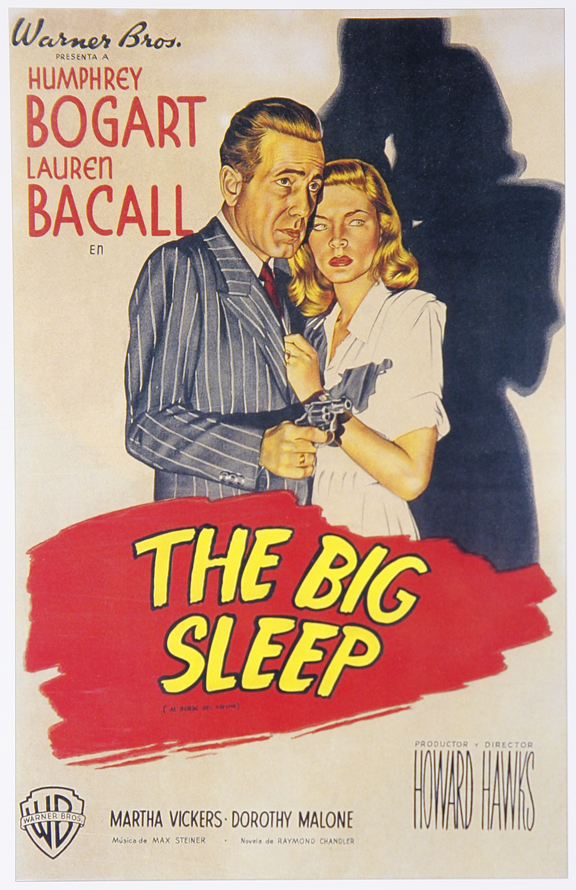
“Second Screening” is devoted to watching alternate versions of NFR entries and determining which version is most worthy of preservation. Today we look at the original version of “The Big Sleep”. You can read my thoughts on the original film here.
First, a little backstory. “The Big Sleep” was filmed in 1944 and slated for a 1945 release. After viewing a final cut, Lauren Bacall’s agent, Charles K. Feldman, requested that scenes be re-shot to put more emphasis on Bacall’s character, as well as to add more scenes that showcase the natural chemistry between Bogart and Bacall. Hawks and his team did just that, and the film was delayed until an August 1946 release.
What’s Different?: Roughly 15% of the film was changed from the 1945 cut to the 1946 theatrical release. As previously stated, the primary change is that while the original cut features Lauren Bacall and includes a potential romance between the two, Bacall’s Vivian is much colder to Bogart’s Marlowe. Their relationship ends at the same place, but it’s a much more gradual build to the final scene. Scenes were either reshot to now include Vivian in them (such as the scene of Marlowe bringing Carmen home after the murder), or completely scrapped in favor of new scenes. A scene of Vivian paying Marlowe for his services initially took place in his office in a quick, somewhat empty scene. The replacement is the “horserace” scene, arguably the most famous (if not the most racy) scene in the final film.
But Bacall wasn’t the only one affected by these cuts. Among other changes was the deletion of a sequence where Carmen seduces Marlowe. It was believed to be filmed in 1944, but not present in the 1945 cut before being restored. The original cut also features a lengthy scene of Marlowe and the D.A. discussing the case up to that point. It answers a lot of questions the 1946 version doesn’t, but it slows the pacing tremendously. This scene’s subsequent removal saw actors James Flavin and Thomas E. Jackson be completely cut from the film. Similarly, a reshoot of the Mona Mars scene (again, to better highlight Bacall) led to the original actor, Pat Clark, being replaced by Peggy Knudsen when Clark was unable to return to the studio.
Does It Help?: The original 1945 version is interesting to watch, but mainly as a supplement to the final cut. The changes made were substantial, but the original cut didn’t hurt the film too much. You could have released the 1945 version and still have a pretty decent film on your hands. The key difference is Bacall’s work. The 1945 cut features a more cryptic Vivian slowly warming up to Marlowe, while the 1946 cut allows her to be more heated towards the beginning, and therefore more vulnerable once Marlowe starts to solve the case. It’s the difference between a good movie and an outstanding one.
The Verdict: Stick with the 1946 cut. The 1945 cut is for movie lovers, or those who need a little more time figuring out the film’s twists and turns. I’m delighted that the UCLA Film Archive discovered and restored the 1945 version, and it lives alongside – but secondary to – the 1946 version, where it belongs.
Written by William Faulkner & Leigh Brackett & Jules Furthman. Based on the novel by Raymond Chandler.
Class of 1997
NOTE: This post is about the original 1946 theatrical version. You can read my thoughts on the 1945 pre-release version here.
The Plot: L.A. detective Philip Marlowe (Humphrey Bogart) is called by millionaire General Sternwood (Charles Waldron) to investigate who is blackmailing his daughter Carmen (Martha Vickers). On his way out, Marlowe meets Sternwood’s other daughter Vivian Rutledge (Lauren Bacall), who suspects Marlowe has been hired to find her father’s missing protégé. There’s a twisted maze of murders and double-crossings throughout, but this is all mainly an excuse to get Bogart and Bacall back together on screen and let them heat things up with their newlywed passion.
Why It Matters: The NFR doesn’t even attempt to summarize the plot, gives no specific reason for the film’s inclusion, and focuses primarily on the story behind the original 1945 cut and subsequent reshoots.
But Does It Really?: The bad news: This is one complicated mystery. Even the people who made it weren’t sure who killed whom. The good news: The film (as well as Chandler’s novel) is more focused on character and atmosphere than plot. And it’s for this reason why the film succeeds. I have no idea what was going on, especially the further along things went, but I still had a good time. “The Big Sleep” is quintessential Bogie, quintessential Marlowe, and quintessential film noir. It’s baffling and convoluted, but fun and exciting nonetheless. I suspect “The Big Sleep” made the list in 1997 due to the (then) recent discovery and restoration of its 1945 prerelease version. How the NFR still hasn’t selected Bogie and Bacall’s first outing, “To Have and Have Not” is the real mystery.
Everybody Gets One: Screenwriter/novelist William Faulkner, and actors Dorothy Malone and Martha Vickers. But most shockingly, this is Lauren Bacall’s only entry on the list. She’ll always be immortalized by her four films with Bogie, but Bacall’s career spans an additional 60-plus years after that. These early films were just Act I for an endlessly fascinating life and career.
Wow, That’s Dated: Lots of wartime jargon (“The Big Sleep” was filmed in 1944 but not released until after the war). The prime example is the B sticker on Marlowe’s windshield, meaning he is allowed eight gallons of gas a week during the war rationing.
Seriously, Oscars?: Not only was “The Big Sleep” left out of the Oscars in 1946, but so was almost every other Warner Bros. release from that year. The only WB films to sneak in were “Humoresque” and the Foghorn Leghorn short “Walky Talky Hawky”. Neither won.
Other notes
Did we catch the opening credit shadows on a smoke break?
Marlowe pronounces shamus as “shah-mus” rather than “shay-mus”. Is the former also acceptable or did no one notice?
Martha Vickers was just one of the millions of Americans who were married to Mickey Rooney at one point.
“She tried to sit on my lap when I was standing up.” There are so many great film noir lines like that throughout, you need a second viewing just to catch them all.
The thing I always like about Lauren Bacall is that no matter how fierce or fiery her characters are, there’s always a hint of vulnerability just underneath.
It’s always nice to see a detective using his local library. Knowledge is Power!
ACME Book Store: Their best seller is “How To Catch a Road-Runner Using Rocket-Powered Skates, Painted Tunnels, and One ‘Help’ Sign”. (That’s TWO Looney Tunes references in one post!)
I’d like to report a robbery: Dorothy Malone practically steals the film right from under Bogie in her one scene. She does, however, fall for the trope of the bookworm removing her glasses and letting her hair down.
Jesus, does every woman in this movie want to go to bed with Marlowe? Is that why it’s called “The Big Sleep”?
The ear tug that Marlowe does throughout the film was apparently Bogie incorporating his own physical trait to the character. And here I thought he was saying hi to Carol Burnett’s grandmother.
Howard Hawks gets his trademark rapid-fire delivery from his actors, but only rarely allows them to overlap their dialogue.
Wow, how did any of the racehorse banter get past the censors? There is nothing subtle about those innuendos.
Bacall does her own singing! Next stop, “Applause”!
A punch to the spine, that’s gotta hurt.
The plot is super dense, but that’s one hell of an ending. It still works, despite the massive headache I’ve acquired from trying to follow the plot.
Legacy
Lauren Bacall was in serious danger of being a one-hit wonder before this film. The new cut that emphasized her romantic tension with Bogart helped solidify her as a bona-fide movie star, and her career took off from there.
Although they were several films of the other Philip Marlowe books, Bogart never played Marlowe again.
This film never got a sequel, but the original novel did. Robert B. Parker got permission from the Raymond Chandler Estate to pen the 1991 follow-up “Perchance to Dream”. It follows Marlowe and Vivian a few years later following the death of General Sternwood, and apparently isn’t that great.
“The Big Sleep” was remade for film in 1978, transporting the action to present day England and starring a way-too-old Robert Mitchum as Marlowe.
“Now wait a minute, you better talk to my mother.”
Bogart’s Philip Marlowe was one of the inspirations behind “The Cheap Detective”.
Further Viewing: Siskel & Ebert give a review and brief overview of the original version’s release in 1997.
The first video is the only complete version of “Topaz” I could find, albeit in black and white. The second video is 10 minutes of “Topaz” in its original color.
Shortly after the attack on Pearl Harbor by the Japanese Navy Air Service, Franklin Roosevelt ordered the forced relocation of hundreds of thousands of Japanese Americans who were deemed threatening. None of them had actually committed any crimes against America, they just happened to be of Japanese descent, and therefore dangerous to their country. There were 10 relocation camps (alternatively known as “internment camps”) across the country, including the Topaz War Relocation Center in Topaz, Utah. Most of the internees at Topaz were from the Bay Area, including Dave Tatsuno, who secretly filmed life in the camp with a smuggled camera throughout his three years of relocation.
“Topaz” gives us a rare glimpse at life in an internment camp. Since this was all filmed in secret, Tatsuno does not focus his camera on any of the guards or watchtowers or the camp’s unsuitable living conditions, but rather on the people who inhabit the camp. There are his family, his children (one of which was born in the camp), many other evacuees from the Bay Area from all walks of life, and several friendly members of the Topaz community who volunteer their support. The film focuses on more positive events, such as social gatherings and playing in the Utah winter snow. There are quick looks at the “volunteer” work being done by the internees, mostly manual labor around the camp. Many of those documented knew they were being filmed, and Tatsuno admits that they were playing for the camera, and hiding “the fear, the loneliness, the despair and the bitterness that we felt.” The film ends in 1945 with Tatsuno and his family finally allowed to return home. An epilogue from ten years later shows the Tatsunos returning to Topaz for the first time to see the former site. Commenting on these events some 30 years later, Dave Tatsuno ends his narration with, “Thank God that it’s all over”.
“Topaz” has natural historical significance, but this footage is a lot more than just reportage of what was happening during World War II. Having actual footage from one of the internment camps is a near-miracle, and we should be forever grateful not only to Tatsuno, but those who helped him smuggle the camera and film in and out of the camp. But my main takeaway was the proof of what we as Americans did/let happen to other Americans. This country tends to ignore our major blemishes, aside from the broadest of strokes (“Slavery was bad. Segregation was bad.” etc.). We are a nation that believes mostly in hindsight – what we did was bad and we shouldn’t have done it. But we did. And without acknowledging the complexity of the Japanese internment camps head-on, we are very much capable of doing it again.
Other notes
In my research I discovered that my hometown of Stockton, California was the site of a Civilian Assembly Center, the temporary set-ups used to assemble Japanese-Americans before sending them to the camps. Like Stockton doesn’t have enough problems with its reputation already.
Topaz was the site of one of seven murders in the Japanese interment camps. James Wakasa was shot by the camp guards when he stood too close to a fence. The funeral held by the internees, as well as their work strike, led to the camp loosening its security. Dave Tatsuno does not document nor comment on these events in his film.
All of this outward cheeriness surprised me. On top of everyone smiling for the camera, there’s a couple who met in the camp and eventually married, as well as the aforementioned children who were born in the camp. Tatsuno even manages to crack a joke or two in his commentary. I guess in the face of all this atrocity you have to keep living.
I totally sympathize with a group of people from the Bay Area who are not used to winters that are actually cold, or having to deal with accumulated snowfall.
The United States Government spent $300 million on the 10 internment camps. And that’s 1942 money! So what you’re telling me is we’ve always been bad at budgeting on a national level.
If you look at the list of internees at Topaz, most of them became one of two things after the war: activists or artists. Not surprisingly, most of them either created art based on their experience in the camps or became very active in civil rights in their communities. One, Yuji Ichkioka, coined the term “Asian American” to give all Asian communities a united front. Another, Goro Suzuki, changed his name to Jack Soo and is best known for his performance on “Barney Miller”.
Obviously there is so much more material out there about the Japanese internment camps, and this post only scratches the surface. A good starting point for information about the camps (and this film) is the NFR’s essay by author Karen L. Ishizuka, who helped campaign for the induction of “Topaz” into the National Film Registry.
Written by Lang and Bartlett Cormack. Story by Norman Krasna.
Class of 1995
The Plot: Loosely based on the real life Brooke Hart murder case, “Fury” is a crime drama with all-around good guy Joe Wilson (Spencer Tracy) at its center. When Joe drives through the small town of Strand on the way to see his fiancée Katherine (Sylvia Sidney) in Capital City, he is pulled over by the police and suspected of being involved in a local kidnapping. He is held in the city jailhouse, and rumors start escalating about Joe and his “crimes”. The town’s citizens get whipped into a frenzy and form a lynch mob, burning down the jailhouse (and presumably Joe) in the process. What they don’t know is that Joe survived and aims to get vengeance on the 22 citizens who incited the mob. Can he get the mob convicted of murder without revealing that he’s still alive?
Why It Matters: The NFR calls “Fury” a “taut drama” with a “gritty story”, and incorrectly states that the film won the Best Original Story Oscar (See, “Seriously, Oscars?” below). Also included is an essay by fellow film blogger Raquel Stecher.
But Does It Really?: As Fritz Lang’s first American film it gets a pass for historical significance. As a drama, “Fury” takes its time getting started, but keeps getting better as it goes along. The film’s take on the American court system and small town mentality is refreshingly unfiltered for a code-era film. It’s not Fritz’s best work, but it’s good enough to earn “minor classic” status and a warranted place on the list.
Shout Outs: No direct references, but one of the guys in the mob does a pretty decent Popeye impression.
Everybody Gets One: Sylvia Sidney spent most of the ‘30s as a leading lady of the studio system, most the ‘40s as fading “box office poison”, and the ‘50s onwards as a successful character actor. Fritz Lang insisted on casting her as Katherine in “Fury”. Sidney is best known today for one of her last roles: Juno the afterlife caseworker in “Beetlejuice”.
Wow, That’s Dated: There’s the standard dated qualities like radio as a primary news source, and the novel idea of using film as courtroom evidence, but we also get enough brief digs at “redskins” to make John Ford proud.
Take a Shot: No one says “fury” at any point in this film.
Seriously, Oscars?: “Fury” received one nomination: Original Story for Norman Krasna. Despite what the NFR’s official write-up says, the film lost to “The Story of Louis Pasteur” (Original story by…God?) Spencer Tracy wasn’t nominated for Best Actor due to already being nominated in that category for “San Francisco” (despite his role in that film being a supporting one). And while he received no praise for his work in this film, Walter Brennan won the very first Best Supporting Actor award that same year for “Come and Get It”.
Other notes
The film opens with the “any similarities is purely coincidental” disclaimer we see nowadays during the end credits. Back then basing a film even tangentially on real-life events was risky.
Yes, that’s Terry (aka Toto from “The Wizard of Oz”) as Joe’s dog Rainbow. She made this film when she was just 21 years old (in dog years).
I love the transition from Joe’s handwritten letters to telegrams. Nice subtle way of saying he’s come into some money.
You can see the constraints of the studio system closing in on Fritz Lang. I suspect he would have used a lot more jump cuts if the studio didn’t dictate scene wipes.
Hector the barber has some serious Sweeney Todd tendencies there.
I don’t mind the game of telephone that goes through the town, but does it have to be primarily busy-body housewives? They even have superimposed footage of hens at one point. This ain’t “Pick-a-Little, Talk-a-Little”.
The lynch mob scene is pretty terrifying. Thank god we reserve our national mob mentality to Twitter these days.
The first half of the film is kinda slow, but things really pick up once we get to the courtroom. It helps that courtroom proceedings are inherently dramatic.
Spencer Tracy is one of my favorite actors, but he’s not quite at his natural Spencer Tracy-ness with this performance. It’s not bad acting, it just doesn’t have the relaxed charm I associate with the man. Put him alongside Katharine Hepburn, see if that helps.
My one question: How did the newsreel team get that many angles of the lynch mob?
Part of the reason the first half is a bit slow is because it’s mostly set-up. Once the pay-offs start happening in the courtroom, things get exciting. It really showcases how solid the screenplay is.
There were some very obvious reshoots for the last scene. Spencer Tracy’s hair and suit continuity is way off.
Legacy
Fritz Lang continued making films in Hollywood for another 20 years, although none were as well received as his earlier German expressionism. He did, however, direct another NFR entry, the 1953 film noir drama “The Big Heat”.
Another film based on the Brooke Hart murder case was released in 1950, Cyril Endfield’s “The Sound of Fury”, aka “Try and Get Me!”
Spencer Tracy once again played a guy named Joe seven years later in… “A Guy Named Joe”.
Further Viewing: Fritz Lang’s early German films that the NFR can’t claim, 1927’s “Metropolis” and 1931’s “M”.
OR “1BR/1BATH, PERFECT FOR AFFAIRS (Upper West Side)”
Directed by Billy Wilder
Written by Wilder & I.A.L. Diamond
Class of 1994
The Plot: Young go-getter C.C. Baxter (Jack Lemmon) wants to move up the corporate ladder at the insurance company he works for in Manhattan. He achieves this by loaning out his apartment to some of the company managers so they can carry on their extra-marital affairs in secret. This attracts the attention of personnel director J.D. Sheldrake (Fred MacMurray), who not only promotes Baxter, but also insists on exclusive use of the apartment. At the same time, Baxter is trying to woo elevator operator Fran Kubelik (Shirley MacLaine) who, unbeknownst to Baxter, is Sheldrake’s mistress. It’s a complicated love triangle that can only be solved with clever Wilder-Diamond dialogue.
Why It Matters: The NFR calls it a “sardonic, satiric comedy” and praises Wilder, Lemmon and MacLaine. There’s an expanded essay by Northwest Chicago Film Society programmer Kyle Westphal.
But Does It Really?: Full disclosure: This is one of my favorite films. Like, top five. “The Apartment” is the rare film that successfully balances comedy and drama, making a modern film that feels more “real” than others of the era. It has all the hallmarks of a studio release, but with none of the conventions. There’s a lot of taboo (for 1960) subjects being discussed here, marital infidelity being the main topic, but Wilder and Diamond provide a well-crafted, funny script that challenges production codes without being preachy about it. This is all supported by brilliant turns by Jack Lemmon and Shirley MacLaine. Like the script, Lemmon and MacLaine’s performances are equally funny and humane. “The Apartment” is still entertaining and touching after all these years, and the last truly great Billy Wilder film.
Shout Outs: Baxter tries to watch “Grand Hotel” on TV, and catches a glimpse of “Stagecoach” while channel surfing. There’s also an allusion to Wilder’s “The Lost Weekend”. In addition, Wilder has cited “The Crowd” as an influence on “The Apartment”.
Everybody Gets One: Edie Adams is the main one, plus most of the supporting cast, including Johnny Seven (hard to believe, but that’s not his real name).
Wow, That’s Dated: The film’s frequent but casual sexism aside for one moment, “The Apartment” also features topical references to Fidel Castro and Cape Canaveral, as well as a shout-out to “The Untouchables”.
Seriously, Oscars?: Critically divisive but commercially successful, “The Apartment” led the 1960 Oscars with 10 nominations and won five, including Picture, Director, and Original Screenplay (making Wilder one of a handful of people to win three Oscars on the same night). Jack Lemmon – a recent Supporting Actor winner for “Mister Roberts” – lost Best Actor to an overdue Burt Lancaster for “Elmer Gantry”. And despite all bets being placed on Shirley MacLaine to win Best Actress, Elizabeth Taylor’s emergency tracheotomy during the voting period gave her a ton of sympathy press, as well as the award for her work in “BUtterfield 8”. MacLaine would be an Oscar bridesmaid for 23 years and four more nominations.
Other notes
Among the screenplays many gifts, it tows the line between airtight and leisurely. This movie takes its time getting started (plot-wise), but you really get to understand the characters of Baxter and Kubelik, and it especially helps you sympathize with their very unsympathetic situation.
This film takes place back when spouting random facts was a sign of intelligence, rather than a sign of falling down yet another internet wormhole.
Baxter’s rent is $85 a month, roughly $715 today. Which is hilarious because do you know what an apartment in the Upper West Side goes for these days?
Who knew Larry Tate was such a shady character? Stephens!
Boy when you get Fred MacMurray in the right role, he is a joy to watch on the screen. Sheldrake is such a dark turn for the dad from “My Three Sons”, and MacMurray nails it.
The one part of this film that ages the poorest is the scene where Baxter tells Kubelik that he looked up her file and knows everything about her. There’s no way you could pull this scene off today without making him a stalker.
On the one hand, my office Christmas parties aren’t this raucous. On the other hand, they’re not this depressing either.
My favorite line in the film: “Hey Charlie! Give me a shot of bourbon, and step on it. My sleigh is double parked.”
Readers, I give you “Rickshaw Boy”!
“The Apartment” is on my “Die Hard” list of great not-Christmas movies. There’s even fruitcake!
Jack Kruschen managed an Oscar nomination for Best Supporting Actor as Dr. Dreyfuss. It’s another case of a veteran character actor finally getting their due, and Kruschen is great as the only real “mensch” in the film.
Wilder is well aware that you only use close-ups for emotional impact. Most of this film is done in wide shots (natural for widescreen); when they cut to a close-up, it’s because something important is happening.
Single living really hasn’t changed since 1960. The main difference is that Jack Lemmon wears a tie even when he’s lounging around the house.
Edie Adams does not get enough credit for her work in this film. She’s primarily remembered as an entertainer/personality, but she absolutely nails the role of scorned lover.
“Shut up and deal”. Wilder was always great at curtain lines.
Legacy
Back when musicals based on popular films were less common, “The Apartment” became the 1968 Broadway musical “Promises, Promises”. It never improves upon the film (and mistakenly de-emphasizes Kubelik), but the show does feature a fun score by Burt Bacharach and Hal David, as well as an automatic Tony Award for whoever plays Margie MacDougall.
This is the film that helped Jack Lemmon transition from comic star to dramatic actor. He followed this film up with “Days of Wine and Roses”.
Wilder, Lemmon, and MacLaine reunited three years later to make another, more farcical comedy, “Irma La Douce”.
Besides every TV show having an episode called “The Apartment” at some point, this film’s other major influence was on future Best Picture winner “American Beauty”, particularly Kevin Spacey’s performance. Remember when you could reference “American Beauty” without feeling slightly dirty?
Further Viewing: One more song from “Promises, Promises”.