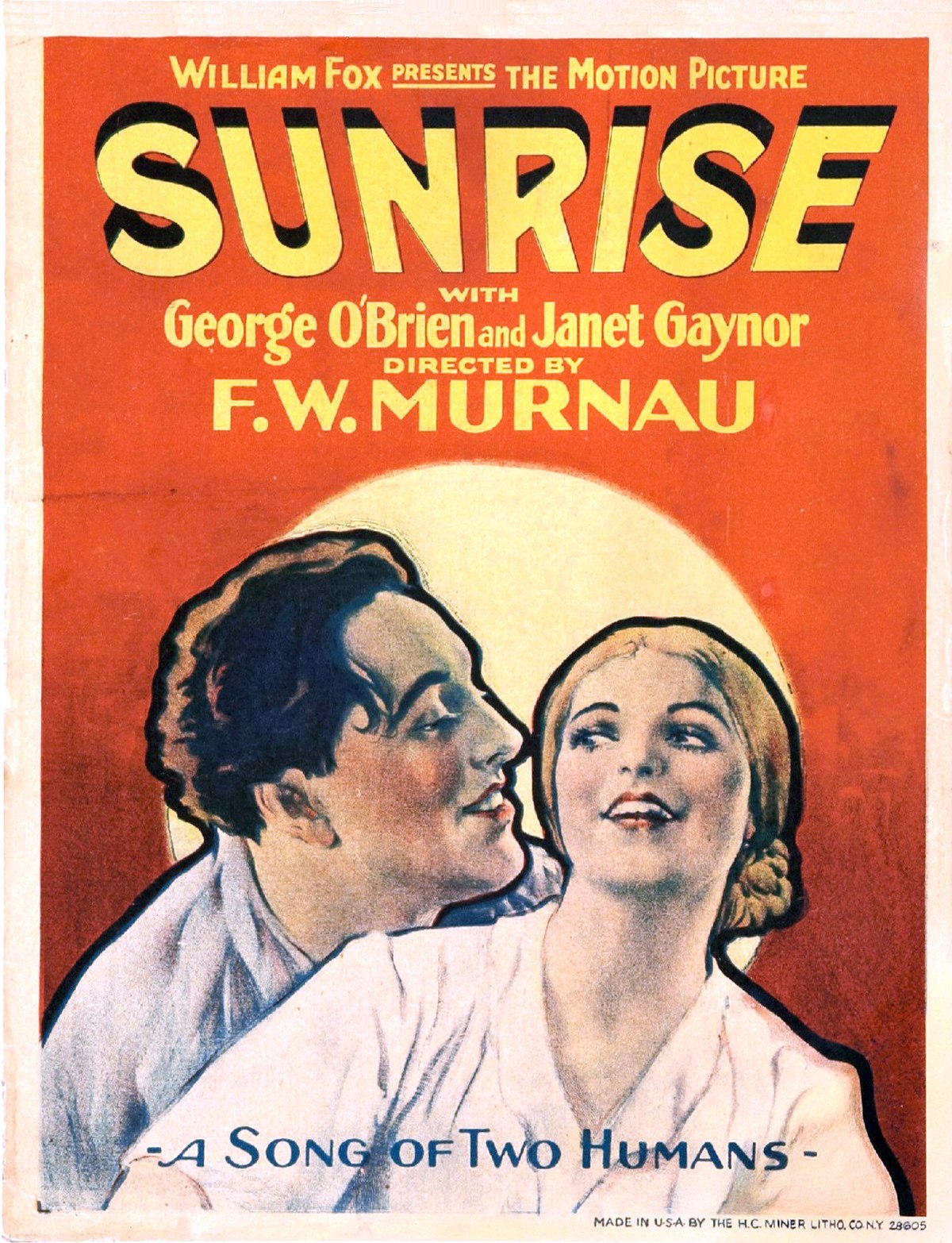
#170) Sunrise: A Song of Two Humans (1927)

1200px-Sunrise_vintage

#170) Sunrise: A Song of Two Humans (1927)

OR “Cinematic Couples Counseling”

Directed by F.W. Murnau

Written by Carl Mayer. Based on the short story “The Excursion to Tilsit” by Herrmann Sudermann.

Class of 1989

The Plot: A Man and his Wife (George O’Brien & Janet Gaynor) live on a farm in the country with their newborn child. Though they were once happily in love, their marriage has fallen on harder times. The Man has been carrying on an affair with a visiting Woman from the City (Margaret Livingston). She convinces the Man that he must kill his wife, sell the farm, and move to the city to be with her. The Man begins to carry out this plan, but cannot bring himself to do it. Their marriage is put to a demanding, yet cinematically beautiful test.

Why It Matters: The NFR salutes Murnau and his penchant for “introducing new technical methods of enhancing the storytelling process.”

But Does It Really?: You don’t make the first round of NFR films without doing something right. “Sunrise” has earned its reputation as possibly the best silent film ever made. It is the apex of what film could achieve before the advent of sound. F.W. Murnau succeeds at the difficult balancing act of strong story and innovative technology. The technical breakthroughs are a revelation, yet always at the service of the story. O’Brien & Gaynor don’t let the aesthetics overpower them, and both give genuine, heartfelt performances that ground the film. “Sunrise” is an apt title for a film that showed us the promise and the beauty of a new era in film.

Everybody Gets One: Margaret Livingston is known for two things: playing the other woman in “Sunrise” and being on William Randolph Hearst’s yacht when director/producer/her alleged lover Thomas Ince died on board. His death certificate says “heart failure”, but yellow journalism at the time speculated murder, and the legend lives on.

Wow, That’s Dated: Mainly the whole “women are property” vibe that permeates throughout. Also big bands and jazz, but mostly that first thing.

Seriously, Oscars?: As if the Academy created the Oscars with this film in mind, “Sunrise” was a major player at the 1st Academy Awards. “Sunrise” started with four nominations and won a record-breaking three: Actress for Janet Gaynor (along with her performance in “7th Heaven”), Cinematography, and something called Best Unique and Artistic Picture. This category was only presented at the first Oscars, alongside the category of Outstanding Picture, which went to “Wings”. The Academy merged these two categories together the following year and retroactively declared “Wings” the first Best Picture, leaving “Sunrise” out of oh-so-many Best Picture montages. Despite the film’s strong turnout, F.W. Murnau was not nominated for Best Director.

Other notes

  • “From an Original Theme by”? I guess the word “adapted” hadn’t been invented yet.
  • All I wish is to one day be cast in a movie as either “Obtrusive Gentleman” or “Obliging Gentleman”.
  • Fox was quick to cash in on the latest trend, consequently making “Sunrise” one of the first movies to have its soundtrack synchronized with the film.
  • Holy crap this is already a vast creative improvement over its contemporary silent films. Murneau is fully aware that movies are not the real world and adhere to their own logic. You can move the camera around, superimpose images for symbolism, or do anything else you can think of. Long Live German Expressionism!
  • Nice try, but you can’t make 21-year-old Janet Gaynor look homely and careworn.
  • A flashback within an intertitle! Talk about innovation.
  • I wonder how that baby felt years later we he learned that not only is his butt featured in a movie, but that movie has been preserved by film historians, meaning his butt will be seen by future generations.
  • Dogs are always the first to sense earthquakes, hurricanes, and attempted murder.
  • George O’Brien may have the worst posture of any movie star ever.
  • I predict a lot of couch-sleeping in The Man’s future.
  • The city is only one trolley stop away? Why would you ever live in the country?
  • Not a big turnout for this wedding. Is it a weekday?
  • But seriously, the cinematography in this is amazing. Kudos to Charles Rosher and Karl Struss. There are several shots that made me think, “How did they do that?”
  • Geez, even back then there was manspreading. No wonder he’s “The Obtrusive Gentleman”.
  • If you’re watching the version with the original soundtrack, you’ll recognize the use of Charles Gounod’s “Funeral March of a Marionette” in the photographer scene. I didn’t realize Hitch made cameos in other people’s movies.
  • And then we get to the funfair sequence that, while entertaining, really has nothing to do with the rest of the movie. It’s an example of the dangers of adapting a short story into a film. I was not expecting one of the first 25 NFR films to devote this much screen time to a drunken pig (and that’s not a euphemism, there’s an actual pig who sops up wine).
  • Not only does Murnau overlap some of the film’s visuals, he also overlaps some of the film’s soundtracks.
  • Wow, Gaynor can sleep through anything.
  • The ending left me breathless. Literally, it wasn’t until the film ended that I realized I was holding my breath.

Legacy

  • F. W. Murnau would go on to make three more films in America (including fellow NFR entry “Tabu”) before his untimely death in a car crash at age 42.
  • The original short story was adapted into a German film in 1939, this time as “The Journey to Tilsit”.
  • Where this movie left off, “A Place in the Sun” picked up and continued.
  • This film’s unintentional legacy was, appropriately enough, the beginning of film preservation. Turns out nitrate film spontaneously combusts when not properly stored, and “Sunrise” was one of several films whose original negative was destroyed in the 1937 Fox vault fire. This was Hollywood’s first wakeup call to the danger of losing our films/cultural heritage. Side Note: Obviously a print of “Sunrise” survived elsewhere, and a new negative was created.

#169) Memento (2000)

** 2020 Update: Told ya.

Listen to This: Speaking of Bowie…

Further Viewing: The similarly structured “Betrayal”, based on the Harold Pinter play. If you’ve ever wanted to see Ben Kingsley with hair, this is your movie.

  • There’s talk of an American remake, but why would you make this again? We already have “Finding Dory”.
  • “Memento” was remade in India as 2005’s “Ghajini”, which itself was remade by Bollywood three years later.
  • And I certainly would not have guessed three Batman movies.
  • If you had asked me in 2000 what Christopher Nolan’s follow-up film would be, I would not have guessed something with Robin Williams.
  • This film started the well-crafted, oft-confusing, internet-worshiped Christopher Nolan filmography that’s still going strong today.

Legacy

  • I cannot hate any movie that plays David Bowie over the closing credits.
  • What a twist! Or, for the chronological viewing: What a set-up!
  • Jimmy goes to the Derek Smalls Academy of Moustache Grooming.
  • Teddy doesn’t strike me as the kind of guy who would namedrop Annie Leibovitz, but here we are.
  • It’s nice to see Harriet Harris do some wonderful low-key acting. I’m used to her work as Bebe Glazer and Bebe Glazer-esque characters.
  • Can credit cards still open a locked door now that they have chips?
  • “Oh, I’m chasing this guy. No, he’s chasing me.” I laughed out loud at that line. This film manages to be quite funny when it wants to be.
  • It must be degrading having your butt kicked by a naked guy.
  • Pearce does a great American accent, but his teeth are the giveaway that he ain’t from around here.
  • Shout out to “Green Acres”.
  • Stephen Tobolowsky loves movies that fuck with linear time.
  • The chronological cut of “Memento” gives you added appreciation for the work of Joe Pantoliano and Carrie-Anne Moss. You won’t see that kind of nuance in “The Matrix”, that’s for sure.
  • Ah yes, the time-honored film tradition of flashbacks to your dead wife. It’s to Nolan what the “absent fathers” trope is to Spielberg.
  • I’ve never understood people who get tattoos with lengthy text. Am I supposed to read the whole thing? Would you stand still for a sec?
  • Not only is Guy Pearce giving a wonderfully captivating performance, but he’s also very good at solving L.A. based homicides.
  • Hey hey hey, no times for puns, Leonard. You leave that to me.
  • This is one of the rare films where the voiceover narration feels necessary. Take that, “Blade Runner” original cut!
  • What a great opening credits sequence. It sets up the whole film perfectly. And to think that opening credits would be all but extinct in just a few years time.
  • Why Original Screenplay instead of Adapted? Because Jonathan’s short story wasn’t published until 2001, a few months after the film’s release.

Other notes

Seriously, Oscars?: A commercial and critical success, “Memento” walked away with a boatload of year-end awards. But when it came time for the Oscars, the film went home empty-handed. Dody Dorn lost Best Editing to “Black Hawk Down”, while the Nolans lost Original Screenplay to “Gosford Park”. Wanna hear something worse? Christopher Nolan would have to wait 16 years to get his first Best Director nomination. That’s right, he wasn’t nominated until “Dunkirk”. Don’t that just beat all?

Title Track: No one says “memento”, even though Leonard has the perfect opportunity when he’s burning his wife’s stuff. All that aside, the real drinking game is every time someone says the word “condition”.

Wow, That’s Dated: Polaroid cameras, that’s the big one. Can you imagine this movie if Leonard was using a smart phone to solve this?

Everybody Gets One: Christopher Nolan, though I’m so positive that will change soon I’m just gonna put the Update Asterisks here now**. Special mention to Jorja Fox as Leonard’s wife, aka “the vic”.

But Does It Really?: Oh yeah. “Memento” is an intellectual thriller that scratches your brain in just the right places. Nonlinear storytelling can feel gimmicky when applied incorrectly [laughs nervously], but married to this particular story it creates a film that isn’t a whodunit, but rather a how and whydunit that kept me guessing until the very end. Nolan expertly leads you through the labyrinth without making things too confusing. Add in a brilliantly subtle yet complex performance by Guy Pearce at the center of it, and you’ve got yourself a modern classic. Not only is “Memento” a thoroughly solid film, but the ripple effect that it gave us with Christopher Nolan is still very much being felt in pop culture and filmdom today.

Why It Matters: The NFR calls the film “innovative” and explains just how Nolan pulled off the film’s nonlinear structure. “Memento” is the first narrative feature from the 2000s to be included on the National Film Registry. So it’s basically the “Citizen Kane” of the last decade, no big whoop.

The Plot: Told in two parallel storylines (one going chronologically and the other in reverse), “Memento” focuses on Leonard (Guy Pearce), a man afflicted with anterograde amnesia (aka short-term memory loss) as the result of an attack on him and his wife (Jorja Fox) that ended with her dead. Using a detailed supply of notes he writes for himself, and tattoos on his own body with just the facts, Leonard is determined to find and murder the man who killed his wife. But the real question isn’t who killed her, it’s who can Leonard trust? The charming but cryptic Natalie (Carrie-Anne Moss)? The suspiciously friendly Teddy (Joe Pantoliano)? Or his own memory?

Class of 2017

Directed & Written by Christopher Nolan. Based on the short story “Memento Mori” by Jonathan Nolan.

OR “Warily We Roll Along”

#169) Memento (2000)

memento_xlg

Fourteen Months Earlier

Windmills on Film

Cinematic Everest

Two Scoops of Random

Confessions of a Film Junkie

The Horse’s Head [Sounds like a bar name, but keep it until you think of something better.]

Eleven Years Earlier

#168) The Musketeers of Pig Alley (1912)

7243561.3

#168) The Musketeers of Pig Alley (1912)

OR “Lower West Side Story”

Directed by D.W. Griffith

Written by Griffith and Anita Loos

Class of 2016

The Plot: A musician and his wife (Walter Miller & Lillian Gish) live in a poor apartment in New York near “Pig Alley” in Greenwich Village. Gangster “The Snapper Kid” (Elmer Booth) mugs the musician right outside his front door. The musician vows to get the money back, inadvertently getting him and his wife mixed up in the Snapper Kid’s turf war with a rival gang. Sounds exciting, right? Well I’ve got some bad news…

Why It Matters: The NFR calls it “the first gangster film” and hails its employment of “several innovative camera techniques”. And it’s not just them; this is all anyone has to say about this film.

But Does It Really?: I try to give silent movies the benefit of the doubt while viewing them, but I could not get into this film. There’s so little to latch on to with this one, despite the impressive pedigree of D.W. Griffith. It’s a breakthrough in genre and technological innovations, sure, but man is it slow. And it’s only 15 minutes! We’ve got other films from D.W. Griffith and other gangster films, so it’s the NFR’s defense that is keeping this thing afloat. This is a “D-” on the preservation-worthy scale: Not exceptional, but still passing.

Everybody Gets One: Elmer Booth’s film career was just getting started when he died in a car crash at the age of 32. D.W. Griffith was especially distraught by Booth’s death, and delivered the eulogy at his funeral. Elmer was survived by his younger sister, legendary film editor Margaret Booth.

Wow, That’s Dated: Common usage of the phrase “musketeers”, women’s hats the size of a tractor tire.

Other notes

  • This is one of those movies where I understand each individual word in the title, but the name as a whole takes some getting used to.
  • For those of you not versed in cinematography terms (like me), this film’s main innovation was the camera technique “follow focus”. This is the practice of focusing only on one part of a shot rather than the entire frame. It has since become the standard.
  • Seeing as this is Greenwich Village, couldn’t the musician find work with the Blue Man Group?
  • This is my first Lillian Gish film on the blog. Mercifully, this is far from her only representation on the NFR.
  • Speaking of, that’s Lillian’s sister Dorothy featured prominently in one of the crowd scenes.
  • One cut in this film makes it seem that the door to their apartment leads straight into the bar. Another successful design from Escher Architect!
  • Can we PLEASE have dialogue intertitles? I am begging you!
  • Everyone dressed liked Buster Keaton back then.
  • Nice of the cops to show up instantly during the fight.

Legacy

  • Follow focus. That’s the main one. I guess someone had to invent it.
  • Martin Scorsese loves this film and is single-handedly keeping its memory alive. Scorsese, of course, would make his own film about the gangs of New York called…um….

#167) Hail the Conquering Hero (1944)

Hail the Conquering Hero (1944)

#167) Hail the Conquering Hero (1944)

OR “Hey, Mr. Sham-Marine Man”

Directed & Written by Preston Sturges

Class of 2015

No original trailer, but here’s a preview from I’m guessing someone’s VHS.

The Plot: Woodrow Truesmith (Eddie Bracken) leaves his small hometown of Oakridge to become a Marine like his late father. Due to his chronic hay fever, he is discharged within a month, and spends a year working in a shipyard while telling his mother (Georgia Caine) that he’s fighting overseas. While commiserating at a bar, Woodrow happens on six Marines led by Sgt. Heffelfinger (William Demarest), who served with Woodrow’s father in WWI. To repay Woodrow for buying a round of drinks, the Marines tell his mother that he received a medical discharge and is coming home. Woodrow is reluctant to go along with the lie, especially when he gets home and finds the whole town cheering his heroism and requesting he run for mayor. Hilarity ensues.

Why It Matters: The NFR claims that Preston Sturges was the rare writer/director of the time who could “satirize the worship of war heroes”. After that, the NFR leaves the praise to contemporary reviews of the film by New York Times critic Bosley Crowther and French critic Andre Bazin. They seemed to like it.

But Does It Really?: It’s not the definitive Preston Sturges film, but it sure did make me laugh. There’s a lot of good stuff in here, from Sturges reliably airtight script to a performance from Eddie Bracken that is equal parts hilarious and heart-warming. The plot snowballs at a hilarious pace and the premise never outstays its welcome. Plus if you think about it, it’s kinda crazy that they got away with very subtly making fun of worshiping our military while we were still in WWII. “Hail the Conquering Hero” is a minor classic to be sure, but a classic nonetheless.

Shout Outs: Look closely in the finale for a poster advertising Sturges’ previous film, “The Miracle of Morgan’s Creek”.

Everybody Gets One: Most of the actors in this film were members of Preston Sturges’ stock company and appear elsewhere on the list. The few “one-and-done” performers include veteran character actor Raymond Wallburn and pin-up girl Ella Raines.

Wow, That’s Dated: Lots of ‘40s slang and WWII references in this one. And, as predicted, there are a few uncomfortable references to “Japs”.

Title Track: There’s one scene 21 minutes in where there is a debate about what song to play when Woodrow comes home. The song “Hail the Conquering Hero” is mentioned several times in a matter of seconds, and then never again.

Seriously, Oscars?: “Hail the Conquering Hero” received one Oscar nomination: Original Screenplay for Preston Sturges. His competition included…himself, additionally nominated for “The Miracle of Morgan’s Creek”. Whether he split the vote or not we’ll never know, but the winner that year was the screenplay for Best Picture-nominee “Wilson”.

Other notes

  • Preston Sturges’ films always seemed to me like Frank Capra films that had leaned in to their comedic elements. Both filmmakers excelled at sweet stories of small town idealism, and while Capra’s are better known today, Sturges’ are a lot funnier.
  • This film is from that point in the ‘40s when Eddie Bracken was your top choice over Donald O’Connor, and not the other way around.
  • Movie bars: where the only thing on tap is “beer”.
  • The scene where Woodrow meets the Marines and tells them about his father is done in one continuous take. Nothing flashy, just the man and his story. And that’s all you need.
  • Woodrow’s father presumably got his nickname “Hinky Dinky” from the WWI song “Mademoiselle from Armentieres”.
  • Franklin Pangborn plays the Committee Chairman, who I’ll just assume is one of them “confirmed bachelors”.
  • Let the record show that Eddie Bracken is only five years older than his on-screen love interest Ella Raines. That’s an inoffensive misdemeanor on the Michael Douglas Scale.
  • Everyone in this town goes to the same church. What is this, “The Simpsons”?
  • Bracken’s reactions, though. They are worth the trip out.
  • Don’t worry about that statue of you, Woodrow. They’ll just tear it down in 75 years anyway.
  • Libby is lit with the Morticia Addams follow-spot.
  • How many wry non-committal one-liners does Forrest need from Libby? She’s. Not. Interested.
  • Werner Heymann’s score sounds like everyone’s going to break into song at any point.
  • Woodrow is very concerned that his will be “an election based on fraud”. That is some low-hanging fruit; you can make your own joke.
  • Woodrow and Libby take a late-night walk during the brightest evening on record. Was there a supermoon that night?
  • Woodrow hatches his plan just as morning breaks. His idea literally dawns on him.
  • “I’m as sane as a Dane.” You’re forgetting about Hamlet, aren’t you?
  • We are informed at the end that people gravitate towards certain politicians simply because they like them. “They don’t need reasons anymore.” This film has way too much vague political talk that can still be applicable today. I guess that’s how you write a classic.

Legacy

  • “Hail the Conquering Hero” was Preston Struges’ last great hurrah as a filmmaker. It was his last film under his contract with Paramount and, no love lost, he jumped ship to become an independent filmmaker. Unfortunately he chose Howard Hughes – already in his post-“Outlaw” decline – as his business partner, and Sturges’ film career never recovered.

#166) The Big Lebowski (1998)

big_lebowski_ver1_xlg

#166) The Big Lebowski (1998)

OR “Farewell, My Rug-ly”

Directed by Joel Coen

Written by Joel & Ethan Coen

Class of 2014

The Plot: The Dude (Jeff Bridges) is an L.A. stoner who shares his real name with local millionaire Jeff Lebowski (David Huddleston). When the Dude is attacked by thugs who think he’s the other Lebowski, he gets mixed up in a plot involving Lebowski’s kidnapped wife (Tara Reid). Along for the ride are the Dude’s friend and angry Vietnam vet Walter (John Goodman), Lebowski’s estranged daughter Maude (Julianne Moore), a bowling tournament, some White Russians, and a rug that really tied the room together.

Why It Matters: The NFR calls the film’s chapters “alternately funny and disturbing”, hails the Coens as “unconventional visionaries” and deems Bridges’ performance “career-defining”. There’s also an essay by J.M. Tyree & Ben Walters, who have written several books about films, including one on “The Big Lebowski”. So, ya know, they’re qualified.

But Does It Really?: While I’m not as fanatic about this film as some are, “The Big Lebowski” is still one of the Coens’ better works. The film’s genre-bending keeps it fresh, with a script that praises Raymond Chandler without being slavish or too uptight. The entire cast is flawless, with Jeff Bridges, like the Dude himself, giving you a lot of layers underneath that laid-back exterior. It’s not the best Coen Brothers film, nor the funniest film ever, but the Dude abides, and “Lebowski” deserves a spot on the list.

Shout Outs: Several noir references throughout, including “Double Indemnity” and Chandler’s own “The Big Sleep”. Plus a nod to “42nd Street“!

Everybody Gets One: Coen Brothers staple John Goodman, Future Oscar Winners Philip Seymour Hoffman and Julianne Moore, early ‘00s It Girl Tara Reid and, via archival footage, President George H.W. Bush.

Wow, That’s Dated: Such late ‘90s relics as answering machines and phone books. Plus the dream sequences include some early CG bowling balls and pins.

Title Track: The Dude refers to “the big Lebowski” just twice throughout the entire film. That’s right, it turns out David Huddleston was the title character this whole time.

Seriously, Oscars?: Well something had to follow “Fargo”. Perhaps this film’s release just a year after the Coens won an Oscar for the “Fargo” screenplay raised the bar too high for “Lebowski”. The film was met with critical and commercial apprehension, leading to zero Oscar nominations. There were, however, a few precursor awards (such as the Online Film Critics Society) that took notice: the first to join the cult of the Dude.

Other notes

  • Co-editor Tricia Cooke is married to Ethan Coen. She shares her editing credit with the elusive Roderick Jaynes.
  • You call them Ralphs, we in the Bay Area call them Foods Co.
  • Bridges performance is fantastic. He really lures you in right from the beginning.
  • This whole post could be me singling out each cast member; they’re all so good. John Goodman practically steals the show from Bridges, Steve Buscemi and Phillip Seymour Hoffman make the most out of parts that don’t spring to life on the page. Julianne Moore gets to play a character so radically different from her other work, David Huddleston finally gets a meaty role after decades of character parts, and don’t even get me started on the meal John Turturro makes of The Jesus.
  • I unapologetically love The Gipsy Kings.
  • This film and “Anchorman” have got to be the most quotable comedies of the last 20 years. Speaking of, when is “Anchorman” coming to the NFR?
  • Shoutout to cinematographer Roger Deakins, especially for the shot from the bowling ball’s point of view. How does he still not have an Oscar?
  • Is Julianne Moore doing a Katharine Hepburn impression?
  • That’s stand-up comic Dom Irrera as the limo driver. “You know me, can’t complain.” His stand-up is pretty solid.
  • Like so many of the recent films on this list, don’t watch “The Big Lebowski” on basic cable. Unless you want to know what happens when you find a stranger in the Alps.
  • Metallica band member Kirk Hammett was pleased that Metallica was referenced in the film, even though the Dude calls the band “a bunch of assholes”. On the flip side, Eagles member Glenn Frey did not appreciate the Dude’s dislike of his music.
  • For all of this film’s quotable moments, the one I’ve used the most is “Stay away from my lady friend”. Don’t ask me why, but that’s the one that sticks.
  • Does Bunnie have “Viva Las Vegas” playing on a loop in her car?
  • Oh Sam Elliott: to be blessed with that combination of voice and moustache. Like the Dude’s damaged rug, Elliott really ties the film together, does he not?

Legacy

  • The film’s fandom and midnight screenings have led to the annual “Lebowski Fest”, a gathering and celebration of all things Lebowski. You don’t see this kind of fandom with “The Last Picture Show”, that’s for sure.
  • Some films have cult followings, “The Big Lebowski” has a religion. Dudeism (aka the Church of the Latter-Day Dude) was founded in 2005 and has its share of followers. Like any new religion, give it 1000 years to catch on.
  • Jeff Bridges’ band The Abiders take their name from one of the Dude’s most iconic lines.
  • “Noodles, we’re in that movie you made me watch.” “Shhhhh. You’re ruining it, like so many other dudes have over the years by quoting it.”
  • While the Coens have vowed to never make a sequel, John Turturro has been given permission to make a film revolving around his character, Jesus Quintana. “Going Places” has been filmed, but no release date has been set, and all we have right now is a Wikipedia page and this photo. What say you, readers from the future?
GP-00284.CR2

Listen to This: “Tumbling Tumbleweeds”, the Stranger’s leitmotif, was the signature song for Roy Rogers’ singing group Sons of the Pioneers. The group first recorded “Tumbling Tumbleweeds” in 1934, and the song found a place on the National Recording Registry in 2010.