The full short is tough to track down online (almost like it’s copyrighted or something), but here’s the clip you’re really here for.
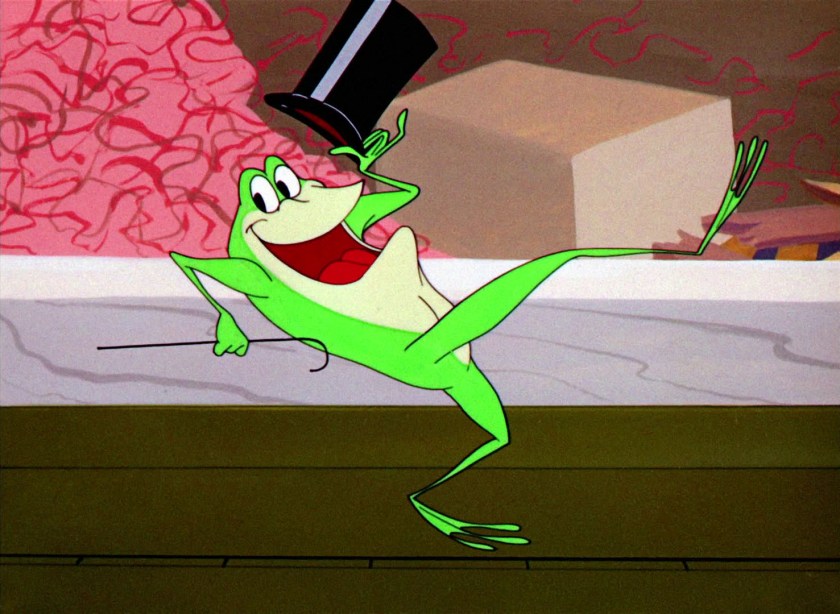
The Plot: While demolishing an old building, a construction worker finds a frog (voiced by William Roberts) who can dance and sing ragtime. The man tries to exploit the frog’s talents, but learns that the frog will only sing and dance when no one else is around.
Why It Matters: The NFR cites the film as being “on every short list of the greatest animation”.
But Does It Really?: It’s still really funny with solid animation and storytelling throughout. Who am I to say no?
Everybody Gets One: Though his identity was unknown for years, famous L.A. baritone William Roberts was the voice of Michigan J. Frog. Roberts’ singing career didn’t transition to the movies, where he only appeared in bit parts throughout the ‘40s. “One Froggy Evening” is his last film appearance.
Wow, That’s Dated: Three words: Tin Pan Alley!
Seriously, Oscars?: No nomination for “One Froggy Evening”. The Looney Tunes choice that year was “Speedy Gonzales”. Only one of these two shorts can still be shown on TV.
Interestingly, “The Michigan Rag” was an original song written for this short by Michael Maltese, and was the reason the frog was eventually named Michigan.
A quick question about the year 2056; Why is he wearing a space helmet? What happens to Earth’s oxygen in less than 40 years?
Legacy
Michigan & Chuck Jones returned to the big screen 40 years later in “Another Froggy Evening”. Despite the fact that it treads almost exactly the same water as the original short, it’s still very entertaining. Plus that’s the original Officer Lockstock as Michigan!
For those who remember a time before the CW, Michigan J. Frog was the mascot for the short-lived WB network.
“One Froggy Evening” has been spoofed many times over the years, but will any of them top “Spaceballs”?
Written by Melissa Mathison & Jeanne Rosenberg and William D. Wittliff. Based on the novel by Walter Farley.
Class of 2002
Thanks, Holly
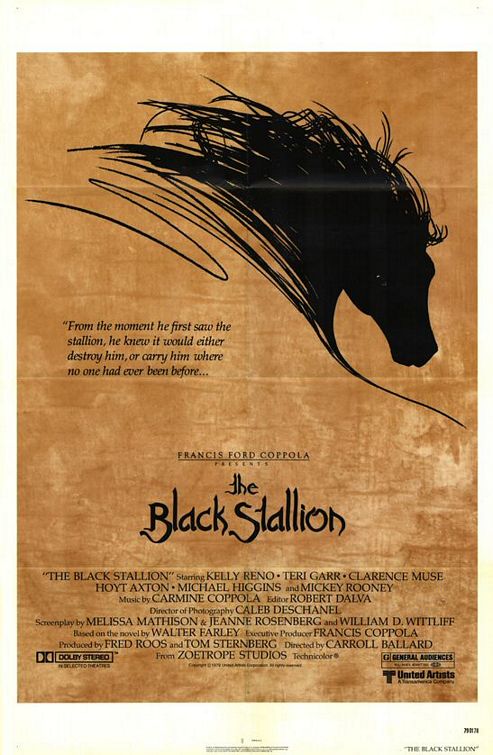
The Plot: While traveling by ship along the coast of North Africa, Alec Ramsey (Kelly Reno) meets and befriends an Arabian Stallion named Black (Cass Ole). After the ship sinks, Alec and Black wash ashore on a deserted island and form a bond that helps them survive. Once rescued, Alec returns home to his mother (Teri Garr) with Black in tow. Too wild for their small town, Black finds refuge on the farm of Henry Dailey (Mickey Rooney) a former jockey who is motivated to come out of retirement to train Black as a racehorse. Things look promising, but can Alec tame Black in time for the big race?
Why It Matters: The NFR mentions the film’s eventual release thanks to Francis Ford Coppola stepping in, as well as its Oscar nominations. There’s also a very sweet essay by writer Keith Phipps, who praises the film’s beauty while also managing to make a “C.H.O.M.P.S.” reference.
But Does It Really?: If nothing else, “The Black Stallion” set the template for kids-and-animal films for the next two decades. Everyone else tries to be this movie, but there’s only one “Black Stallion”. It doesn’t talk down to kids or try to give the animal some magical quality. The film shows that children and animals have their own natural way of living, and by listening to each other they can not only coexist, but also give Mickey Rooney a much-needed comeback vehicle.
Shout Outs: A photograph of Henry in his jockey days is actually young Mickey Rooney from “National Velvet”.
Everybody Gets One: Director Carroll Ballard, lead actor Kelly Reno, and almost the entire supporting cast, most notably folk singer Hoyt “Mitchell” Axton.
Wow, That’s Dated: Actually, this film fares okay in the dated department. The only giveaway that this is a ‘70s film is its quiet, art film style. You don’t see any kid movies doing that nowadays I’ll tell you that.
Title Track: Snoe mentions a “black stallion” once about halfway through the film.
Seriously, Oscars?: “The Black Stallion” received only two nominations, but did receive an honorary Oscar for Alan Splet’s sound editing (while the category of Best Sound Editing did exist back in 1979, there weren’t enough eligible films that year, so “Black Stallion” won an Honorary Award instead). Robert Dalva’s editing lost to the flashier work of “All That Jazz”, and Mickey Rooney’s sentimental Supporting Actor nomination lost to the even more sentimental Melvyn Douglas for “Being There”. “The Black Stallion” was not nominated for Best Picture, nor for Carmine Coppola’s score or Caleb Deschanel’s cinematography.
Other notes
Speaking of Caleb Deschanel: In addition to being a (still very active) five-time Oscar nominated cinematographer, Caleb is the father of actors Emily & Zooey Deschanel. Now that’s one creative family.
Man, between Kelly Reno, Justin Henry and Ricky Schroder, 1979 was the year of the child actor.
A fun game to play while watching this film; Connect-the-Dots with Kelly Reno’s Freckles!
I didn’t realize the first half of this film is basically “Cast Away”. The scene where Tom Hanks tries to ride Wilson just doesn’t pack the same punch.
Jesus, that cobra is booking it. Damn nature, you scary!
Nope, didn’t see the plate of glass between Alec and the cobra.
The montage of Alec riding Black along the beach is just awe-inspiring. But if he’s not careful they’re going to run into those “Chariots of Fire” guys coming the other way.
I bet when Alec came back to school, his “How I Spent My Summer Vacation” essay was the best.
Mom seems sort of nonplussed by all of this. Dad’s dead, my kid vanished and now there’s an untamed horse in the backyard. Cool, cool.
Clarence Muse, seen here as Snoe, was one of the first black stars of the sound era. This film was released just four days after his death.
Snoe’s horse Napoleon also played Niedermeyer’s horse Trooper in “Animal House”. That’s right, one of the horses in this film has more NFR credits than the director.
This is Mickey Rooney in what I call his “Lampie” era. It’s also telling when the best child actor in your film is 59 years old.
Cass Ole gives the best side-eye. But then again, that’s all a horse can really give you I suppose.
Why is Alec dressed like a Mexican wrestler for the race?
Stick around during the end credits for a rare double rainbow. What does it mean!?
No AHA disclaimer in the credits, but by all accounts those horses were not harmed during filming.
Legacy
Despite the original book having 900 sequels, “The Black Stallion” only had one follow-up film; 1983’s “The Black Stallion Returns”, which follows its source novel pretty faithfully.
Early ‘90s Family Channel viewers may recall “The Adventures of the Black Stallion” a TV series with Mickey Rooney reprising his role of Henry. Although it’s never explained why it’s the ‘90s all of a sudden. Is Henry immortal?
“The Black Stallion” joined the early ‘00s prequel craze with “The Young Black Stallion”, which featured Black finding mystic artifacts and bumping into historical figures, I guess.
Director Carroll Ballard has only directed a handful of films, but almost all of them are about the bond between humans and animals, most notably “Never Cry Wolf” and “Fly Away Home”.
In a misguided attempt to keep two film franchises alive, The Black Stallion fought Rocky “The Italian Stallion” Balboa in “Rocky V”. Cass Ole called being in that film “one of my deepest regrets”.
Written by Clara Beranger. Based on the novel and play by Zona Gale.
Class of 2001
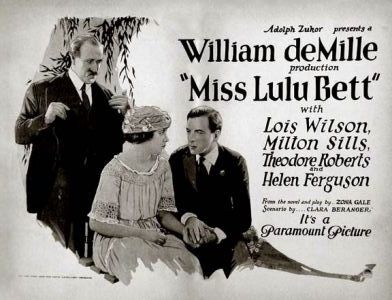
The Plot: Lulu Bett (Lois Wilson) is unmarried and unhappily living as a housekeeper with her sister Ina (Mabel Van Buren) and her family. When Ina’s brother-in-law Ninian (Clarence Burton) returns home after 20 years, he takes a liking to Lulu and jokes about them getting married. When they accidentally say wedding vows in front of Ina’s husband/Justice of the Peace Dwight (Theodore Roberts), they become legally married. This complicates life for everyone, especially as Lulu starts to fall for local schoolteacher Neil Cornish (Milton Sills).
Why It Matters: The NFR praises Wilson’s “quiet and restrained performance” as well as William C. deMille’s “deceptively simple visual storytelling style”.
But Does It Really?: Maybe it’s just because the story itself hasn’t aged well, but this film just kinda lays there for me. Interestingly, this film suffers from the same problem as more recent films based on plays; it’s not opened up enough. Most of “Lulu” takes place in the same house and nothing is done stylistically with the camera or the editing to make it anything other than a filmed play. At almost 100 years old, this film neither wows nor bores in its presentation. Like many of the silent era, “Lulu” is on the NFR list because it survived. An accomplishment to be sure, but not enough for me to recommend it.
Everybody Gets One: While never a major movie star, Lois Wilson had a successful career in silent films and managed to make the transition to “talkies”. In addition to being a matinée idol, Milton Sills was a founding member of both Actors’ Equity and the Academy of Motion Picture Arts and Sciences.
Wow, That’s Dated: Mainly the way we ostracized “spinsters” from our society. In addition, this film features cars that you had to crank, and cigarette girls!
Other notes
This is a film with a screenplay by a woman based on work by another woman. You’ve done it before you can do it again, Hollywood!
The stage version of “Miss Lulu Bett” won the Pulitzer Prize for Drama in 1921, making Zona Gale the first woman to win the prize.
If the name of the director sounds familiar it’s because William C. deMille is the older brother of Cecil and the father of Agnes. And at one point he was married to screenwriter Clara Beranger. Another exciting family to spend Thanksgiving with.
It’s only 70 minutes, but this film sure takes its time getting started. We get a virtual realtor walk-through of the house, followed by very slow introductions of the characters and the actors playing them. Very “Robin Hood”.
Lulu asks Ninian if he’s “a Miss Mister or a Mrs. Mister?” As long as he’s not Mr. Mister we’re all fine.
Did Ina just cop a feel on her mom?
Oh yeah, the patriarchy is in full swing in this film. Dwight and Ninian are the least fleshed-out characters, but everything revolves around what they want.
Speaking of, when did the name Ninian go out of fashion? He is a saint after all.
This film utilizes the lesser-used second definition of “making love”; in this case to be amorously attentive to someone.
Again, the whole reason this film doesn’t hold up is that we have accepted as a society that life is not over for unmarried women in their late-20s. That’s right, she’s 27, and they’ve already cast her off on the metaphorical ice floe (which, like this movie, hasn’t been a thing for a long time).
Legacy
Oh, the things you learn while researching a film blog. Turns out that my grandfather was named after Milton Sills. He was my great-grandmother’s favorite actor when Milton was born.
Like Sills, William C. deMille was a founding member of AMPAS and hosted the first two Oscar ceremonies. That’s right, the director of this film has hosted the Oscars more times than Seth MacFarlane or James Franco ever will.
But seriously, has anyone seen or heard from “Miss Lulu Bett” in any of its incarnations since 1921?
#96) President McKinley Inauguration Footage (1901)
OR “Mr. Edison Goes to Washington”
Directed by Thomas Edison
Class of 2000
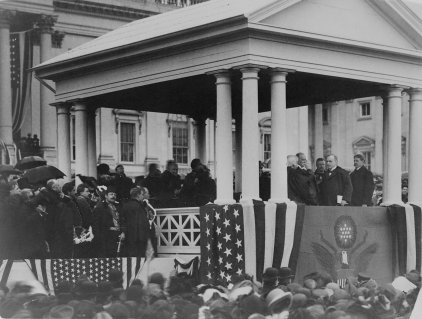
The Plot: Two very short films that capture brief moments from President William McKinley’s second inauguration in March 1901. The first is McKinley taking the oath of office and beginning to give his speech, the second is a glimpse of the procession down Pennsylvania Avenue.
Why It Matters: The NFR calls these shorts “a unique look at one of the seminal events of turn-of-the-20th-Century political history.” More historical context is provided in an essay by a film expert named “Buckey”.
But Does It Really?: I guess, though weirdly this is not the first presidential inauguration to be filmed. That distinction goes to McKinley’s first inauguration in 1897. Why the 1901 film made the list and 1897 didn’t is beyond me.
Everybody Gets One: During his first term, President William McKinley helped America get out of a recession and led the country to a swift victory in the Spanish-American war. He was initially reluctant to have his inaugurations filmed, but his brother Abner talked him into it. Once again, President William McKinley had a brother named Abner. Abner McKinley. That was the name of a real person. Carry on.
Wow, That’s Dated: Horse drawn carriages as a mode of transportation, wearing a formal top hat without being a tap dancer or a magician.
Other notes
Do yourself a favor and read Thomas Edison’s descriptions of these twofilms in the Edison film catalog. He really oversells them. He calls the footage he got of McKinley passing by on his camera “an absolutely perfect photograph”. Not really Tom, not really.
The stands seem a bit empty at the beginning of the inauguration. Must…not…make…crowd size joke…
The hexagram symbol in front of McKinley is actually made up of 13 smaller stars, representing the 13 colonies. It’s the same design on the back of the dollar bill. Really disappointing, because I was hoping McKinley was our first Jewish president.
The procession was filmed on the corner of 15th and Pennsylvania Avenue, right by the current site of the White House Visitor Center.
I am always happy to watch a parade without hearing C-list celebrities attempting banter.
Why are Buckingham palace guards at this inauguration?
No one in this cavalry knows how to ride a horse. Was this really the best we could do for the president?
Random Presidential Fact: William McKinley was the first president to ride in an automobile. It was in 1900 when the president rode in a Stanley Steamer (which I assume made his carpets cleaner).
Legacy
Six months after the events of these films, while visiting the 1901 Pan-American Exposition in Buffalo New York, President McKinley was shot by anarchist Leon Czolgosz and died eight days later. Theodore Roosevelt succeeded McKinley as our 26th president.
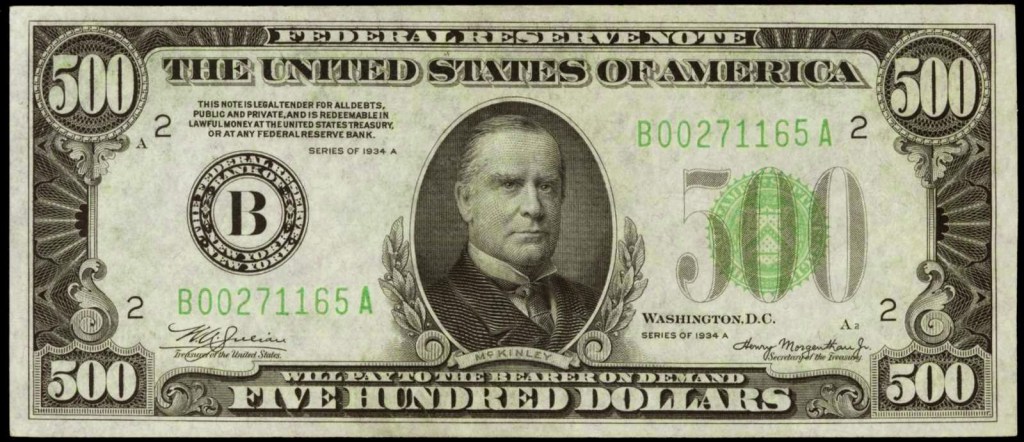
Like many presidents, McKinley has his share of memorials, including replacing Lincoln on the $500 bill.
What else can I tell you…um…well, we still film presidential inaugurations, so that’s a cool thing.
Listen to This: McKinley’s opponent during both of his campaigns was former Congressman William Jennings Bryan. McKinley won both elections, but Bryan had The Speech. Bryan’s “Cross of Gold” speech at the 1896 Democratic Convention is still the benchmark for election speeches. Bryan supported the new Silver Standard to replace the Gold Standard and ended his oration by saying Americans would not be crucified “upon a cross of gold”. The Silver Standard never caught on, but boy did he sound great talking about it. While the original speech was not recorded, Bryan did record some excerpts in 1921, just a few years before the other event that keeps him relevant; The Scopes Monkey Trial. Also included is an essay by Professor Robert Cherny from my alma mater, SFSU.
Written by Jay Dratler and Samuel Hoffenstein and Elizabeth Reinhardt. Based on the novel by Vera Caspary.
Class of 1999
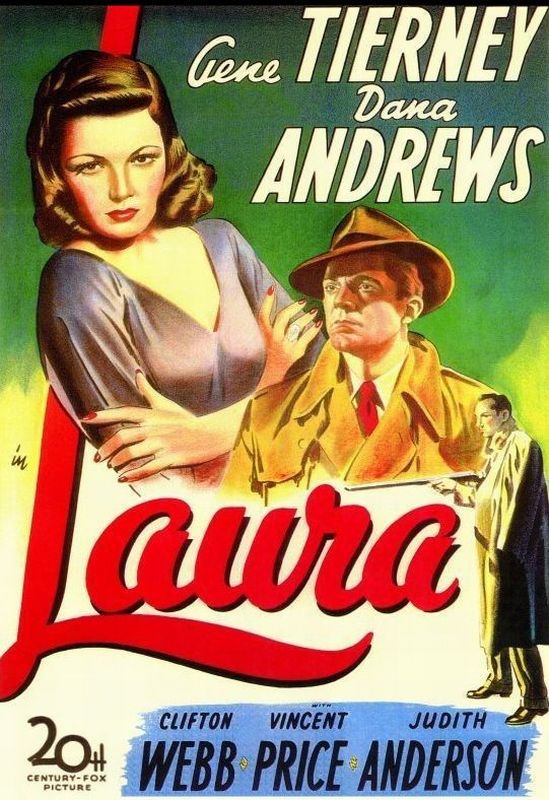
The Plot: Business executive Laura Hunt (Gene Tierney) is murdered and Det. McPherson (Dana Andrews) is brought in to investigate. Among the suspects are her charming fiancé Shelby Carpenter (Vincent Price), her mentor/famous columnist Waldo Lydecker (Clifton Webb), and her socialite Aunt Ann Treadwell (Judith Anderson). As the clues pile up and stories are changed, McPherson finds himself falling for the deceased Laura.
Why It Matters: The NFR calls it “[l]ess a crime film than a study in obsession” and praises Preminger’s direction, as well as the score and cinematography.
But Does It Really?: “Laura” still packs quite the punch over 70 years later. Its style is prime noir and the whole cast plays it in the most wonderfully suspenseful way. At no point are you ever completely sure who killed Laura, and the twists just keep coming. Anyone trying to craft the perfect murder mystery needs look no further than “Laura”.
Everybody Gets One: Title character Gene Tierney**, as well as Clifton Webb and two of the three screenwriters.
Wow, That’s Dated: ‘40s terminology like “dames” and “dolls”, cars with suicide doors, newspaper columnists with any sort of major clout or influence.
Seriously, Oscars?: “Laura” received five Oscar nominations, and took home one for Joseph LaShelle’s black-and-white cinematography. Preminger, Webb and the screenwriters all lost to that year’s feel-good big winner “Going My Way”. “Laura” wasn’t nominated for Best Picture, perhaps to make way for that other, more famous 1944 noir film. More surprisingly, David Raksin was not nominated for film noir’s most iconic score. And this was back when Best Score had 20 nominees. Come on!
Other notes
This film stars a man named Dana and a woman named Gene.
McPherson’s handheld puzzle game; the Fidget Spinner of 1944.
Perhaps the greatest joy of watching this film is seeing young Vincent Price in one of his early films. This film’s second biggest mystery is Vincent’s disappearing/reappearing southern accent.
Like so many of the New York elite, Waldo dines at the Algonquin. Do you think he knows Benchley?
As is often the case with the great film noir mysteries, so much is conveyed through action and reactions rather than dialogue. And everyone plays it so close to the chest it creates wonderful tension.
Shelby briefly mentions hearing Laura’s “mules” across the room. Mule in this case being an old term for slippers. Though the alternative is a fun visual as well.
After making a career playing characters like Bessie the maid, Dorothy Adams must have been pissed when Thelma Ritter came along.
She doesn’t get much to do, but Gene Tierney has more sex appeal in just a few shots than most actors do in whole films.
If the murder described throughout the film was actually that gruesome, then my kudos to the unseen cleanup crew. That apartment is spotless.
Waldo quotes Ernest Dowson’s “Vitae Summa Brevis”, which is where we get the phrase “days of wine and roses”.
And as always, buy your War Bonds at this theater!
Legacy
The film has been remade a few times. In 1955, “Laura” was condensed to an hour-long episode of “The 20th Century-Fox Hour” starring Robert Stack, Dana Wynter, and a well-cast George Sanders as Lydecker.
The Germans took a shot at “Laura” (poor choice of words) for television in 1962.
The last remake of “Laura” was in 1968, adapted by Truman Capote and starring Lee (younger sister of Jackie) Bouvier. Seeing as how Lee’s acting career never took off, it’s safe to say this version is not very good.
Following the popularity of the score, Johnny Mercer wrote lyrics to the “Laura” theme (despite not having seen the film) and created a jazz standard.
Further Viewing: Gene Tierney followed-up “Laura” with “Leave Her to Heaven”, the rare color film noir. Tierney’s femme fatale performance gives her more range to play than her more iconic work in “Laura”, and she received her only Oscar nomination.
** 2018 Update: Gene Tierney now appears on the list in “Leave Her to Heaven”. Hey, that’s this post’s Further Viewing! Who knew I could be so prescient?

 The Horse's Head