OR “Oooo Eeee Oooo Steve Looks Just Like Buddy Holly”
Directed & Written by Quentin Tarantino. Story by Tarantino and Roger Avary.
Class of 2013
The Original Trailer, which tries its best to clean up the language.
The Plot: A classic pulp magazine on film, “Pulp Fiction” is the interwoven stories of seedy lowlife in 1990s L.A. Among them are two hit men, Vincent & Jules (John Travolta & Samuel L. Jackson). Vincent has an unexpectedly eventful night when he has to take the boss’ wife (Uma Thurman) to dinner, and Jules experiences an epiphany while witnessing a robbery at a diner. Meanwhile (or before, or later) a prizefighter named Butch (Bruce Willis) makes a deal with crime lord Marsellus Wallace (Ving Rhames) and loses his family’s valuable watch. All this, plus at least two Arquettes.
Why It Matters: The NFR calls it, “one of the few films on the National Film Registry as notable for its lasting impact on the film industry as its considerable artistic merits.” The essay by film critic Jami Bernard echoes these sentiments, and also uses the phrase “pissing contests” in a complimentary way.
But Does It Really?: I’m gonna get this over with; I enjoy this movie a lot. It deserves to be here. It’s a movie I have to watch every year or two and just have a good time. But does that mean I think Tarantino’s a genius? No. I think he’s a great writer and a great lover of film whose work has been embraced (maybe a little too fanatically) around the world. But good acting helps good writing, and everyone in this movie relishes the opportunity to speak good dialogue. The film is uniquely stylized and is an instant classic, but to quote The Wolf, “let’s not start sucking each other’s dicks quite yet.”
Everybody Gets One: Among the big names in this film making their only NFR appearance are Uma Thurman, Amanda Plummer, Tim Roth, and Bruce Willis (Though I suspect Willis has at least two movies that will show up eventually**). Noteworthy in the featured cast are Phil “Hermes” LaMarr, Julia “It’s Pat” Sweeney, and Kathy “Kathy Griffin” Griffin. Also starring Stephen Hibbert as “The Gimp”.
Wow, That’s Dated: Cellular phones the size of your head, and the ability to smoke indoors in California. Plus that woman who Marsellus accidentally shoots could not be dressed more like 1994.
Seriously, Oscars?: The little indie film that could, “Pulp Fiction” ended up with seven Oscar nominations, including Best Picture. But in a year dominated by big studio-backed “Forrest Gump”, the film only took home one prize; Best Original Screenplay for Tarantino and Avary. Samuel L. Jackson’s loss in the Best Supporting Actor category gave us one of the great nominee reactions ever.
Other notes
Never, ever, under any circumstances, watch this movie on basic cable.
Geez, less than four minutes in and Tarantino has used more ethnic slurs than your average ‘40s film.
I would love to have seen the woman who Jules is dating.
What’s in the briefcase? Who cares?
Samuel L. Jackson is clearly enjoying every minute of this film, and we all benefit from it.
Don’t be a…rectangle?
What exactly about it makes it a “Douglas Sirk steak”? Is it melodramatic? Does Todd Haynes eat it?
Of all the casting “what-ifs” posed on the internet, the one that intrigues me the most is Alfre Woodard as Mia Wallace. I would love to have seen that.
“Girl, You’ll Be a Woman Soon” is performed of course by…Urge Overkill? What, did Neil Diamond want too much for his version? This is why we can’t have nice things!
I’m not his biggest fan, but I must admit John Travolta is damn good in this film.
The little detail I noticed this go-round with the film is Trudi, as played by Bronagh Gallagher, just sitting on the couch with her bong while Mia’s life is at stake. Hilarious.
Christopher Walken as Captain Koons is the reason the Oscars should have a “Best Cameo” category. In a limited amount of screen time he fully captures the spirit of this film. This is also just before Walken became a caricature of himself.
Butch has my favorite never-quoted line in the film; “We’re American, honey, our names don’t mean shit.”
For what it’s worth, “The Watch” is my least favorite of the film’s segments. It’s the most removed from the other segments (this is Roger Avary’s primary contribution to the screenplay), and it moves at a slower pace. There’s the conversation with Butch and the cab driver, then him and Fabienne, then another conversation between them the next morning, and THEN we finally get to the missing watch. We’re too far into the film to slow things down like that.
Zed kinda looks like Daniel Day-Lewis. Oh, but what if it IS Daniel Day-Lewis? Such range.
I respect Quentin Tarantino as a writer and director, not so much as an actor.
If only Jules and Vincent had waited a year, then they could have seen “Babe”, the most charming pig of them all!
Legacy
Every indie movie since 1994. Seriously, every damn one. Just Google it, I’m tired.
John Travolta: Act II.
Samuel L. Jackson’s entire film persona.
Confused Travolta!
Not only did Uma Thurman’s Oscar nomination thrust her into movie-stardom, but she got to meet Oprah too!
That point in the ‘90s when the ‘70s came back.
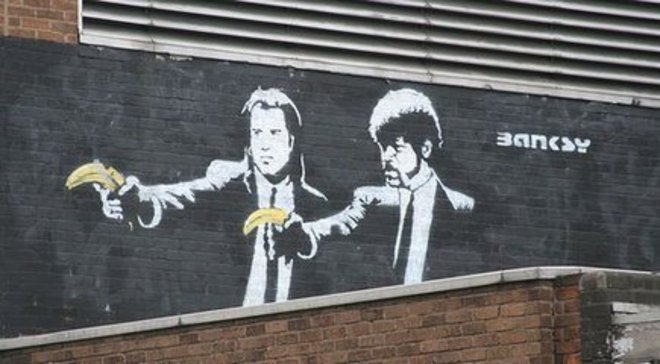
This Banksy mural;
Countless parodies, but we’ll focus on this one from the 1995 MTV Movie Awards that gave the other Sweathogs a chance to shine.
What happened next? Well in Hollywood they say, that Tarantino’s small ego grew three sizes that day.
Listen to This: Another fantastic film soundtrack, one song from “Pulp Fiction” has made it onto the National Recording Registry: Al Green’s “Let’s Stay Together”. You could listen to it while staring at Ving Rhames’ neck band-aid, or while getting next to that special someone. The point is, “Let’s Stay Together” is awesome.
** 2017 Update: And one those movies just showed up: “Die Hard“.
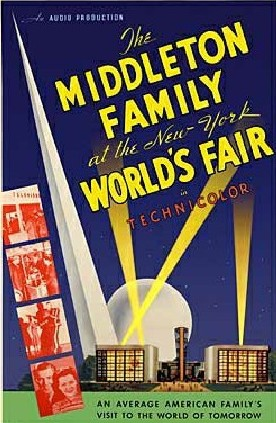
The Plot: The Middletons come to New York to see the goings-on at the 1939 World’s Fair, though mainly just the exhibits at the Westinghouse pavilion. Along the way they see modern marvels like an automatic dishwasher, a robot named Elektro, and a new thing called television. But all of this takes a backseat to steamy romantic intrigue when daughter Babs (Marjorie Lord) is torn between Westinghouse worker/Capitalist mouthpiece Jim (Douglas Stark) and her art teacher/Marx-loving dirty Commie boyfriend Nick (George J. Lewis). Also around is her little brother Bud (Jimmy Lydon) who’s just a complete pain in the ass.
Why It Matters: The NFR calls it “[b]oth charming and heavy-handed” and cites the historical document of the fair’s exhibits as well as “the heartland values of the age”. These thoughts are echoed in an essay by San Jose State Professor Andrew F. Wood.
But Does It Really?: I think Westinghouse went a little too far with this one. You want to document your time at the World’s Fair? Go ahead, we’re happy to see it. But do you really have to throw in a convoluted love story too? The whole film lays it on really thick; Technology is progress and anything else is pure Communism. Those of you who are not big fans of Capitalism these days may want to skip this one. If you’re willing to take a deep breath and just accept this film’s very optimistic view of industry, you might enjoy yourself. As a peek at the 1939 World’s Fair, I give it a pass. As entertainment – or heck, even as a Westinghouse commercial – it’s a bit much.
Shout Outs: Quick mention of how stuff like Frankenstein’s Monster is “only in the movies”.
Everybody Gets One: Marjorie Lord would go on to TV fame as Wife #2 on “Make Room for Daddy”. Jimmy Lydon played Henry Aldrich in a series of films in the ‘40s and as of this writing is the only cast member who is still alive. Special mention to Harry Shannon (Father), who would go on to play Kane’s father in “Citizen Kane”, and Georgette Harvey (Elvira), who was in the original Broadway cast of “Porgy and Bess”.
Wow, That’s Dated: I mean, the whole thing really. I’ll mention some more along the way, but for now let’s settle on Barney Google being in the Westinghouse Time Capsule alongside Mickey Mouse and Dick Tracy (A Note to Readers in the Year 6939; no one knows who Barney Google is back now).
Seriously, Oscars?: How this thing didn’t get a nomination in any category is beyond me.
Other notes
I want to beat the crap out of Bud.
Geez Dad, stop being such a creep towards your daughter. Who are you, the President?
I got a feeling the dishwashing competition was fixed in favor of Mrs. Modern. But to their credit, both she and Mrs. Drudge do the whole thing in heels.
So there’s the main plotline about the family visiting the fair, the love triangle, Bud being persuaded to like Westinghouse, Bud entering the letter contest, Grandma’s little soliloquy…. For Pete’s sake “Short Cuts” had less plotlines than this film.
Grandma loves what electrical engineers did for housewives; “They signed our Emancipation Proclamation.” All I can say is [Deep exhale].
I’m glad that when Westinghouse made its first robot the first thing they taught him was how to smoke a cigarette.
No information I can find can confirm this, but I’m pretty confident the same actor who was the lead in “A Case of Spring Fever” plays the salesman towards the end of this film. He is uncredited in both films. Anyone know the guy’s name?
Speaking of which, I would love to see what the folks at “Mystery Science Theater 3000” would make of all this.
Yes, the future does look bright for technology and job opportunities. Hope there isn’t a war anytime soon.
Legacy
The 1939 New York World’s Fair was so successful they did another one 25 years later. It was the Woodstock ’94 of its day.
Knoxville! Knoxville! Knoxville!
Television would become a big hit after the World’s Fair, but let’s focus on its greatest impact; game show bloopers.
Thanks to the universal success of this film, Communism was never heard from again.
Elmer “Bud” Middleton: Killed in Korea, 1952.
Elektro would later appear as Thinko in the 1960 film “Sex Kittens Go to College”. That’s not a joke – that actually happened.
And of course, the Time Capsule would lead to Earth rediscovering Barney Google in the year A.D. 6939, and adopting his adventures with Snuffy Smith as scripture. Praise be to Barney Google!
Further Viewing: This newsreel shows off the non-Westinghouse parts of the World’s Fair, including something called “Futurama”.
Written by Barré Lyndon. Based on the novel by H.G. Wells.
Class of 2011
See the trailer two years in the making!
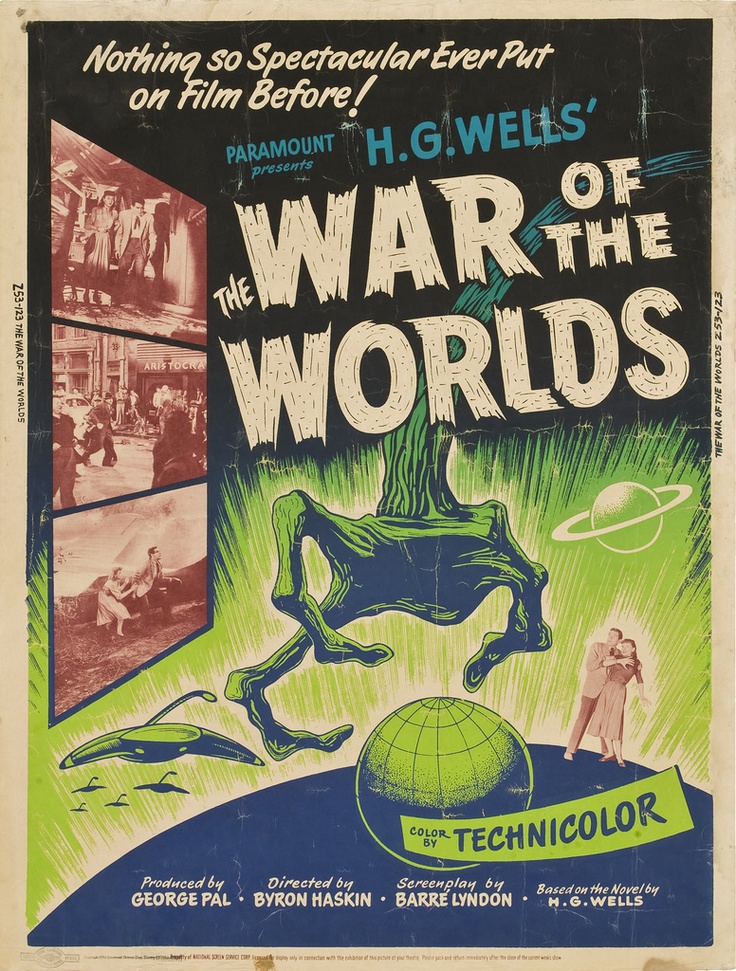
The Plot: A large object crashes near a small town in southern California, and Dr. Clayton Forrester (Gene Barry) investigates. The object begins emitting alien spacecrafts, which then proceed to destroy everything in their path. On the run with townsperson/love interest/only woman Sylvia Van Buren (Ann Robinson), their only hope is that the government’s nuclear bombs will stop the Martians.
Why It Matters: The NFR praises the film’s special effects (calling them, among other things, “hackle-raising”) and singles out the film’s capitalization of “the apocalyptic paranoia of the atomic age”.
But Does It Really?: If it were just a highlight reel of the effects, sure. This film, while not awful, is not that great either. Maybe it’s because I’m watching this relatively soon after “The Day the Earth Stood Still”, but “The War of the Worlds” is lacking a lot of that film’s substance. In the span of two years sci-fi went from “We come in peace” to “RUN FOR YOUR LIVES!” This would have all been fine if it weren’t for this film’s very Christian ending. Most films end an alien encounter with ray guns or effective communication. This one ends with the power of prayer and some very good timing. A noteworthy film to be sure, but compared to others of the genre, not the first one I’d preserve.
Everybody Gets One: Both Gene Barry and Ann Robinson would find later success on television; Barry on “Burke’s Law”, Robinson on “Fury”. Barry would also achieve later notoriety in the original Broadway cast of “La Cage aux Folles”. This movie also features a rare on-screen appearance by legendary voice actor Paul Frees.
Wow, That’s Dated: Despite the growing popularity of television, radio is still the only way to get news around here. Also this film reeks of Cold War paranoia, but you knew that already.
Seriously, Oscars?: The film won the Oscar for Visual Effects and was nominated for its editing and its sound. That’s about all I’d give it, too.
Other notes
Obviously, since the source novel was written in 1897, this film version takes a few liberties. To quote MST3K’s take on another H.G. Wells adaptation; “Based on? Oh, in that they’re both in English.”
According to the credits, Sir Cedric Hardwicke isn’t doing the narration; he’s doing the “commentary”. Huh?
Early on it’s mentioned that the crash site would make a good roadside attraction, like “a lion farm”. Apparently that used to be an actual thing.
This film has the old “talking to a stranger about an important person and then realizing the stranger IS the important person” cliché. It’s Clayton and Sylvia’s meet cute.
Square dancing! That’s what the original novel was missing!
Forrester’s pronunciation of “gyroscopic” (with a hard g sound) is incorrect. Some scientist he is.
I’m just gonna go ahead and ignore the countless wires holding up all the Martian ships.
Whoa, slam on Hinduism for no good reason! I do not like this film’s pushy religious views at all.
How is traffic on L.A.’s freeways less packed during an alien evacuation than during a typical rush hour?
The “bacteria ex machina” in this film comes directly from the original novel. The divine intervention part definitely does not.
Legacy
“The War of the Worlds” has been remade several times over the years, most notably in 2005 by Steven Spielberg of all people.
The 1953 version spawned a TV series follow-up in 1988. Ann Robinson showed up in that one, too!
This film’s Dr. Clayton Forrester was the namesake of MST3K’s Dr. Clayton Forrester.
Speaking of, if “The War of the Worlds” and “The Day the Earth Stood Still” had a baby it’d be called “This Island Earth”.
Based on the success of this film, producer George Pal got permission from the H.G. Wells estate to adapt another of his stories. Pal chose “The Time Machine”.
For you Trekkies out there; the sound effects used for hand phasers and photon torpedoes on the original series came from the Martian ships in “The War of the Worlds”.
Bonus Clip: It was during promotion of the 2005 remake that Tom Cruise did this:
Listen to This: 15 years prior to this film, “War of the Worlds” was adapted by Howard E. Koch for the radio program “The Mercury Theatre on the Air”. It was directed by a 23 year old wunderkind named Orson Welles and, depending on who you believe, scared the bejesus out of the country. The National Recording Registry included this broadcast as one of its original 50 recordings in 2002. You can learn more in this essay for the NRR by telecommunications expert Christopher Sterling.
The Plot: It’s 1972 and there’s a break-in at Washington D.C.’s Watergate complex. Rookie Washington Post reporter Bob Woodward (Robert Redford) is sent to investigate, and learns that a few of those convicted have CIA connections. Under the guidance and support of editor Ben Bradlee (Jason Robards), Woodward is paired up with fellow reporter Carl Bernstein (Dustin Hoffman) and the two continue their research. What they find may be the biggest scandal of the 20th century, as well as the reason why we now have to add the suffix “-gate” to any political controversy.
Why It Matters: The NFR praises Pakula’s “taut directing” and calls the film “a rare example of a best-selling book transformed into a hit film and a cultural phenomenon in its own right”.
But Does It Really?: Oh yes. Not only is it a great representation of ‘70s politics during the actual decade, but it is also a surprisingly suspenseful film. It’s a lot of talking and a lot of dry politics (plus it’s a story that everyone knows the ending to), but between Pakula, Goldman, and cinematographer Gordon Willis, the film keeps you at attention trying to figure out just how Woodward and Bernstein pulled this all off. A great reminder that the truth is a very powerful thing, and no one – NO ONE – is immune to it.
Everybody Gets One: This is the only appearance on the Registry for future Oscar nominees Hal Holbrook & Jane Alexander, future Oscar winner F. Murray Abraham, TV stars Meredith “Mrs. Keaton” Baxter, Polly “Flo” Holliday & Dominic “Junior” Chianese, stage actors Penny Fuller & John McMartin, former actor/current scumbag Stephen Collins, and Watergate security guard Frank Wills (For real, that’s the actual Watergate security guard playing himself).
Wow, That’s Dated: Well, journalism as a high-profile, respected profession, am I right folks? But seriously, there are the usual things like rotary/pay-phones. But I think the most impressive dated part of this is all the research they had to do without the aid of the Internet. Which is a shame because I found this Wikipedia page that would have saved them a lot of time.
Seriously, Oscars?: In a very competitive year that included “Taxi Driver”, “Network” and “Rocky”, “All the President’s Men” was nominated for eight Oscars and won four; Adapted Screenplay for Goldman, Supporting Actor for Jason Robards (a perfectly fine performance from someone who didn’t make a lot of films), Art Direction (I presume for its detailed recreation of the Washington Post office), and Sound (For essentially the first and last 30 seconds of the film). Despite nominating Robards and Jane Alexander (for a performance that clocks in at around 5 minutes), the Academy failed to nominate either Redford or Hoffman. In addition, the Oscars continued their proud tradition of snubbing Gordon Willis.
Other notes
That has got to be one of the best opening shots in any movie. Now that’s how you start a film!
How did Martin Balsam get the credit “Special Appearance by”? And why are so many actors listed in the credits as “Guest Stars”? This ain’t “The Love Boat” for crying out loud!
Bob Woodward wishes he were that handsome in real life.
Seeing as how this is a blog about the National Film Registry, I feel obligated to mention that a scene in this film takes place at the actual Library of Congress.
This film features a mini-reunion of 2 Angry Men: Jurors #1 & #7 (Martin Balsam & Jack Warden, respectively). Also, Balsam co-starred with Jason Robards in one of my favorite movies; 1965’s “A Thousand Clowns”. It seems like every time these two got together, one of them won an Oscar.
I appreciate that this film does not give a crap about either Woodward or Bernstein’s personal lives. Pakula and Goldman (as well as Redford and Hoffman) recognize that this story is much bigger than any of them.
A scene was written but not included in the final cut in which Washington Post publisher Katharine Graham questions Woodward. The story goes that for this one scene they tried to get such heavy-hitters as Lauren Bacall, Patricia Neal, and Geraldine Page to play Ms. Graham. I wonder what happened?
Side-note; the potential casting of Lauren Bacall as Katharine Graham intrigues me because she had been divorced from Jason Robards for about 6 years at this point in time. Layers upon layers that never were.
Did you know that Richard Nixon delivered his famous “I’m not a crook” speech at the Contemporary Resort at Walt Disney World? It’s not directly connected to this film, but it’s a weird fact that I feel bears repeating.
Legacy
Hmmm…. journalists trying to take down a corrupt president. Something seems…nope, there’s nothing wrong here.
This film gave us the phrase “Follow the money” (something the real Deep Throat never actually said), as well as mainstreaming the phrases “non-denial denial” and the ever-popular “ratfucking”.
Woodward and Bernstein’s follow-up book, “The Final Days”; essentially the post-Watergate events from Nixon’s point of view. The book was eventually turned into a TV movie starring the always-dependable Lane Smith.
The 1999 film “Dick”; which suggests that Nixon was actually taken down by Kirsten Dunst and pre-fame Michelle Williams.
Hal Holbrook’s critically acclaimed solo show “Deep Throat Tonight!”
Chris Carter has said that this film was a major influence on that there “X-File” show.
Best Picture Oscar Winner “Spotlight”, which features Ben Bradlee’s son as a major character and definitely emphasized the “All the President’s Men” parallels during its Oscar campaign.
Further Viewing: “All the President’s Men Revisited”; a documentary on Watergate 40 years after the fact, with some observations from Redford and Hoffman about the film. Stay tuned towards the end to see Ben Stein cry.



 #23) The War of the Worlds (1953)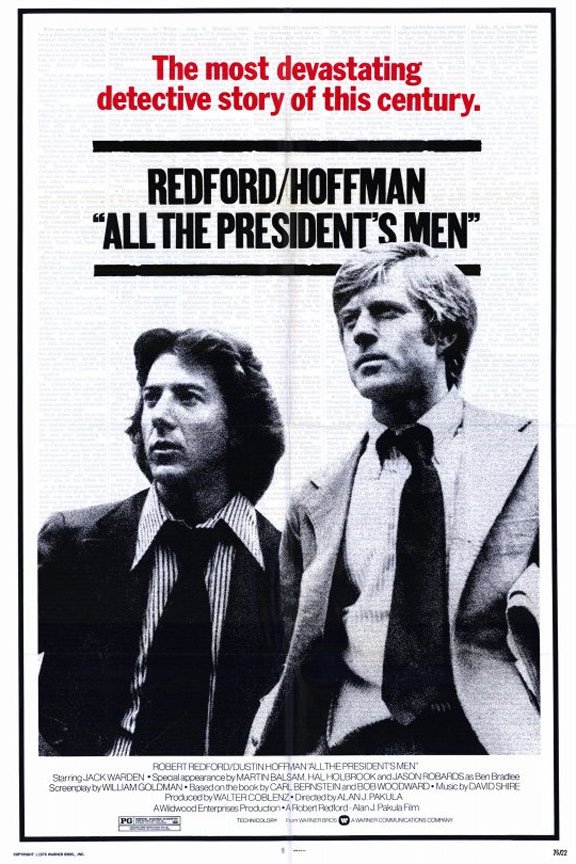
 The Horse's Head