#571) Destry Rides Again (1939)

#571) Destry Rides Again

OR “…But I Did Not Shoot the Deputy”

Directed by George Marshall

Written by Felix Jackson & Gertrude Purcell & Henry Myers. Suggested by the novel by Max Brand.

Class of 1996

The Plot: When the Sheriff of Bottleneck (Joe King) mysteriously “leaves town”, town drunk Wash Dimsdale (Charles Winninger) is appointed the new sheriff, a tactic to keep corrupt saloon owner Kent (Brian Donlevy) in business. Wash sends for Tom Destry, the town’s former sheriff, to appoint him as his new deputy and help clean up Bottleneck. When Destry arrives, it’s actually his son Tom Jr. (James Stewart), a quiet man who believes in non-violence. The town is immediately dismissive of this new civility, but Tom proves them all wrong with his strong convictions and skilled gunmanship. Oh, and Marlene Dietrich is there as Frenchy the saloon girl.

Why It Matters: Weirdly, the NFR write-up doesn’t give any superlatives or explain why “Destry” is on the list. It gives the plot, mentions this film within the context of Stewart and Dietrich’s careers, and cites the many other iterations of this story.

But Does It Really?: I’ll chalk this one up to a “minor classic”. “Destry Rides Again” is a quick, enjoyable film that gets lost in the shuffle of classic westerns (and other 1939 movies). That being said, “Destry” holds up remarkably well (especially in comparison to the other, more problematic westerns on this list), with strong performances from Stewart and Dietrich, and a surprising humorous streak. “Destry” is an underrated gem that I hope keeps getting rediscovered alongside its fellow NFR entries.

Wow, That’s Dated: Mostly the sexism that shows up in these types of movies, like the scene where Destry tells Frenchy she’d be prettier if she didn’t wear makeup. Great, now I got that Amy Schumer song stuck in my head.

Title Track: Wash assures the townspeople that when his new deputy comes to town, “Destry will ride again.”

Judges?

….Ooh, sorry, but we’re looking for an exact match.

Seriously, Oscars?: Like many of the 1939 greats, “Destry Rides Again” was shut out at the Oscars. Two of its main cast, however, did receive nominations for other films that year: Brian Donlevy for Supporting Actor in “Beau Geste”, and James Stewart for Lead Actor in “Mr. Smith Goes to Washington“.

Other notes

  • The original novel of “Destry Rides Again” (and its 1932 film version with Tom Mix) is about cowboy Harrison Destry seeking vengeance on those who framed him for a robbery. Obviously, the film took a different route, hence the “Suggested by” designation in the opening credits. And despite the title, this is not a sequel to anything.
  • Marlene Dietrich’s career had hit a slump when “Destry” came her way, having been labeled “Box Office Poison” a few years earlier. She wasn’t sure about playing Frenchy, but was encouraged by her longtime collaborator Josef von Sternberg, who allegedly told her, “I made you into a goddess. Now show them you have feet of clay.” If nothing else, Dietrich does more emoting in one scene of “Destry” than she does in all of “Morocco“.
  • This movie is filled with character actors I’ve started to recognize on sight thanks to this blog: Billy Gilbert, Una Merkel, Mischa Auer, Dickie Jones. Also popping up here is Lillian Yarbo, a sensation in the Harlem nightclub scene of the 1920s, but like many a Black performer of the time, seen here as the stereotypical help/comic relief. 
  • Dietrich sings three songs in this movie, but not “I’m Tired”? Come on!
  • My favorite line may not be one from the movie: In a scene where Frenchy is sticking money into her bra, she originally patted her chest and said, “There’s gold in them thar hills”. The Hays Code made Universal delete the line.
  • James Stewart was a rising talent in 1939, his breakout in “Mr. Smith” finished but not yet released when he made “Destry”. Stewart landed the role of Tom Destry when Gary Cooper and Joel McCrea turned it down. This is one of Stewart’s more unsung performances, and it’s fun watching an actor who is clearly ready for his breakout role.
  • One of my notes reads “Hey, this one’s fun.” After a run of NFR westerns that are either heavy on action, philosophy, or racial insensitivity, it’s a relief to watch a western with a sense of humor. I laughed out loud quite a bit during my viewing.
  • This is the movie where Marlene Dietrich gets into a catfight with Una Merkel. According to Merkel, as well as Dietrich’s grandson Peter Riva, the two actors did the entire fight themselves without calling in their doubles. The fight was allegedly unrehearsed and filmed in one take. You gotta admire anyone who does their own stunts.
  • Charles Winninger is giving me older Mickey Rooney vibes; he overplays everything but it’s more endearing than annoying. And the dynamic of the comic sheriff and his straight-laced deputy is what we call a “Reverse-Andy Griffith”.
  • I’m enjoying the running gag of Tom constantly telling stories about friends he knows. It’s somewhere between Gabe Kaplan’s family stories on “Welcome Back, Kotter” and Betty White’s St. Olaf run on “The Golden Girls”.
  • “The Boys in the Backroom” is the best remembered of Frenchy’s song, though it’s not that different from her other saloon numbers. Side note: All the songs in this movie were co-written by Frank Loesser, future composer of “Guys and Dolls” and “How to Succeed in Business…”.
  • At one point Frenchy mentions going back to New Orleans. Back? She must be from the same part of Louisiana as Yul Brynner in “The Magnificent Seven“.
  • Watching the climactic fight with hundreds of people in a crowded saloon, I have to say: I’m really going to miss social distancing.
  • [Spoilers] The ending seems tough on Frenchy, but then I remembered the Hays Code, and knew that she had to be punished for her role as co-conspirator. I will point out, however, that Tom thinks of Frenchy in the epilogue when he hears children singing “Little Joe, the Wrangler”…a song Frenchy sang about 15 minutes before Tom showed up in this movie.
  • This is one of the rare classic movies that does something creative with its closing credits. The last shot is Tom telling another story about a friend of his, with the cast list scrolling past him as he keeps talking. It’s hilarious.

Legacy

  • “Destry Rides Again” did okay with audiences and critics, not helped by the fact that the film was released a week after “Gone with the Wind“. Luckily, “Destry” is one of many films that got rediscovered through TV reruns.
  • Although Jimmy Stewart is often associated with his many westerns, “Destry” was his first, and he would not return to the genre until 1950’s “Winchester ’73“.
  • There are two kinds of remakes of “Destry Rides Again”: the ones that follow the novel’s plot, and the ones that follow the movie’s plot. The former is represented by a TV series starring John Gavin that came and went in the spring of 1964.
  • Retellings that favor the movie include “Destry”, a 1954 almost shot-for-shot remake directed once again by George Marshall, and a Broadway musical starring Andy Griffith. Hmmm…Griffith as the town sheriff. Interesting…
  • “The Boys in the Backroom” became a staple for Marlene Dietrich, who performed the song at various USO tours and nightclubs over the years. The song is also a favorite of Dietrich impersonators. 
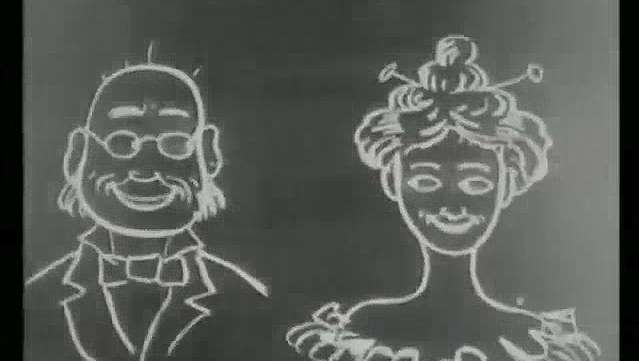
June 2021 Poll: Animation, cuz why not?

The results are in and the bonus June post will be…

… “All the President’s Men“!

The last time I covered this film was in 2017 when, let’s say there were certain parallels that attracted me to this film at the time. I’m curious to see what watching this movie is like in a post-that one guy America. Stay tuned.

Now on to the June poll: You know what I haven’t covered yet in my revision series? Any animation. Here’s a few of my favorite bits of animation that’s in need of a rewrite. But which one to choose?

Let me know your choice, and I’ll announce the winner on July 1st!

#28) Rushmore (1998)

#28) Rushmore (1998)

OR “Wunderkind Powers, Activate!”

Directed by Wes Anderson

Written by Anderson & Owen Wilson

Class of 2016

This is a revised and updated version of my original “Rushmore” post, which you can read here.

The Plot: At Houston’s prestigious Rushmore Academy, Max Fischer (Jason Schwartzman) is an overachiever in every extracurricular activity from fencing to beekeeping, but is failing his actual classes. Max unexpectedly bonds with Herman Blume (Bill Murray), a local industrialist whose two sons also go to Rushmore. Around the same time, Max meets Rosemary Cross (Olivia Williams) the school’s first grade teacher, and develops an intense crush on her. Over the next few months, Max is expelled from school, and finds himself in a bizarre (and unrequited) love triangle with Rosemary and Herman. All of this told through the symmetrical, saturated lens of a young Wes Anderson.

Why It Matters: The NFR calls the film “a cultural milestone of Gen X and millennials”, praising Wes Anderson’s “incisive detail to pop sensitivities” (which means…?). There’s also a quote from Anderson and Owen Wilson about the film’s “slightly heightened reality, like a Roald Dahl children’s book.”

But Does It Really?: Oh sure. In the last 25 years Wes Anderson has become one of the few American directors whose name is as much an audience draw as his biggest stars. “Bottle Rocket” would have been a good choice for NFR induction, but “Rushmore” is the first one that really feels like a “Wes Anderson movie”: the wonderfully framed cinematography, the detailed props and costumes, the appearances of Schwartzman and Murray. I’m glad the NFR found a spot for Wes Anderson, and “Rushmore” is a marvelous representation of his filmography.

Shout Outs: Wes Anderson has cited (among other movies) “The Graduate“, and “Harold and Maude” as influences on “Rushmore”. I get it: the former with its isolated young protagonist and an extended shot in a swimming pool, the latter with its age-gap relationship and Cat Stevens needle-drops. Also, “Apocalypse Now” is one of several Vietnam War movies paid homage to in Max’s play “Heaven and Hell”.

Everybody Gets One: Perhaps the least stereotypically Texan person to come out of Houston, Wes Anderson started making movies as a child with his dad’s 8mm camera. While attending University of Texas at Austin, he met fellow student Owen Wilson, and the two collaborated on a script about their prep school days (Anderson attended St. John’s in Houston, Wilson at St. Mark’s in Dallas). The “Rushmore” script sat on the back-burner while they focused on “Bottle Rocket”. Once that film was completed, the two returned to “Rushmore”.

Wow, That’s Dated: The usual late ’90s staples: cassettes, checks, giant desktop computers, smoking in public places. Though the biggest dated aspect is the idea that the romantic obsession a 15 year old has for an adult could be played for laughs.

Seriously, Oscars?: “Rushmore” was originally intended for a spring 1999 release, but Touchstone Pictures was so impressed with the film they bumped up the release date to qualify for the 1998 Oscars. Despite a slew of critics awards (and two wins at the Independent Spirit Awards), “Rushmore” received zero Oscar nominations. Although his subsequent films have been recognized by the Academy, and Anderson has received seven personal nominations, the Oscars have yet to hand a trophy to the man himself.

Other notes

  • This movie is Wes Anderson from frame one. Any other movie would just have their establishing text added to the lower third in post-production, but “Rushmore” has it projected onto a stage curtain.
  • This is Jason Schwartzman’s film debut! Unsurprising for someone in the Coppola/Shire/Schwartzman/Cage gene pool, he hits it out of the park. Every detail about his characterization is perfect; the costume, the physicality. You learn so much about Max even before he says his first line.
  • Brian Cox: Because Albert Finney costs how much!?
  • Anderson and Wilson wanted Bill Murray to play Herman Blume, but were convinced their script would never get to him. Luckily, Murray’s agent was a big fan of “Bottle Rocket”, and Murray loved the script so much he offered to do the film for scale. What makes Bill Murray work within the universe of “Rushmore” is that he adapts his talents to support the movie, and not the other way around.
  • I do love Seymour Cassel in this movie, he’s such a sweetheart as Max’s supportive dad. A total 180 from his other NFR appearance, the carefree playboy in “Faces“.
  • “Diving for Sunken Treasures” by Jacques Costeau? File that one away for later, Anderson.
  • Still the best line in the movie: “In summation, I have one question: Is Latin dead?”
  • That is, of course, Luke Wilson, Owen’s younger brother and fellow future movie star, as Dr. Peter Flynn. Watching Max become increasingly jealous of Peter is a highlight.
  • This movie could easily have been people sitting around talking, but Anderson and his team do a masterful job of making the dialogue scenes visually exciting. There’s a lot of movement, and wonderful usage of location shooting (Max and Herman’s scene at the factory comes to mind). Equally impressive, Anderson knows when to reign it in for the more intimate conversations.
  • Oh yeah, I forgot Alexis Bledel is in this. A Houston native, Bledel is one of the student extras at Grover Cleveland High, and was about two years away from her breakout role as Rory Gilmore.
  • Shoutout to Mason Gamble as Max’s sidekick Dirk Calloway. Only upon doing research for this post did I realize Gamble was also Dennis the Menace in the 1993 film version with Walter Matthau. That story again: Jane Fonda: 0 NFR movies, Kid from “Dennis the Menace”: 1.
  • This movie has one of my favorite tropes: the second act “everyone is sad” montage.
  • Alright, another “Die Hard” Not-Christmas movie, complete with Vince Guaraldi!
  • “Rushmore” benefits from something a lot of these NFR movies have in common: super charming lead actors distracting you from how awful everyone is. Schwartzman, Murray, and Williams are all so charismatic in their performances, you forget that their characters are all kind of the worst.
  • In the four years since my last “Rushmore” post I have gotten “Oh Yoko!” stuck in my head at least once a month. In fact, kudos to everyone who put together this soundtrack. “Rushmore” is a prime example of why there should be an Oscar category for compilation scores. Repurposing pre-existing material is as much an art form as creating an original composition.
  • Ah yes, that point in the late ’90s when we could start using the Vietnam War for comedic purposes. Not necessarily making fun of the war or its veterans, but rather poking fun at the heightened dramatic versions of the war a la “Platoon”.
  • Of COURSE a Wes Anderson movie would have a credit for “Calligrapher”.

Legacy

  • “Rushmore” was a modest success upon release, earning a decent box office return and receiving much critical praise. The film’s success led to Wes Anderson’s continued outpouring of highly stylized movies.
  • Wes Anderson’s dream to create a style akin to a Roald Dahl book came true in 2009 when he adapted “Fantastic Mr. Fox” into a cussin’ great movie.
  • Bill Murray pivoted from SNL alumni/movie star to indie darling with this movie, and has appeared in every Wes Anderson movie since “Rushmore”.
  • Pop culture doesn’t necessarily parody specific Wes Anderson movies, but rather his overall aesthetic. I still love “The Midnight Coterie of Sinister Intruders”, further proof that the best SNL skits of the past decade aren’t necessarily the live ones.

#74) Groundhog Day (1993)

#74) Groundhog Day (1993)

OR “Live. See Shadow. Repeat”

Wait, that was the subtitle for the first one. Does anyone even get that reference anymore?

#74) Groundhog Day (1993)

OR “Murray Holidays”

Mmmm, better, but not great. What about…

#74) Groundhog Day (1993)

OR “Fuck You, Desson Thomson!”

Too dark. Oh, I know!

#74) Groundhog Day (1993)

OR “Let’s Do the Time Loop Again”

Directed by Harold Ramis

Written by Ramis and Danny Rubin

Class of 2006

This a revised and expanded version of my original “Groundhog Day” post, which you can read here.

The Plot: Arrogant TV weatherman Phil Connors (Bill Murray) travels to Punxsutawney, Pennsylvania to cover their annual Groundhog Day ceremony with charming new producer Rita Hanson (Andie MacDowell) and seasoned cameraman Larry (Chris Elliott). After a blizzard leaves him stranded in town, Phil awakes the next morning to find that it is once again Groundhog Day, and that he is stuck in some sort of time loop. As Phil endlessly repeats February 2nd, he goes through a wide variety of reactions, from frustration to depression, to eventual acceptance of his predicament. On the advice of Rita, Phil decides to turn this time loop into a positive experience, bettering himself and the people around him. And from this he learns…whatever theological moral you want him to.

Why It Matters: The NFR calls the film a “clever comedy with a philosophical edge to boot”, praising the “deft, innovative script”. An essay by film professor Steve Ginsberg addresses the film’s themes, and opines how this film will look 100 years from now. Don’t ask me, ask those damn dirty apes!

But Does It Really?:  I don’t like throwing out the word “perfect”, but “Groundhog Day” may in fact be a perfect movie. It may not be Danny Rubin’s original concept (more on that later), but the end result is a beautifully structured comedy that successfully balances the fantasy and real-world elements. All of this spearheaded by a revelatory Bill Murray and an ensemble that can’t be beat. Like any great movie, “Groundhog Day” only gets better with age, and its continued presence in our pop culture justifies its NFR inclusion.

Shout Outs: Quick reference to “Dirty Harry“, plus an overall “It’s a Wonderful Life” vibe that permeates the whole movie.

Everybody Gets One: Danny Rubin got the idea for “Groundhog Day” when he was reading “The Vampire Lestat”. His screenplay about immortality eventually became about a time loop to save money, and Groundhog Day was chosen because it was the closest holiday. Initially written as a spec script, “Groundhog Day” found its way to Harold Ramis, who got it greenlit at Columbia.

Wow, That’s Dated: Harold Ramis aimed for a timelessness with “Groundhog Day”, and for the most part he got it. The main giveaway is the film’s use of blue screen during Murray’s opening weather report, and Phil’s non-digital alarm clock.

Title Track: A reminder that we here in America observe a holiday based on a Pennsylvania Dutch superstition about a groundhog seeing its shadow and predicting the weather. The first official ceremony in Punxsutawney was held in 1887 (though there was an unofficial gathering the year before).

Seriously, Oscars?: A modest hit upon release, “Groundhog Day” was part of Columbia’s official Oscar campaign in 1994, but received zero nominations. The film did, however, receive a few critics nominations for its screenplay, with Danny Rubin and Harold Ramis winning the BAFTA for Original Screenplay.

Other notes 

  • There is A LOT of information out there about the making of this movie and its development, all of it worth exploring (Danny Rubin even wrote a whole book about it). Long story short: The film was drastically rewritten by Harold Ramis, and then some more by Danny Rubin after Bill Murray was cast. Rubin’s original version explored Phil’s darker exploitations of the time loop, Ramis wanted a more lighthearted rom-com, while Murray wanted more delving into the philosophical aspects. The shoot was difficult, primarily due to on-set clashes between Ramis and Murray (the latter was going through a divorce at the time). “Groundhog Day” was their seventh and final film collaboration, though the two eventually patched things up prior to Ramis’ death in 2014.
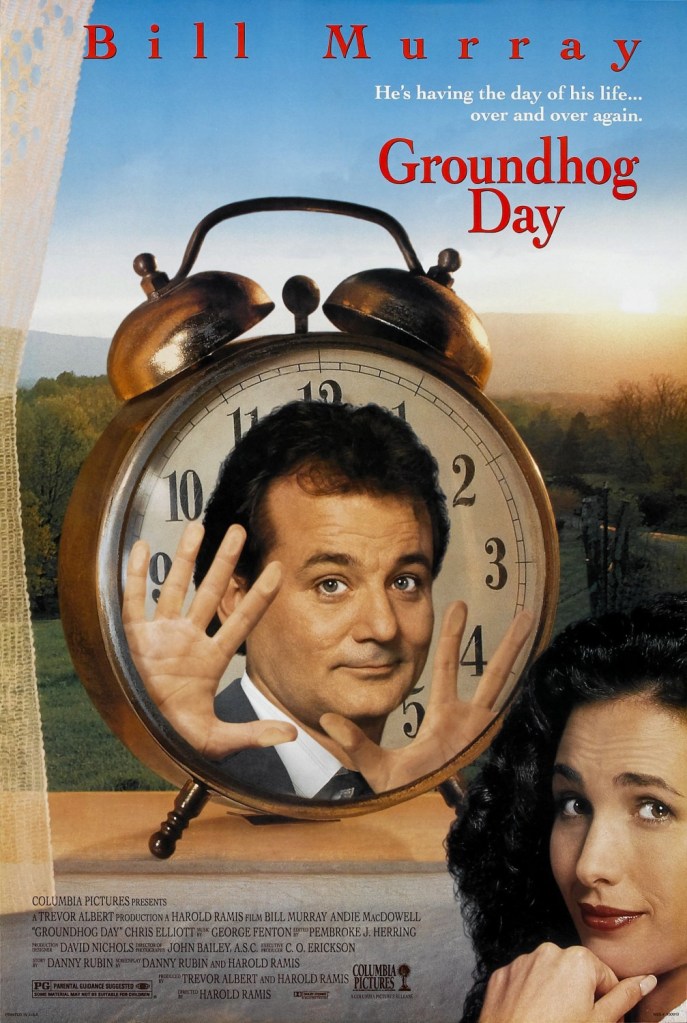
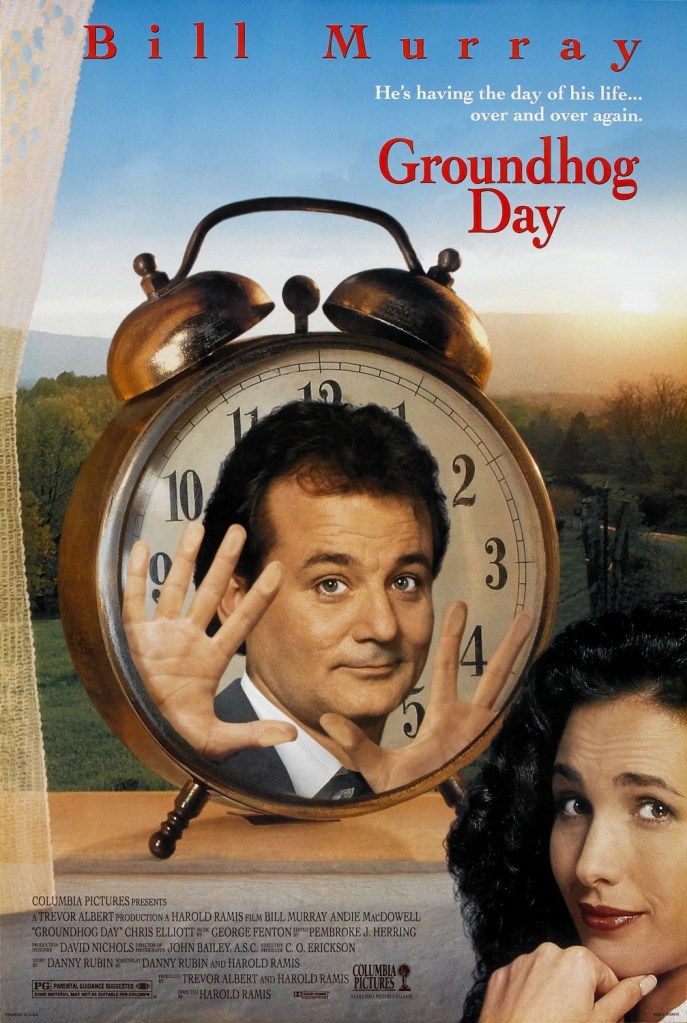
  • Last time, I gave the movie poster crap for not accurately portraying the film. Further research this go-round, however, showed me that family comedies were very marketable in the early ’90s (thank you, “Home Alone”), and the misrepresentation was intentional.
  • Bill Murray may have been a pain in the ass to work with, but if you believe that the end justifies the means, look no further than his performance. Part of what makes Murray work is his Buster Keaton stoneface. You can read almost anything into his hangdog expression, and Murray’s acting subtleties reward you for the inspection.
  • I’m enjoying the dynamic between Murray and Andie MacDowall. Another comedian would have ruined the chemistry, but having a natural, sweet performer like MacDowall is the perfect balance to Murray’s asshole demeanor.
  • Stephen Tobolowsky. Talk about turning a meal into a feast. His Ned Ryerson is so memorably quirky, and his limited screentime goes a long way.
  • I appreciate that this movie doesn’t waste time. You get the bare minimum of set-up, an extended take on Day One, and then it’s off to the time loop.
  • They could have used any song as the one that Phil wakes up to every morning; some more annoying, some more on the nose. But somehow, “I’ve Got You, Babe” is the perfect choice.
  • Phil consults Dr. Cameo for his possible brain damage. The doctor’s most important advice: “Don’t cross the streams. It would be bad.
  • Kudos to editor Pembroke J. Herring, who not only aided in effectively visualizing the time loop, but also helped with some restructuring in post-production.
  • Composer George Fenton was asked to create a score reminiscent of Nino Rota, which explains why the opening sounds like “8 1/2“. There’s also a point where the score gets a little “Schitt’s Creek”-esque. Thank goodness Roland is there.
  • My favorite line in the movie: “Maybe [God’s] not omnipotent. He’s just been around so long, he knows everything.”
  • That’s future two-time Oscar nominee Michael Shannon as the young groom-to-be whose fiancée may be getting cold feet.
  • Among the many things that make this movie work are the abundance of philosophical viewpoints thrown in. No wonder every major religion thinks it’s about them. Part of that is the vagary of the film’s philosophies, part of that is the fact that every major religion boils down to the same bullet points if you think about it.
  • I still don’t get why Larry becomes such a sleaze at the end. Is it to show how much better Phil has become? Larry gets the raw deal in terms of character development and depth. But hey, at least he’s got “Cabin Boy” coming up.
  • My take on Phil’s growth in this movie is from what I call Luke Skywalker syndrome. “All his life has he looked away to the future…never his mind on where he was.” Only when Phil learns to be in the moment and live spontaneously can he train Baby Yoda break the time loop.
  • “Groundhog Day” has one of moviedom’s most unappreciated curtain lines: the scripted “Let’s live here”, followed by Murray’s ad-lib, “We’ll rent to start.”

Legacy 

  • While it took a while for “Groundhog Day” to become a bona fide classic, the film had an immediate impact on the holiday itself. Attendance at the 1994 Groundhog Day festival in Punxsutawney increased dramatically. Woodstock, Illinois (this film’s Punxsutawney stand-in) has also started doing its own festivities, and offers tours of the film’s shooting locations.
  • With this movie, audiences and critics started to see Bill Murray as less of a comedic actor and more of a leading man. This led to his more dramatic work in such films as “Rushmore” and “Lost in Translation”.
  • Harold Ramis followed up “Groundhog Day” with… “Stuart Saves His Family”? Oh no. Well..after that he had a nice run of comedies, including “Multiplicity”, another high-concept comedy with Andie MacDowell, but this time with Michael Keaton, one of many who passed on being in “Groundhog Day”.
  • Danny Rubin turned down several screenwriting offers after “Groundhog Day”, unwilling to give up his creative freedom, and hasn’t had a screenplay produced since. Although Rubin has mixed feelings about what “Groundhog Day” ultimately became, he has said he is grateful for the experience.
  • Like “Ferris Bueller” before it, “Groundhog Day” got its closest approximation to a sequel with a Super Bowl commercial.
  • Speaking of, this may be the only movie on the NFR with a VR video game that’s also a sequel. Well, this and “Double Indemnity“.
  • Many elements from “Groundhog Day” have been referenced over the years, and the title itself has become shorthand for a mundane, repetitive experience. Example: This whole re-write has been a real “Groundhog Day” for me.
  • Although “Groundhog Day” did not invent the time loop genre, it certainly helped make it more acceptable to a wide audience. Recent additions to the genre include the films “Edge of Tomorrow”, “Happy Death Day” and “Palm Springs”, as well as the TV series “Russian Doll”.

Listen to This: STILL no Sonny & Cher on the National Recording Registry. Perhaps I need to start a petition or something.

#570) To Fly! (1976)

#570) To Fly! (1976)

OR “These Are a Few of My Favorite Wings”

Directed by Jim Freeman & Greg MacGillivray

Written by Freeman & MacGillivray & Francis Thompson & Robert M. Young & Arthur Zegart. Narration written by Tom McGrath

Class of 1995

There are two ways to watch “To Fly!”: at the Smithsonian Institution on a big screen, or on the Hagley Digital Archive website as a VHS rip. I chose the latter, but would one day love to experience the former.

The Plot: When visiting the National Air and Space Museum in Washington D.C., be sure to stop by the theater and watch their original IMAX movie “To Fly!”. “To Fly!” chronicles the history of flight in America, from the first manned balloon flights, to the breakthrough of the Wright Brothers, all the way to the (then) modern Space Age. And because it’s IMAX, this movie is mostly beautiful helicopter shots of sweeping vistas and iconic panoramas.

Why It Matters: The NFR cites “To Fly!” as the film that “pioneered the ultra-wide IMAX format” and calls it “among the most popular diocumentaries [sic] ever produced”.

But Does It Really?: This is another one of those “but of course” movies for me. When discussing essential film, we typically think of essential movies, and not the physical film stock itself, but no film history would be complete without IMAX. With its big screen and stunning imagery, an IMAX movie is as much about the experience as it is about the film. “To Fly!” is a fun, visually engaging movie, and a natural choice to represent IMAX on the NFR.

Everybody Gets One: Best friends Greg MacGillivray and Jim Freeman started their filmmaking careers with some 16mm shorts in the early ’60s, mostly about surfing. The unexpected success of their documentary “Free and Easy” (another surf movie) inspired the two to drop out of college and pursue filmmaking full-time. In 1974, the two were approached by IMAX to film “To Fly!” to coincide with the opening of the Smithsonian Institution’s National Air and Space Museum.

Wow, That’s Dated: Only a few giveaways, such as the narration “As the century moves to its close…”, and a shoutout to the film’s now-defunct sponsor, Conoco Inc. There’s also the now unfortunate shot of the camera flying over the World Trade Center.

Seriously, Oscars?: No Oscar love for “To Fly!”, though Greg MacGillivray would be nominated for two of his later IMAX films: 1995’s “The Living Sea”, and 2000’s “Dolphins”. For the curious, 1976’s Best Live Action Short winner was “In the Region of Ice”, based on the short story by Joyce Carol Oates.

Other notes 

  • A quick word on IMAX: founded in the late ’60s by Graeme Ferguson, Roman Kroitor, Robert Kerr, and William C. Shaw, IMAX was created as an attempt to recreate the Cinerama widescreen process with only one camera. IMAX uses 70mm film stock (as opposed to standard 35mm stock), and like Cinerama before it, requires a special projector and theater to play its films. IMAX also benefited from higher picture and sound quality decades before Hollywood caught up with the technology. Fun Fact: the name IMAX is not an acronym, but rather a shortened flip of the phrase “maximum image”. The name was coined when the creators learned that their original title – Multiscreen Corporation – couldn’t be copyrighted.
  • Ezekiel, the hot-air balloonist at the film’s opening, is purely fictional. The first person to fly over the United States in a hot-air balloon was French inventor Jean-Pierre Blanchard in 1783, 40 years before the flight depicted in this movie. But damn it, this is an American story, we can’t start things off with no Frenchman!
  • Yeah, I definitely need to see this movie on an IMAX screen. Still, I can admire a lot of the cinematography from my computer screen. Heck, one of the upside down shots actually made me a little dizzy.
  • This whole movie has an early EPCOT vibe to it, or maybe I’m just thinking of “If You Had Wings“. Come to think of it, without “To Fly!” there is no “Soarin’ Over California“.
  • Among the vintage vehicles in this movie are a covered wagon, a stagecoach, a Wright flyer, and a biplane. My question: are these replicas or was the Smithsonian a little too generous with helping this movie out? “Careful not to damage that plane, we got to get it back to the museum by 5:30.”
  • How can you discuss early flight this much and not show the stock footage of people’s failed attempts at flying?
  • Anytime there’s a biplane/barnstorming scene in a movie, I always think that they’re on their way to kill Cary Grant.
  • I say it every year, and I’ll say it again now: Damn you, Blue Angels!
  • One of the most impressive shots in the film is when a camera flies directly through St. Louis’ Gateway Arch, which I didn’t realize has only been around since the mid-’60s.
  • I can no longer watch hang gliding in a movie without thinking of the hang gliding scene from “Cave Dwellers”. “Gomez! I’ve invented the wheel!”
  • This film’s history of flight ends naturally enough with the Space Age, and our quest to fly among the stars. I’m glad this movie wasn’t made today, otherwise this section would be about how billionaires are trying to send people up into space rather than use their vast wealth to help out with this planet’s multitude of problems. But I digress…
  • The film ends by pointing out that due to the Earth’s rotation around the sun, we are always in flight. Mind blown.
  • Among the credited crew members is Supervising Editor Alexander Hammid. Experimental film buffs (and longtime readers of this blog) may recall Hammid’s work with his then-wife Maya Deren on the landmark experimental film “Meshes of the Afternoon“. Turns out Hammid contributed to many early IMAX films towards the end of his career.

Legacy 

  • “To Fly!” premiered at the Theatre of the National Air and Space Museum on July 1st, 1976, and is still playing there to this day (COVID pending). By virtue of its continued performance, “To Fly!” is one of the most successful IMAX movies ever made, estimated to have been seen by over 100 million viewers in one theater alone!
  • “To Fly!” has played a few other engagements over the years, including as part of Ronald Reagan’s inauguration ceremony in 1981. President Reagan also presented a copy of the film as a gift to the Soviet Union’s General Secretary Mikhail Gorbachev, and I like to think this was a tradeoff to get Mr. Gorbachev to tear down a certain wall.
  • One of the film’s longer runs was at the Pictorium theater at Six Flags Great America in Gurnee, Illinois throughout the ’80s.
  • Sadly, “To Fly!” would be Jim Freeman’s final film, as he died in a helicopter crash just two days before its premiere.
  • Greg MacGillivray is still making IMAX movies, his most recent is “Into America’s Wild”, narrated by Morgan Freeman.
  • MacGillivray also shot the helicopter footage at the beginning of “The Shining” (and one of the endings of “Blade Runner“).
  • And of course, IMAX is still going strong, perhaps best associated today with big Hollywood blockbusters praying that IMAX is enough for you to pay money to see a movie in a theater instead of on your phone. Save us, Christopher Nolan!