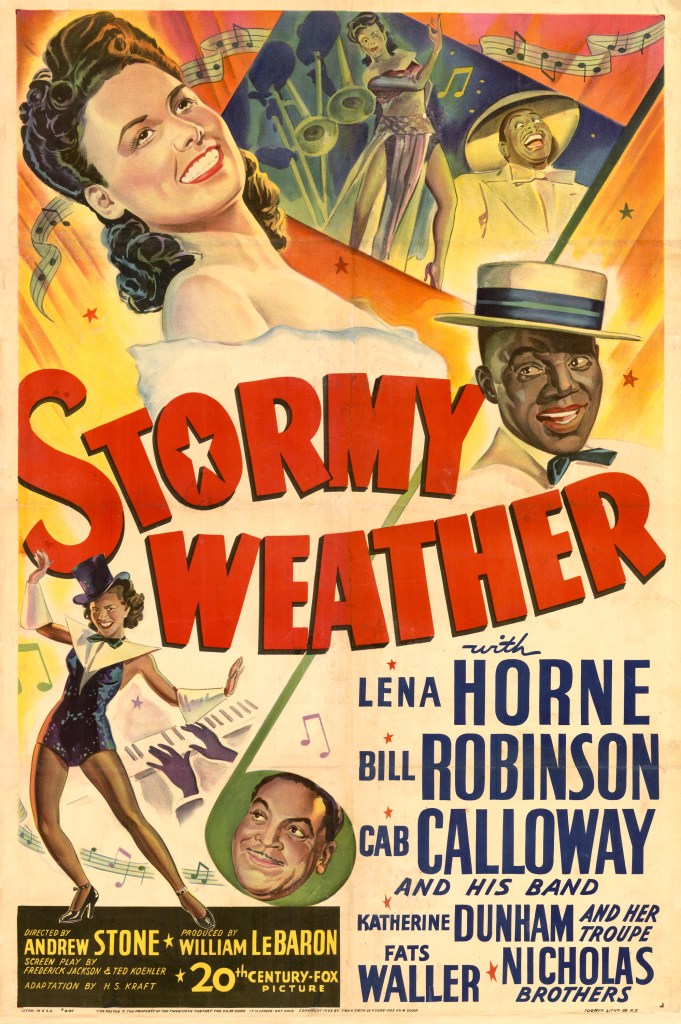
#544) Stormy Weather (1943)

#544) Stormy Weather (1943)

OR “Here’s to You, Mr. Robinson”

Directed by Andrew Stone

Written by Frederick Jackson and Ted Koehler

Class of 2001

No trailer so…I dunno, here’s the opening?

The Plot: Told primarily in flashback, Bill Williamson (Bill Robinson) recounts his show business career, from dive bars to nightclubs to Vaudeville. There’s an ongoing romantic subplot with singer Selina Rogers (Lena Horne), and some comic relief from Bill’s friend Gabe (Dooley Wilson), but primarily this movie is an excuse to highlight some of the great African-American talent of the era. Besides Robinson and Horne, there’s Fats Waller, Ada Brown, Mae E. Johnson, Katherine Dunham, the Nicholas Brothers, and Cab Calloway!

Why It Matters: While the NFR admits “Stormy Weather” is “not the most imaginative of scripts or direction”, they feel that the film’s roster of talent “distinguishes it among musicals of the day”.

But Does It Really?: The NFR write-up pretty much hits this one on the head. “Stormy Weather” is on the NFR for what it represents (an outstanding array of African-American talent) rather than what it is (an otherwise standard movie musical). You still have to muscle through some of the era’s more uncomfortable racial stereotypes and tropes (more on those later), but “Stormy Weather” is an important time capsule of some of the 20th century’s greatest entertainers. A slight pass for NFR induction.

Everybody Gets One: After starting out as a busker at age 8, Bill “Bojangles” Robinson eventually became a tap dancer in vaudeville, with some saying he single-handedly revived tap as an art form. Although often chastised for the “Uncle Tom” figure he played on stage and in the movies, Robinson was proud of the many racial barriers he broke during his lifetime, as well as his ongoing civil rights efforts. Side note: No one knows exactly how Bill Robinson got the nickname “Bojangles”, though the most common story is he acquired it as a child in Richmond, Virginia.

Wow, That’s Dated: It’s an all-Black cast and I still have to issue a BLACKFACE WARNING? Is nothing sacred?

Title Track: Written by Harold Arlen and Ted Koehler in 1933, “Stormy Weather” was first performed by Ethel Waters at Harlem’s famous Cotton Club. As this film’s title, “Stormy Weather” was a replacement for the original name, “Thanks, Pal”.

Other notes 

  • “Stormy Weather” is often linked with MGM’s “Cabin in the Sky”, the first all-Black movie from a Hollywood studio, released three months before “Stormy”. This important one-two punch in movie history stemmed from a concentrated effort by the NAACP to encourage Hollywood studios to present African-Americans in more diverse roles. These conversations led to, among other films, “Stormy Weather” and “Cabin in the Sky”. Coincidentally, both movies star Lena Horne.
  • Director Andrew Stone is not well remembered today, but he had a successful run of films that, like “Stormy Weather”, centered around music or musical figures (he had recently helmed “The Great Victor Herbert“). I couldn’t find any specifics regarding Stone’s input on “Stormy Weather”, corroborating accounts from various colleagues that his directing style was “unimaginative” and “literal”.
  • We have a massive readout on the Michael Douglas scale: Despite their characters being portrayed as contemporaries, Bill Robinson is 39 years older than love interest Lena Horne! Not that it matters: this is the least affectionate love story in movie history. I don’t even think they hug at any point. An unfortunate double-standard of the time.
  • At last we get Dooley Wilson in a non-“Casablanca” movie. Wilson’s turn here as Gabe is essentially the old Jack Benny routine: a cheapskate constantly conning his way out of paying for anything. I was waiting for Dooley to have a White, raspy-voiced valet.
  • In addition to the aforementioned blackface, this movie gives us an extended cakewalk sequence, with costumes a bit on the Little Black Sambo side. It’s fleeting, but still quite cringeworthy.
  • The more of Bill Robinson I watch in this movie, the less likely I am to keep submitting “The Little Colonel” for NFR consideration. Sure, the scene of Robinson and Shirley Temple dancing up the stairs is iconic, but why induct a movie for one Robinson number when you’ve already got a movie on the list that’s full of them?
  • This is one of Thomas “Fats” Waller’s rare film appearances, and sadly his last before dying of pneumonia at age 39 five months after the release of “Stormy Weather”.
  • When you think about it, the film’s emphasis on musical numbers over characters makes sense for the time. “Stormy Weather” is an entire feature of the one-note stereotypes and specialty acts that Black actors were allowed to be in the movies. Aside from the work of Oscar Michaeux and Spencer Williams, this is what Black representation looked like in 1943.
  • “Diga Diga Doo” is a tough number to watch, but points for whoever rhymed “nature” with “mate, you’re”.

  • Cab Calloway is another one of those performers who somehow has three movies on the Registry despite not being known for their film work. I’m not complaining, I just think it’s interesting.
  • Whoa, Cab and Gabe are giving me a lot of jive talk at once. Someone call Barbara Billingsley.
  • By virtue of its “staged” appearance, “Stormy Weather” is hardly a remarkable movie musical moment, but it’s a great performance by Lena Horne, as well as by Katharine Dunham and her dance troupe.
  • And then at the very last minute we get an appearance from dancers Fayard and Harold Nicholas. As always, the brothers do not disappoint with their precision, and their “Jumpin’ Jive” number still gets shared on social media as a testament to their work.
  • And because it’s 1943: Remember to buy your war bonds in this theater.

Legacy 

  • “Stormy Weather” was released in the summer of 1943, in the midst of several race riots throughout the country (including the “Zoot Suit Riots“). Despite protests from African-American groups, and half of the country’s first-run theaters refusing to screen it, “Stormy Weather” was a box office hit.
  • “Stormy Weather” the movie helped extend the popularity of “Stormy Weather” the song, with everyone from Frank to Judy to Etta to Ringo covering the classic. Lena’s performance in this movie made the song one of her standards as well.
  • After almost 50 years in show business, “Stormy Weather” was Bill Robinson’s last movie before his death in 1949.
  • Between “Stormy” and “Cabin”, 1943 was Lena Horne’s breakout year, with Ms. Horne maintaining her well deserved icon status for the rest of her long life.
  • “Stormy Weather” rarely gets mentioned outside of its historical significance, though the Nicholas Brothers’ routine has its fans, including Fred Astaire, who once told the brothers that it was “the greatest movie musical number” he had ever seen.

Further Viewing: “Cabin in the Sky”, this movie’s companion piece, was finally added to the National Film Registry in 2020. The Horse’s Head post for that is coming soon…maybe. [UPDATE: Four years later]

Listen to This: Ethel Waters’ original 1933 rendition of “Stormy Weather” made the National Recording Registry in 2004. Other “Stormy” artists on the Registry include Lena Horne (“Command Performance“), Cab Calloway (“Minnie the Moocher“), and Fats Waller (“Ain’t Misbehavin’“).

#543) Porky in Wackyland (1938)

#543) Porky in Wackyland (1938)

OR “Much A Dodo About Nothing”

Directed by Robert Clampett

Written by Warren Foster

Class of 2000

The Plot: Porky Pig (voiced by Mel Blanc) travels to “Darkest Africa” to hunt the elusive Dodo bird (also voiced by Mel Blanc). Porky arrives in Wackyland, which is filled with all kinds of surreal cartoon creations. The Dodo bird finally appears, but it turns out capturing him is more challenging (and more absurd) than Porky expected.

Why It Matters: The only superlative in the NFR write-up comes not from the Registry itself, but rather Leonard Maltin, who calls the film an “eye-popping tribute to the unlimited horizons of the animated cartoon.”

But Does It Really?: Oh sure. At a time when Disney had the market cornered on groundbreaking, realistic animation, shorts like “Porky in Wackyland” are a good reminder that cartoons shouldn’t always obey real-world physics and logic. Plus, I’m always surprised how few Looney Tunes and/or Merrie Melodies shorts are on the NFR (Bugs, Daffy, and Porky have one starring role apiece). A yes for “Porky in Wackyland”, and hopefully some more classic Warner Bros. animation on this list.

Everybody Gets One: “Porky in Wackyland” is the only NFR appearance for three of the most influential figures in Looney Tunes history. “Wackyland” was writer Warren Foster’s first Looney Tunes script, and he wrote 170 more over the next 20 years. Producer Leon Schlesinger was responsible for bringing such luminaries as Mel Blanc, Tex Avery, and Chuck Jones on board to Looney Tunes, and his hands-off approach to producing allowed his animators free reign over their creations. Director Bob Clampett spent 15 years with Looney Tunes, helping create Porky Pig, Daffy Duck, and Tweety, among other characters.

Wow, That’s Dated: Mainly the idea of a cartoon character’s comic schtick being a stutter. Other than that, paperboys, as well as a reference to the Sinclair Lewis novel “It Can’t Happen Here“. Is Wackyland in danger of becoming a dictatorship?

Seriously, Oscars?: No Oscar nomination for “Porky in Wackyland”; the Animated Short category was still dominated by Walt Disney in 1938 (the winner was his “Ferdinand the Bull“). Although Porky Pig never won the Oscar outright, he received his first nomination with 1944’s “Swooner Crooner“.

Other notes 

  • Predating Bugs Bunny and Daffy Duck by a few years, Porky Pig was the first breakout star of Warner Bros.’ Merrie Melodies. After his supporting debut in 1935’s “I Haven’t Got a Hat”, Porky became an audience favorite and quickly rose to star status. At this point, Bob Clampett hadn’t quite settled on Porky’s personality (sometimes he was depicted as a child), but here with “Wackyland” Porky settles into his years as the befuddled straight man.
  • Porky was originally voiced by Joe Dougherty, who actually did speak with a stutter. Because Doughtery had no control over his stutter, he was quickly replaced by Mel Blanc, with the speech disorder being maintained for comic effect.
  • For the curious, the last official sighting of a dodo bird was in 1662 in one of the Mauritius isles in the Indian Ocean, so Porky heading off to Africa to find the dodo isn’t so far-fetched. The dodo bird would become synonymous with extinction 200 years later when it was featured as a character in Lewis Carroll’s “Alice’s Adventures in Wonderland“, which this short gets its title from.
  • Oh good, a Jolson “Mammy” reference. This is why I keep putting off watching “The Jazz Singer” for the blog.
  • Among the assorted oddities in Wackyland is a prototype of “CatDog“.
  • There’s also a three-headed monster that is close enough to the Three Stooges, but not close enough for copyright infringement. In theory, anyone could have those haircuts and poke each other in the eyes.
  • Dodo has a lot of the same qualities as early Daffy Duck: the voice, the antagonism, and the overall, well, daffiness. It feels like either one of them could have become Looney Tunes’ next breakout character.

Legacy 

  • “Porky in Wackyland” is considered one of the greatest animated shorts of all time. In 1994, animation expert Jerry Beck ranked “Wackyland” number 8 in his book “The 50 Greatest Cartoons”. In reference to its unapologetic absurdism, historian Steve Schneider called this short “Warner Bros.’ Emancipation Proclamation”. A bit extreme, but I see their point.
  • After his successful stint with Looney Tunes, Bob Clampett would focus on his other great artistic love – puppetry – and create “Time for Beany” in 1949. Warren Foster would go on to work for “The Flintstones”, writing almost half of the show’s episodes.
  • “Wackyland” would be remade in color as 1949’s “Dough for the Do-Do”, and the Dodo character would make appearances throughout Looney Tunes history, including the 1990s cartoon “Tiny Toon Adventures”.

Bonus Clip: This “blooper” of Porky Pig cursing after messing up a take. Who knew that Porky was the Christian Bale of his day?

That’s all, folks!

#542) Kiss Me Deadly (1955)

#542) Kiss Me Deadly (1955)

OR “Hammer Time”

Directed by Robert Aldrich

Written by A.I. Bezzerides. Based on the novel by Mickey Spillane.

Class of 1999 

The Plot: Ralph Meeker is Mike Hammer, an L.A. detective who plays by his own rules. Late one night Hammer picks up hitchhiker Christina (Cloris Leachman), who gives him the cryptic message “Remember me” before she is beaten up and killed by thugs. Hammer decides to investigate the circumstances surrounding Christina’s murder, deducing that following this thread will lead to “something big”. What follows is a joyride through L.A.’s seedy underbelly and ecounters with mob boss Carl Evello (Paul Stewart), Christina’s roommate Lily (Gaby Rogers), and the corrupt Dr. Soberin (Albert Dekker). It seems that everyone connected to Christina is trying to find a mysterious box rumored to contain a fortune. What they find is a mystery so big film geeks are still debating it.

Why It Matters: The NFR write-up is mostly an overview about the movie and its “alternate” ending (more on that later). There’s a more thorough analysis in an essay by filmmaker/Robert Aldrich expert Alain Silver.

But Does It Really?: “Kiss Me Deadly” stands out in the film noir category not so much for its gritty realism or its taboo subject matter, but rather from its off-beat artistic strokes. Underneath the hood of this seemingly straight-forward murder mystery is some really creative work from Aldrich, Bezzerides and cinematographer Ernest Laszlo. I suspect the film is also on this list to represent Mike Hammer, a popular 20th century literary figure. While not an untouchable film classic, “Kiss Me Deadly” is still an enjoyable, fun-to-analyze movie 65 years later, and I give it a pass.

Everybody Gets One: Born into a family of wealthy Rhode Island socialites and politicians, Robert Aldrich was disinherited by his father after dropping out of the University of Virginia. Aldrich moved out west and got a job at RKO as a production clerk. He worked his way up to becoming an assistant director (including for fellow NFR entry “Force of Evil“), and by the 1950s was directing feature films. Many of Aldrich’s frequent collaborators first worked with him in his assistant director days.

Wow, That’s Dated: The usual ’50s stuff: pay phones, gas station attendants, plus the phrase “bedroom dick”, which doesn’t mean what you think it does.

Other notes 

  • This movie assumes you already know who Mike Hammer is. First appearing in Mickey Spillane’s 1947 book “I, the Jury”, Hammer is a hard-nosed detective and self-described misanthrope. In contrast to the stoic cynicism of a Sam Spade or Philip Marlowe, Hammer’s emotions often got the better of him, his rage consistently leading to violent fights with various lowlifes. Although critics at the time derided the brutality and sensuality of the novels, the Mike Hammer series were among the most successful books of the 1950s.
  • “Kiss Me Deadly” was the second film adaptation of a Mike Hammer novel. The first was 1953’s “I, the Jury” with actor Biff Elliot as Hammer.
  • Right from the start this movie is going to be different. A cold open (unheard of in 1955), followed by credits that scroll downwards! And a song from Nat “King” Cole! Talk about unforgettable.
  • Despite all of the murder mysteries on this list, we so rarely get an actor playing the “vic” who went on to become a star in their own right. In this case, the late great Cloris Leachman. You don’t see her pre-70s work too often, but as always, Leachman imbues a lot of character into Christina’s brief screentime.
  • The best exchange in this movie is between Hammer and his assistant Velda. “You’re never around when I need you.” “You never need me when I’m around.”
  • The film’s most impressive technology: Hammer’s early version of an answering machine, consisting of a reel-to-reel tape mounted on his wall.
  • “Kiss Me Deadly” is to Los Angeles what “Vertigo” is to San Francisco: a lovely time capsule of the city as it once was. There’s plenty of local landmarks highlighted throughout Hammer’s travels, including Angels Flight.
  • [Spoilers] When people think of the film’s cinematography, they’re usually thinking of the shot of mechanic Nick being crushed to death by a car he’s working on. The camera rushes to his face, making that shot from the point of view of the car’s…axle?
  • Thankfully neither Aldrich nor screenwriter I.A. Bezzerides care a lot about the novel’s convoluted mystery, and the movie spends more time on character and aesthetic, which helps make the film more palatable. You can follow the clues if you want, but that’s not this film’s priority.
  • Ralph Meeker kinda looks like Charlton Heston. And occasionally Maximilian Schell from the right angle.
  • I also enjoy the moment where Hammer points out how polite the henchmen are being as they escort Hammer away. Their response: “We’re here on this Earth such a brief span, we might as well be.”
  • Dr. Soberin shows up in full classic Bond villain mode, monologuing while the hero is tied up. They even obscure his face during his first scene!
  • Shoutout to Percy Helton as Doc Kennedy, the somewhat sadistic coroner who tries to extort money out of Mike Hammer. Helton also played the drunk Santa who gets fired at the beginning of “Miracle on 34th Street“.
  • My main takeaway from this movie is that no one locked anything in the ’50s. People could just hop into your car or walk into your home. Different times indeed.
  • And just when you think you know where this movie is going, along comes that ending. Without giving too much away, it infuses the Cold War paranoia of the time with the ending of “Raiders of the Lost Ark“, and a pinch of “Seven” thrown in for fun. It packs quite a punch.
  • [Mini-spoiler] At some point following the film’s first release, the ending was trimmed by about a minute. The original closing shots show Hammer and Velda escaping the burning house along the beach, but the truncated ending finishes with the previous shot of the house on fire, implying that Hammer and Velda perished inside. What a difference a few cuts make.

Legacy 

  • Although “Kiss Me Deadly” received rave reviews from critics, it was not a hit with American audiences. The film did, however, do well overseas, and found a cult following in France. Both Jean-Luc Goddard and François Truffaut have cited “Kiss Me Deadly” and its experimental cinematography as an influence on the French New Wave cinema of the late 1950s.
  • Easily the film’s most iconic homage: Quentin Tarantino alludes to “Kiss Me Deadly” and its mystery box with the briefcase in “Pulp Fiction“.
  • Mickey Spillane wrote nine more Mike Hammer novels after the release of “Kiss Me Deadly”, two of which were published posthumously following Spillane’s death in 2006.
  • There have been several adaptations of Mike Hammer over the years, most memorably a TV series in the ’80s starring Stacy Keach as Hammer.
  • Among Robert Aldrich’s later films as director are “What Ever Happened to Baby Jane?” and “The Dirty Dozen”; neither of which are on the NFR. As God is my witness, I will get “Baby Jane” on that list (and then “Dirty Dozen” if there’s time). [2021 Update: “Jane” is in, onto “Dirty Dozen” I guess.]

#541) Sky High (1922)

#541) Sky High (1922)

OR “Mixology”

Directed & Written by Lynn Reynolds

Class of 1998

The Plot: Grant Newbury (Tom Mix) is an Inspector of Immigration in Calexico, CA. After a successful bust, Newbury infiltrates a gang sneaking a group of Chinese immigrants across the Mexican border (more about that later). On his way to turn the gang in, Newbury saves the lovely Estelle Halloway (Eva Novak) from drowning, and he sticks around to take care of her. It turns out that Estelle is the ward of Jim Frazer (J. Farrell MacDonald), the boss of the gang Grant is trying to sabotage. This all comes to a head in a climactic fight across the Grand Canyon, filmed on location, with some incredible aerial footage as Grant takes to the skies.

Why It Matters: The NFR gives a brief overview, and calls Tom Mix by his given moniker “King of the Cowboys”, adding that Mix’s easygoing style contrasted with William S. Hart’s screen persona, and “set a standard for cowboy stars that lasted decades”.

But Does It Really?: “Sky High” has two things going for it in terms of NFR recognition: It represents Tom Mix, and it features impressive footage of the Grand Canyon. That’s about it. As a movie, “Sky High” isn’t that memorable, but there are worse ways to spend an hour. A slight pass for NFR inclusion.

Everybody Gets One: The son of a stable master, Tom Mix learned to ride horses at a young age. After a stint with the Army during the Spanish-American War (stories of him being one of Teddy Roosevelt’s Rough Riders are false), Mix became a rancher in the Oklahoma Territory. A skilled horseman and a good shot, Mix joined the ranch’s touring Wild West show, which led to the start of his film career in 1909. By the 1920s, Mix was one of the biggest stars (Western or otherwise) in Hollywood. Also making their sole NFR appearance in “Sky High” are frequent Mix leading lady Eva Novak, and writer/director Lynn Reynolds.

Wow, That’s Dated: The Chinese immigrants in this movie are referred to solely as “Chinamen”. We’re a long way from “Chan Is Missing“.

Title Track: “Sky High” was originally titled “The Go Getter” during pre-production, and at some point during filming was renamed the similar sounding “Go Get Her”. I presume “Sky High” made the cut to associate the film with its aerial scenes.

Seriously, Oscars?: The Oscars were still a few years away, but apparently camera operator Blaine Walker received a gold medal from Fox Film for his “enterprise and daring in obtaining the first motion pictures of the Grand Canyon taken from an airplane”. I’m sure this was all a big publicity stunt from Fox, but hey someone got a medal out of it!

Other notes 

  • This is typically the part where I mention that this Fox film is now technically a Disney property, but “Sky High” is in the public domain. Your loss, Mouse House!
  • This movie goes all in on the Grand Canyon gimmick. Immediately following the opening credits, we get an intertitle proudly stating the film’s on-location production, followed by some facts about the Grand Canyon. It’s standard Grand Canyon trivia, though I will point out that “It is one of nature’s most sublime spectacles” is not a fact, but rather an overall agreed upon sentiment.
  • As soon as I learned that Mix’s character worked border patrol, I knew we were in trouble. Thankfully the film doesn’t lean too much on our shitty immigration policies, though neither side comes out of this looking good.
  • You read the synopsis correctly, the illegal aliens being trafficked over the border are Chinese. Who does this movie think we share a border with?
  • Despite his status as King of the Cowboys, I don’t have a lot to say about Tom Mix in this movie. His performance is fine, but not particularly noteworthy or a confirmation of his star power. Honestly, my takeaway from Tom Mix is that he’s wearing a huge cowboy hat. I mean, I get it; it’s a big hat, it’s funny.
  • Oddly enough, I can’t find anything to confirm that Grant’s horse in this movie is Tom Mix’s famous companion Tony the Wonder Horse. I feel cheated.
  • That bar fight is sped up like crazy. I was waiting for the Keystone Kops to break it up.
  • Whoa, they have cars in this western? And biplanes!? My mind is blown.
  • I do not want to know how someone in your posse earned the nickname “Chili Beans”.
  • During my viewing, I was thinking about where exactly Tom Mix fits in the pantheon of classic movie cowboys. In terms of NFR induction, Mix joined the roster after John Wayne, Clint Eastwood, and William S. Hart, but before Gene Autry and Roy Rogers. I guess Mix is the last of the great non-singing cowboys.
  • Did they really make these actors climb the Grand Canyon? No wonder they unionized.
  • Frazier henchman Bates to Estelle upon her capture: “Better start enjoyin’ the scenery – ’cause you’re goin’ to see some that’s different”. In the annals of film history this has got to be the least threatening threat of all time.
  • And then we get to the film’s meat and potatoes: Grant flying over the Grand Canyon in a biplane. It’s an impressive sight in a fun action sequence, and I’m sure it went over like gangbusters in 1922. Despite a reputation for doing his own stunts, Mix had stunt pilots Bud Creeth and Dick Grace do the actual flying. During one take, Creeth almost fell out of the plane, but was saved by Grace (as in Dick Grace, but possibly also “of God”).
  • In true leading lady fashion of the time, Estelle is a passive, sidelined character for most of the movie. She doesn’t get much to do, but at least Grant trusts her with his gun while he’s out fighting the main baddies.
  • “Sky High” may be the only western on this list that spares both Mexicans and Native Americans from the typical sweeping racism associated with the genre.

Legacy 

  • Tom Mix made 291 films over the course of 25 years! Sadly, due to a number of setbacks (including the famous 1937 Fox Fire), only about 30 of Mix’s films are known to still exist.
  • Although Mix’s film career started to decline in the 1930s (he transitioned to talkies successfully, but grew weary on the injuries he was incurring), Mix found continued success on radio. Sadly, Mix died in a car accident in 1940 at the age of 60.
  • Tom Mix is still the King of the Cowboys to a lot of film buffs, and gets occasionally referenced in period pieces like “Boardwalk Empire” and “Peaky Blinders”. Plus he was played by a young Bruce Willis in Blake Edwards’ light historical fiction “Sunset”.
  • In reference to this film’s apparent lack of significance, there are countless other movies also named “Sky High”, including that one about a superhero high school. I guess “Sky High” is a Disney property after all.

#540) Hindenburg Disaster Newsreel Footage (1937)

#540) Hindenburg Disaster Newsreel Footage (1937)

Filmed by Pathé News, Hearst News of the Day, Paramount, and Fox Movietone

Class of 1997

As always with my posts based on historical events, this write-up is about the footage of the Hindenburg crash, not necessarily the event itself. Do not let this oversimplified summary be your one stop for Hindenburg knowledge.

There’s plenty of YouTube videos of the Hindenburg disaster, but this video synchs them all in an approximation of real time.

During our fascination with aviation throughout the 1930s, rigid airships were considered to be the next big thing in commercial air travel. The most well-known of these airships were made by the German company Luftschiffbau Zeppelin, and the most famous Zeppelin was the LZ 129 Hindenburg. Launched in March 1936, the ship was in operation for 14 months and 17 roundtrips across the Atlantic. On May 6th, 1937, the Hindenburg had been delayed from Germany due to weather conditions, and was landing in Lakehurst, New Jersey (about 75 miles south of New York City). As the ship was starting to make its landing approach, it suddenly caught on fire. Within a matter of moments, the Hindenburg went from being one of the largest airships in the world, to a smoking pile of rubble on the ground. Of the 97 people on board, 35 were killed in the crash, and another died on the ground. Following similar crashes in years past, the Hindenburg disaster was the final nail in the coffin for Zeppelins as a commercial transport.

Airship landings were still a unique occurrence in 1937, and thanks to some heavy promoting from the Zeppelin Company, many news sources were at Lakehurst to cover the event. The footage of the crash as preserved by the National Film Registry was recorded by William Deeke of Pathé News, Al Gold, Larry Kennedy and Deon de Titta of Fox Movietone, James J. Seeley of Hearst’s News of the Day, and Tommy Craven of Paramount. Many of these newsreels can be easily viewed online synced with the audio recording of Herbert Morrison’s eye-witness report for WLS Chicago, culminating in his oft-repeated cry of “Oh, the humanity!”

Like the “Tacoma Narrows Bridge Collapse“, the Hindenburg footage is a reminder of some of the tragic missteps taken in our technological advancements. The footage is NFR worthy not only for its multiple perspectives of an historic moment, but also for its continued echos throughout history.

Why It Matters: The NFR gives some historical context and calls the disaster “[o]ne of the 20th Century’s most vivid historic images”.

Wow, That’s Dated: Rigid airships, that’s the big one. Turns out the lifting gas of choice for these ships was the incredibly flammable hydrogen. Yep, there’s your problem right there.

Other notes 

  • I recently realized that I’ve never actually researched the Hindenburg or its crash until now. Perhaps the most intriguing element to me: no one knows for sure how the ship burst into flames, and there’s no existing footage that documents the very beginning of the disaster. Among the speculated theories are a sudden bolt of lightning (it had started to rain just before the crash), or some static electricity tampering with the ship’s weather-proofing. A little further down the iceberg we find claims of sabotage by anti-Nazi organizations, or possibly self-sabotage at the command of Hitler himself. Speaking of…
  • You know what little detail this film pointed out to me that everyone glosses over? THERE WERE SWASTIKAS ON THE TAIL OF THE HINDENBURG! Of course this was a tragic event, but how sad can you be that a Nazi ship went down?
  • My main takeaway from the actual newsreel footage is just how much sensationalism is thrown into this. Each of these reports took an already sad occasion and cranked it up using dramatic music, with the sounds of screaming people dubbed in later (all of these films were recorded silently). It reminded me of the “Simpsons” line about the news covering “a crisis so serious it has its own name and theme music“.

Legacy 

  • It was shortly after the Hindenburg disaster that airships switched from using hydrogen to helium, and stopped being used for commercial travel. Today, only a handful of non-rigid airships (such as blimps) still exist and operate, including the Goodyear Blimps.
  • The Hindenburg crash footage pops up in all kinds of historical documentaries, often paired with Herbert Morrison’s “Oh, the humanity!” The name Hindenburg has become synonymous with total disaster, and “Oh, the humanity” has been referenced and parodied quite a lot over the years, presumably by people not entirely aware of the tragic event they’re making light of.
  • This real-life disaster of the ’30s met the disaster movie genre of the ’70s in 1975’s “The Hindenburg”. With a cast led by George C. Scott and Anne Bancroft, the movie leaned more on the sabotage theories of the flight’s demise. Although dismissed by critics, historians, and moviegoers alike, “The Hindenburg” won two Oscars in 1976 for its Special Effects and Sound Editing.

Listen to This: Among the first 50 recordings added to the National Recording Registry in 2002 was Herbert Morrison’s reportage of the Hindenburg crash, cited by the NRR as “[a]n emotional, never-to-be forgotten moment of news broadcasting”. There’s also a very detailed historical essay by…Cary O’Dell again. Doesn’t anyone else at the NRR want to write an essay? O’Dell can’t carry all of you!