#526) Top Gun (1986)

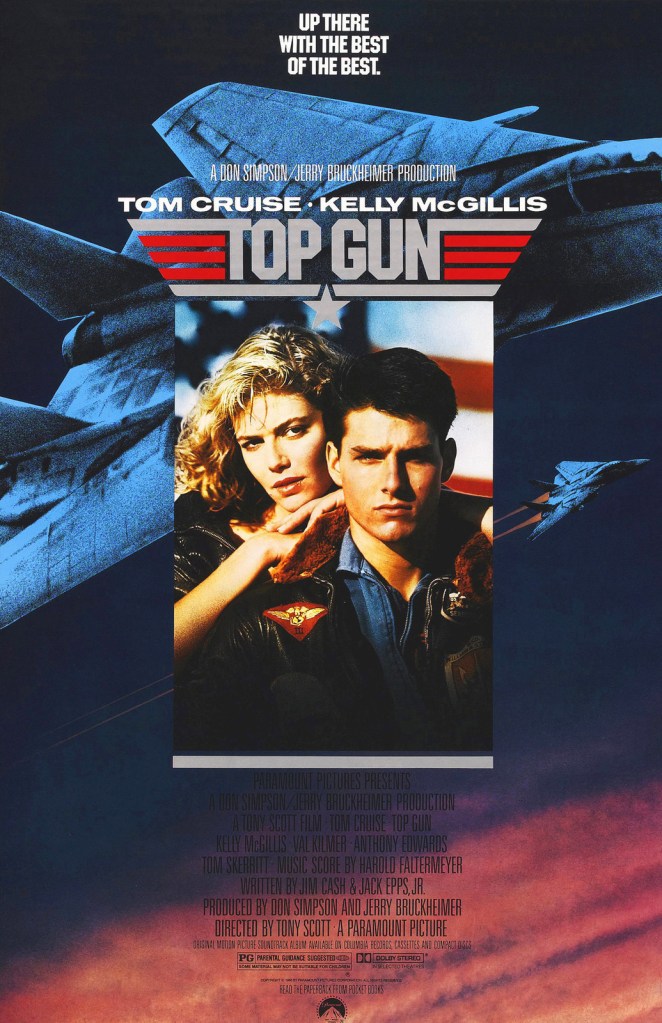
#526) Top Gun (1986)

OR “Yvan Eht Nioj”

Directed by Tony Scott

Written by Jim Cash & Jack Epps Jr. Based on the magazine article “Top Guns” by Ehud Yonay.

Class of 2015 

The Plot: LT Pete “Maverick” Mitchell (Tom Cruise) is a cocky young pilot in the US Navy. Despite his disregard for safety, he is still one of the best pilots in his unit, and he and his wingman LTJG Nick “Goose” Bradshaw (Anthony Edwards) are recruited for TOPGUN, a program teaching the top 1% of navy pilots dogfighting skills. During his training, Maverick butts heads with fellow student LT Tom “Iceman” Kazansky (Val Kilmer), woos civilian instructor Charlotte “Charlie” Blackwood (Kelly McGillis), plays some volleyball, feels the need for speed, and of course, rides into the Danger Zone!

Why It Matters: The NFR praises Tony Scott, saying he “delivers on all fronts” with “slick, visually arresting action-set pieces”. Tom Cruise’s star appeal is also highlighted. The write-up, however, begins with a weird sentence about how “a wag might be tempted to call this…film ‘The Testosterone Chronicles'”. Where is this coming from?

But Does It Really?: I had never seen “Top Gun” prior to this viewing, and it’s…fine. The flight scenes are extraordinary, but everything else just sits there. Not bad, not great either. Despite these shortcomings, “Top Gun” has continued to be an iconic crowd-pleaser 35 years on. Sure it’s a Popcorn Movie, but it’s also the definitive Popcorn Movie of the ’80s. With a focus on action entertainment, and a plethora of quotable/spoof-able moments, “Top Gun” more than earns its spot among notable American films.

Everybody Gets One: Tony Scott got his start making commercials for his older brother Ridley Scott’s production company in England. Tony was approached with “Top Gun” based on his work helming the vampire movie “The Hunger” as well as a Saab commercial in which the Swedish car is shown racing a fighter jet. This is also the only NFR appearance for many of the film’s stars, including Tom Cruise, Kelly McGillis, Val Kilmer, and Meg Ryan.

Wow, That’s Dated: Surprisingly, “Top Gun” doesn’t show off its inherent ’80s-ness the way a “Ferris Bueller” or “Fast Times at Ridgemont High” does. And call me a wag, but “Top Gun” definitely could have been called “Toxic Masculinity: The Motion Picture”.

Seriously, Oscars?: The biggest hit of 1986, “Top Gun” entered the 1987 Oscars with four tech nominations. The film lost three of these nods to “Platoon” and “Aliens”, but “Take My Breath Away” took home the Best Song Oscar. After Berlin passed on performing at the ceremony, the song was sung on air by…Melba Moore and Lou Rawls?

Other notes 

  • Like many a movie based in a branch of the US military, the script for “Top Gun” was subject to approval by the US Navy in order to receive their cooperation (including access to Miramar Base in San Diego, site of the actual TOPGUN program). This resulted in several script changes, including less crashes and more incidents involving human error rather than anything wrong with the Navy.
  • Any movie that brought us the song “Danger Zone” cannot be all bad.
  • Amazingly, I don’t have a lot to say about Tom Cruise’s performance, other than he is very charming in this movie, and has not aged a day in 35 years.
  • James Tolkan gives a nice turn as CDR Stinger, though this begs the question: Didn’t that guy ever have hair?
  • Wow, Kelly McGillis is giving a total 180 from her performance as an Amish mother in “Witness”. For starters, she uses zippers!
  • We have arrived at the volleyball scene which I gotta say, may have been overhyped for me. I went in knowing it was filled with homoerotic imagery (intentional or otherwise), and sure there’s a bunch of fit shirtless guys being athletic but…I guess I expected more? I’ve seen more slabs of meat in my freezer.
  • Apparently the love scene was an afterthought, filmed when preview audiences complained that Tom Cruise and Kelly McGillis never “hook up”. The whole scene is silhouetted because McGillis had changed her hair for another movie. This lighting effect ensures that we see how much tongue both of these actors are using, and boy is it gross. More like “Take My Lunch Away”.
  • This is Meg Ryan’s third movie! She doesn’t have much to do, but she delivers exactly what the part of Mrs. Goose calls for. Now what’s it gonna take to get “When Harry Met Sally” on this list?
  • “I feel the need, the need…for speed.” I didn’t realize just how random that moment is. It just kinda happens and then we all move on. Do people quote it because it rhymes?
  • All of the dogfight scenes are giving me flashbacks to when the Blue Angels fly over my neighborhood during Fleet Week. That may be the one annual tradition I’m glad quarantine took away from us.
  • Wait, Tim Robbins was in this? I guess he had his gear on the whole time.
  • “Top Gun” is dedicated to the memory of Art Scholl, a veteran stunt pilot who crashed in the Pacific Ocean while filming second unit aerial footage for this movie.
  • On a lighter note, the end credits also give us a plethora of nicknames from the various pilots who served as technical consultants. Among my favorites: “Bozo”, “D-Bear”, “Rabbi”, “Squire”, “Organ”, “Jambo” and “Jaws“.

Legacy 

  • “Top Gun” was met with a mixed critical reception, but word of mouth made it the biggest hit of the year, solidifying Tom Cruise as a movie star. Tom Cruise has spent the last four decades making some of the biggest blockbusters of all time, and that’s all I have to say about him.
  • Tony Scott spent the next 25 years cranking out well-crafted action movies including “Days of Thunder”, “True Romance”, “Crimson Tide”, and pretty much every action movie Denzel Washington did in the 2000s.
  • The US Navy called “Top Gun” one of the best recruitment efforts of all time, with some reports estimating that Navy enrollment shot up 500 percent in the summer of 1986. Also surging in popularity: Bomber jackets and Aviator sunglasses, a look today known as “The Biden”.
  • An immediate “Top Gun” follow-up was quickly rejected by Tom Cruise, and while another sequel idea stalled after Tony Scott’s death, “Top Gun: Maverick” will finally be reaching theaters in July 2019 June 2020 December 2020 July 2021. [Update: The film has now been pushed back to November 2021. I’m beginning to think this movie doesn’t actually exist.] [Update: May 2022. Final answer.]
  • “Top Gun” has been subjected to its share of parodies over the years, most memorably in the movies “Hot Shots!” and “Team America”. The “Top Gun” references came full circle in 2013 when the Pixar film “Planes” featured Anthony Edwards and Val Kilmer as the voices of two Navy fighter planes.
  • And of course: “Danger Zone”.

#525) Ruggles of Red Gap (1935)

#525) Ruggles of Red Gap (1935)

OR “Gentleman’s Gentleman’s Agreement”

Directed by Leo McCarey

Written by Walter DeLeon and Harlan Thompson. Adaptation by Humphrey Pearson. Based on the novel by Harry Leon Wilson.

Class of 2014

No trailer, but here’s a recommendation from Peter Bogdanovich, and isn’t that just as good?

The Plot: While on holiday in Paris, the Earl of Burnstead (Roland Young) reveals to his loyal valet Ruggles (Charles Laughton) that he placed Ruggles as collateral in a poker game with nouveau riche Americans Egbert and Effie Floud (Charlie Ruggles and Mary Boland), and lost. While initially upset by this news, Ruggles accepts his new position as the Flouds’ servant, and journeys back with them to their home in Red Gap, Washington. After a miscommunication picked up by a local journalist, Ruggles is presumed to be a famous British colonel staying as the Flouds’ houseguest, and he becomes a local celebrity. Despite the mistaken identity, Ruggles begins to enjoy America, and wonders if he could make it on his own in this new world.

Why It Matters: The NFR praises director McCarey, and commends Laughton for “pull[ing] off comedy perfectly.”

But Does It Really?: While I question the placement of “Ruggles” on a list of quintessential American film, I did enjoy the film. Overall, “Ruggles” is a fun, harmless bit of entertainment, centered around Laughton’s outstanding comic performance, and aided by an ensemble of reliable studio players. While I can think of another, more iconic 1935 Charles Laughton film that still hasn’t made the NFR cut, “Ruggles” is a pleasant movie from the studio era that is still worth a watch over 85 years later.

Everybody Gets One: Shortly after editing “Ruggles”, Edward Dmytryk got his first directing gig with the low-budget Western “The Hawk”. His career was sidelined in the early ’50s when he became one of HUAC’s “Hollywood Ten”, but he eventually named names and his directing career resumed. Dmytryk is probably best remembered for directing the Humphrey Bogart courtroom drama “The Caine Mutiny“.

Wow, That’s Dated: Besides an opening shoutout to the shortlived National Recovery Administration, this film has the kind of casual racism towards Native, African and Asian-Americans we’ve come to expect from films of the era. Okay, so it’s not 100% harmless and enjoyable.

Seriously, Oscars?: “Ruggles of Red Gap” is one of the rare Best Picture Oscar nominees to only be nominated for Best Picture. “Ruggles” ultimately lost to “Mutiny on the Bounty”, for which Charles Laughton received a Best Actor nod.

Other notes 

  • Paramount bought the film rights of “Ruggles” specifically for Charles Laughton, who in turn recommended Leo McCarey to direct based on his recent successful string of comedies such as “Duck Soup“. Production was delayed so that Laughton could play Mr. Micawber in MGM’s “David Copperfield”, though he was dismissed after two days of filming (some say at Laughton’s insistence, some say at the studio’s insistence). Despite Laughton’s early return to Paramount, “Ruggles” was still delayed because Laughton returned with a completely shaved head (Micawber is described as hairless in the Dickens novel). Paramount made MGM pay for delays while they waited for Laughton’s hair to grow back.
  • Oh man, Laughton’s great in this. He does such a wonderful job playing it totally deadpan, mixed with some occasional character growth to keep the bit from going stale. The opening sequence between Ruggles and Lord Burnstead is a master class in comic timing. This all being said, speak up Laughton! I can’t hear you half the time!
  • Charlie Ruggles is very good in this movie too, but that must have been a confusing time on this set. You couldn’t call for “Charlie” or “Ruggles” without both him and Laughton showing up. Attention must also be paid to Mary Boland, excellent as Egbert’s put-upon wife, and Maude Eburne as Effie’s fun-loving “Ma”.
  • It’s nice seeing Zasu Pitts in a talkie. Most of Pitts’ NFR representation is for her silent work as an ingenue, and in “Ruggles” we see the beginnings of the dependable second banana she played for the remainder of her career. And she gets to play the awkward love interest! She’s still got it!
  • Perhaps the film’s most memorable scene: Ruggles, as part of his new knowledge of America, reciting Lincoln’s Gettysburg Address to a roomful of visibly moved bar patrons. It’s a speech about the inalienable rights and equality of all Americans, and the hope that a “government of the people, by the people, for the people, shall not perish from the earth.” So, ya know, fantasy.
  • When Ruggles announces he wants to open a restaurant, Egbert suggests that it be called “A horse’s something”, which is immediately shot down. I’ll try not to be offended.
  • Roland Young is giving Laughton a run for his money in the mumbly Brit department: I can’t understand him either! He’s throwing away every line! Young was still a few years away from perhaps his best known movie character; Cosmo Topper in a series of MGM comedies.
  • Overall, I liked “Ruggles” and its harmless look at the American dream, with an immigrant being welcomed with open arms and successfully opening their own business. Different times indeed.

Legacy 

  • The 1935 “Ruggles” was itself the third film adaptation of the 1915 novel (and the first with sound). A fourth remake followed in 1950, renamed “Fancy Pants” and starring Bob Hope and Lucille Ball, the latter who apparently decided immediately afterwards “Let’s try television.”
  • Charles Laughton considered “Ruggles” one of his favorites of his own movies, and called the Gettysburg Address sequence “one of the most moving things that ever happened to me”. Laughton recited the address on numerous occasions after “Ruggles”, including on an Abbott & Costello hosted episode of “The Colgate Comedy Hour”. I’m assuming “Comedy” had the night off.
  • “Ruggles of Red Gap” gets the occasional mention by film buffs. A shoutout in the Coen Brothers’ “Barton Fink” led to a young Edward Norton discovering the film, which he now includes as one of his favorites. Thanks for getting the word out, Other Hulk.

And with that unnecessarily condescending Marvel reference, we conclude Year Four of The Horse’s Head. Thanks to each and every one of you for making 2020 easily the most successful year for the blog so far. We’ll be taking the holidays off, but will return in the new year for Year Five and a new roster of classic movies. Until then, please stay safe and take care of each other.

Happy Viewing,

Tony

#524) The Magnificent Seven (1960)

#524) The Magnificent Seven (1960)

OR “Yul Never Walk Alone”

Directed by John Sturges

Written by William Roberts (but really Walter Newman). Based on the film “Seven Samurai” by Akira Kurosawa & Shinobu Hashimoto & Hideo Oguni.

Class of 2013

The Plot: A small Mexican village is being terrorized by the bandit Calvera (Eli Wallach) and his gang. The villagers decide to take action, crossing the border to buy weapons. They encounter gunslinger Chris Adams (Yul Brynner) who convinces them to hire gunfighters to ward off the bandits. Aided by fellow gunfighter Vin Tanner (Steve McQueen), Adams recruits four more lowlifes (Charles Bronson, Robert Vaughn, James Coburn, Brad Dexter) and one young hotshot (Horst Buchholz) to join the cause. And if any of this sounds familiar, just replace cowboys with Sengoku era samurai and you’ve got another movie classic.

Why It Matters: The NFR highlights the film as “a springboard for several young actors” and singles out Elmer Bernstein’s “vibrant” score. There’s also an essay by Kurosawa expert Stephen Prince.

But Does It Really?: Overall “The Magnificent Seven” is…fine. Not quite firing on all cylinders compared to other westerns, but iconic enough to warrant eventual NFR inclusion. Part of the problem is that every story and character element from “The Magnificent Seven” has been done to death in countless other movies (“Three Amigos” comes immediately to mind), to say nothing of the Kurosawa film they’re lifting everything from! “Magnificent Seven” is an engaging watch with a top-notch cast, but I’m still putting it in the “Minor Classic” category.

Everybody Gets One: Although credited as the sole screenwriter, William Roberts was brought in to do rewrites of Walter Newman’s script when Newman refused to be on-site during filming in Mexico. When Roberts went to the WGA for a screen credit, Walter Newman took his name off the picture. Speaking of screenwriters: by virtue of his source material credit, this is technically the only NFR appearance for legendary Japanese director Akira Kurosawa.

Wow, That’s Dated: Despite the film presenting Mexicans in an overall positive light to appease local censors, native Brooklynite Eli Wallach plays the lead bandito, in an acting process I’m calling “Method Stereotyping”.

Seriously, Oscars?: While not a critical or box office hit, “The Magnificent Seven” did manage one Oscar nomination for Elmer Bernstein’s score. Despite its now-iconic status, the score lost to Ernest Gold’s composition for Otto Preminger’s “Exodus“.

Other notes 

  • “Seven Samurai” was released in Japan in 1954, and was one of the most successful films of the year. A 1956 US release was well received, and two years later Yul Brynner purchased the rights for an American remake. After a few attempts to get the film off the ground (including directing it himself), Brynner sold the rights to The Mirisch Company, but retained his leading man status, as well as casting approval. Director John Sturges was hired based on his work in such films as “Bad Day at Black Rock” and “Gunfight at the O.K. Corral”.
  • Ah yes, the Russo-Ukranian cowboy Chris Adams. The screenplay explains Yul Brynner’s accent with one line mentioning that Chris is…Cajun?
  • While not a movie star at this point, Steve McQueen was known to American audiences for the TV western “Wanted: Dead or Alive“. When the show wouldn’t give him time off to make “Seven”, McQueen faked a car accident and claimed he needed time off to recuperate, therefore freeing him to make the movie.
  • Stories of an on-set rivalry between Yul Brynner and Steve McQueen are apparently true. McQueen was given permission from John Sturges to add bits of business to make up for his character’s lack of dialogue, which Brynner perceived as upstaging. Although the two never worked together again, McQueen and Brynner reconciled shortly before the former’s death.
  • I get why Yul Brynner was so upset, my takeaway from this movie is Steve McQueen’s natural star power. He’s so casually charming in this film, almost as if he stumbled onto the wrong set and is just playing along.
  • James Coburn was a diehard fan of the original “Seven Samurai” and lobbied hard for his role in the film. Thankfully, his friend and former Los Angeles City College classmate Robert Vaughn was already cast in the movie, and recommended Coburn to the producers.
  • Here’s a real problematic element for you: the women of the town are hidden before the Seven arrive for fear they might get raped. Chris’s response: “Well, we might.” What?
  • Robert Vaughn is great as something you don’t see too often in movies: a cowboy with PTSD. He doesn’t do much in the first half, but when the time comes he’s going to do something and you know it’s going to be good.
  • Are there a lot of day-for-night shots in this movie, or does it all take place on a very cloudy day?
  • No disrespect to Horst Buchholz (who is giving me a German Anthony Perkins vibe), but I’m not digging his Chico character. Granted, the movie is trying too hard to make Buchholz the breakout star. Not happening, Mirisch Company.
  • Charles Bronson is another one of those actors who I know mostly through later parodies (looking at you, “Simpsons”), but it turns out he’s giving a skilled performance here that’s a far cry from his imitators. To them I say, “No dice.” (which he may never have actually said).
  • [Spoilers] The shootout finale is an exciting payoff, but I was not expecting so many of the Seven to be killed off. No wonder they didn’t come back for the sequels.

Legacy 

  • “The Magnificent Seven” was not a hit in America, but fared better overseas. The film’s stateside popularity grew over time thanks to repeat viewings on television.
  • Among the film’s first fans was Akira Kurosawa, who bestowed John Sturges with a ceremonial sword as a congratulatory gift.
  • Sturges would reunite with Steve McQueen, James Coburn and Charles Bronson three years later for another classic action movie with an iconic Elmer Bernstein score: “The Great Escape”.
  • Despite its lackluster first outing, “The Magnificent Seven” spawned several sequels. 1966’s “Return of the Seven” featured Yul Brynner as the only returning cast member, followed by entirely different casts for 1969’s “Guns of the Magnificent Seven” and 1972’s “The Magnificent Seven Ride”.
  • CBS aired a “Magnificent Seven” TV series in the late ’90s, which featured guest appearances by original cast member Robert Vaughn.
  • “Magnificent Seven” got a full remake in 2016 with a cast including Denzel Washington, Chris Pratt, and Ethan Hawke. By most accounts it was…fine.
  • Yul Brynner would riff on his gunslinger image from this film playing a robotic cowboy in “Westworld”. Now if only they had made him do gratuitous nude scenes…
  • But of course, the main takeaway from “The Magnificent Seven” is the score. Elmer Bernstein’s work got a second life in 1963 when it was used for Marlboro cigarette commercials. Many films and TV shows have needle-dropped the theme over the years, and it’s referenced at the start of the 1967 song “Sweet Soul Music”. Spotlight on Arthur Conley, y’all.

Further Viewing: I had every intention of watching “Seven Samurai” in addition to “Magnificent Seven”, but a 3 1/2 hour movie? Come on, Kurosawa, I just got through “Empire“.

The Horse’s Head: Class of 2020

Finally, some good news for 2020. My favorite national film archive hit a milestone today when the National Film Registry added 25 films to their roster, bringing the Registry’s total to 800 movies! Below is the list of the groundbreaking films in chronological order. Any film with a * denotes a movie I submitted for consideration this year, any with a + are movies I have submitted in previous years.

  • Suspense (1913)
  • Kid Auto Races at Venice (1914)
  • Bread (1918)
  • The Battle of the Century (1927)
  • With Car and Camera Around the World (1929)
  • Cabin in the Sky (1943)*
  • Outrage (1950)
  • The Man with the Golden Arm (1955)
  • Lilies of the Field (1963)
  • A Clockwork Orange (1971)*
  • Sweet Sweetback’s Baadasssss Song (1971)
  • Wattstax (1973)
  • Grease (1978)*
  • The Blues Brothers (1980)
  • Losing Ground (1982)
  • Illusions (1982)
  • The Joy Luck Club (1993)*
  • The Devil Never Sleeps (1994)
  • Buena Vista Social Club (1999)
  • The Ground (1993-2001)
  • Shrek (2001)+
  • Mauna Kea: Temple Under Siege (2006)
  • The Dark Knight (2008)+
  • The Hurt Locker (2008)*
  • Freedom Riders (2010)

The official press release is quick to point out that nine of these films are directed by women, and seven by people of color, a record in both categories for a single NFR year, and a trend I suspect will continue in the years to come.

I achieved a personal best this year when FIVE of the movies I submitted made the cut (at long last I can free up my “Grease” and “A Clockwork Orange” spaces). As always, this list of 25 is a good mix of undisputed classics and undiscovered treasures. I look forward to covering each of these in the future.

The first “Horse’s Head” write-up on one of these movies will appear in January. Until then, stay safe, take care of each other, and happy viewing.

Tony

P.S. Sorry “Back to the Future” fans, the sequels didn’t make the cut. Better luck next time you all remember the NFR is a thing.

#523) One Survivor Remembers (1995)

#523) One Survivor Remembers (1995)

Directed by Kary Antholis

Class of 2012

“One Survivor Remembers” is available for free at the US Holocaust Memorial Museum website.

The Plot: Commissioned by HBO, “One Survivor Remembers” is the story of Gerda Weissmann, a Polish and Jewish woman who as a teenager, endured the horrors of Nazi occupation and the Holocaust. Over 50 years after these events, Weissman recounts in grim detail being separated from her family, working in labor camps making fabric for the German military, and walking over 350 miles on a death march intended to kill herself and other prisoners, therefore destroying any evidence of Nazi inhumanity. Throughout her journey Weissmann details the extraordinary happenstances that had to occur for her survival, which she took as a sign that her story needed to be told.

Why It Matters: The NFR gives a rundown and praises the “simple yet powerful eloquence” Kary Antholis brings to telling this story. There’s also an essay by…filmmaker Kary Antholis! Why don’t more movies on this list have corresponding essays from the actual filmmakers?

But Does It Really?: World War II and the Holocaust are such seismic events in world history that any first-hand recollection is undoubtedly worthy of preservation, and “One Survivor Remembers” is no exception. The story is powerful, tragic, yet somehow uplifting, told by Gerda Weissman in a focused, natural style, with effective visuals and archival footage from Kary Antholis and his team. At a time when we started to seriously re-evaluate World War II, I’m glad someone decided to document this story, and “One Survivor Remembers” is an important addition to the National Film Registry.

Everybody Gets One: A history major at Stanford, Kary Antholis pivoted towards documentary filmmaking, and by the early ’90s was an executive at HBO’s Documentary programming. When commissioned to produce something for the 50th anniversary of WWII’s end, Antholis and HBO Documentary President Sheila Nevins visited the US Holocaust Memorial Museum, and were so moved by a video interview of Gerda Weissmann and her husband Kurt Klein, they immediately contacted the couple for their documentary. In an unorthodox move, Antholis suggested himself to direct the film, seeing it as a way to connect with his mother, who lived in Nazi-occupied Greece during the war.

Seriously, Oscars?: Clocking in at just under 40 minutes, “One Survivor Remembers” met the Oscar eligibility requirements for Best Documentary Short. When the film won the category, Kary Antholis brought Gerda Weissman on stage, and Weissman gave a brief yet powerful speech about not taking freedom for granted. In a weird bit of eligibility overlap, by virtue of its premiere on HBO, “One Survivor Remembers” was also nominated for – and won – the Emmy for Outstanding Informational Special.

Other notes 

  • After zeroing in on Gerda Weissman as the documentary’s subject, Kary Antholis went to her home in Arizona, and spent two days talking to her and learning more about her stories. In an attempt to capture this kind of intimate, revealing conversation on film, Antholis asked Sandy Bradley to interview Gerda, as she had for the original video that inspired Antholis. They even went so far as to match Gerda’s hair, makeup and wardrobe with how she looked in the first interview.
  • Shoutout to the film’s sound team (headed by Richard Fiocca), who use Weissmann’s recollections – as well as footage shot in the actual locations of her stories by Kary Antholis – to recreate her wartime experience. It helps put you in Gerda’s shoes, though I’m sure watching the final product was a bit triggering for her.
  • It’s very easy for a modern audience (especially those of us who weren’t there) to oversimplify the WWII experience to binary viewpoints (Allies good-Nazis bad), but Gerda’s story about her boss at the textile mill Frau Kugler shows the shades of gray involved, with Weissmann even saying that she is indebted to Kugler for saving her life on a day when SS officers arrived for a surprise inspection.
  • The moments that sticks out most to me occurs during the film’s examination of the death march. Gerda explains that what kept her going during the march was focusing on trivial things like what dress she would wear to a party after the war was over. It was these seemingly insiginifant mental exercises that kept her going each day of the death march. Weissmann believes that this imagination saved her, whereas focusing on the reality of her situation would have broken her spirit.
  • The film does not reveal Lt. Kurt Klein (or the fact that he is Gerda’s husband) until he appears in her story, as part of her liberation. For those unfamiliar with Kurt and Gerda’s story (like myself) it is a pleasant surprise. The one silver lining in the midst of all this chaos.
  • As with “Into the Arms of Strangers“, “One Survivor Remembers” has an online teacher’s guide. The film has a page on the Teaching Tolerance website that includes discussion questions, photos of Gerda and her family, as well as an interview with Gerda from 2005. According to the Teaching Tolerance website, over 130,000 copies of “One Survivor Remembers” have been distributed to schools across the country in the last 15 years.

Legacy

  • Kary Antholis spent the ’90s and ’00s as the President of HBO’s Miniseries Programming, overseeing such hits as “Angels in America”, “John Adams” and “Chernobyl”. Antholis left HBO in 2019 and now does what every American does these days: hosts a true crime podcast.
  • As per this film’s epilogue, Gerda Weissman and Kurt Klein married in 1946, and moved to Phoenix, Arizona, with their family eventually expanding to three children and eight grandchildren. Although Kurt Klein passed away in 2002, Gerda Weissman is still with us at age 96. Among her accomplishments after “One Survivor Remembers”: publishing a children’s book and receiving the Presidential Medal of Freedom.

Further Reading: Gerda Weissmann wrote several books about her Holocaust experience, with many of the stories in “One Survivor Remembers” being related in her first book: 1957’s “All But My Life“.