#512) All the King’s Men (1949)

#512) All the King’s Men (1949)

OR “Stark Complexion”

Directed & Written by Robert Rossen. Based on the novel by Robert Penn Warren.

Class of 2001

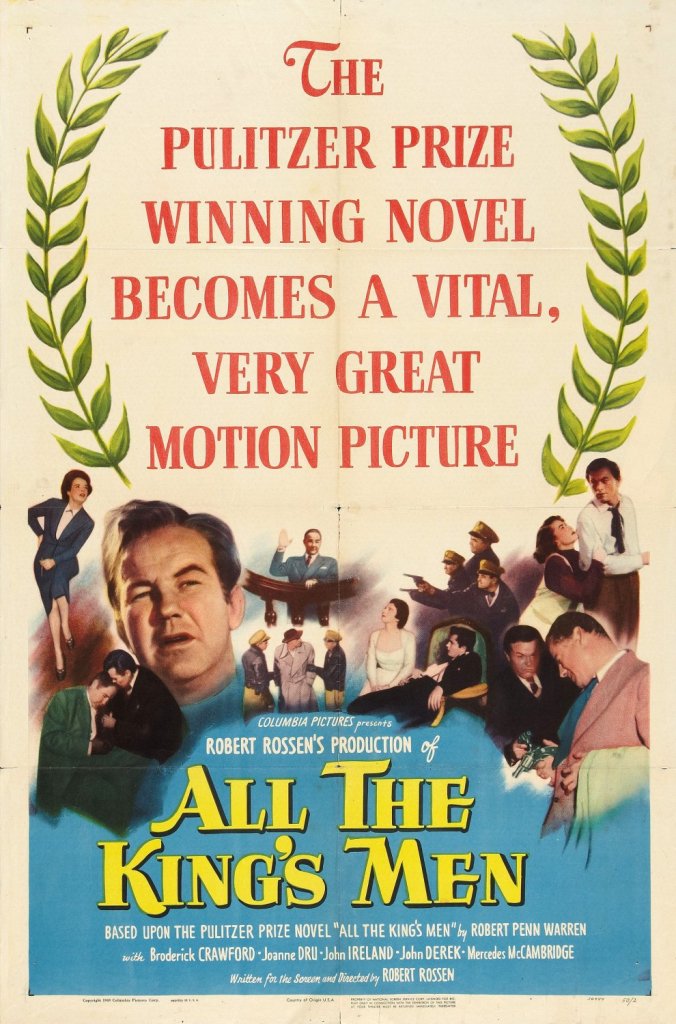
The Plot: Newspaper reporter Jack Burden (John Ireland) is assigned to write about Willie Stark (Broderick Crawford), a small town political hopeful with an anti-corruption platform. Jack sees Willie as a man who speaks the truth on behalf of the people, and joins his campaign. Aided by his ruthless campaign manager Sadie Burke (Mercedes McCambridge), Stark rallies the citizens of his state behind him and gets elected governor. As Stark gains power, he becomes just as corrupt as his predecessors, and everyone around him becomes equally amoral. It’s a tale of power and money, and may or may not be based on Louisiana political powerhouse Huey Long

Why It Matters: The NFR gives a rundown of plot and Oscar wins, with the only commentary being that director Robert Rossen “injects a note of ambiguity” into the characterization of Willie Stark.

But Does It Really?: As happens from time to time on this blog, my viewing of “All the King’s Men” set off my sixth sense that something was amiss. Typically this is either the film’s production woes or some meddling with the source material. Turns out that for “All the King’s Men”, it’s both. While not a bad movie by any stretch, “King’s” suffers from its deletions, be they elements from the original novel or scenes from the final film. The result is a bit muddled and confusing, but you see the remnants of good work throughout, especially by Crawford and McCambridge. I’m still on the fence regarding this film’s NFR standing, but “All the King’s Men” has enough political bite to warrant a viewing 70 years later.

Wow, That’s Dated: Mostly the more dated aspects of politics, such as whistle stop train tours, and corruption being viewed as an anomaly rather than the status quo.

Title Track: The title, of course, is derived from “Humpty Dumpty” (who, like Willie Stark, had a great fall). The title is also likely a reference to Huey Long’s “Every Man a King” slogan, as well as his nickname “The Kingfisher”.

Seriously, Oscars?: “All the King’s Men” entered the Oscar race with seven nominations, one behind that year’s leader, “The Heiress“. While the awards were pretty evenly handed out amongst “The Heiress”, “Twelve O’Clock High” and “A Letter to Three Wives”, “King’s” managed three big wins: Actor for Crawford, Supporting Actress for McCambridge, and Best Picture. “King’s” is one of the rare Best Picture recipients to not win for its director or screenplay.

Other notes 

  • “All the King’s Men” novelist Robert Penn Warren was open about Willie Stark being largely based on Louisiana Governor (later Senator) Huey Long. Both Long and Stark began as small town lawyers, lost their first major political race, won a later race by highlighting class divisions, and were assassinated on the steps of their State Capitol. Warren did, however, refuse to declare his book either a praise or condemnation of Long, stating, “For better or worse, Willie Stark was not Huey Long. Willie was only himself.”
  • This movie was filmed partially in my hometown of Stockton, California. Willie’s victory speech is given at the landmark Hotel Stockton, and the Stockton Courthouse was used for the final scene. It’s always nice to be able to mention one of Stockton’s more positive claims to fame rather than, ya know, all the other stuff.
  • Because of political neutrality in films during the Production Code era, there is no specific mention of Stark’s political party, nor the state he becomes governor of. I’ll go ahead and say he’s from West Dakota, running as part of the Donner Party. Every Man an Entrée!
  • There are a lot of political moments in this film that ring true in a modern viewing (Check the publication date on this post: you’ll see where I’m coming from). “King’s” is further proof that the problems regarding American politics are eternal, and that one candidate can go a long way based on how loudly they speak and how much they can whip their followers into a frenzy. Side note: no matter how enthusiastic you are for your candidate, torches are never a good look for a crowd.
  • I liked Mercedes McCambridge a lot in this film. Primarily a radio actor, McCambridge is making her film debut here, playing a rarity in 1949: a woman driven more by her career than any man in her life. Although Sadie doesn’t have a lot of screentime, McCambridge is always compelling to watch whenever she pops up.
  • As with any film adaptation of a novel, “King’s” has its share of alterations. The main one is the focus away from Jack Burke and more towards Willie Stark (Jack himself even states “I’m not the hero of this piece”). Also missing is most of the seedier aspects of the novel, either deleted outright or alluded to with characters talking in half sentences. “Are you saying he was a…”
  • My suspicion that these montages are comprised of deleted scenes was correct. Robert Rossen’s original cut was over four hours long! Rossen instructed editors Al Clark and Robert Parrish to find the pivotal moment of each scene, and cut 100 feet from either side (roughly 2 minutes of film). This brought the final cut down to 110 minutes, and explains why there are so many quick, jarring cuts throughout the movie. If this film was made today I’m sure there’d be petitions to release the Extended Director’s Cut.
  • Willie Stark puts his name on all of his buildings, and is eventually acquitted from an impeachment. He’s not entirely a Trump metaphor, but damn if he’s not close.
  • Clearly I am not a student of history, as the assassination ending took me by surprise. We get a bit of chaos in the immediate aftermath, followed by Stark’s dying words and a quick fade to black. This ending combines my two frequent notes “What is happening?” and “Wait, that’s it?”

Legacy 

  • “All the King’s Men” has received a few remakes over the years, most notably a 2006 film version with Sean Penn that, despite an A-list roster of talent, failed to make an impact with critics and audiences. As Rotten Tomatoes put it “these Men give Oscar bait a bad name.”  
  • Director Robert Rossen continued to make movies, except when he was briefly blacklisted by HUAC after pleading the fifth, though he did eventually name names. Rossen would go on to make fellow NFR entry “The Hustler“, but retired from filmmaking shortly before his death in 1966.
  • Broderick Crawford became a Columbia contract player following his success in “King’s Men”, and the next year played a similar heavy role in “Born Yesterday“. Crawford spent the next 30 years playing various tough guys on film and TV, most notably on “Highway Patrol”.
  • And of course, Bob Woodward & Carl Bernstein would evoke this film’s title with their book (and future NFR movie) “All the President’s Men“.

Listen to This: Huey Long’s 1935 “Every Man a King” speech was added to the National Recording Registry in 2003. There’s also an essay by special guest writer Christopher H. Sterling.

#511) Apocalypse Now (1979)

#511) Apocalypse Now (1979)

OR “Waiting for Brando”

Directed by Francis Ford Coppola

Written by Coppola and John Milius. Based on the novella “Heart of Darkness” by Joseph Conrad.

Class of 2000 

For this post, I viewed the original theatrical cut. No time for you, French plantation subplot!

The Plot: At the height of the Vietnam War, Captain Benjamin Willard (Martin Sheen) receives a classified mission from the Army and CIA. Colonel Walter Kurtz (Marlon Brando) has gone rogue, commandeering an outpost in Cambodia and waging his own war against the Viet Cong. Willard’s assignment is to find Kurtz and “terminate with extreme prejudice”. A Navy patrol boat escorts Willard down the river, and along the way Willard and the crew encounter various outposts and battles, including a napalm air strike led by Lt. Col. Bill Kilgore (Robert Duvall). As Willard’s boat delves deeper into the jungle rivers, Willard delves deeper into understanding Kurtz’s psyche, illustrating that the mental anguish of war is just as painful as the physical.

Why It Matters: The NFR calls the film a “hallucinatory, Wagnerian project” that “produced admirers and detractors of equal ardor”, but argues that this eclectic reception is a good analogy for the Vietnam War.

But Does It Really?: “Apocalypse Now” is just shy of an untouchable classic for me, a Flawed Classic if you will. Everything about the whole undertaking is impressive and admirable, but ultimately I’m still not sure what this movie was trying to say, about the war or about anything. Maybe the point is there is no point? Regardless, “Apocalypse Now” successfully respects the psychological damage of warfare on our soldiers, while simultaneously making the war a visually stunning event. I would even dare to use pretentious words like “poetic” and “lyrical” to describe this film’s visuals and dialogue. Despite its shortcomings, “Apocalypse Now” is a one-of-kind movie that has more than earned its NFR designation.

Everybody Gets One: An aspiring filmmaker and former USC classmate of George Lucas, John Milius challenged himself to adapt the “unfilmable” novel “Heart of Darkness” to the screen. Rather than keep the book’s setting of turn-of-the-century Congo, Milius transplanted the action to the Vietnam War, keeping the book’s themes of obsession and insanity. “Apocalypse Now” is also the only NFR entry for master cinematographer Vittorio Storaro, who has collaborated with such directors as Bernardo Bertolucci, Warren Beatty and…Woody Allen? Recent Woody Allen? Oh no…

Title Track: Originally called “The Psychedelic Soldier”, John Milius changed the title after remembering a button he had seen worn by hippies that read “Nirvana Now”. Because the film has no opening or closing credits, the title is written on a wall at Kurtz’s temple so the film could be copyrighted.

Seriously, Oscars?: “Apocalypse Now” got mixed notices from the critics, but was one of the highest grossing movies of 1979. At the 1980 Oscars, “Apocalypse” received eight nominations, one behind “All That Jazz” and “Kramer vs. Kramer”, which the film lost most of its categories to. “Apocalypse Now” did, however, take home two deserving awards: Cinematography for Vittorio Storaro and Sound for Walter Murch and his team.

Other notes

  • If you want a detailed account of the film’s legendary production woes, look no further than 1991’s “Hearts of Darkness: A Filmmaker’s Apocalypse”, in which Fax Bahr and George Hickenlooper use Eleanor Coppola’s extensive behind-the-scenes footage to chronicle her husband’s own descent into madness. In brief, among the setbacks Coppola faced during production: Replacing Harvey Keitel with Martin Sheen a week into filming, the destruction of multiple sets from Typhoon Olga, Brando showing up overweight and having not read the book, Martin Sheen suffering a heart attack and being off the film for six weeks, and Coppola struggling to come up with a satisfactory ending. All of these and other events made the film’s budget balloon from $12 million to $31 million, the actual shoot extend to over 14 months, and the film’s scheduled release date of April 1977 pushed back to spring 1978, and then again to August 1979.
  • The opening sequence is a wonderful set-up to the ride we’re in for. Footage of jungles being destroyed by helicopters, mixed with The Doors’ “The End” immediately puts you in the time and place, and Martin Sheen’s instantly dynamic performance makes you question what exactly you’re in for.
  • I always forget that Harrison Ford is in this movie. Harrison filmed his cameo as Colonel G. Lucas (get it?) before “Star Wars” was released, so he was still relatively unknown during production. Also appearing in this scene is the film’s assistant director Jerry Ziesmer, who utters the famous line “Terminate with extreme prejudice.”
  • Among this film’s achievements is that “Apocalypse” never falls into the trappings of your standard war movie. If anything, with its jaded narration and cinematic lighting, “Apocalypse Now” feels more like film noir in the jungle (film vert?).
  • The napalm strike on the Viet Cong is one of the most impressive endeavors of this or any movie. The sheer scope of the attack is so immense, you forget it’s a work of fiction. As awe-inspiring as the sequence is, I found myself genuinely saddened by the total destruction of life and land occurring, juxtaposed with the jingoistic rowdiness of the American soldiers, and all set to Wagner’s “Ride of the Valkyries”. A truly unsettling movie moment in the best way possible.
  • Robert Duvall, man. He embodies Col. Kilgore so thoroughly you buy everything he’s selling. There’s a certain intensity mixed with a cavalier attitude that would make the character hilarious if he wasn’t so terrifying. The “Napalm in the morning” speech is a film highlight, and a perfect cap to Kilgore’s character.
  • This movie has issues with women. There are only a handful, and all of them are either mercilessly killed, called a “bitch” by a man, or both. The only substantial female actor in the movie was Aurore Clément, and she got cut!
  • As we get deeper into the movie, the film becomes more about Willard trying to get inside Kurtz’s head, causing Willard to become a bit mad himself. Sheen’s intense performance is nicely balanced by the work of his shipmates, Frederic Forrest, Sam Bottoms, Albert Hall, and a 14-year-old Laurence Fishburne, who lied about his age to get cast in the movie.
  • Once we arrive at Kurtz’s temple, the film doesn’t stop being good, but it does become a different movie. Perhaps it’s the film’s lack of literal momentum once they’ve reached their destination. One thing that’s definitely helping is Dennis Hopper’s performance as the unnamed photojournalist who has drank the Kurtz Kool-Aid. It’s your standard spaced out Dennis Hopper performance, but with a tinge more fear in it. This is a man in over his head, and he knows it.
  • Like Orson Welles in “The Third Man” or John Huston in “Chinatown“, Marlon Brando’s inherent mystique and star power help carry the dramatic weight and limited screentime of Col. Kurtz. It’s a chilling performance that’s worth the two-hour wait. Also, he swallowed a bug.
  • For those of you keeping score, that’s two Coppola movies in which a character is awakened to find a severed head of someone they know lying next to them. Maybe I should have called this blog “The Chef’s Head”?
  • While still effective, the ending doesn’t fire on the same cylinders as the rest of the movie. For starters, I just watched a water buffalo get slaughtered for real; I’m as unpleased by that as the American Humane Association was. Then, Willard kills Kurtz, takes his writings and just…leaves? I thought the whole point was Willard’s descent into madness; shouldn’t he stay in the jungle and become the Montagnard’s new god? I don’t know what the definitive satisfying ending would be, but there’s something missing. But hey, if I went through what Coppola went through making this movie, I would also end it with the lines “The horror…the horror…”

Legacy 

  • Francis Ford Coppola’s gamble on “Apocalypse Now” paid off handsomely, but his next film, “One From the Heart”, was an expensive flop, leading to a decade of Coppola making more commercial films to keep Zoetrope Studios afloat. While Coppola has never again reached the same pinnacle as “Apocalypse Now”, he still has quite a legacy of films. Plus the winery up in the Napa, so he’s fine.
  • Feeling that he may have cut too much out of “Apocalypse”, Coppola revisited the film in 2001 with “Apocalypse Now: Redux”, which reinstated 45 minutes into the film. In 2019, Coppola went back again, cutting 20 minutes from the “Redux” version for the 40th anniversary Final Cut. And we’re all fine with these changes because the original cut is still readily available (hint hint, Lucasfilm).
  • There have been more faithful adaptations of “Heart of Darkness”, most notably the 1993 TV movie with Tim Roth and John Malkovich.
  • Many, many, many parodies over the years for “Apocalypse Now”, most of them paraphrasing the napalm line or making the film’s subject matter a more light-hearted fare, like this musical!
  • My personal favorite of all the parodies comes courtesy of “Hot Shots! Part Deux”. “I loved you in ‘Wall Street’!”
  • And once again, “Hearts of Darkness: A Filmmaker’s Apocalypse” is a wonderful companion piece to this movie. Even more impressive, Eleanor Coppola paints that unflattering a portrait of her husband, and they’re still together! Talk about #CoupleGoals.

Listen to This: The Doors’ self-titled 1966 debut album made the National Recording Registry in 2015, and appropriately concludes with “The End”.

#510) Duck Amuck (1953)

#510) Duck Amuck (1953)

OR “Keeping Up with the Joneses”

Directed by Chuck Jones

Written by Michael Maltese

Class of 1999


The Plot: Daffy Duck (voiced by Mel Blanc) stars as a swashbuckling musketeer in this Merrie Melodies…at least at first. A few seconds in, Daffy meets his match in an omnipotent animator who keeps erasing and redrawing the duck’s surroundings. Daffy’s patience wears out quickly when this mysterious artist changes everything about him, from his voice to his appearance. With a limitless supply of clever cartooning, “Duck Amuck” asks the question, “Fourth wall? What fourth wall?”

Why It Matters: The NFR calls it “[o]ne of the defining examples of Chuck Jones’ irreverent creativity”, praising Mel Blanc’s vocal performance and the film’s inventive fourth-wall breaking. Also on hand is the Craig Kausen essay that covers all three of Chuck Jones’ NFR entries.

But Does It Really?: While not the most iconic Daffy Duck short of all time, “Duck Amuck” is a fine example not only of Daffy’s character, but also of Chuck Jones’ imaginative animation and respect for his animated stars. Plus, it’s funny and short, two big points in its favor. A pass for “Duck Amuck”.

Wow, That’s Dated: Like everyone else in the ’50s, Daffy Duck appropriates Hawaiian culture by donning a grass skirt and playing “Aloha ‘Oe” on the ukulele.

Seriously, Oscars?: “Duck Amuck” did not receive an Oscar nomination for Best Animated Short. 1953’s winner was Disney’s “Toot, Whistle, Plunk and Boom“, and Warner Bros.’ sole nomination was for “From A to Z-Z-Z-Z“, featuring none of the recognizable Looney Tunes characters. 

Other notes

  • Daffy Duck made his film debut as a bit player in 1937’s “Porky’s Duck Hunt“. His standout appearance led to larger parts, eventually playing the zany foil to the straightlaced Porky Pig. By the time “Duck Amuck” rolled around, Daffy’s… well, daffiness had toned down a bit, replaced with, as film critic Steve Schneider would later call it, “unleashed id”. For the first 52 years of his existence, Daffy was voiced by the legendary Mel Blanc, who felt that the duck’s “extended mandible would hinder his speech”, thus creating Daffy’s lateral lisp.
  • According to Chuck Jones, the general idea behind “Duck Amuck” was to highlight how animation can create characters with distinct personalities. As he put it “Who is Daffy Duck anyway? Would you recognize him if I did this to him?…What if he had no voice? No face? What if he wasn’t even a duck anymore?” The fact that Daffy survives all of these changes throughout the short is a testament to the character.
  • Also dated: Daffy, exasperated from the umpteenth alteration, “What a way to run a railroad.”
  • I’m a bit disappointed that at no point during this short does Daffy utter his catchphrase “You’re deth-spicable!” Surely this animator gave him plenty of reasons to say it.
  • Originally, Chuck Jones was to appear as himself in live-action as the mystery animator. This was later changed to Bugs Bunny, as he was the only Looney Tunes character with any sort of antagonism towards Daffy (their “Duck Season/Rabbit Season” feud began a few years earlier).

Legacy

  • Chuck Jones would revisit this short’s premise two years later in “Rabbit Rampage”, only this time with Bugs being tormented by an animator revealed to be Elmer Fudd (“I finawwy got even with that scwewy wabbit!”).

  • Daffy would exact his own revenge in two later shorts: the “Baby Looney Tunes” episode “Duck Reflucks”, and the New Looney Tunes short “One Carroter in Search of an Artist”.
  • Daffy Duck appears in one other NFR entry: a cameo alongside fellow cartoon duck Donald in “Who Framed Roger Rabbit“. 

#509) The Last Picture Show (1971)

#509) The Last Picture Show (1971)

OR “Texan Graffiti”

Directed by Peter Bogdanovich

Written by Bogdanovich and Larry McMurtry. Based on the novel by McMurtry.

Class of 1998

The Plot: “The Last Picture Show” is a coming of age story about high-school seniors Sonny and Duane (Timothy Bottoms and Jeff Bridges) in 1951 Anarene, Texas. The boys spend most of their days playing pool, going to the local movie house, and trying to lose their virginity. Duane is dating Jacy (Cybill Shepherd), despite the objections of her mother Lois (Ellen Burstyn), and Sonny is having an affair with Ruth (Cloris Leachman), the repressed wife of Sonny’s gym coach (Bill Thurman). Watching all of this unfold is pool house/movie theater proprietor Sam “The Lion” (Ben Johnson), who reflects on how much Anarene has changed in his lifetime. Depressed yet?

Why It Matters: The NFR highlights Robert Surtees’ black and white cinematography, and the cast of stars-to-be, especially the “subtly moving performances” of Leachman and Johnson.

But Does It Really?: I had never seen “The Last Picture Show” prior to this viewing, and I have to admit the film is…fine. Maybe I wasn’t in the right mood, but while I enjoyed “Picture Show”, it didn’t grab me the way its status as a classic suggested it would. The film is several great performances by a cast on the brink of stardom, mixed with two hours of bleak existence for everyone. But hey, if that’s what Bogdanovich et al were going for, mission accomplished. Despite my less-than-stellar viewing experience, “The Last Picture Show” has held firm for 50 years thanks to its cast and aesthetic, and is deserving of its NFR standing.

Shout Outs: The titular last picture show is Howard Hawks’ “Red River“. And keep an eye out for the movie posters of “White Heat” and “Winchester ’73“.

Everybody Gets One: Peter Bogdanovich was a movie buff from an early age, seeing literally hundreds of movies a year, and eventually becoming a film programmer at New York’s MoMA. Inspired by critics-turned-directors like Jean-Luc Godard, Bogdanovich moved to Los Angeles to pursue directing. After a few early films with Roger Corman, Bogdanovich spied a copy of Larry McMurtry’s “The Last Picture Show” in a drug store…and put it back after losing interest. Coincidentally, Bogdanovich’s friend Sal Mineo gave him a copy of the book a few weeks later, telling him he just had to make the movie.

Seriously, Oscars?: “The Last Picture Show” was well received by critics, and tied for most Oscar nominations of the year (8) with “Fiddler on the Roof” and “The French Connection“. “French” ended up taking home the big prizes, but “Last Picture” won the two supporting prizes for Ben Johnson and Cloris Leachman.

Other notes 

  • Special mention goes to Polly Platt: Peter Bogdanovich’s then-wife and collaborator. Credited as the film’s production and costume designer, Platt has been called by many involved with “Last Picture Show” the glue that held the film together. The podcast “You Must Remember This” devotes an entire season to the unsung influence Polly Platt had on everything from “Last Picture Show” to “The Simpsons”.
  • The roster of talent assembled for this movie is incredible, but what’s even more impressive is how no one upstages anyone, nor are there any distracting signs of future stardom. No traces of Cybill Shepherd’s run as a ’70s sex symbol or Jeff Bridges’ future as The Dude; just a bunch of well-cast young actors doing exactly what their roles call for.
  • During filming in Archer City, Texas, Sam Bottoms came to visit his brother Timothy, and Bogdanovich cast him on the spot as Billy, the developmentally disabled boy. This may explain why to this day I still can’t tell you which one is Timothy and which one is Sam.
  • Eileen Brennan doesn’t get a lot to do as diner waitress Genevieve, but it’s a nice 180 from her later, more comedic work.
  • It’s no secret that Peter Bogdanovich and Cybill Shepherd began a romantic relationship during production of “Last Picture Show”. From Jacy’s first introduction in a glossy close-up, you know that Jacy/Cybill is getting the star treatment.
  • The student that Coach Popper slaps on the behind is played by Frank Marshall, the film’s assistant production manager and future producer of “Raiders of the Lost Ark” and “Back to the Future“.
  • At first I cried foul at the idea of Ellen Burstyn playing Cybill Shepherd’s mom, but it turns out Burstyn has 18 years on Shepherd, so it’s appropriate for the characters. Also, as previously mentioned on this blog, I have a thing for Ellen Burstyn, so her performance here is flawless as far as I’m concerned.
  • It’s around the pool party scene (and its bevy of full-frontal nudity) that I realized how, as the kids say nowadays, “thirsty” everyone in this town is. Sex and sexuality is the undercurrent of practically every scene in this movie, and the sex that does eventually take place is awkward and uncomfortable. I feel like the only satisfying ending would be if Rodney Dangerfield shouted “Hey everybody, we’re all gonna get laid!
  • Ben Johnson was hesitant to play Sam the Lion because of the script’s wordiness, but Johnson’s longtime friend John Ford convinced him to take the role. Any trepidation Johnson had over the script is nowhere to be found in his monologue at the fish tank, where Sam the Lion recounts bringing a young lady to the tank 20 years earlier. No flashy theatrics, just a straightforward performance from Johnson as the camera zooms in. It’s definitely a highlight.
  • Things get a lot drearier in the film’s second act, including the unexpected deaths of a few characters, and a brief subplot in which one of the townspeople is accused of pedophilia. I know they’re going for dreary, but they are piling it on. After this, maybe I’ll watch an Ingmar Bergman movie to cheer myself up…
  • I have no interest in slut-shaming Jacy as she sleeps with the various male characters, but I will shame the men (both on and off-camera) who keep objectifying her.
  • Cloris Leachman is so well-known for her pitch-perfect comic acting, it’s easy to forget about her pitch-perfect dramatic acting. Ruth Popper doesn’t get a lot of screentime, but Cloris says so much about the character without speaking a word. When Ruth finally vents her frustrations at Sonny, it doesn’t feel like Oscar-bait theatrics, but rather a justified burst of emotion. I’d give Cloris an Oscar too after that scene.
  • “Last Picture Show” can trace some of its influence to Bogdanovich’s mentor Orson Welles and “Citizen Kane“. In addition to the black-and-white cinematography, both movies have nearly identical openings (static title shot in silence, no credits) and closings (credits with footage of the cast and curiously upbeat music). Unsurprisingly, reviews of “Picture Show” made the same kind of wunderkind comparisons to Bogdanovich that had been made of Welles 30 years earlier.

Legacy 

  • While Peter Bogdanovich would follow up “Last Picture Show” with “What’s Up, Doc?” and “Paper Moon”, his next few films were poorly received (he even publicly apologized for “At Long Last Love”), and his directing career stalled. Luckily, Bogdanovich is still around, and an active advocate for classic films.
  • Once again, “The Last Picture Show” is responsible for some of the biggest movie and TV stars of the last 50 years, including Jeff Bridges, Cybill Shepherd, Timothy Bottoms, Randy Quaid, and Ellen Burstyn.
  • In 1987, Larry McMurtry wrote “Texasville”, a sequel that chronicles the lives of the main characters 30 years after “The Last Picture Show”. In 1990, the novel became a movie that reunited Bogdanovich and most of the original cast. The film received decent reviews, but permanently resides in the shadow of its predecessor. And at no point does anyone explain when exactly Anarene, Texas switched from black and white to color.

#508) Grass: A Nation’s Battle for Life (1925)

#508) Grass: A Nation’s Battle for Life (1925)

OR “The Iranian Trail”

Directed by Merian C. Cooper & Ernest B. Schoedsack

Written by Richard P. Carver & Terry Ramsaye

Class of 1997 

Here’s a modern trailer for the film

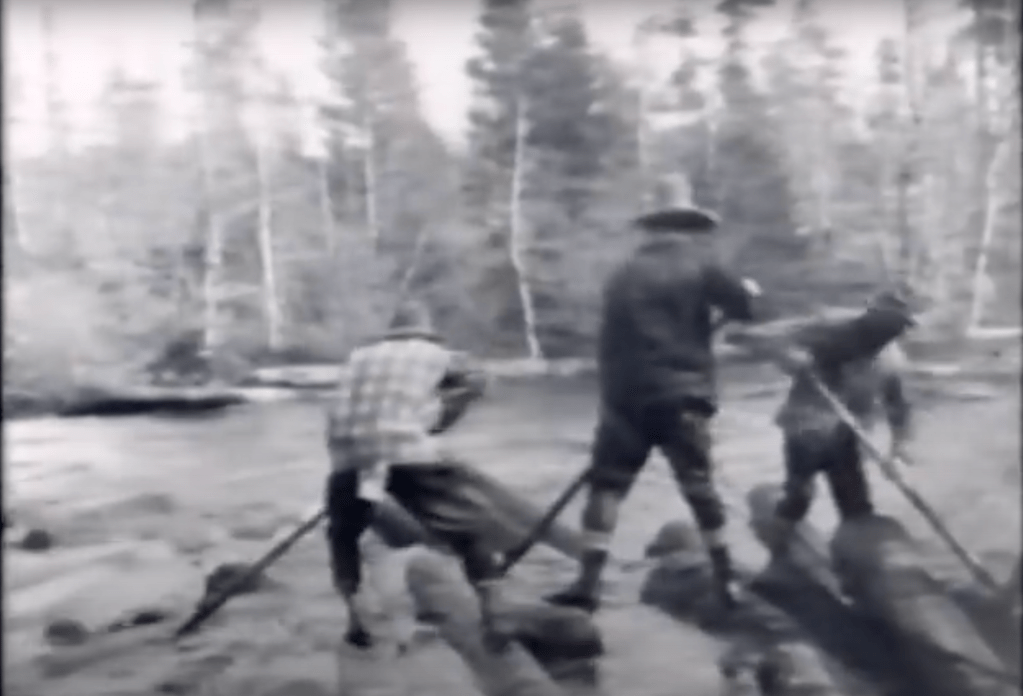
The Plot: Eight years before they gave us filmdom’s quintessential stop-motion ape, Merian Cooper & Ernest Schoedsack – along with adventurous socialite Marguerite Harrison- gave us a real-life story of the Middle East, and one of the first documentary features in American film. “Grass” chronicles the Bakhtiari (often referenced here as “The Forgotten People”) of Persia as they migrate from the arid summer heat to literally greener pastures. Led by Haidar Khan, the tribe spends 48 days migrating with thousands of people and animals. Cooper, Schoedsack and Harrison document all the tribulations, including the crossing of the Karun River, and the scaling of Zard Kuh, one of the highest peaks in the Middle East.

Why It Matters: The NFR gives a brief run-down, calling the film “[o]ne of the earliest ethnographic documentaries”. A more detailed appreciation for “Grass” comes from the accompanying essay by Denis Doros, co-founder of Milestone Films, which currently owns the rights to “Grass”.

But Does It Really?: While not on anyone’s shortlist of greatest documentaries, “Grass” stands on a unique piece of ground in what it’s presenting and how it’s being presented. While I don’t care for the film’s constant exoticizing of Persian (now Iranian) culture, this is definitely a story worth telling. The adventure Cooper, Schoedsack and Harrison had to get this movie made is just as exciting as the adventure they’re recording. A yes for “Grass” and its NFR induction.

Shout Out?: Some sources state that Cooper and Schoedsack were inspired to make the film after seeing “Nanook of the North“, while other sources say the two were unaware of the film’s existence until after they returned from filming in Persia. 

Everybody Gets One: Marguerite Harrison was born into Maryland’s social elite, but as an adult defied convention by marrying a man without money. After her husband’s sudden death, Harrison became a reporter for the Baltimore Sun. During the first World War, women were not allowed to be war correspondents, so Harrison used a connection in the War Department to enlist as a spy, even serving 10 months in a Russian prison! During the war, Harrison met Merian C. Cooper, then a fighter pilot for the U.S. Air Force, and years later helped fund and produce “Grass”.

Wow, That’s Dated: Mainly the geography. Angora (where they start their journey) is now Ankara, Turkey, and the Bakhtiari land in Persia is now the Chaharmahal and Bakhtiari Province of Iran.

Other notes 

  • “Grass” came about when Schoedsack and Cooper were looking for a project to work on that would give them the kind of adventure they had during the war. With Marguerite Harrison, the trio traveled to Turkey with the intention of filming the Kurdish people of then-Upper Mesopotamia . When that footage was deemed unsatisfactory, Harrison had her friend, the archaeologist Gertude Bell, introduce them to the Bakhtiari tribe. After months of negotiations and trust-gaining, the Bakhtiari agreed to let Cooper, Schoedsack and Harrison join and film their journey, making them the first non-Bakhtiari to make the trek.
  • Historian Terry Ramsaye was brought in to write the intertitles, and is clearly having fun giving the trip an epic, poetic description. For the record, Marguerite Harrison hated these intertitles, calling them “old-fashioned and hokey”.
  • Right out the gate I got problems with this movie’s emphasis on colonization. The opening title cards state that “the way of the world is west” and specifically mentions Aryans. Uh-oh.
  • The first part of the film is the journey from Angora to the Bakhtiari, which involves its own set of hurdles, including a sandstorm. All in all, this film isn’t so much a documentary as it is a travelogue. It’s like someone found the dramatic core of your vacation slides.
  • Once again, the key to a good movie is always include a puppy, even if it’s just for a second.
  • Easily the most impressive segment of the film is the Karun River crossing. Watching these people travel down the river with only the supplies on their backs is simply incredible. My one question: How are they filming this? If I find out that Cooper and Schoedsack had a motorboat this whole time…
  • Speaking of, it turns out Schoedsack’s trip was a bit more harrowing than Cooper’s or Harrison’s. At the end of each day, Schoedsack would travel ahead of the migration and plan out the next day’s shoot, meaning that he typically faced each of these hardships before everyone else.
  • Someone is clearly having fun with these intertitles. Shots of the sheep being prepared to cross the Karun are accompanied by several animated “Baa!” intertitles. The actual crossing by the sheep features the commentary “Every where that Mary went…”
  • If this film were made today it would be a NatGeo documentary narrated by…I’m gonna say Shohreh Aghdashloo.
  • The film’s finale is an almost vertical climb by the Bakhtiari up and over Zard-Kuh to their final destination. Once again, the intertitles emphasize the extreme conditions: “Barefoot! Barefoot through the snow!” This intertitle sounds like it was written by my grandparents.
  • The group’s arrival to the titular grass is worth the wait, especially that wide shot with the entire migration in a long, winding line that stretches seemingly forever.
  • I can’t get over that this migration took 48 days! And they did this every year! The river crossing alone took three days!

Legacy 

  • Upon completion, “Grass” played the lecture circuit, with Cooper providing live narration. A presentation at a private dinner party caught the eye of Paramount executive Jesse Lasky, who bought the distribution rights. “Grass” became one of the few non-fiction films of the era with a studio-backed wide distribution.
  • In additon to “King Kong”, Merian Cooper and Ernest Schoedsack would go on to give us future NFR entry “This Is Cinerama”. What I wouldn’t give to see the Bahktiari make their journey in color, sound, and a curved widescreen.
  • While Marguerite Harrison never made another film, she went on to found both the Society of Women Geographers and the Children’s Hospital of Baltimore.
  • The Bahktiari still exist, though like so much of Iranian culture, much of their practices were upturned following the Iranian Revolution of 1979.  While a small population of Bakhtiari still make this annual migration, trucks are used to transport the livestock.
  • According to his son Lufta, Haidar Khan died of yellow fever one year after the events of “Grass”.
  • There have been a few other films that attempted to document the Bakhtiari trek, including 1973’s “The Ascent of Man” and 1976’s “People of the Wind”.