
#70) Lady Windermere’s Fan (1925)

MV5BNTQ3Yjg5YmItMjQyOC00ZDA2LTk4MzUtYzExNTkyOWZkOTA5XkEyXkFqcGdeQXVyMDI2NDg0NQ@@._V1_SY500_CR0,0,720,500_AL_

#70) Lady Windermere’s Fan (1925)

OR “Wilde Abandon”

Directed by Ernst Lubitsch

Written by Julien Josephson. Based on the play by Oscar Wilde.

Class of 2002

The Plot: Stay with me folks. Lord Windermere (Bert Lytell) is married to Lady Windermere (May McAvoy), who is being secretly wooed by Lord Darlington (Ronald Colman). Meanwhile Lady W. thinks Lord W. is having an affair with Mrs. Erlynne (Irene Rich). In reality, Erlynne is Lady Windermere’s mother, presumed dead after abandoning her family. Lord Windermere is being blackmailed by Erlynne to keep her secret from her daughter. At the same time Erlynne is being pursued by Lord Augustus Lorton (Edward Marindel) who knows nothing about what’s going on. Everything comes to a head at Lady Windermere’s birthday party, where a certain fan plays a key role.

Why It Matters: The NFR praises Ernst Lubitsch’s ability “to translate Wilde’s witty play into a successful silent film”. There’s also an essay by silent film expert and UC Davis professor Scott Simmon. Go Aggies!

But Does It Really?: As much as I enjoyed this film, its NFR inclusion gets a “meh” from me. The film is very impressive as an exercise in translating a very wordy play into a much more visual film, but a classic worth preserving? I don’t know. We’ll see more of Lubitsch throughout this list. In the meantime I’m staying on the fence about all this.

Everybody Gets One: Screenwriter Julien Josephson made a career out of adapting plays and novels into films, earning an Oscar nomination in 1930 for his film translation of the play “Disraeli”. He also wrote the screenplay for the Shirley Temple version of “Heidi”. With the exception of Ronald Colman, most of this cast did not survive the end of the silent era.

Wow, That’s Dated: I don’t think I’ll ever truly understand English high society of the 1890s, er…1920s. Make up your mind, movie!

Other notes

  • Not only does the film eliminate all of Wilde’s dialogue, it reveals that Mrs. Erlynne is the mother almost immediately. You had to wait until the end of the second act to find that out in the play. On top of this, the first half hour of the film isn’t even in the play!
  • Pretty gutsy to call your film a “Classic of the Screen”. I’ll be the judge of that, thank you.
  • Hey, no means no, Darlington!
  • You can’t sign a letter “Yours Very Truly” when you’re blackmailing someone.
  • Mom kinda looks like Diana Rigg.
  • The version of this film that I saw openly samples “Ascot Gavotte” from “My Fair Lady” during the horse race scene. Lerner & Lowe expect a royalty check.
  • Speaking of, when did horseracing go from the sport of the upper class to a place where deadbeats go to have their dreams crushed?
  • No fair Lubitsch, you can’t fade to another shot while in binocular mode! What kind of “Lubitsch Touch” is that?
  • I appreciate how much of this film I understand without having to rely on title cards. Everything I need to know is being told visually.
  • May McAvoy does wide-eyed stare very well. It’s like she’s a deer in the headlights, and she’s pissed about it.
  • Erlynne strikes me as the mom who would try to pass her and her daughter off as sisters. It probably helps that in real life, these two actresses are only eight years apart.
  • This film perfectly showcases how farce on film is all about perspective. We need to see what each character sees and how that specific point of view misconstrues the situation. We have to understand the misunderstandings.
  • Are all the doors in Darlington’s house huge or is everyone just really small?

Legacy

  • “Lady Windermere’s Fan” has been adapted for film on several occasions, most notably 1949’s “The Fan” and 2004’s “A Good Woman”.
  • That other great British wit Noel Coward turned this play into the 1954 musical “After the Ball”.
  • This mathematical nonsense.
  • Had Oscar Wilde lived to see this adaptation throw away all of his dialogue, he probably would have said “I have nothing to declare except, ‘This blows!’”

#69) The Tell-Tale Heart (1953)

tell-tale_002

#69) The Tell-Tale Heart (1953)

OR “UPA: Unique Poe Adaptation”

Directed by Ted Parmelee

Written by Bill Scott and Fred Grable. Based on the short story by Edgar Allan Poe.

Class of 2001

https://www.youtube.com/watch?v=x8evph2fw4Y


The Plot: James Mason lends his voice to this Edgar Allan Poe classic about an unreliable narrator who murders “the old man” due to his obsession with the man’s slightly deformed eye. He has committed the perfect murder, but will his conscience let him get away with it?

Why It Matters: The NFR mentions Ted Parmelee’s directorial work, as well as the animation of Paul Julian and Pat Matthews, and James Mason’s narration. Interestingly, there are no superlatives (good or bad) regarding any of the work done by the aforementioned. The description just says they worked on the film. Weird.

But Does It Really?: “The Tell-Tale Heart” is a young animation studio proving that it can not be pigeonholed as the studio of “Gerald McBoing-Boing” and “Mr. Magoo”. The film succeeds in not only being a new style of animation for UPA, but also in being very creepy. I give it a pass, and cite it as the reason I’m not sleeping tonight.

Wow, That’s Dated: The whole film has a surrealistic, moving storyboard feel to it. Very ‘50s.

Seriously, Oscars?: “The Tell-Tale Heart” was nominated for Best Animated Short, losing to Walt Disney’s significantly less scary cartoon “Toot, Whistle, Plunk and Boom”. This was one of four Oscars Walt Disney won that night, which is still the record for a single night.

Other notes

  • Even the credits are unsettling.
  • Is there a better marriage between actor and text than James Mason and The Tell-Tale Heart? This performance is a serious example of why the Oscars need a voice-over category.
  • Anyone know who the other voices in this short are?
  • Did you know that Edgar Allan Poe wrote the original “Tell-Tale Heart” on a dare? That’s not true, but wouldn’t it be amazing if it were?

Legacy

  • The Tell-Tale Heart has been adapted for film many times, but any version longer than this one is just Padding City.
  • This diorama;

Further Viewing: This is as good an excuse as any to mention Eddie Izzard as James Mason as God. It’s towards the end of this clip, but it always makes me laugh.

https://www.youtube.com/watch?v=gTRjWDW3JSg

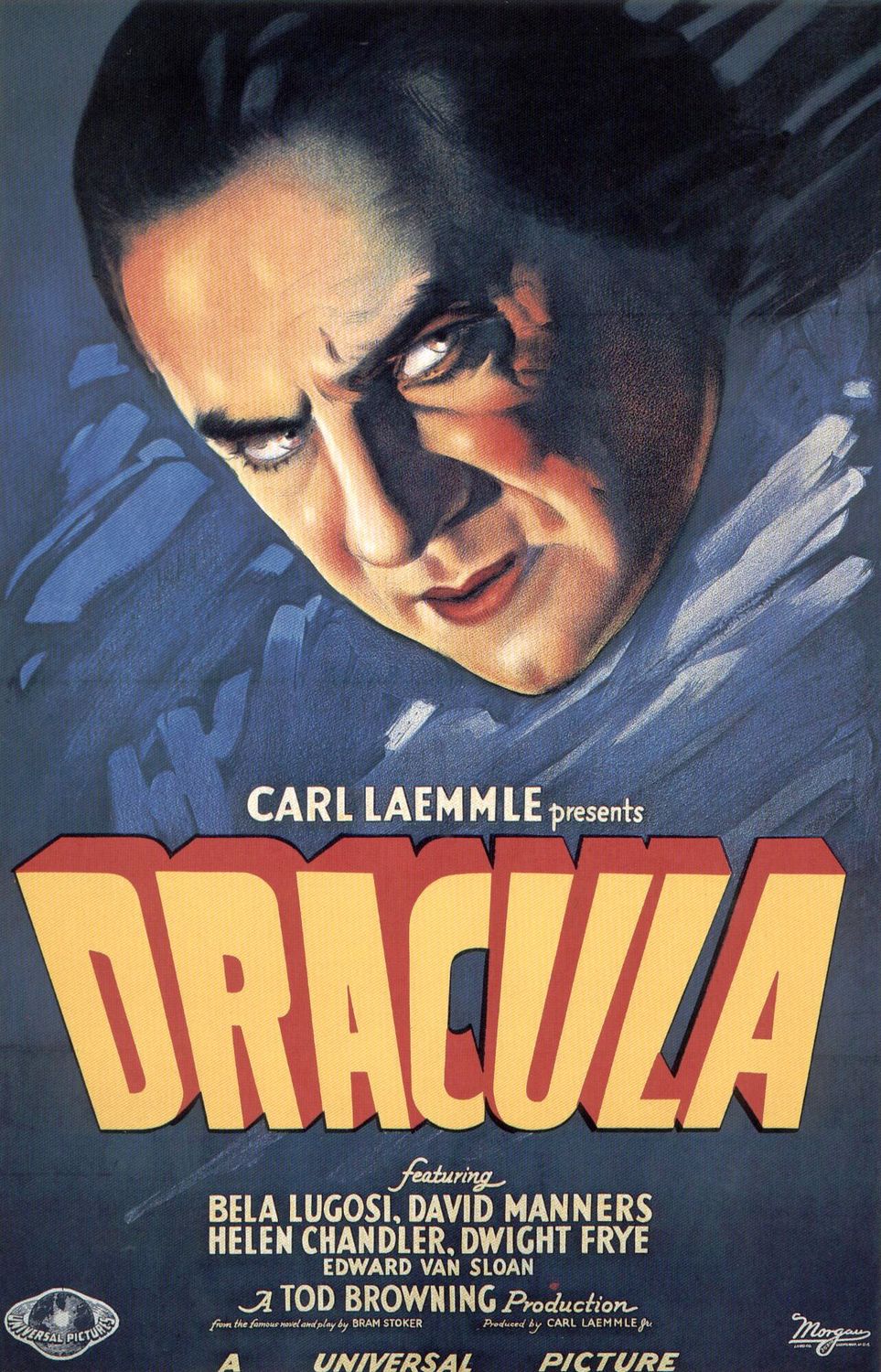
#68) Dracula (1931)

dracula_xlg

#68) Dracula (1931)

OR “The Man Who Bites”

Directed by Tod Browning (and possibly Karl Freund)

Written by Garrett Fort. Based on the novel by Bram Stoker and the play by Hamilton Deane and John L. Balderston.

Class of 2000

The Plot: Bela Lugosi is Count Dracula, a Transylvanian vampire who must drink the blood of the living. Assisted by his servant Renfield (Dwight Frye), they travel to London to settle the lease on an Abbey next to the local sanatorium. The Count falls for the doctor’s daughter Mina (Helen Chandler) and plans to make her his next bride. But Doctor Van Helsing (Edward Van Sloan) suspects Dracula’s vampire habits while studying the mysterious deaths that have happened since Dracula arrived.

Why It Matters: The NFR praise Browning, cinematographer Karl Freund, art director Charles D. Hall, and of course, Lugosi for “the ultimate vampire characterization”. Also included is an essay by Lugosi and Browning expert Gary Rhodes.

But Does It Really?: Oh of course. You cannot think of Dracula or any other vampire without thinking of Bela Lugosi’s performance. On top of that, the entire film has a wonderfully creepy vibe to it, thanks to its effective lighting and almost entirely absent soundtrack. 86 years later, “Dracula” can still elicit some serious chills.

Everybody Gets One: Actors Helen Chandler, Frances Dade and David Manners, the latter whom claimed never to have seen the final film.

Wow, That’s Dated: The film is done on such a cheap budget I can’t tell if it’s supposed to be the 1890s or the 1930s. So who’s to say what’s accurate and what isn’t?

Take a Shot: They say the Count’s name a lot. Don’t make this a drinking game.

Seriously, Oscars?: Despite its critical and commercial success, “Dracula” received zero Oscar nominations. The Academy gave a few nods to a similarly haunting film from 1931: Warner Brothers’ “Svengali” starring John Barrymore.

Other notes

  • Why Swan Lake at the beginning?
  • Ah yes, the native armadillos of Transylvania.
  • In addition to playing Renfield, Dwight Frye plays Dr. Frankenstein’s assistant Fritz in that Universal classic. There’s just something about the way he says “master” that just feels right.
  • Nope, definitely not a model of a ship, and it’s definitely being hit by regular sized waves.
  • The London newspaper is just called “The”?
  • Does Dracula not have eyelids?
  • When I die, please let it not be in an operating theater.
  • Special mention to Charles K. Gerrard and his bizarre comic relief performance as Martin, the sarcastic Cockney attendant at the sanatorium.
  • Can bats hover?
  • This film features very few special effects, but it gets the point across with clever editing and camera shots. Very effective.
  • Van Helsing kinda looks like Al Pacino in “You Don’t Know Jack”.
  • Helen Chandler’s natural South Carolina accent slips through a couple of times throughout the film.
  • In case you forgot, It’s a Universal Picture!

Legacy

  • Every Dracula you have ever seen is taking something from Bela Lugosi’s performance. Now that’s a legacy.
  • While helping establish the Universal Horror Series, “Dracula” only had two direct sequels; 1936’s “Dracula’s Daughter” and 1943’s “Son of Dracula”.
  • Dracula has been adapted for screen many times over the years, but the stage version this “Dracula” is based on got a Broadway revival and remake in the ‘70s with Frank Langella.
  • Last I checked, Dracula was dead…and loving it!
  • And of course, Blacula.

Further Viewing: It was common practice at the time for studios to film foreign-language versions of their films with different casts at the same time. The Spanish-language version of “Dracula” eventually found its own place in the NFR. Read my observations on that version here.

#67) Do the Right Thing (1989)

dj_simsa_do_right_thing_640

#67) Do the Right Thing (1989)

OR “Long Day’s Heat Wave Into Night”

Directed & Written by Spike Lee

Class of 1999

The Plot: “Do the Right Thing” centers around a diverse neighborhood in Brooklyn on one of the hottest summer days on record. Mookie (Spike Lee) works for Sal (Danny Aiello) at his pizzeria, but constantly clashes with Sal’s hothead son Pino (John Turturro) over their racial differences. Meanwhile neighborhood drunk Da Mayor (Ossie Davis) tries to woo Mother Sister (Ruby Dee), while Buggin’ Out (Giancarlo Esposito) attempts a boycott of Sal’s over the lack of African-Americans on his Wall of Fame. As the temperature rises and “Fight the Power” blasts from the boombox of Radio Raheem (Bill Nunn), the racial tension reaches a boiling point.

Why It Matters: The NFR calls it “provocative” and praises Lee and his cast. An essay by film critic David Sterritt discusses, among other things, why the film was so divisive in its day. “Do the Right Thing” was included in the NFR after the minimum 10-year eligibility period.

But Does It Really?: Yes! Dear God Yes! This film says so much about racial tension in this country, and unfortunately a lot of it is still relevant (perhaps even more so today than in 1989). Like so many of Lee’s films, “Do the Right Thing” is not here to entertain you. It is here to wake you up, shake you, and remind you that all is not right with the world. Like any film that really wants to you to learn something, it doesn’t actually give a lesson or a resolution. “Do the Right Thing” shows you all sides, points out the shades of gray in the middle, and asks you to think about what “the right thing” really is.

Shout Outs: Brief references to “The Godfather” and “Planet of the Apes”, plus a revised version of the “Love/Hate” speech from “The Night of the Hunter”.

Everybody Gets One: A large selection of the film’s supporting cast, most notably Giancarlo Esposito and Rosie Perez. And yes, that’s Martin Lawrence making his film debut. Truly, everybody gets one.

Wow, That’s Dated: There’s a lot of 1989 culture in this one. From Air Jordan to Roger Clemens to boom boxes the size of a Hummer. Plus, perhaps the most dated reference, a diverse Brooklyn.

Title Track: The great Ossie Davis tells Spike Lee to “always do the right thing”.

Seriously, Oscars?: “Do the Right Thing” was praised by many critics and was a success upon its release. The Academy gave it two nominations – Original Screenplay for Lee and Supporting Actor for Aiello – but gave the bulk of that year’s Oscars to “Driving Miss Daisy” instead. Lee was pretty upset about not getting a Best Picture nomination over a film that served racial tolerance with a more genteel hand. He predicted that in the future, “Do the Right Thing” would be the more discussed film between the two. If the NFR is any indication, he’s on to something.

Other notes

  • Speaking of the Oscars, a film with this many African-Americans in it and they give the acting nomination to a white guy. Some things never change.
  • This film introduces up to Rosie Perez. And that opening credits sequence is one hell of an introduction.
  • The easiest way to win me over is to have your lead character shout “Hell no!” to some Jehovah’s Witnesses. I like you, Mookie.
  • In addition to ongoing racial tensions, this film correctly predicted global warming.
  • Sal says that he only puts Italian-Americans on the wall. I hate to break it to him, but Sophia Loren is just Italian.
  • Quick drive-by cameo from Frank Vincent. He must be on his way to beat up Joe Pesci.
  • Shoutout to cinematographer Ernest Dickerson. There’s a lot of great camerawork being done here that demands a second viewing. For starters, a lot of these scenes are played out in one continuous take, but the shots are dynamic enough not to make the scene static, but also not flashy enough to call attention to themselves. It’s an impressive balancing act.
  • I also really like how many of the scenes feature other major characters in the background. It really gives the sense of a small neighborhood where everybody’s on top of each other.
  • Piragua guy courtesy of “In the Heights”.
  • Today’s history lesson; the graffiti behind Mookie and Jade that reads “Tawana Told the Truth”.
  • Oh my god I can’t believe they mention Donald Trump in this film. For you future historians, this was back when he was just a punchline in the late 80s, rather than Death, Destroyer of Worlds. [Side note to future readers: How’s Kathy Griffin doing?]
  • I promised myself that I would confess to you, the reader, if any film on this list made me cry. And I will admit that I cried at the death of [Name Redacted].
  • As always, Samuel L. Jackson is the voice of reason. I’m still not convinced that this film has a message, but if it does, I bet it’s “Chill!”

Legacy

  • Spike Lee’s next film “Jungle Fever” brings back pretty much the entire cast of this film, including the exact same police officer characters!
  • This shout-out on “The Critic”.
  • For some reason, “Do the Right Thing” has yet to spawn an attraction at any of the Universal Studios Theme Parks worldwide.
  • And of course, every “Spike Lee Joint” since then. We’ll see more from Mr. Lee when we take a look at “Malcolm X”.

Listen to This: The film’s main theme “Fight the Power” can be heard on Public Enemy’s third album “Fear of a Black Planet”, one of the most successful and influential hip hop albums of all time. “Fear” made it into the NRR in 2004, being hailed for its “new sound” and for its “coupling of a strongly political message with hip hop music.” I’m just glad that someone finally called out John Wayne on his shit.

https://www.youtube.com/watch?v=39ROZ3fzNbA

#66) Tacoma Narrows Bridge Collapse (1940)

TACOMA NARROWS BRIDGE

#66) Tacoma Narrows Bridge Collapse (1940)

Filmed by Barney Elliot

Class of 1998

As far as I know, the footage preserved in the Library of Congress is this color footage of the collapse (minus the bizarre music selection).

Bonus version: This version is in black & white, but includes the kind of commentary we expect from ‘40s newsreels. And you think they sensationalize the news nowadays.

https://www.youtube.com/watch?v=nFzu6CNtqec

The Tacoma Bridge was one of the largest suspension bridges in the United States upon its completion in July 1940. On November 7th, the bridge (nicknamed “Galloping Gertie” by builders and public alike) collapsed during a strong wind. Local camera shop owner Barney Elliot captured the collapse on his 16mm camera. While not the greatest disaster in American history (there was only one casualty; a dog), the footage of the collapse is worth preserving. If nothing else it’s a good lesson for all you aspiring architects out there. You can find more information on the bridge and its history here.

Legacy

  • World War II prevented the bridge from immediately being rebuilt, but the good people of Tacoma finally got a new bridge in 1950.
  • IMDb only lists of handful of films that have featured clips of the collapse, but I’m pretty sure it’s made the stock footage rounds. It should be up there with “Fat Guy Gets Hit with Cannonball”.
  • The production logo at the end of “Drawn Together”. THAT’S where I know this from!

https://www.youtube.com/watch?v=d_Ljgs2YDlQ