#167) Hail the Conquering Hero (1944)

Hail the Conquering Hero (1944)

#167) Hail the Conquering Hero (1944)

OR “Hey, Mr. Sham-Marine Man”

Directed & Written by Preston Sturges

Class of 2015

No original trailer, but here’s a preview from I’m guessing someone’s VHS.

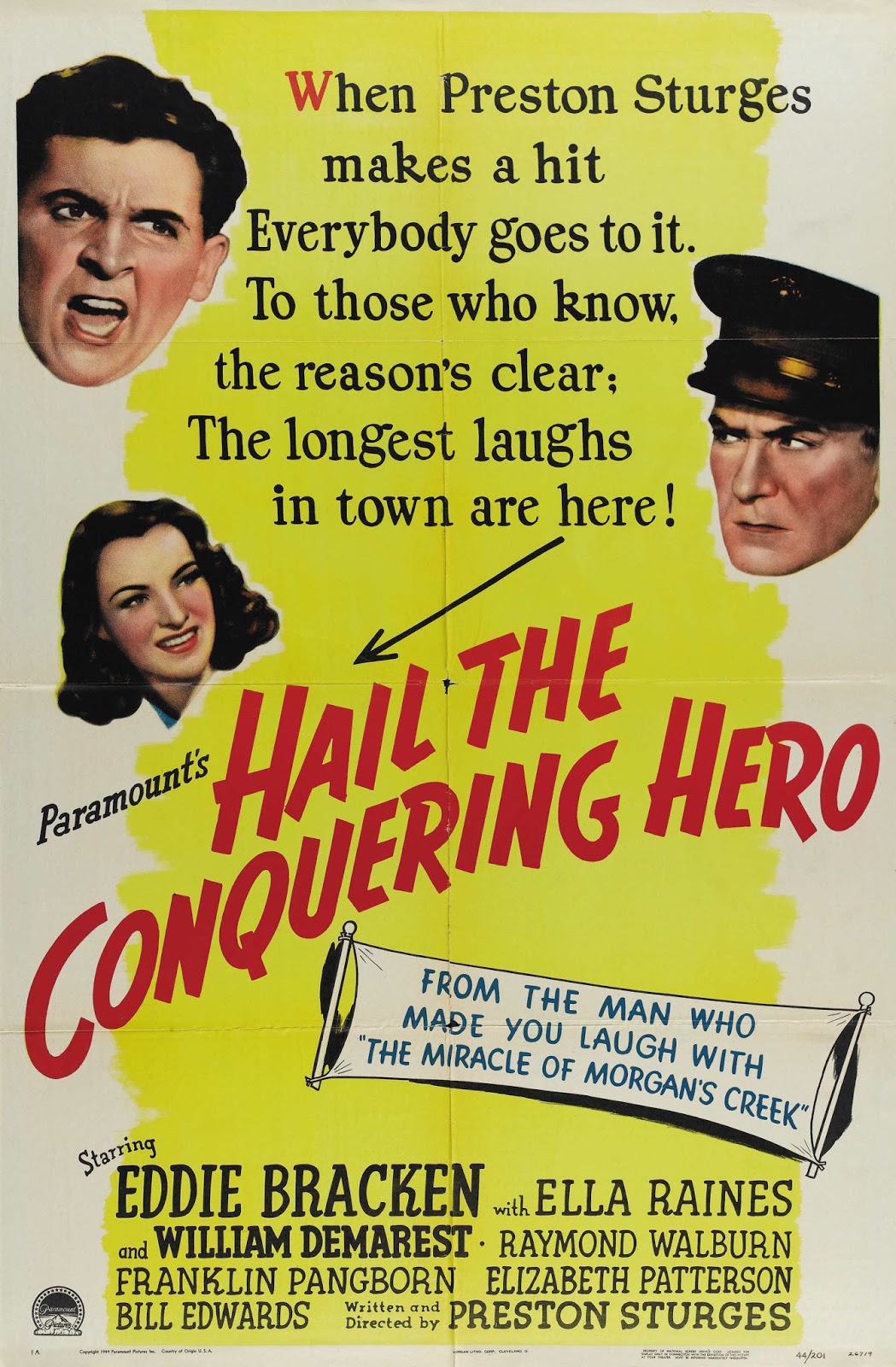
The Plot: Woodrow Truesmith (Eddie Bracken) leaves his small hometown of Oakridge to become a Marine like his late father. Due to his chronic hay fever, he is discharged within a month, and spends a year working in a shipyard while telling his mother (Georgia Caine) that he’s fighting overseas. While commiserating at a bar, Woodrow happens on six Marines led by Sgt. Heffelfinger (William Demarest), who served with Woodrow’s father in WWI. To repay Woodrow for buying a round of drinks, the Marines tell his mother that he received a medical discharge and is coming home. Woodrow is reluctant to go along with the lie, especially when he gets home and finds the whole town cheering his heroism and requesting he run for mayor. Hilarity ensues.

Why It Matters: The NFR claims that Preston Sturges was the rare writer/director of the time who could “satirize the worship of war heroes”. After that, the NFR leaves the praise to contemporary reviews of the film by New York Times critic Bosley Crowther and French critic Andre Bazin. They seemed to like it.

But Does It Really?: It’s not the definitive Preston Sturges film, but it sure did make me laugh. There’s a lot of good stuff in here, from Sturges reliably airtight script to a performance from Eddie Bracken that is equal parts hilarious and heart-warming. The plot snowballs at a hilarious pace and the premise never outstays its welcome. Plus if you think about it, it’s kinda crazy that they got away with very subtly making fun of worshiping our military while we were still in WWII. “Hail the Conquering Hero” is a minor classic to be sure, but a classic nonetheless.

Shout Outs: Look closely in the finale for a poster advertising Sturges’ previous film, “The Miracle of Morgan’s Creek”.

Everybody Gets One: Most of the actors in this film were members of Preston Sturges’ stock company and appear elsewhere on the list. The few “one-and-done” performers include veteran character actor Raymond Wallburn and pin-up girl Ella Raines.

Wow, That’s Dated: Lots of ‘40s slang and WWII references in this one. And, as predicted, there are a few uncomfortable references to “Japs”.

Title Track: There’s one scene 21 minutes in where there is a debate about what song to play when Woodrow comes home. The song “Hail the Conquering Hero” is mentioned several times in a matter of seconds, and then never again.

Seriously, Oscars?: “Hail the Conquering Hero” received one Oscar nomination: Original Screenplay for Preston Sturges. His competition included…himself, additionally nominated for “The Miracle of Morgan’s Creek”. Whether he split the vote or not we’ll never know, but the winner that year was the screenplay for Best Picture-nominee “Wilson”.

Other notes

  • Preston Sturges’ films always seemed to me like Frank Capra films that had leaned in to their comedic elements. Both filmmakers excelled at sweet stories of small town idealism, and while Capra’s are better known today, Sturges’ are a lot funnier.
  • This film is from that point in the ‘40s when Eddie Bracken was your top choice over Donald O’Connor, and not the other way around.
  • Movie bars: where the only thing on tap is “beer”.
  • The scene where Woodrow meets the Marines and tells them about his father is done in one continuous take. Nothing flashy, just the man and his story. And that’s all you need.
  • Woodrow’s father presumably got his nickname “Hinky Dinky” from the WWI song “Mademoiselle from Armentieres”.
  • Franklin Pangborn plays the Committee Chairman, who I’ll just assume is one of them “confirmed bachelors”.
  • Let the record show that Eddie Bracken is only five years older than his on-screen love interest Ella Raines. That’s an inoffensive misdemeanor on the Michael Douglas Scale.
  • Everyone in this town goes to the same church. What is this, “The Simpsons”?
  • Bracken’s reactions, though. They are worth the trip out.
  • Don’t worry about that statue of you, Woodrow. They’ll just tear it down in 75 years anyway.
  • Libby is lit with the Morticia Addams follow-spot.
  • How many wry non-committal one-liners does Forrest need from Libby? She’s. Not. Interested.
  • Werner Heymann’s score sounds like everyone’s going to break into song at any point.
  • Woodrow is very concerned that his will be “an election based on fraud”. That is some low-hanging fruit; you can make your own joke.
  • Woodrow and Libby take a late-night walk during the brightest evening on record. Was there a supermoon that night?
  • Woodrow hatches his plan just as morning breaks. His idea literally dawns on him.
  • “I’m as sane as a Dane.” You’re forgetting about Hamlet, aren’t you?
  • We are informed at the end that people gravitate towards certain politicians simply because they like them. “They don’t need reasons anymore.” This film has way too much vague political talk that can still be applicable today. I guess that’s how you write a classic.

Legacy

  • “Hail the Conquering Hero” was Preston Struges’ last great hurrah as a filmmaker. It was his last film under his contract with Paramount and, no love lost, he jumped ship to become an independent filmmaker. Unfortunately he chose Howard Hughes – already in his post-“Outlaw” decline – as his business partner, and Sturges’ film career never recovered.

#166) The Big Lebowski (1998)

big_lebowski_ver1_xlg

#166) The Big Lebowski (1998)

OR “Farewell, My Rug-ly”

Directed by Joel Coen

Written by Joel & Ethan Coen

Class of 2014

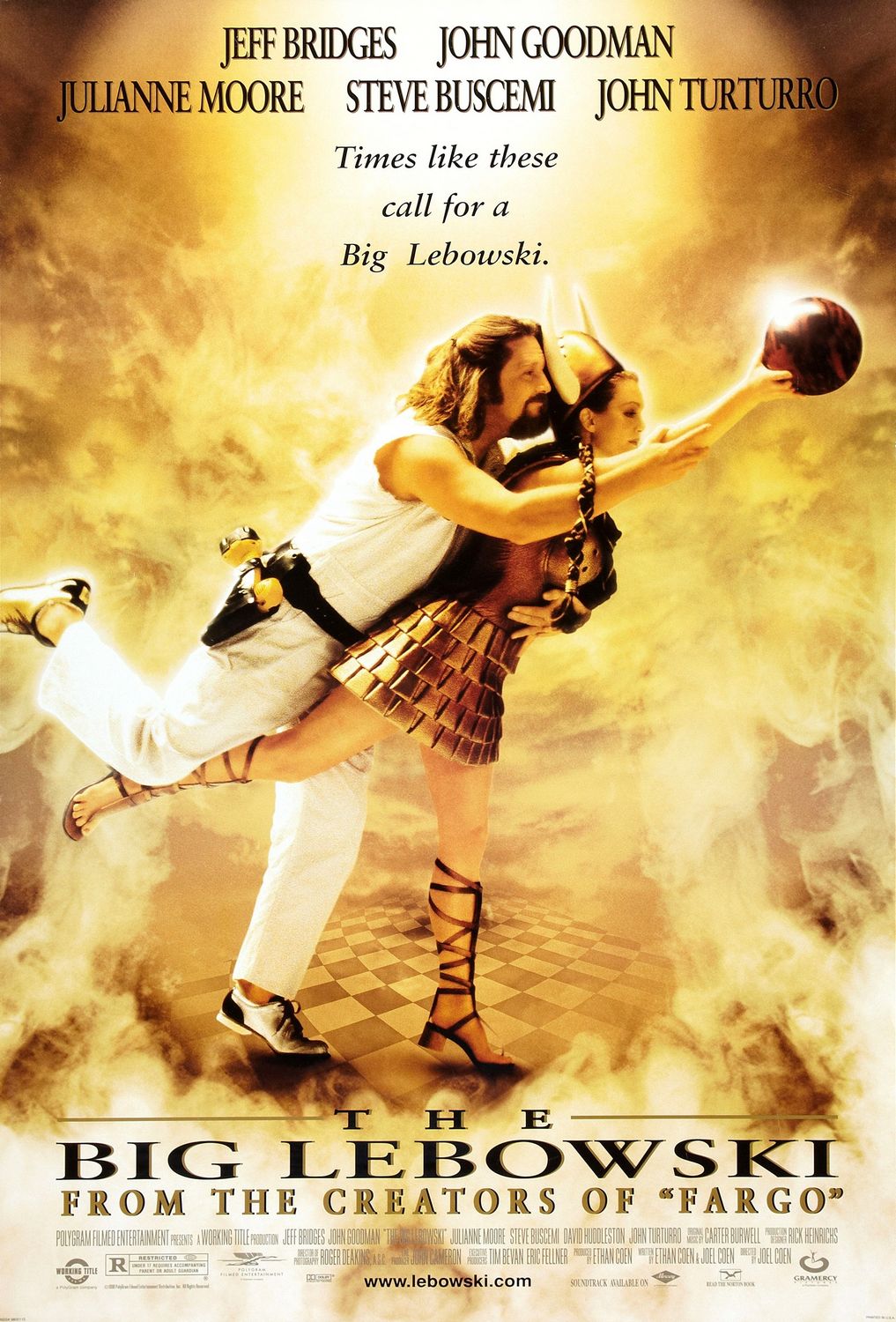
The Plot: The Dude (Jeff Bridges) is an L.A. stoner who shares his real name with local millionaire Jeff Lebowski (David Huddleston). When the Dude is attacked by thugs who think he’s the other Lebowski, he gets mixed up in a plot involving Lebowski’s kidnapped wife (Tara Reid). Along for the ride are the Dude’s friend and angry Vietnam vet Walter (John Goodman), Lebowski’s estranged daughter Maude (Julianne Moore), a bowling tournament, some White Russians, and a rug that really tied the room together.

Why It Matters: The NFR calls the film’s chapters “alternately funny and disturbing”, hails the Coens as “unconventional visionaries” and deems Bridges’ performance “career-defining”. There’s also an essay by J.M. Tyree & Ben Walters, who have written several books about films, including one on “The Big Lebowski”. So, ya know, they’re qualified.

But Does It Really?: While I’m not as fanatic about this film as some are, “The Big Lebowski” is still one of the Coens’ better works. The film’s genre-bending keeps it fresh, with a script that praises Raymond Chandler without being slavish or too uptight. The entire cast is flawless, with Jeff Bridges, like the Dude himself, giving you a lot of layers underneath that laid-back exterior. It’s not the best Coen Brothers film, nor the funniest film ever, but the Dude abides, and “Lebowski” deserves a spot on the list.

Shout Outs: Several noir references throughout, including “Double Indemnity” and Chandler’s own “The Big Sleep”. Plus a nod to “42nd Street“!

Everybody Gets One: Coen Brothers staple John Goodman, Future Oscar Winners Philip Seymour Hoffman and Julianne Moore, early ‘00s It Girl Tara Reid and, via archival footage, President George H.W. Bush.

Wow, That’s Dated: Such late ‘90s relics as answering machines and phone books. Plus the dream sequences include some early CG bowling balls and pins.

Title Track: The Dude refers to “the big Lebowski” just twice throughout the entire film. That’s right, it turns out David Huddleston was the title character this whole time.

Seriously, Oscars?: Well something had to follow “Fargo”. Perhaps this film’s release just a year after the Coens won an Oscar for the “Fargo” screenplay raised the bar too high for “Lebowski”. The film was met with critical and commercial apprehension, leading to zero Oscar nominations. There were, however, a few precursor awards (such as the Online Film Critics Society) that took notice: the first to join the cult of the Dude.

Other notes

  • Co-editor Tricia Cooke is married to Ethan Coen. She shares her editing credit with the elusive Roderick Jaynes.
  • You call them Ralphs, we in the Bay Area call them Foods Co.
  • Bridges performance is fantastic. He really lures you in right from the beginning.
  • This whole post could be me singling out each cast member; they’re all so good. John Goodman practically steals the show from Bridges, Steve Buscemi and Phillip Seymour Hoffman make the most out of parts that don’t spring to life on the page. Julianne Moore gets to play a character so radically different from her other work, David Huddleston finally gets a meaty role after decades of character parts, and don’t even get me started on the meal John Turturro makes of The Jesus.
  • I unapologetically love The Gipsy Kings.
  • This film and “Anchorman” have got to be the most quotable comedies of the last 20 years. Speaking of, when is “Anchorman” coming to the NFR?
  • Shoutout to cinematographer Roger Deakins, especially for the shot from the bowling ball’s point of view. How does he still not have an Oscar?
  • Is Julianne Moore doing a Katharine Hepburn impression?
  • That’s stand-up comic Dom Irrera as the limo driver. “You know me, can’t complain.” His stand-up is pretty solid.
  • Like so many of the recent films on this list, don’t watch “The Big Lebowski” on basic cable. Unless you want to know what happens when you find a stranger in the Alps.
  • Metallica band member Kirk Hammett was pleased that Metallica was referenced in the film, even though the Dude calls the band “a bunch of assholes”. On the flip side, Eagles member Glenn Frey did not appreciate the Dude’s dislike of his music.
  • For all of this film’s quotable moments, the one I’ve used the most is “Stay away from my lady friend”. Don’t ask me why, but that’s the one that sticks.
  • Does Bunnie have “Viva Las Vegas” playing on a loop in her car?
  • Oh Sam Elliott: to be blessed with that combination of voice and moustache. Like the Dude’s damaged rug, Elliott really ties the film together, does he not?

Legacy

  • The film’s fandom and midnight screenings have led to the annual “Lebowski Fest”, a gathering and celebration of all things Lebowski. You don’t see this kind of fandom with “The Last Picture Show”, that’s for sure.
  • Some films have cult followings, “The Big Lebowski” has a religion. Dudeism (aka the Church of the Latter-Day Dude) was founded in 2005 and has its share of followers. Like any new religion, give it 1000 years to catch on.
  • Jeff Bridges’ band The Abiders take their name from one of the Dude’s most iconic lines.
  • “Noodles, we’re in that movie you made me watch.” “Shhhhh. You’re ruining it, like so many other dudes have over the years by quoting it.”
  • While the Coens have vowed to never make a sequel, John Turturro has been given permission to make a film revolving around his character, Jesus Quintana. “Going Places” has been filmed, but no release date has been set, and all we have right now is a Wikipedia page and this photo. What say you, readers from the future?
GP-00284.CR2

Listen to This: “Tumbling Tumbleweeds”, the Stranger’s leitmotif, was the signature song for Roy Rogers’ singing group Sons of the Pioneers. The group first recorded “Tumbling Tumbleweeds” in 1934, and the song found a place on the National Recording Registry in 2010.

#165) Men and Dust (1940)

F3.large

#165) Men and Dust (1940)

OR “Mine Over Matter”

Directed by Lee Dick

Written by Sheldon Dick

Class of 2013

The Plot: Part documentary, part tone poem, “Men and Dust” is an examination of the life of coal miners in the tri-state area (Oklahoma, Kansas, and Missouri). The film looks at what the effect of mining has on the health of not only the miners, but of their families and fellow townsfolk.

Why It Matters: The NFR calls this “a stylistically innovative documentary and a valuable ecological record”. Also included is an essay by film lecturer Adrianne Finelli, who according to this also lives in the Bay Area. Hey Adrianne, wanna grab coffee and talk classic movies sometime?

But Does It Really?: This is an historical yes, primarily for its frank (albeit artistically manipulated) depiction of life in a mining town. It’s an interesting time capsule of an era and its liberal beliefs, plus an introduction to the works of Lee & Sheldon Dick. It gets a pass from me.

Everybody Gets One: Very little is known about director Lee Dick (Mary Lee Burgess), apart from her being married to writer/cinematographer Sheldon Dick. Sheldon was already an established photographer by 1939, having done several assignments for the Farm Security Agency. An assignment in Joplin, Missouri inspired Sheldon to make this film. The FSA did not support this decision, so Sheldon financed the whole thing himself.

Wow, That’s Dated: This thing has New Deal, Dust Bowl-era leftist filmmaking written all over it.

Other notes

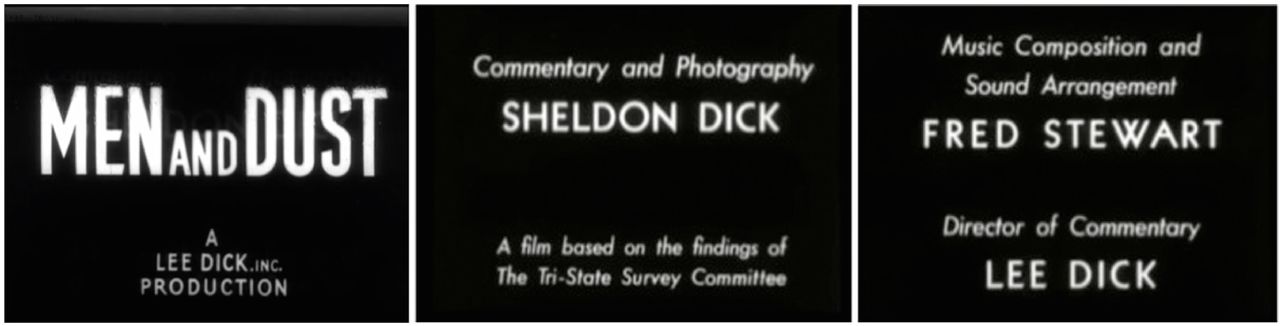
  • I know it’s the print’s fault, but that is a quick title card.
  • Sheldon isn’t the writer, no sir. He’s the “Director of Commentary” (a title I’m pretty sure belongs to Kevin Smith).
  • They keep saying that America is “the richest country in the world”. Give it a few decades, that’ll change.
  • There’s so much Dust Bowl devastation I keep expecting Roy Rogers to show up and sing about it.
  • The film has four different narrators! Three of them (Storrs Haynes, Robert Porterfield, Eric Walz) have languished in almost total obscurity, while the fourth (Will Geer) seems to be permanently stuck in the Dust Bowl era.
  • Good thing the health and safety of our nation’s miners isn’t a major problem anymore, right? …Right?

Legacy

  • Sheldon and Lee Dick separated at some point following “Men and Dust”. Lee’s life afterwards is not prominently documented, but we know that Sheldon married his third wife in 1950, and that definitely did not end well.
  • “Men and Dust” was supported by labor unions across the country, and private screenings led to revised laws and safety regulations within various mining communities. Now that’s change I can believe in.

Further Viewing: Fellow NFR entry “Harlan County U.S.A.”, Barbara Kopple’s documentary on the struggles of coal miners in the ‘70s. Keep fighting the good fight!