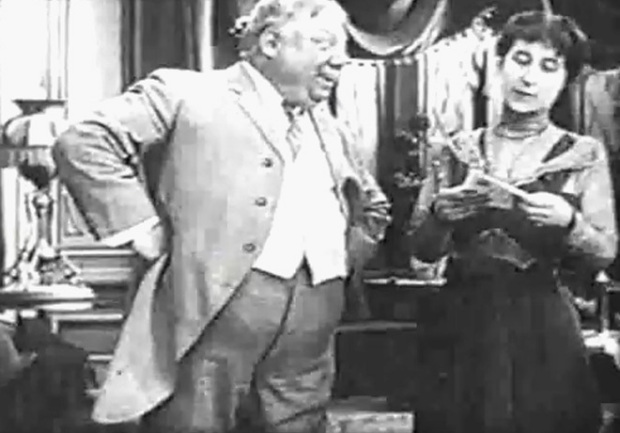
The Plot: Bunny Sharpe (John Bunny) has a gambling problem, and when his wife (Flora Finch) pleads with him to stop, he vows never to play poker with the boys again. Later, his wife finds out that he’s still going to his weekly poker games in the guise of a fraternal meeting. She gets her cousin Freddie (Harry T. Morey) and his bible study group to infiltrate the club dressed as police officers. Hilarity ensues.
Why It Matters: The NFR gives the film its historical significance, and then devotes a lot of the write-up to a New York Times editorial calling for film preservation after Bunny’s death in 1915. Yeah, we get it; it’s prescient. An essay by go-to silent film expert Steve Massa provides more insight into Bunny and Finch, but is weirdly cut off at the end.
But Does It Really?: Oh sure. It’s not a masterpiece or a laugh riot, but it’s one of the rare surviving pieces of film depicting one of America’s earliest silent comedy duos.
Everybody Gets One: John Bunny and Flora Finch will show up elsewhere on this list, but this film is their only moment in the spotlight. Both were stage actors who made the transition to film with Vitagraph in the early 1910s. Despite their alleged dislike for each other, their films together (affectionately known as “Bunnyfinches”) were Vitagraph’s most popular shorts.
Wow, That’s Dated: Mainly the immoral stigma of poker playing.
Other notes
Wow, John Bunny is 90% face. He looks like if Winston Churchill got stung by a bee.
Flora is so lucky that online poker isn’t a thing yet.
When did we stop using “Geo” as a nickname for George?
Could the Keystone Kops sue these guys?
A group of men dressed as police officers come into a room of unescorted ladies. This is so close to being a bachelorette party.
Wait that’s it? That is a long, confusing final shot.
Legacy
After John Bunny’s death in 1915, the film was re-released as “A Sure Cure for Pokeritis”. Although there were many who predicted that future generations would love the “Bunnyfinches”, these films fell into obscurity, with many of them presumed lost.
Flora Finch found some success in the sound era in small supporting roles. She appears in the Laurel & Hardy film “Way Out West” and fellow NFR entry “The Women”.
Scientists have yet to find a cure for pokeritis. They have, however, been able to confine the symptoms to what experts refer to as “Poker Face”.
Written by Norman Wexler. Based on the story “Tribal Rites of the New Saturday Night” by Nik Cohn.
Class of 2010
The Plot: Young hothead Brooklynite Tony Manero (John Travolta) lives with his dysfunctional family and works a dead-end job. He spends his weeks waiting for Saturday, when he goes to the local discotheque and is the undisputed king of the dance floor. One Saturday he sees an impressive dancer named Stephanie (Karen Lynn Gorney) and eventually convinces her to be his dance partner in an upcoming dance contest. They clash instantly and constantly, but Tony keeps at it because Stephanie represents what he wants, a life better than his current one and a chance out of Brooklyn.
Why It Matters: The NFR highlights Travolta and the Bee Gees, and states that the “crossover between music and movies set the pace for many films to follow.”
But Does It Really?: I saw this movie for the first time a few years back, and hated it. Watching it again…I still don’t care for it. There’s some good work going on here, but the film’s characters (especially their attitudes towards women) are repulsive and indefensible. I completely understand that this film is capturing a specific time for a specific subculture, so I guess I just hate this specific subculture. Ultimately this film is about a young man coming into his own and trying to leave this life behind, but they layer on the more reprehensible aspects of his life real thick. I guess you just had to be there. Regardless, there’s a well-crafted film under all of this crap, and the historical impact alone is worthy of recognition. The film warrants inclusion on this list, but as I’ve said before, Disco (and everything it stands for) Sucks.
Shout Outs: Tony has posters of “Rocky” and “Enter the Dragon” in his room, goes to a club called “2001 Odyssey”, walks past a marquee advertising “Network”, and makes a “Dog Day Afternoon” reference in his underwear, the kind of tribute the prisoners of Attica had in mind when they rioted.
Everybody Gets One: Almost everyone, most notably the Brothers Gibb, legendary producer/manager Robert Stigwood, actor Donna Pescow, and director John Badham. Fun Fact: John’s brother Mary was Scout in “To Kill a Mockingbird”.
Wow, That’s Dated: Everything. From the aesthetics to the attitudes, everything about this movie is America’s unfortunate disco phase.
Title Song: We get a title song so good they changed the title of the movie.
Seriously, Oscars?: “Saturday Night Fever” received one nomination: Best Actor for breakout star John Travolta. He was a new face with a movie the older Academy members didn’t get, so he lost to veteran Richard Dreyfuss’ more endearing work in “The Goodbye Girl”. But the major controversy that year was that none of the Bee Gees’ music made the cut for Best Song or Best Score. But hey, “You Light Up My Life”, am I right? The Best Song winner the following year – the disco hit “Last Dance” – probably got some help from this oversight.
Other notes
The opening credits are an excellent set-up to Tony and his world. Take note, “Baby Driver”.
“You can’t fuck the future.” Wait until they see “The Terminator”.
It’s difficult watching John Travolta criticize someone’s religious beliefs.
But seriously, am I supposed to like these guys? The only thing they haven’t done yet is punch an orphan.
Can you imagine a world where one of the other Sweathogs made it big? Two-time Oscar nominee “Boom-Boom” Washington? Epstein butchering Idina Menzel’s name? Horshack as Robert Shapiro?
That is a really fast centrifuge Tony and Stephanie have going. Any faster and they’ll time travel…and fuck the future!
After their rehearsal, Tony and Stephanie walk down Brooklyn’s landmark “ADR Boulevard”.
What’s that sound I hear? Why it’s Modest Mussorgsky rolling over in his grave.
And then they start attacking David Bowie. This movie goes too far! To add insult to injury, Stephanie pronounces his last name as “Boo-ie”.
This film almost does a precursor to the “Manhattan” shot.
Would you like a healthy sprinkling of homophobia and racism to go with your misogyny? Say when…
As much as I don’t care for this film, the dance sequences are pretty great. The contest in particular is wonderfully choreographed; they actually managed to make disco dancing look graceful. Where is Lester Wilson’s honorary Oscar for choreography? If it’s good enough for “Oliver!” it’s good enough for this film.
And then the boys take Annette for a car ride. Aaaaaaand fuck this movie.
Legacy
Disco was waning by 1977, but this film brought it back even bigger than before.
John Travolta: Act I
A sequel that removes everything you liked about the first one and replaces it with two Stallones and something called “Satan’s Alley”.
Oh god, I forgot there was a stage version. And I guess it’s still touring. Why won’t you die?
Everyone has spoofed this film’s iconic disco scenes, but we’ll stick with “Airplane!” for now.
“The Barry Gibb Talk Show”
This is the reason “Welcome Back, Kotter” jumped the shark.
The 2004 documentary “Get Down Tonight” features Karen Gorney recreating her climactic dance scene with “Dance Fever” host (and this film’s uncredited dance instructor) Deney Terrio.
Something called “Saturday Night Glee-ver”
And of course, “Flashbeagle”!
Listen to This: The prime example of a soundtrack being more popular than its film, the Bee Gees’ “disco masterpiece” was added to the National Recording Registry in 2012. Check out this essay by special guest poster David N. Meyer.
Written by John Taintor Foote. Story by Garret Fort and Bess Meredyth. Based on “The Curse of Capistrano” by Johnston McCulley.
Class of 2009
No trailer, but here’s a sample.
Thanks, Allison
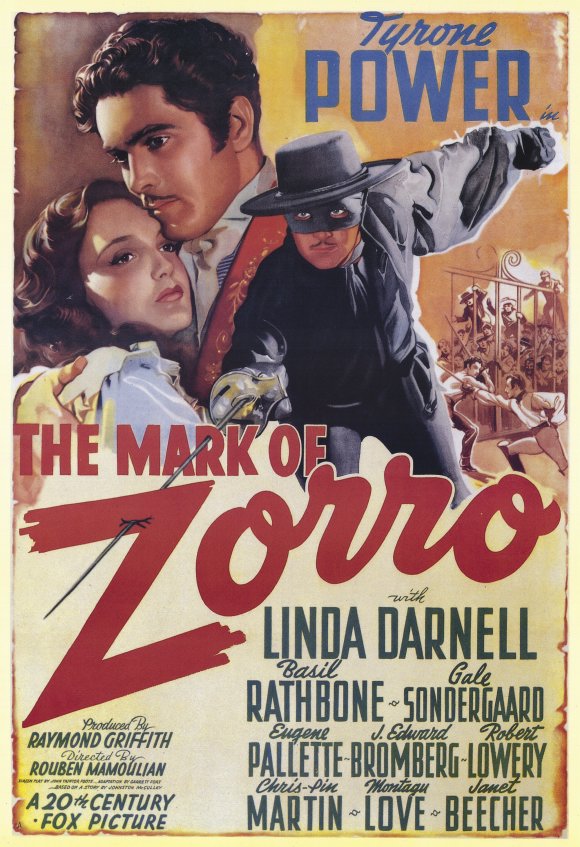
The Plot: Don Diego Vega (Tyrone Power) is Zorro, a masked outlaw who robs from the rich and gives to the poor (like that other, less exciting folk hero). At night Zorro takes on Los Angeles’ corrupt alcade Luis Quintero (J. Edward Bromberg) and Captain Esteban Pasquale (Basil Rathbone). By day Diego plays up his foppishness to divert suspicion, and still finds time to woo Luis’ niece Lolita (Linda Darnell). Action! Romance! Z carvings!
Why It Matters: The NFR praises director Rouben Mamoulian as well as the “thrilling duel between Rathbone and Power”.
But Does It Really?: Eh, I guess. I wasn’t able to get too excited about this one. We’ve got other swashbuckling epics on this list. Hell, we’ve got another Zorro film on this list. I give this “Mark of Zorro” a slight pass for the popularity of Tyrone Power, and not much else. I kinda wish I had just watched the Antonio Banderas Zorro movie instead.
Everybody Gets One: Tyrone Power was unable to find success in Hollywood, despite the connection to (and same name as) his father, legendary silent film star Tyrone Power. The younger Power eventually found success on the Broadway stage, which finally caught the attention of Hollywood. After years of playing swashbuckling types, Power returned to the stage to hone his craft (one of the few movie stars of the time to do so). His last film features one of his best performances, and is a film I’m surprised isn’t on this list yet: 1957’s “Witness for the Prosecution”.
Wow, That’s Dated: Today on “Whitewashed Casting”, the native Californians/Mexicans of “Zorro” are played by people who are Irish/English mix (Tyrone Power) English (Basil Rathbone, Montagu Love), Danish-American (Gale Sondergaard), Romanian (J. Edward Bromberg), German (Janet Beecher) Greek (George Regas), and even Texan (Linda Darnell). The highest billed actor who is playing the correct ethnicity is Mexican born Chris-Pin Martin (10thbilling).
Take a Shot: Diego says the title once, about 50 minutes in.
Seriously, Oscars?: “The Mark of Zorro” was one of 17 nominees in the Best Original Score category in 1940. Alfred Newman’s work lost to the score from another future NFR entry: “Pinocchio”.
Other notes
“The fine and fashionable art of killing.” Woof. Different times, indeed.
You’re not seeing things: Basil Rathbone and Eugene Pallette are playing essentially the same characters from “The Adventures of Robin Hood” two years earlier: Rathbone as Sir Guy of Gisbourne (complete with swordfight) and Pallette as Friar Tuck.
Gale Sondergaard has two claims to fame: She was the first Best Supporting Actress winner in 1936 for “Anthony Adverse”, and she passed on playing the Wicked Witch of the West in “The Wizard of Oz”. She made the NFR list eventually, but in a film nowhere near as iconic.
So crime and corruption has always been a problem in L.A.
Hey, Lolita is 17! Knock it off, Zorro! In fact, just steer clear of anyone named Lolita.
I am so bored with this film. Screw this; I’m switching over to “The Mask of Zorro”…
That opening sequence has more Mexicans than all of “Mark of Zorro” combined.
You can’t convince me that Anthony Hopkins did his own stunts.
Speaking of, there’s an obvious attempt to make the casting more culturally appropriate, and yet a Welsh man as Don Diego? Was Edward James Olmos not available? Or marketable?
And his daughter is Welsh too? Catherine Zeta-Jones, who doesn’t have an ounce of Mexican blood in her, plays Don Diego’s daughter Elena. No one in the states knew who she was back then, and the last name Zeta is just vague enough you can get away with this if no one’s paying attention.
God this is taking forever. How much longer until the next action sequence?
I guess I remember “Mask of Zorro” being better than it actually is. Antonio Banderas is everything you could ask for in a Zorro, and that’s the most sexual tension in a swordfight that a PG-13 can handle, but man is this thing bloated. Lemme check back with “Mark of Zorro”…
Well, the Power/Rathbone swordfight is fun, but don’t think I didn’t notice the under-cranking going on to speed it up a little.
“Mark of Zorro” isn’t that spectacular either, but at least it’s short. Will we ever have a good “Zorro” movie? You’re my last hope, 1920 version I will have to watch eventually.
Legacy
Tyrone Power would spend most of the ‘40s playing Zorro-esque action heroes, including a 1941 follow-up with Linda Darnell, “Blood and Sand”.
Jury’s still out on whether or not this version (or the 1920 version) is the “Mark of Zorro” that Bruce Wayne watches the night his parents are murdered. Either way, he took notes.
Many films of Zorro over the years, but the only direct remake of this film is the 1974 version with Frank Langella. At least in this one the main bad guy is Ricardo Montalban.
I’ll always enjoy the ‘90s version “The Poke of Zorro” best. With James Earl Jones as the voice of the Magic Taco.
It’s not directly connected to this film, but here’s the “Zorro” TV theme anyway.


 The Horse's Head