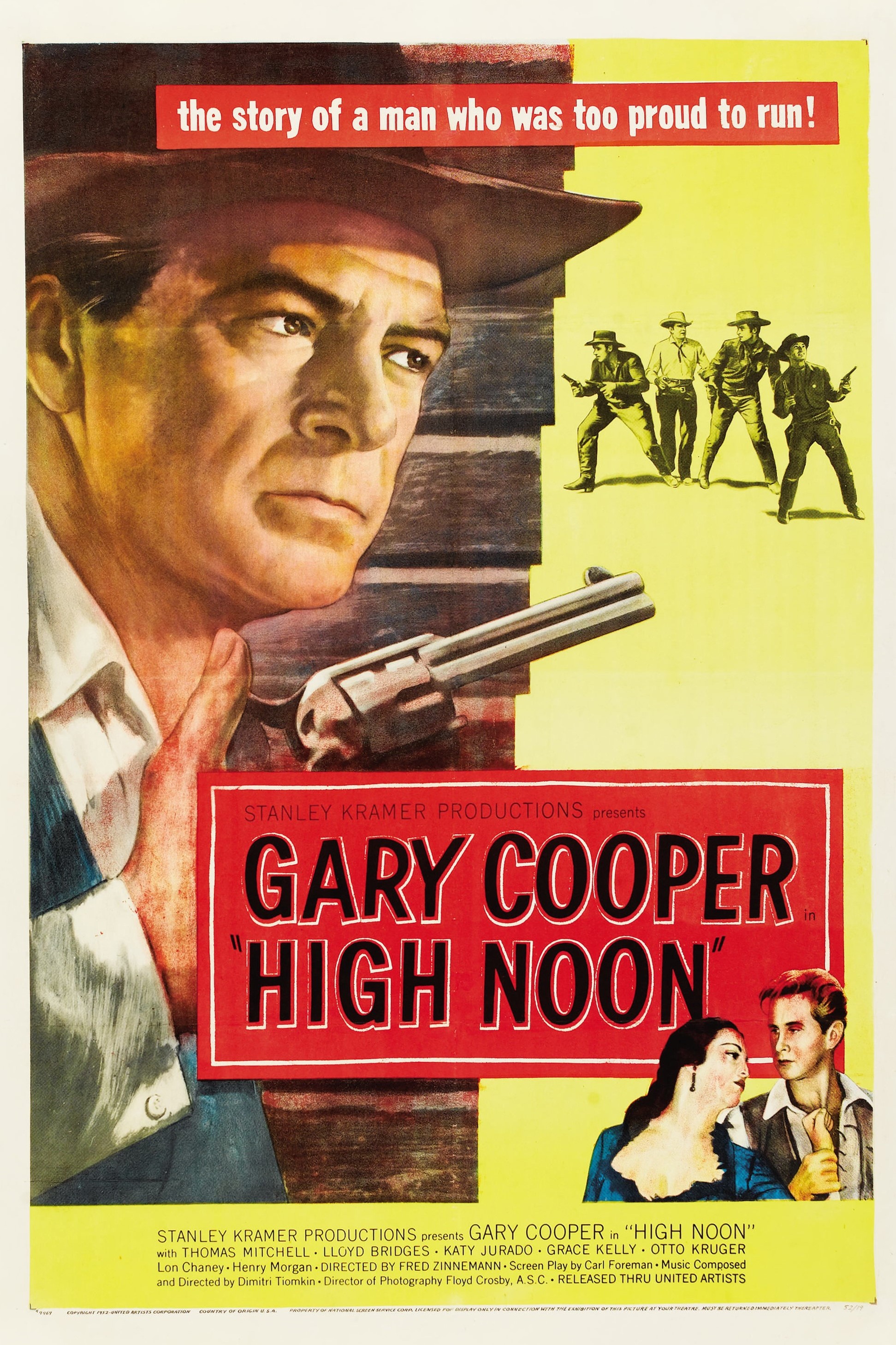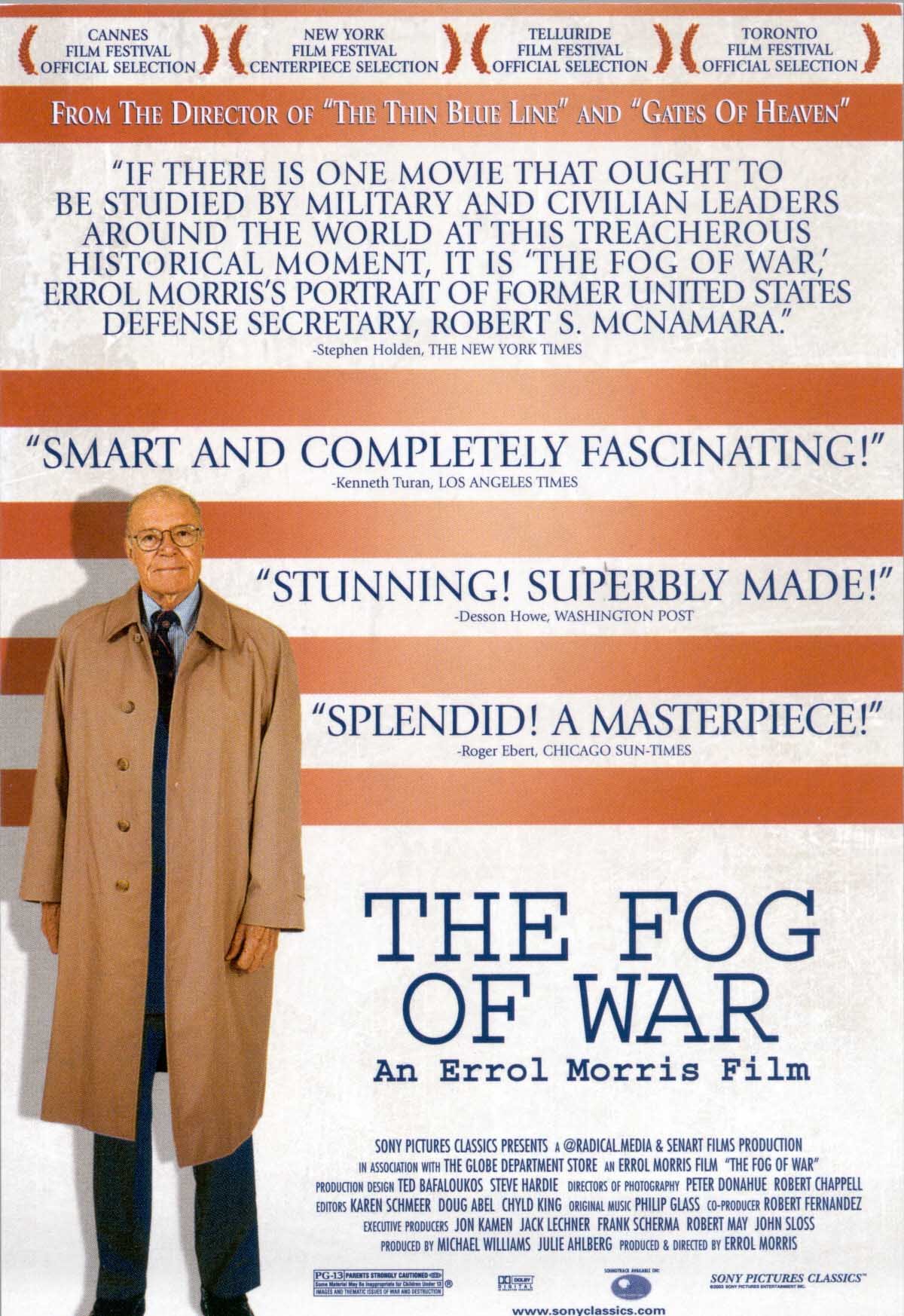
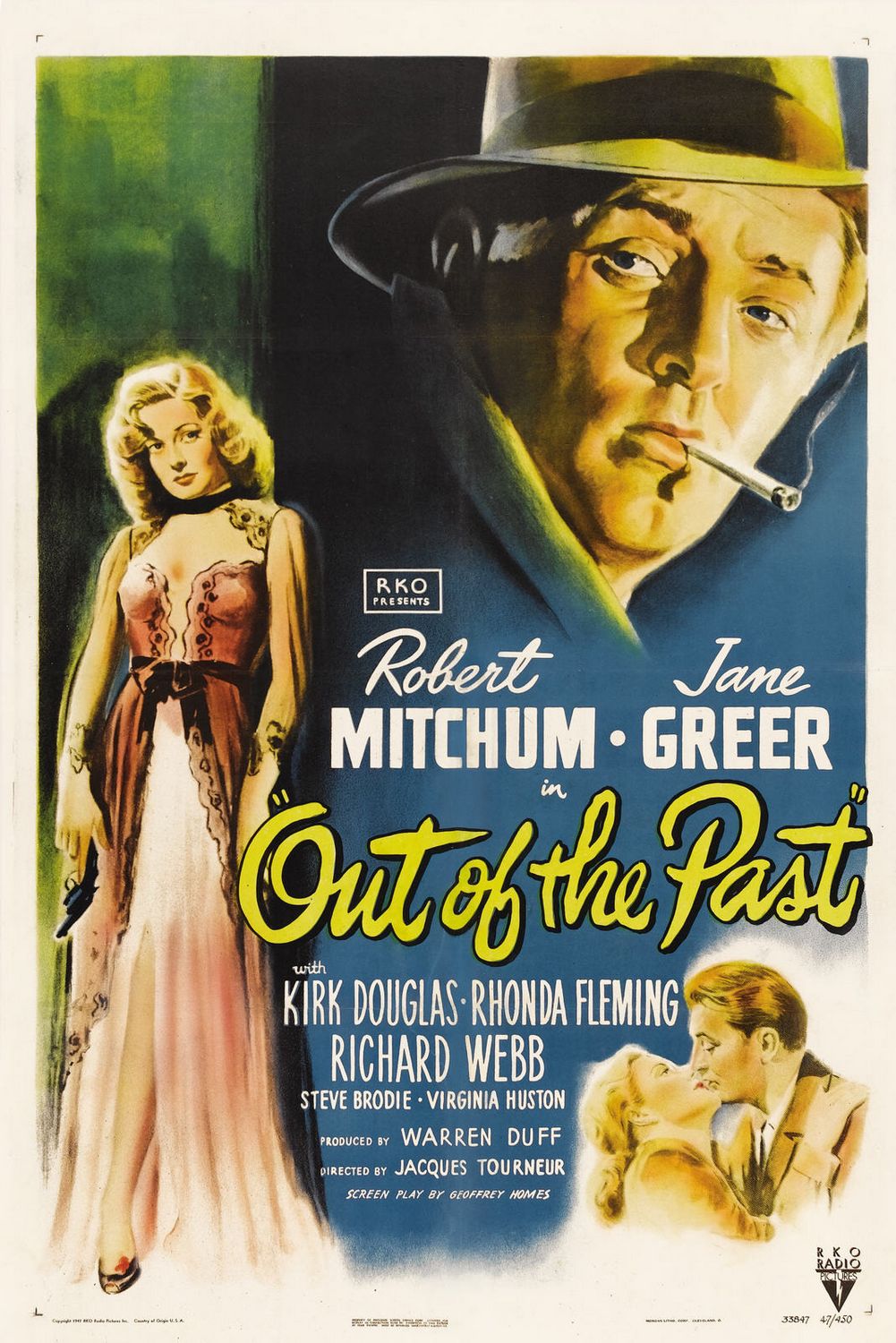
#409) Out of the Past (1947)

MV5BMDE0MjYxYmMtM2VhMC00MjhiLTg5NjItMDkzZGM5MGVlYjMxL2ltYWdlL2ltYWdlXkEyXkFqcGdeQXVyNjc1NTYyMjg@._V1_

#409) Out of the Past (1947)

OR “Won’t You Come Home, Jeff Bailey?”

Directed by Jacques Tourneur

Written by Geoffrey Homes (aka Daniel Mainwaring). Based on his novel “Build My Gallows High”.

Class of 1991

No original trailer, but here’s a re-creation.

The Plot: Jeff Bailey (Robert Mitchum) runs a gas station in the small town of Bridgeport, California, and has settled down with the lovely young Ann (Virginia Huston). When a former business associate (Paul Valentine) arrives in town, Jeff confesses to Ann his past life as a private investigator, specifically the case in which he tracked down Kathie Moffat (Jane Greer), the girlfriend of businessman/gambler Whit Sterling (Kirk Douglas). Jeff and Kathie have an affair, but eventually split up to avoid further trouble with Whit and his associates. Back in the present day, Whit has become aware of Jeff’s past with Kathie, and hires Jeff for one final job. Will Jeff be able to return to his simple life in Bridgeport, or will his relationship with Kathie return…out of the past?

Why It Matters: The NFR calls the film a “classic example of 1940s film noir” and throws superlatives at Tourneur, Homes, Mitchum, Greer, and cinematographer Nicholas Musuraca. An essay by film critic Stephanie Zacharek is equally effusive, and a dissection of the film’s two female leads.

But Does It Really?: “Out of the Past” is one of those movies that I always knew was a designated classic, but couldn’t tell you anything else about it. The film is well-crafted on each front, and has all the hallmarks of the great film noirs, but it’s lacking that extra “je ne sais quoi” that possesses a “Double Indemnity” or a “Touch of Evil”. “Out of the Past” may be reserved for the film buffs nowadays, but it is respected and referenced enough to earn its NFR designation.

Everybody Gets One: Jane Greer’s film career got started when Howard Hughes spotted her modeling in Life Magazine. Greer made a slew of movies for RKO and MGM (“Past” was at the former), but she blamed studio politics for the lack of momentum in her career. And as always, shoutout to Ken Niles as Leonard Eels, aka “the vic”.

Wow, That’s Dated: Standard ‘40s stuff, but this movie got me to wondering: can ridesharing ever replace cabs in the movies? First off, no one can make a quick getaway if your driver isn’t showing up for 6 minutes, and the old “follow that cab” sequence could never happen. And don’t even get started on the huge insurance risk a chase sequence entails.

Title Track: No one says “out of the past”, but Bailey does utter the novel’s title – “Hang My Gallows High” – near the end of the film.

Seriously, Oscars?: “Out of the Past” was successful in its day, but RKO still considered it a B-Picture, and focused their campaigning on two of their A-Pictures: “The Bishop’s Wife” and “Crossfire”, both of which got Best Picture nominations.

Other notes

  • The opening credits, shot around Lake Tahoe, made me legitimately wonder if I was watching the wrong movie. Quintessential noir never leaves the dark alleyways of the big city. This movie is already throwing me.
  • Wait, Jeff’s girlfriend is named Ann Miller? The Hollywood dancer of the same name was already making movies at that point; wouldn’t this have led to some confusion?
  • Kirk Douglas was still a Hollywood newcomer when he was cast as the heavy in “Out of the Past”. This is also your reminder that as of this writing, Kirk Douglas is still alive at 103! He’s lived in 12 different decades!
  • Robert Mitchum is one of those stars who has never done it for me. I don’t have anything against him, but I don’t have anything for him either. I try to not let that interfere with my viewings for this blog, but overall Mitchum in this movie is…fine.
  • It’s a shame Jane Greer’s career never took off, she’s very good in this. She’s a good match for Mitchum, and hits both aspects of “femme fatale” quite effectively. My favorite shot in the movie is Kathie’s restrained joy while watching Jeff and Fisher fight each other. It’s wonderfully subtle shading to an already dimensional character.
  • It’s thoughtful of Jeff to open up to Ann about his past, but he fails to remember one of life’s most important truths: No one wants to hear about your ex.
  • “Out of the Past” was filmed partially on location in the cities mentioned throughout the film; either for the full sequence or for background projections. The shot of Jeff’s cab arriving in San Francisco is on Broadway Street, not too far from the North Beach neighborhood Jeff and Kathie briefly lived in. Everyone in this movie could probably recommend a good Italian restaurant.
  • “That’s one way to be clever: look like an idiot.” Ooh, that’s a good line, I’ll have to remember that one.
  • It’s around the point where Kathie tells Jeff about his set-up that this film started to lose me. Did the plot become too convoluted? Was I not in the right frame of mind for this movie? Who’s to say? The point is I did not take a lot of notes during the third act for fear of missing something.
  • Like “Stranger Than Paradise”, “Out of the Past” has enough diverse locales that its black and white cinematography is imperative. A color film set in Tahoe, Mexico, and San Francisco would have been too much of a travelogue.
  • Knowing that crime can never pay in a Code-era movie, you can more or less deduce how a film like “Out of the Past” is going to end, but I appreciated that the final few scenes try to subvert expectations and keep things interesting. Points deducted for the obvious model cars used in the climactic crash.

Legacy

  • Robert Mitchum’s film persona as the stoic, somewhat cryptic tough guy was cemented in this film. He branched out for such films as “Night of the Hunter”, but he more-or-less played this guy for the rest of his career.
  • “Out of the Past” was remade in 1984 as “Against All Odds” with Jeff Bridges and Rachel Ward. Worth noting is Jane Greer’s appearance as Kathie’s mother, and the title song by Phil Collins.
  • In 1987, Robert Mitchum hosted “Saturday Night Live”, and appeared in a short film called “Out of Gas”, directed by his daughter Trina, and reuniting him with Jane Greer. I can’t find a single clip from this episode that hasn’t been blocked by NBC, so here’s a track from Robert Mitchum’s calypso album instead.

Bonus Clip: Here’s Ann Reinking performing “Against All Odds (Take a Look at Me Now)” at the Oscars. Phil Collins was not invited to perform his own song at the ceremony, and….just watch.


How to Get Your Movie Into the National Film Registry

these-amazing-shadows

This week marks the 3rd anniversary of “The Horse’s Head”! Instead of celebrating movies already on the list, let’s look at what it takes for your movie to get inducted into the National Film Registry.

First of all, let’s make sure your film is eligible. To be on the National Film Registry your movie must be:

At Least 10 Years Old: The 10-year waiting period ensures that your film continues to be remembered long after its initial release. Only a handful of movies make the cut after exactly 10 years (“Raging Bull”, “Goodfellas”, other non-Scorsese pictures). As of this writing, the movies of 2010 are freshly eligible, meaning you could legitimately nominate “Despicable Me” if you so choose. Think about it: Haven’t those creepy little Minions proven their cultural endurance?

Culturally, Historically, or Aesthetically Significant: Is your movie quotable and prone to parody years later? Is it an encapsulation of a specific era in American and/or film history?  Did it introduce the world to those unsettling sentient Twinkies known as Minions? If you can prove that your movie stands on a unique piece of ground, that’s half the battle right there.

Does your movie meet the above qualifications? Excellent, let’s continue (NOTE: I assume you said yes. If the answer is no, please stop reading this).

The first step is to Nominate Your Movie. Since 1997, the public has been able to submit up to 50 film titles for consideration via the Library of Congress website. It’s easy! Their website even gives you a comprehensive guide to movies not yet on the Registry (updated to include “Despicable Me”). Literally thousands of movies are submitted every year, and roughly 75 percent of the final list (18 or 19 movies) will come from these public recommendations.

After the submission deadline has passed (typically mid-September), the proposed films are then compiled and a preliminary ballot with 200-400 of the highest-polling titles is sent to the National Film Preservation Board. The board is comprised of 44 members: filmmakers, historians, critics, industry insiders, and drifters from all walks of life. Every October, these members meet to determine which movies will be seriously considered for inclusion. The first day of these meetings is typically reserved for films that are in serious need of preservation (i.e. your recently discovered silent movies). The following days are an open forum in which anyone can suggest any movie. Movies that receive a strong showing of public support are prioritized for consideration (“Back to the Future”, “Hoosiers”, and “Ghostbusters” all got on the list thanks to devoted fan campaigns). For the more obscure titles, many board members go the extra mile with their presentations, including screenings. On a related note, shoutout to Wendy Shay of the Smithsonian Institution for her tireless yet unsuccessful campaigning to get “Jane Fonda’s Workout” on the list. Keep fighting the good fight, Wendy!

The board’s goal is to create an eclectic roster of movies from a diverse group of filmmakers. In recent years, emphasis has been placed on including films by women and people of color (who collectively make up 11% of the Registry).  On occasion, subcommittees are appointed to find student films worthy of NFR recognition. This is how we got such obscure yet preservation-worthy titles as “Time and Dreams” and “Growing Up Female”.

After much deliberation, each board member votes for their top 25 choices, ranked by preference. A short list of the biggest vote getters is presented to the head Librarian of Congress, who hand picks the final 25 behind closed doors. That’s right: one person is ultimately responsible for inducting your movie into film history. Currently, the Librarian of Congress is Carla Hayden, the first woman and African-American to hold the title. Appointed by President Obama in 2016, Carla is a lifelong librarian, meaning she is presumably more inclined to select films by people who speak quietly and have no outstanding late fees. Hayden’s librarian career was primarily in Chicago, so if you’re looking to sway Carla’s opinion, perhaps a Bears game or a deep-dish pizza will do the trick. Once the Librarian makes their decision, the final 25 are officially announced in mid-December.

Now that your movie has been selected, the Library of Congress will obtain the best possible print of the film for preservation in their vaults at the National Audio-Visual Conservation Center in Culpeper, Virginia. For the better-known titles, it’s most likely that the Library of Congress already has a print from when the film was originally submitted for copyright approval (such is the case with “Star Wars”, despite what the rest of the internet has told you). If that print is not in good condition, a request is made to the copyright holder to donate a better print. For the more obscure titles, archives and private collections are scoured for the best possible print. Registry films must be preserved in their original format and in their original unaltered versions, so the extended Blu-ray cut of “Despicable Me” will be bypassed for the inferior theatrical release.

If you, the filmmaker, are still alive when your movie makes the cut, all you receive are bragging rights, as well as permission to use the official NFR logo when promoting your movie (designed by no less than Saul Bass!).

featured2_170111_031836

So there you have it, the quick and easy way to ensure the legacy of your movie. All you have to do is make a technologically innovative or zeitgeist capturing film, add a few Minions, wait 10 years, and presto! You’re on the list! What are you waiting for? Go make your classic I’ll be forced to watch sometime in the 2030s.

Happy Filmmaking,

Tony

Interested in learning more about the process? I found these articles to be incredibly helpful in my research:

Film Comment: Choosing the National Film Registry

Hollywood Reporter: National Film Registry: The Politics Behind It

Refinery29: How to Get Women Directors on the National Film Registry

The New York Times: Which Movies are the Best? The Library of Congress Has a List

Mental Floss: What Happens to Films Selected for Preservation by the Library of Congress?

And don’t forget “These Amazing Shadows”, aka “National Film Registry: The Motion Picture”!

#408) Dodsworth (1936)

MV5BNTIzOWU0NWUtN2Y2ZC00N2U2LTliMzQtZWNjNmZkNTc4YTU3L2ltYWdlL2ltYWdlXkEyXkFqcGdeQXVyNjc1NTYyMjg@._V1_

#408) Dodsworth (1936)

OR “Huston, We Have a Problem”

Directed by William Wyler

Written by Sidney Howard. Based on the novel by Sinclair Lewis and the stage adaptation by Howard.

Class of 1990

No trailer, but here’s a clip.

The Plot: Sam Dodsworth (Walter Huston) retires as head of his motor company in a small Midwestern town, and agrees to take his wife Fran (Ruth Chatterton) on an extended vacation through Europe. The down-to-earth Sam is interested in seeing the common tourist spots, while the vain, youth-obsessed Fran is more focused on becoming a socialite and leaving her boring home life behind. The Dodsworths’ marriage is put to the test when Fran begins flirting with a trio of young European men (David Niven, Paul Lukas, Gregory Gaye), and Sam connects with an American divorcée (Mary Astor) living in Naples. Can their marriage be saved!?

Why It Matters: The NFR calls the film “highly acclaimed”, but offers no other superlatives, opting instead for a detailed (and spoiler-ridden) plot synopsis, as well as a rundown of the film’s Oscar stats.

But Does It Really?: “Dodsworth” is just shy of a minor classic. On the plus side, it’s a well-made, impeccably acted character piece, but through no fault of its own, its status as one of the greatest films continues to wane. The movie rarely gets referenced nowadays (even by classic film buffs), and over the years has been overshadowed by William Wyler’s later, superior films (“The Best Years of Our Lives” and “Ben-Hur”, to name just two). Like many movies whose cultural significance has diminished, the inclusion of “Dodsworth” on this list is welcomed, though far from essential.

Everybody Gets One: Ruth Chatterton was one of Paramount’s biggest stars in the late ‘20s, and found fame in the ‘30s as an aviator! Unfortunately, her time making “Dodsworth” was not pleasant, as she and Wyler frequently clashed over their interpretations of Fran. This is also the only NFR appearance for dashing leading man Paul Lukas, just a few years shy of his Oscar winning turn in “A Watch on the Rhine”.

Wow, That’s Dated: Mostly the film’s depiction of international transportation methods (the Dodsworths travel to Europe on the still operational Queen Mary, and are wary of aeroplanes). There’s also a “hilarious” joke about spousal abuse. The ‘30s!

Seriously, Oscars?: A critical hit, “Dodsworth” received seven Oscar nominations, including Best Picture. The film tied for most nominations with “The Great Ziegfeld” and “Anthony Adverse”, both of which beat out  “Dodsworth” in several categories, but “Dodsworth” picked up one win for Richard Day’s Art Direction.

Other notes

  • Walter Huston reprises his role from the Broadway production, and does an excellent job of reigning in his work for film. He’s a charming, relatable leading man; a full 180 from his more famous turn as a grizzled prospector.
  • Easily the film’s most cited production note: While shooting “Dodsworth”, Mary Astor was going through a very public divorce and custody battle with second husband Franklyn Thorpe. To avoid being hounded by the press during production, Astor slept at the studio (some sources say in her bungalow, others say on the “Dodsworth” set). Ultimately, Astor was granted the divorce, as well as custody of her daughter Marylyn. By court ruling, Astor’s diary (which contained details of her affair with playwright George S. Kaufman) was dismissed as evidence, impounded, and eventually destroyed. Any personal stress that Astor was going through does not come through in the final film.
  • I’m always surprised when David Niven shows up on this list. I guess I wasn’t expecting him to have so many classic films on his resume. Speaking of, when’s “Candleshoe” making the cut?
  • With the exception of specially filmed background projections, the entire movie was shot at Goldwyn Studios, including replicas of Paris, Vienna, and Naples. Richard Day earned the hell out of his Art Direction Oscar.
  • I appreciate that this is a movie about a long-married couple who are recognizing their relationship troubles for the first time. It’s a very adult premise, done without the kind of melodramatics I expect from studio films of the era. The excellent acting overcompensates for the somewhat static staging. Despite its impressive sets and occasionally liberating cinematography, “Dodsworth” is still very much a filmed play.
  • “Dodsworth” is the film debut of John Payne, seen here as Dodsworth’s son-in-law, and about a decade away from legally proving the existence of Santa Claus.
  • This is the second movie from the ‘30s I’ve covered that has a sad farewell scene at a train station. I didn’t realize what a trope that was. “Airplane!” was on to something.
  • Maria Ouspenskaya gives what I can only describe as a “Beatrice Straight/Judi Dench turn”. In less than five minutes of screentime – most of it sitting down – Ouspenskaya schools Ruth Chatterton in the Stanislavsky Method. She even got an Oscar nomination in the brand new category of Best Supporting Actress.
  • [Spoilers] As much as I was disengaged from this movie, I came around at the end. Huston and Astor have a natural chemistry that made me root for them to get together. And can we talk about how this is a ‘30s movie in which a couple gets divorced and doesn’t reunite at the end? Talk about groundbreaking.

Legacy

  • The stage version of “Dodsworth” has not been seen on Broadway since its initial 1934 engagement, and there has only been one other major adaptation: a 1956 teleplay with Fredric March, Claire Trevor, and Geraldine Fitzgerald.
  • Various remakes have been announced over the years, with such stars as Rock Hudson, Grace Kelly, Elizabeth Taylor, Gregory Peck, and Harrison Ford attached to headline. None of these came to fruition, but something about a William Wyler movie in which Gregory Peck finds love in Italy sounds familiar…

#407) High Noon (1952)

MV5BOWIzZGUxZmItOThkMS00Y2QxLTg0MTYtMDdhMjRlNTNlYTI3L2ltYWdlXkEyXkFqcGdeQXVyNjc1NTYyMjg@._V1_

#407) High Noon (1952)

OR “Twelve O’Clock Nigh”

Directed by Fred Zinnemann

Written by Carl Foreman. Kinda sorta but not really based on the short story “The Tin Star” by John W. Cunningham.

Class of 1989

The Plot: Marshall Will Kane (Gary Cooper) is ready to retire and move to another town with his new wife Amy (Grace Kelly). Shortly after the wedding, Kane learns that Frank Miller (Ian MacDonald), a criminal he convicted five years prior, has been released from prison and vows revenge. With less than 85 minutes before Frank’s train arrives, Will opts to stay and face his foe, despite protests from his wife, his Deputy Marshall Harvey Pell (Lloyd Bridges), and his fellow townspeople. Can Kane convince the town to help him, or will he stand alone when Frank comes at…high noon?

Why It Matters: The NFR gives a brief overview, praises Gary Cooper’s “taut” performance, and suggests that the film’s “most unforgettable element” is the title song. Umm…no?

But Does It Really?: I’m afraid this film’s reputation as one of the indisputable classics has built it up too much for me. I liked “High Noon”, but wasn’t blown away by it. It’s a well-crafted Western with an emphasis on brain over brawn, and Cooper is giving the best performance of his career, but overall “High Noon” didn’t connect with me. Perhaps the film’s political subtext is a requirement to fully understand the film. Regardless, “High Noon” has had enough of a cultural impact for me to not question its NFR inclusion, but I’ll be curious to see how well “High Noon” holds up to future film buffs.

Title Track: “The Ballad of High Noon” (aka “Do Not Forsake Me, O My Darling”) is sung over the opening credits by Tex (father of John) Ritter. The theme appears throughout Dimitri Tiomkin’s score as a motif for Will Kane. It also has to be one of the rare movie title songs that references specific plot points in its lyrics (Frank Miller gets two mentions).

Seriously, Oscars?: In a very packed year for nominees, “High Noon” tied “The Quiet Man” and “Moulin Rouge” (not that one) for most Oscar nominations of the year: seven. “Noon” took home four: Score, Song, Editing, and a second Best Actor prize for Gary Cooper. Perhaps due to the film’s political controversy, Carl Foreman’s screenplay lost to “The Bad and the Beautiful”, while the film lost Best Picture to the more conventional “The Greatest Show on Earth” by Hollywood veteran Cecil B. DeMille.

Other notes

  • The real star of this movie is screenwriter Carl Foreman. First off, after Foreman finished his initial four-page outline, he learned it was very similar to the John Cunningham short story “The Tin Star”. In order to avoid the inevitable cries of plagiarism, Foreman bought the film rights to “Tin Star”. But the main story is Foreman being blacklisted during production. A former member of the Communist party in the late ‘30s, Foreman was summoned to testify in front of HUAC. His refusal to name names led to him being blacklisted from working in Hollywood. As a result, many critics – then and now – view “High Noon” as a parable for standing up against the Red Scare. Ironically, Gary Cooper had been a “friendly witness” for HUAC, though he too did not name names.
  • We have a major readout on the Michael Douglas scale. Cooper was 50 during filming, Grace Kelly was 21. Sure that kind of age gap was period appropriate, but still. And while we’re on the subject, rumors of Cooper and Kelly having an affair during filming are unsupported.
  • Another victim of the Hollywood blacklist was co-star Lloyd Bridges, who was “graylisted” for being a member of the Communist-adjacent Actors’ Laboratory Theatre. Looks like he picked the wrong week to join a politically progressive theater troupe.
  • As I’ve said before, Cooper’s very good in this. Will Kane is the perfect combination of Cooper’s established screen personas: rugged cowboy and heroic everyman. You buy Kane’s convictions immediately. Like Fonda in “12 Angry Men”, this man will stand steadfast for his beliefs even when everyone around him tells him otherwise.
  • Shoutout to Katy Jurado, a Mexican-born actor playing a Mexican-born character who is devoid of stereotypes and actually influences the plot of the movie. We won’t see their likes again until “Stand and Deliver”.
  • My favorite shot in the entire movie is when the children are asked to leave the church, and they all very excitedly run outside and play in the field. It’s a lovely moment of levity in an otherwise very serious film.
  • Speaking of the church scene, I’m pretty sure this is the scene “Blazing Saddles” is riffing on for their “Howard Johnson is right!” sequence.
  • When Kane goes to the stable as he considers leaving town, a chicken can be heard clucking in the background. Get it?
  • Fun Fact: The fight between Will and Harvey had to be reshot because Lloyd’s son/future actor Beau Bridges was hiding in the hayloft watching the shoot, and couldn’t stop laughing when his father was doused with water.
  • If you’ve seen any shot from “High Noon”, it’s the shot of Will Kane standing alone as the camera pans back to reveal a deserted town. It’s still a very powerful moment almost 70 years later.
  • No spoilers, but the final shootout (as well as the denouement) does not disappoint. Though now that I think about it, “Dirty Harry” totally rips off this ending.

Legacy

  • Every movie, western or otherwise, that involves a showdown between two characters at high noon is taking their cue from this movie. Now that’s a legacy.
  • Everyone’s career benefited from the success of “High Noon”. Fred Zinnemann followed up with “From Here to Eternity”, Gary Cooper’s career got a resurgence, and Grace Kelly became…Grace Kelly. Although Carl Foreman moved to England to avoid the blacklist, he maintained a successful career as a screenwriter/producer, penning a draft of “The Bridge on the River Kwai”.
  • “High Noon” received the unnecessary sequel treatment twice! 1966’s “High Noon: The Clock Strikes Noon Again” starred Peter Fonda as Will Kane Jr. and Katy Jurado returning as Helen Ramirez. 1980’s “High Noon, Part II: The Return of Will Kane” ignored the previous sequel’s continuity and featured Lee Majors as Will Kane, but this time better than he was before: better, stronger, faster…
  • Adding insult to injury, “High Noon” got the unnecessary remake treatment in 2000 with a TV Movie for TBS starring Tom Skerritt.
  • 1981’s “Outland” starring Sean Connery might as well be called “High Noon…In…Spaaaaaace”.
  • “Well this time John Wayne does not walk off into the sunset with Grace Kelly.” “That’s Gary Cooper, asshole.”
  • And finally, 1989 was a good year for “High Noon”. Three months before making the inaugural roster of NFR films, the film’s Polish poster was modified to promote the Solidarity party in Poland’s first partially free elections under Communist rule. Looks like “High Noon” helped fight Communism after all!
lowHighNoon1

#406) The Fog of War (2003)

MV5BMTc3MTA4NDgzNl5BMl5BanBnXkFtZTcwOTAxNTQyMQ@@._V1_

#406) The Fog of War (2003)

OR “What About Bob?”

Directed by Errol Morris

Class of 2019

Robert McNamara is a very complex figure in U.S. history, as are the wars he participated in. A short write-up about a 2 hour movie can only scratch the surface, so please don’t let this post be your only resource on any of these topics.

The Plot: Controversial political figure Robert McNamara looks directly into Errol Morris’ camera to discuss his life and career, specifically his time as Secretary of Defense under Presidents Kennedy and Johnson. Topics covered include his data analysis for the Air Force during World War II, his tenure as one of the Ford Motor Company’s “Whiz Kids”, his resolution to John Kennedy’s Cuban Missile Crisis, and his clashes with Lyndon Johnson over the Vietnam War. Errol Morris centers his conversations with McNamara around 11 “lessons” that could be applied to, hypothetically speaking, an unpopular war in Iraq we may or may not have been engaging in during the film’s production.

Why It Matters: The NFR gives a thorough rundown of McNamara, and calls Errol Morris an “idiosyncratic documentary filmmaker”. The write-up highlights reviewers who find the film “riveting”, as well as those who are critical of the film’s “selective presentation” of events.

But Does It Really?: As the man who broke the mold of modern documentary, Errol Morris is allowed more than one NFR entry. “Fog of War” covers a lot of the same ground as other films on this list (WWII, the Kennedy presidency, the Vietnam War), but it does so from the perspective of someone who was there. It also discusses these events with the added subtext of the impending Iraq War, an era we are unfortunately reflecting upon quite a bit these days. McNamara is an engaging subject (even when you completely disagree with his motives), and Morris keeps the pace up to prevent this from becoming 110 minutes of an 85-year-old man talking at you. It’s a little too early to call “Fog of War” a classic, but I welcome its inclusion on the list.

Title Track: McNamara defines “fog of war” near the end of the film: “War is so complex it’s beyond the ability of the human mind to comprehend all the variables. Our judgment, our understanding, are not adequate.”

Seriously Oscars?: “Fog of War” did something no Errol Morris movie has done before or since: it won an Oscar. Morris thanked the Academy “for finally recognizing my films”, and pleaded with Americans to “reflect on some of the ideas and issues in this movie” in order to avoid another war. Host Billy Crystal responded with “I can’t wait for his tax audit. Scary times.”

Other notes

  • For starters, shoutout to me! In my “Thin Blue Line” write-up, I predicted that “Fog of War” would make the National Film Registry “eventually”. Granted I have made such predictions for many NFR hopefuls in the last three years, but damn it, this time I was right!
  • Errol Morris became interested in interviewing Robert McNamara after reading his 2001 book “Wilson’s Ghost: Reducing the Risk of Conflict, Killing, and Catastrophe in the 21st Century”. McNamara’s interview was originally intended to be an episode of Morris’ PBS series “First Person”, but after several days of interviews and 20 hours of footage, Morris realized he had enough material for a feature-length documentary.
  • Though not invented for “Fog of War”, the film utilizes Errol Morris’ Interrotron. Much like how a teleprompter displays words in front of a camera lens, the Interrotron displays a live feed of the interviewer, so that the interviewee can respond to the questions while looking directly into the camera. Morris pioneered this interviewing tactic for what he calls “true first person”. The name came from Morris’ wife Julia Sheehan, by jokingly combining the words “interview” and “terror”.
  • The most challenging part of this movie is watching someone enthusiastically talk about their problem solving skills when the result was the death of millions of innocent civilians. Sure, McNamara stopped World War Three from happening by empathizing with Castro, but he also awkwardly sidesteps his involvement in the Tokyo Bombings of 1945. This movie is challenging you to see the complexities of a man you can easily write off as a war criminal.
  • The bombing sequence includes the names of Japanese cities being replaced by comparable American cities to give a context to just how massive this destruction was. It made me feel the weight of what we did in WWII more effectively than almost any other movie on the subject.
  • All this devastation AND he helped invent the seat belt? What won’t you let me just hate this guy?
  • Like “Thin Blue Line”, Morris utilizes a variety of visual aids to punch up subject matter that is more verbal than visual. Throughout the film Morris illustrates his points with newspaper headlines, graphs, data; he even shows dominoes falling over a map of Asia to visualize the “domino theory” of Communism.
  • Wait, McNamara used the phrase “hearts and minds” too? I thought LBJ said it first. Whose talking point is it?
  • Interestingly enough, once the movie focuses on the Vietnam War, McNamara’s presence is covered primarily by archival interviews and footage. Where’d you go, 2003 Bob? That being said, McNamara wrote an entire book pointing out in great detail how the US mishandled Vietnam and its people.
  • “Answer the question you wished had been asked.” If that’s not Politics 101, I don’t know what is.
  • This movie’s big question is, of course, should we sympathize with McNamara? On one hand, he seems genuinely sorrowful while discussing some of the more fatal aspects of his career. On the other hand, he’s had 35 years and countless interviews to hone his responses. Even at 85, McNamara seems to still be grappling with some of it, straight up refusing to answer some of Morris’ questions (“You don’t know what I know”).

Legacy

  • While being interviewed for the film’s release, McNamara refused to apply his 11 lessons to Iraq, stating they were meant in general terms and not in reference to a specific war. As the war progressed, however, McNamara became more candid about his disapproval, and met with George W. Bush (along with other former Secretaries of Defense) in 2006 to discuss the war. McNamara died in 2009 at the age of 93.
  • Errol Morris is still cranking out a new documentary every few years. His most recent is “American Dharma”, a film centered around another controversial political figure…gah! Steve Bannon! Hide the kids!

Further Viewing: The early 2000s inadvertently gave us a Robert McNamara Double Feature. 2001’s “Thirteen Days” tackled the Cuban Missile Crisis, while the 2002 TV Movie “Path to War” chronicled Johnson’s escalation of the Vietnam War. McNamara is played in the former by Dylan Baker and the latter by Alec Baldwin.