Every once in a while my Google alert for “National Film Registry” sends me a gem that’s worth sharing with all of you. Over the years, many of the NFR’s more popular entries got on the list thanks to extensive fan campaigning, and it looks like we might be adding one or two more of these to the list.
In 2007, BacktotheFuture.com encouraged fans to nominate “Back to the Future” for National Film Registry consideration, and lo and behold, it worked! Now, 13 years later (and 5 years after the film’s “future”), the website is at it again with a petition to induct Parts II & III into the NFR. Also supporting this is none other than “Back to the Future” producer/co-writer Bob Gale, who suggested the campaign after some BTTF fans noticed that the version of “Part II” on Netflix was a slightly edited version made for a foreign release. (This cut eliminates Michael J. Fox’s outstanding line reading of “Oh La La? OH LA LA!?“). Now that Netflix is streaming the uncut version, Gale suggested that the BTTF sequels might have earned a place as culturally significant films, ending a letter to fans with “Preserve the Trilogy!”
I’ve already submitted my 50 films for 2020 consideration (full list coming soon), so all I can do is mull over the film’s chances. Pop culture-wise, “Part II” definitely has more going for it than “Part III”. Many have tried emulating what Part II predicted 2015 would look like (Hoverboards! Flying Cars! ’80s Nostalgia!) When October 21st, 2015 finally arrived, the day was declared “Back to the Future Day” by the White House (back when that meant something!). As for “Part III”…that’s a tougher sell. It’s a great movie and a wonderful conclusion to the trilogy, but is it referenced as often as, say, other 1990 films like “Goodfellas“? Plus, while there are a few sequels on the list, no “threequel” has ever made the National Film Registry. If that distinction is going to any movie, it would probably go to “Return of the Jedi” first [UPDATE: Called it].
As much as I support this campaign, I think the BTTF fan community has a bit of an uphill battle if they want the sequels on the NFR. That being said, I will always endorse movie buffs to submit their favorite movies for NFR consideration every year. Here’s the nomination form! You don’t have to stop at the BTTF sequels either, you can nominate 48 more movies too! I always recommend consulting with this list of well-known movies missing from the Registry first. Good luck, Future Fans. As Doc Brown never actually said, “If you put your mind to it, you can accomplish anything.”
The Plot: Amateur filmmaker Wallace Kelly chronicles a day in the life for him and his family in their hometown of Lebanon, Kentucky. After waking up and having breakfast, Wallace, his wife Mabel, and brother Oliver go to work, while mother Mattie and dog Lady Luck tend to the garden. Upon returning home, the family entertains themselves with croquet and Crokinole. Seemingly dull stuff, but Wallace Kelly has a knack for editing and staging that makes his home movies feel like a professional short film.
But Does It Really?: The NFR sure loves putting home movies on this list. “Our Day” is definitely a notch above your average home movie, with its fine balance of cinema verite and polished set-ups, but its induction as a significant film is a bit puzzling. Ultimately, “Our Day” makes the cut for representing Wallace Kelly, an amateur filmmaker far removed from Hollywood, and for its depiction of average Kentuckians free of any hillbilly-esque stereotypes. The Compton essay makes enough of an argument for me to give “Our Day” a very slight pass. You win this round, NFR.
Everybody Gets One: Wallace Kelly was born and raised in Lebanon, Kentucky (his ancestors founded the town!). A skilled artist, Kelly moved to New York as an adult to pursue an illustrator career. It was during his time in New York that Wallace first became interested in moviemaking, saving up for a year to buy his first film camera. Shortly thereafter, Kelly returned home following the death of his father to help run the family business (Dad was the editor of “The Lebanon Enterprise”). Kelly and his fiancée Mabel settled down in Lebanon, eventually studying portrait photography and opening the studio featured in “Our Day”.
Wow, That’s Dated: Mostly radio as a primary source of media entertainment, and professional cameras the size of a mini-fridge.
Other notes
Though not shown in the film, brother Oliver was the editor of “The Lebanon Enterprise”, taking over for their late father.
Lady Luck Kelly is giving me flashes of Asta from “The Thin Man“.
I just want to point out that the adults in this movie are in their late 20’s and appear to still be living with their mom/mother-in-law. Typically the people in this living situation would not want any of their lives to be documented.
Hand-written intertitles: you just don’t see that kind of handcrafted charm in other movies.
Ooh, instant coffee. I didn’t realize this was One Day in the life of the Rockefeller’s.
Sure that dog acts all sweet and innocent, but then we get to the garden and we watch Lady Luck take down a cat. It’s not at a “The Hunters” level of animal cruelty, but it’s more intense than I would have anticipated from this film.
I had never heard of the game Crokinole until this movie; I guess it’s a tabletop version of bocce ball? It looks complicated, but the Kellys seem to be having fun.
This movie ends with two pastimes that really don’t come across in a silent film: listening to the radio and playing the piano. That being said, Oliver appears to be quite an accomplished player.
Legacy
Wallace Kelly continued to make well-crafted home movies until his death in 1988. Despite his extensive filmography, Kelly never screened them outside of family or neighborhood gatherings.
“Our Day” received its first public screening in 2007. In attendance was NYU Professor Dan Streible, a National Film Preservation Board member who successfully lobbied to get “Our Day” on the NFR list later that year.
Wallace Kelly’s filmography has been made available online courtesy of his daughter, Martha Kelly.
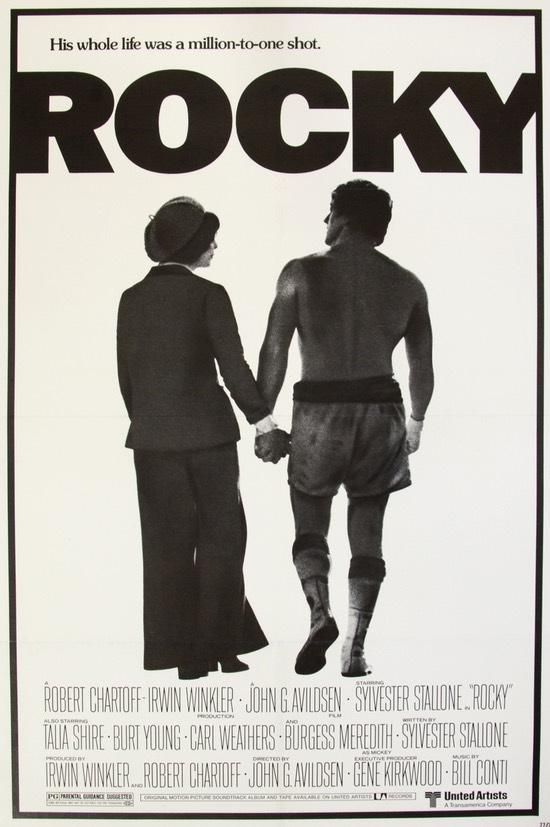
The Plot: Rocky Balboa (Sylvester Stallone) is a down-on-his-luck boxer who makes a living roughing up people who owe money to his loan shark boss (Joe Spinell). Heavyweight champion Apollo Creed (Carl Weathers) is looking for a new opponent to fight on New Years’ Day in Philadelphia, and comes up with the marketing ploy of getting an unknown to challenge him. Rocky is selected, and reluctantly agrees, training under the guidance of retired bantamweight Mickey Goldmill (Burgess Meredith). With his shy girlfriend Adrian (Talia Shire) in his corner – and her abusive brother Paulie (Burt Young) definitely not – can Rocky go the distance? Hey, they made 800 more of these, what do you think?
Why It Matters: The NFR calls it a “stirring tale” that “has become part of the American psyche”. The film’s iconic shot of Rocky running up the Philadelphia Museum of Art steps is also highlighted.
But Does It Really?: It may be a tad too by-the-book in terms of underdog movie story beats, but “Rocky” more than makes up for it with its heart and guts. Sylvester Stallone pours himself into this story, and this passion shines through in every aspect of this movie. In the wake of Watergate and the Vietnam War, “Rocky” gave the world something that had been missing from the ’70s movie scene: Hope. And the film’s ongoing references/sequels has kept its legacy alive and well. How it took 15 years for “Rocky” to make the NFR cut is anyone’s guess.
Everybody Gets One: Sylvester Stallone spent almost a full decade as a struggling actor, appearing in bit parts in such ’70s films as “Bananas” and “Klute”. The 1975 match between Muhammad Ali and underdog Chuck Wepner inspired Stallone to write a screenplay, and three days later he had a rough draft of “Rocky”. United Artists was hesitant to let Stallone play Rocky rather than an established star like Robert Redford or James Caan, but they finally agreed to it, with the caveat that the film’s budget be reduced to $1,000,000. Director John G. Avildsen was eager to direct a more upbeat movie as a change of pace from “Joe” and “Save the Tiger”. He admitted to knowing very little about boxing before taking the job.
Wow, That’s Dated: The main one, of course, is the film’s setting amidst the country’s Bicentennial Celebration. Fun Fact: the Bicentennial gave us the “I’m Just a Bill” song from “Schoolhouse Rock!”
Seriously, Oscars?: “Rocky” the movie was as much an underdog as Rocky himself. The unexpected smash hit of 1976, “Rocky” led the Oscar pack with 10 nominations. Facing such heavyweight competition as “Network“, “Taxi Driver“, and “All the President’s Men“, “Rocky” took home Best Picture, Director, and Editing. Sylvester Stallone lost both his acting and writing nominations to the team from “Network”, but did get to present an award with self-proclaimed “real Apollo Creed” Muhammad Ali.
Other notes
Although the Ali-Wepner match served as Stallone’s initial inspiration, very little of Rocky is based on Wepner himself. Rocky Balboa was a combination of several boxers, including two real-life Rockys: Marciano and Graziano. Stallone also based Rocky’s story arc on his own struggles becoming a professional actor.
Say what you will about Stallone, he’s loyal to animals. Rocky’s dog Butkus was Stallone’s real dog, and as of this writing Stallone still owns Rocky’s turtles Cuff & Link!
The flirting between Rocky and Adrian is adorably awkward. It’s “Marty” meets “Somebody Up There Likes Me”.
Speaking of, Talia Shire’s Adrian is a full 180 from her work in the “Godfather” films. Like everything else in the movie, Adrian is a subversion of the “boxer’s girlfriend” trope.
Shoutout to Carl Weathers. Most movie boxing champs are dimwitted, but Apollo Creed is an intelligent businessman and a strategic showman. Throw in a disciplined performance from Weathers, and baby you got a stew going!
“Who discovered America? An Italian, right?” ….no.
I always forget that “Rocky” is one of the rare classic Thanksgiving movies. And then later a thoroughly depressing Christmas movie. Thanks, Paulie.
“Rocky” once again proves my theory that a famous movie quote simply needs to be repeated multiple times. Rocky says “Yo, Adrian” quite a bit, and his easily imitable cadence makes it all the more fun!
So as soon as Rocky and Adrian hook up, she doesn’t need glasses anymore? I didn’t know it was that easy.
Oh Burgess Meredith, what a performance. It’s so close to campy, but never quite crosses that line. Plus you get to hear one of the greatest actors of his generation say things like “You’re gonna eat lightning, and you’re gonna crap thunder!” Thank god we dissolved the blacklist.
This movie did no favors for either the eggs or giant meat slabs industries.
“Gonna Fly Now” is the training montage that all other training montages aspire to be. And the song itself wins the “Shaft” award for least amount of lyrics while still technically being a non-instrumental (it has two lyricists!) My one question: did Apollo do any training for this match? We never see him outside of a business suit until the finale.
Surprise Guest Star Smokin’ Joe Frazier! The producers sent out invites to several notable boxers to make cameos in the final scene, but only Frazier showed up. It ended up working out, as Frazier was based in Philadelphia, adding some authenticity to the proceedings.
Apollo Creed is introduced as “The Master of Disaster”. I thought that was Irwin Allen?
The final match is quite an exciting viewing experience. It helps that there has been very little actual boxing up until this point, and that both contenders are actually skilled (and do their own stunts). Like many movies of the era, “Rocky” takes its time getting started, but the third act is one exhilarating pay-off.
“Ain’t gonna be no rematch. .Well…at least for three years.”
Legacy
“Rocky”, of course, catapulted its star to A-list Hollywood, where Stallone has spent the last four decades latching on to any franchise that will have him. He’s still making “Rambo” movies for God’s sake!
John G. Avildsen’s career also took off after his Oscar win, and he would go on to helm another iconic inspirational sports film: “The Karate Kid”.
As for “Rocky” himself, the film got a sequel in 1979. …And then another in 1982. …And 1985. And 1990…. Oh, and 2006, I always forget about that one.
Ryan Coogler’s 2015 film “Creed” casts Michael B. Jordan as Apollo Creed’s illegitimate never mentioned son, now being trained by a semi-retired Rocky. It went over well with critics and audiences, and even got Stallone another Oscar nod.
“Rocky the Musical” played Broadway in 2014, but even the reliable songwriting team of Ahrens & Flaherty couldn’t save this one. On the plus side, the musical lifted “Eye of the Tiger” from the third movie.
And of course, tourists and movie-lovers have been running up the steps to the entrance of the Philadelphia Museum of Art in triumph since 1976. Hopefully they take the time to go inside too; they’ve got Picassos!
Written by Richard Matheson. Based on the short story by Edgar Allan Poe.
Class of 2005
The Plot: Poe’s classic story gets the Roger Corman treatment in “House of Usher”. Philip Winthrop (Mark Damon) arrives at the dilapidated mansion of Roderick Usher (Vincent Price), the brother of his fiancée Madeline (Myrna Fahey). Roderick keeps his sister away from Philip, telling him of the curse of madness upon the Usher family, as well as their house. When Madeline supposedly dies shortly after an argument with Roderick, the mysteries of the house come to the forefront.
Why It Matters: The NFR write-up is a tribute to Roger Corman and his penchant for finding fresh talent. The write-up also highlights the Corman/Poe film series, calling them “elegant” and setting “a new standard for screen horror.”
But Does It Really?: I am all for Roger Corman being on this list. Despite his movies being remembered mostly for their cheap production value, Corman is a true original, and one of the few independent film producers to be successful amidst the Hollywood studio system. I suppose a selection from Corman’s Poe film series is a natural choice for the NFR, but I’m always a fan of putting more low-budget cult films on this list, and Corman gives you plenty of options (“The Little Shop of Horrors” comes to mind). That being said, no argument here for “House of Usher”/Roger Corman making the NFR.
Everybody Gets One: Roger Corman earned an engineering degree at Stanford University, but quit his job at U.S. Electrical Motors after four days. Following his younger brother Gene (agent to such stars as Joan Crawford and Harry Belafonte), Roger went into filmmaking. Using his money from selling his screenplay “Highway Dragnet”, Corman founded his own production company and struck a deal with the American Releasing Company, later called American International Pictures. Classic Corman/AIP collaborations include “It Conquered the World”, “The Undead”, and “The Saga of the Viking Women and Their Voyage to the Waters of the Great Sea Serpent”. Many of these films were shot in a matter of days using sets and props recycled from previous movies.
Title Track: We have a title dispute! As with many Corman pictures, “House of Usher” was released under two different titles. The print I watched carried the full name “The Fall of the House of Usher”, but literally everything else I’ve read about the film carries the shorter title.
Seriously, Oscars?: This will shock you, but the Oscars never embraced the low-budget world of Roger Corman. As for the man himself, see “Legacy” below.
Other notes
Despite his good working relationship with American International, Corman grew tired of making cheap movies. When approached by AIP to make two black-and-white horror films for $100,000 each on a ten day schedule, Corman countered with one color film for $200,000 on a fifteen day schedule. AIP agreed, and Corman settled on Poe’s “The Fall of the House of Usher” as it was in public domain, and therefore free to adapt.
Even with his newly expanded budget, Corman cut costs where he could. The barren forest Winthrop rides through at the beginning of the movie is a real location in Hollywood Hills that had just been destroyed by a fire. Corman heard about the fire on the radio, and got his crew over there the next day.
I was incredibly wary of a feature length adaptation of “House of Usher”, especially after watching the visually stunning silent film version that’s also on the Registry. For the most part, this “Usher” does alright, with most of the padding being an extension of the film’s foreboding atmosphere, as opposed to extra characters or subplots. The addition of Winthrop and Madeline being engaged is inevitable, but not farfetched or distracting.
There is a 22 year age gap between on-screen siblings Vincent Price and Myrna Fahey. Not impossible, but were there any siblings between them? Are they cursed too?
What does evil do to a house’s property value? Regardless, this manor is definitely what you would call a “fixer-upper” (a fixer-usher?). And the constant trembling in the house may just be from their next door neighbor Admiral Boom.
Yes, it’s a bit morbid to have your own casket ready to go in the family crypt, but do you have any idea how expensive those are? If there’s a deal, take it.
Vincent Price is another one of those actors who I could listen to recite anything. You can hear every consonant so clearly from Price.
I hate to say it, but the two younger leads aren’t that great. Myrna Fahey’s film career never took off, but she had a successful run on episodic TV throughout the ’60s. And Mark Damon pivoted to producing, most notably 2003’s “Monster” with Charlize Theron.
A dream sequence? Here’s your padding in full force.
Hmmm…a character in a Poe story haunted by the movement of a presumed dead person: where have I seen this before?
The film ends with another bit of Corman cost-cutting. When Corman learned of a barn in Orange County set to be demolished, he struck a deal with the owners to have it burned, and for Corman to film it. The footage was used for this film’s finale, as well as in several subsequent Corman projects.
Legacy
“House of Usher” was a hit, and Corman made seven more films for AIP based on Edgar Allan Poe stories. Highlights include “The Raven” and “The Masque of the Red Death”. “Usher” was the first collaboration between Corman and Vincent Price, who would go on to star in seven of the eight Poe films.
Roger Corman continued to direct and produce over 400 movies in the past 60 years. Among the young up-and-coming filmmakers Corman help get started in show business are Martin Scorsese, Ron Howard, Jonathan Demme, and Francis Ford Coppola, many of whom cast Corman in bit parts in their later big-budget movies as a thank you. In 2009, Roger Corman received an honorary Oscar “for his rich engendering of film and filmmakers”.
The Plot: “Pups Is Pups” is one of Hal Roach’s original “Our Gang” shorts (aka “The Little Rascals”). This two-reeler is about the gang getting into some mischief when they bring their menagerie of pets to a high society dog show. They’re all here: Jackie, Chubby, Farina, Wheezer…wait, who the hell are these kids? This isn’t my gang at all! None of this is o-tay by me!
Why It Matters: The NFR calls the film “one neat, entertaining package”, and an essay by Hal Roach expert Randy Skretvedt pleads a strong case for the film’s NFR status.
But Does It Really?: An “Our Gang” short should absolutely be on the National Film Registry, but this one? While “Pups Is Pups” overall is harmless fun, it has none of the child actors most commonly associated with “Our Gang”. Where’s Alfalfa or Spanky or Buckwheat? These characters would star in the series’ later shorts (c. 1936-1939), so the inclusion of an earlier short with a cast unknown to a casual viewer and with no obvious significance to the series is a bit perplexing. “Our Gang” is worthy of preservation, but the choice of “Pups Is Pups” is a missed opportunity.
Everybody Gets One: Director Robert McGowan was a firefighter in his native Denver before moving to Los Angeles and taking a job as a director at Hal Roach’s newly opened studios. McGowan helmed a majority of the “Our Gang” shorts for the series’ first 11 years. Nicknamed “Uncle Bob” by the cast, McGowan worked well with the children, encouraging them to improvise for more natural performances.
Wow, That’s Dated: On the one hand, the “Our Gang” shorts were surprisingly progressive in their casting of racially diverse children, with no attention being brought to these children playing together. On the other hand, cast-members Allen Hoskins and Allen Tong are portraying, respectfully, the African-American and Asian-American stereotypes of the day.
Seriously, Oscars?: No Oscar love for “Pups is Pups”, but the 1936 short “Bored of Education” would win the series its only Oscar for Short Subjects (One-Reel).
Other notes
The story goes that Hal Roach first conceived the “Our Gang” series after watching a group of kids playing across the street from the studio. After realizing he had been watching them for 15 minutes, he theorized that natural, unpolished kids would make a good series of shorts. The series, originally called “Hal Roach’s Rascals”, premiered in 1922 with the short “Our Gang”. Theater exhibitors started calling the shorts “the Our Gangs”, leading to the change in name (for the films’ more famous name change, see “Legacy” below).
“Pups Is Pups” was the 100th “Our Gang” short, and the 12th since the series transitioned from silent to sound.
The most well known of this group of child actors is Jackie Cooper, one of the series’ leads from 1929 to 1931. Shortly before leaving “Our Gang”, Cooper starred in the film “Skippy“, and at nine years old is still the youngest actor to receive a Best Actor Oscar nomination. As an adult, Jackie Cooper was a successful television director with the occasional acting gig, most memorably as Perry White in the Christopher Reeve “Superman” movies.
One of the puppies in this short is the gang’s iconic Pete the Pup. The Pete in this short is the son of the original dog, who died prior to this short’s production. While the first Pete had a large circle drawn around his right eye, his son had the same design over his left eye.
“Pups Is Pups” has joined the shortlist of NFR entries in which one of my notes simply reads “What is happening?” Obviously I shouldn’t be overanalyzing a comedy short with a bunch of kids, but I was thrown by the lack of recognizable “Little Rascals” hallmarks.
Legacy
Hal Roach continued with “Our Gang” until 1938 when he sold the series to its distributor MGM. After the series ended in 1944, MGM sold the original shorts back to Roach, but retained the “Our Gang” name. Roach packaged the shorts for television under their new name – “The Little Rascals” – and a new generation discovered “Our Gang”.
There have been many attempts at “Little Rascals” revivals over the years, including an animated series in the ’80s! But the most memorable (at least to my generation) is the 1994 big-screen adaptation. Directed by Penelope Spheeris, the film included cameos from the likes of Mel Brooks, Whoopi Goldberg and…Donald Trump? Talk about the decline of western civilization.
In anticipation of the 1994 film version, several “Our Gang” shorts were released on video with special introductions by Leonard Maltin. A decade later, Maltin, now a member of the National Film Preservation Board, successfully lobbied to get an “Our Gang” short on the Registry.
And now a moment of silence for the “Little Rascals” parody clips I couldn’t shoehorn into the main body of this post. From Eddie Murphy’s Buckwheat impression to Spanky and Our Gang to Moe Szyslak killing the original Alfalfa.





 The Horse's Head