#558) The Story of Menstruation (1946)

#558) The Story of Menstruation (1946)

Directed by Jack Kinney

Class of 2015

This is another film with a subject matter I am definitely not qualified to discuss at length: the female menstrual cycle. As always, I am just here to watch the movie, and comment on the information as presented, which in this case is a streamlined, simplified version of the process geared towards young girls.

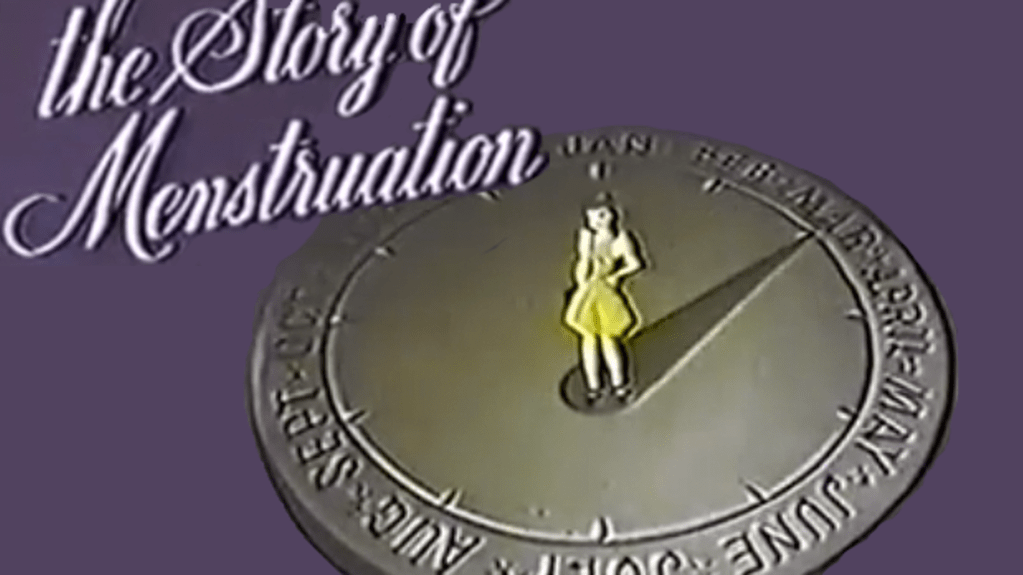
The Plot: Narrated by Gloria Blondell, “The Story of Menstruation” is a straightforward presentation of what young women can expect when their bodies start developing and they experience their monthly menstrual cycle. Great lengths are taken to remind female viewers that this is a normal, natural part of life, and nothing to be embarrassed or ashamed about, nor should it prevent you from your everyday activities. Sponsored by Kimberly-Clark (the makers of Kotex), and produced by…Walt Disney Productions!? Well this just got a whole lot more interesting.

Why It Matters: The NFR mentions the film’s “friendly Disney-style characters and gentle narration”, but is also quick to quote from film scholars who “take issue” with the film’s approach to such a delicate subject.

But Does It Really?: A tip of my hat to whoever got this little gem out of the Disney Vault and into the NFR. Disney is always quick to sweep anything that contradicts their current image under the rug, so I’m thrilled that this short has not only been salvaged, but placed on a historical list ahead of many of Disney’s better known classics. “The Story of Menstruation” makes the NFR thanks to its sensitive take on its subject matter, as well as for its standing as one of Disney’s more unique and obscure treasures.

Everybody Gets One: Like her sister Joan, Gloria Blondell was a performer, though she was typically relegated to such minor roles as “Secretary” and “Lady Bill Collector”. “Menstruation” was not Ms. Blondell’s first foray with Disney; she occasionally voiced Daisy Duck when the character spoke without her partner’s famous impediment. Fun Fact: Gloria Blondell was briefly married to Albert Broccoli, about 15 years before he started producing the James Bond film series.

Wow, That’s Dated: My assumption was that some of this movie’s science would be incorrect or antiquated, so I watched a YouTube video of an OB-GYN reacting to this short. Turns out that the science is accurate (albeit simplified), making the only thing truly dated about the film the belief that a woman still needs to look her best during her period in order to feel better. Screw that: you do you.

Seriously, Oscars?: Unfortunately, no theatrical release, and therefore no Oscar love for “The Story of Menstruation”. Disney’s nominee at the 1946 Oscars was the far more conventional Mickey and Pluto short “Squatter’s Rights“, which lost to Tom and Jerry’s “The Cat Concerto“. I will point out, however, that “The Story of Menstruation” received the Good Housekeeping Seal of Approval.

Other notes

  • So how did a family-friendly image-conscious company like Disney end up making a short about periods? It’s important to remember that in 1946 Disney was far from the mega conglomerate it is today, and WWII depleted a lot of their funds. Disney spent most of the ’40s digging itself out of financial debt, mainly by producing sponsored shorts for various companies. Other Disney shorts of the era include “The Building of a Tire” for Firestone, “The ABC of Hand Tools” for General Motors, and “Bathing Time for Baby” for Johnson & Johnson. 
  • I appreciate that Disney does not shy away from using the actual biological terminology. Some film buffs cite “The Story of Menstruation” as the first film in history to use the word “vagina”.
  • Perhaps the film’s most controversial artistic choice, the animation of the menstrual blood leaving the uterus is colored white instead of red.
  • As someone who has never experienced a period, anyone who can carry on their life under those circumstances has my respect.
  • While this film does put certain rumors to rest (such as the falsehood that you can’t bathe or exercise while on your period), it does add its own share of problems, like suggesting you shouldn’t throw off your cycle by being “emotionally upset” or “catching cold”. Again, I’m no expert, but surely that can’t be right.
  • As this film was commissioned by Kimberly-Clark, I kept waiting for “the hard sell” about Kotex. While there’s no obvious product placement in the short, there is mention of the booklet “Very Personally Yours“, which the narrator encourages young ladies use to track their periods. In addition to a mini-calendar, the inside of the booklet contained, you guessed it, ads for Kotex.
  • Every character in this short looks like a cross between a Precious Moments figurine and a Margaret Keane painting.
  • And they say “rectum” too? Wow, Disney must have been really strapped for cash.
  • This short really goes out of its way to refer to the menstrual cycle as a “normal and natural” part of life. The phrase “normal and natural” gets repeated a lot. I assume previous discussions of the menstrual cycle were either nonexistent or filled with shame.

Legacy

  • “Menstruation” was one of the last educational shorts Disney was commissioned to make. A series of cheaper animated films (the “package features”) helped bring in money for the studio, with financial gamble “Cinderella” being the hit that got Disney out of the red.
  • Following its run in schools up through the early 1960s, I assume “The Story of Menstruation” settled down in a cozy corner of the Disney Vault, locked away next to “Song of the South” and the WWII propaganda. 

Further Viewing: Disney’s other long-gone journey into the uterus: “The Making of Me”, which played at EPCOT’s Wonders of Life Pavilion from 1989 to 2007. You get a cartoon sperm courting a cartoon egg, as well as Martin Short giving the vaguest description of “making love” that could be uttered in a theme park.

#557) The Dragon Painter (1919)

#557) The Dragon Painter (1919)

OR “Art Ache”

Directed by William Worthington

Written by Richard Schayer. Based on the novel by Mary McNeil Fenollosa.

Class of 2014

The Plot: In Hakawa, Japan, Tatsu (Sessue Hayakawa) paints landscapes to cope with the loss of his fiancée, who he believes is a princess that turned into a dragon. Tatsu’s art catches the eye of Kano Indara (Edward Peil Sr.), a famous painter who wants Tatsu as his protégé. Indara presents his daughter Ume-ko (Tsuru Aoki) as the reincarnation of Tatsu’s lost fiance, and the two fall in love. But when their newfound love gives Tatsu a case of painter’s block, things turn surprisingly tragic. Well, kinda.

Why It Matters: The NFR gives a rundown of the film and Sessue Hayakawa, and mentions that critics of the time praised the film’s “seemingly authentic Japanese atmosphere” (it was shot in Yosemite Valley). There’s also a very detailed essay by film professor and Sessue Hayakawa expert Daisuke Miyao.

But Does It Really?: Oh sure. Not only is “Dragon Painter” one of your standard lost and found silent movies, but it’s also the rare movie (silent or otherwise) produced by and starring an Asian creative team. Historical significance aside, “Dragon Painter” is a quick, easy to follow fable devoid of harmful stereotypes (for the most part; see “Wow, That’s Dated”). Over 102 years later “Dragon Painter” is still worth a viewing, and worth the reminder of how important it is to view art from all walks of life.

Everybody Gets One: Director William Worthington started off as a stage and film actor, and focused his attention on directing through the 1910s and ’20s. He returned to film acting in the ’30s, playing bit parts in such films as “Duck Soup” and “Mr. Smith Goes to Washington“.

Wow, That’s Dated: It’s a movie devoid of Japanese stereotypes and I STILL have to issue a Yellowface Warning? Ugh. Despite the majority of the cast being of Japanese descent, Kano Indara is played by White actor Edward Peil Sr. from Racine Wisconsin.Why, Sessue, why?

Other notes

  • Following his success in “The Cheat“, Sessue Hayakawa was one of the biggest and highest paid stars in Hollywood. Fearful of being cast in the stereotypical Asian roles of the studio system, Hayakawa formed his own production company: Haworth Pictures Corporation, a combination of his name and co-founder William Worthington’s. “The Dragon Painter” was one of 23 films made by Haworth Pictures.
  • The version I watched is 3 minutes longer than other prints. No, they didn’t reinstate 3 minutes of long-lost footage; this version is a restoration that begins with 3 minutes of text explaining how “Dragon Painter” was restored and who funded it. I applaud the effort, but why not stick this after the movie?
  • So Tatsu’s fiancée turned into a dragon 1000 years ago? If that’s the case, Tatsu looks amazing for 1033. (But seriously, Sessue Hayakawa was 33 when he made this and looks like he’s 20. How I envy those genes).
  • Kano Idara believes his legacy must end because he did not produce a son. I was hoping that the introduction of his daughter would lead to a progressive stance on women in this culture, but I guess it’s not that kind of movie.
  • Ume-ko is played by Tsuru Aoki, the real-life Mrs. Sessue Hayakawa. The two married in 1913, and were together until Aoki’s death in 1961. Throughout the ’10s and ’20s Aoki was often cast as Hayakawa’s leading lady.
  • Of course you can’t see Tatsu’s fiancée in his paintings: she’s a hidden dragon. She’s right next to the crouching tiger.
  • In true silent film fashion, “Dragon Painter” is giving me some glorious day-for-night shots, tinted in a lovely lavender blue.
  • I hate that Tatsu’s art suffers because he has found love. You can have both! This is like when Elaine Benes got dumb after practicing abstinence.
  • And then the movie gets kinda dark with Ume-ko contemplating suicide. …Or you could just break up with him. That’s fine too. Thankfully, everyone gets a happy ending here, though we end with the moral “Love must be art’s servant” which, I don’t know…

Legacy

  • “The Dragon Painter” marked the end of Sessue Hayakawa’s reign as a silent film star; he left Hollywood for his native Japan a few years later (some speculate because of anti-Asian sentiment). Hayakawa would return to American stage and screen occasionally, most notably in “The Bridge on the River Kwai” for which he received an Oscar nomination.
  • “The Dragon Painter” disappeared for many years until a print was found in France sometime in the 1980s. The French-translated intertitles were translated back into English, and the entire film received a restoration in 1988. For those of you keeping score, that’s two movies in two weeks of this blog that had a single surviving print in France. Clearly we need to be copying the French style of film preservation.

#556) The Right Stuff (1983)

#556) The Right Stuff (1983)

OR “Mercury in Retrospect”

Directed & Written by Philip Kaufman

Class of 2013 

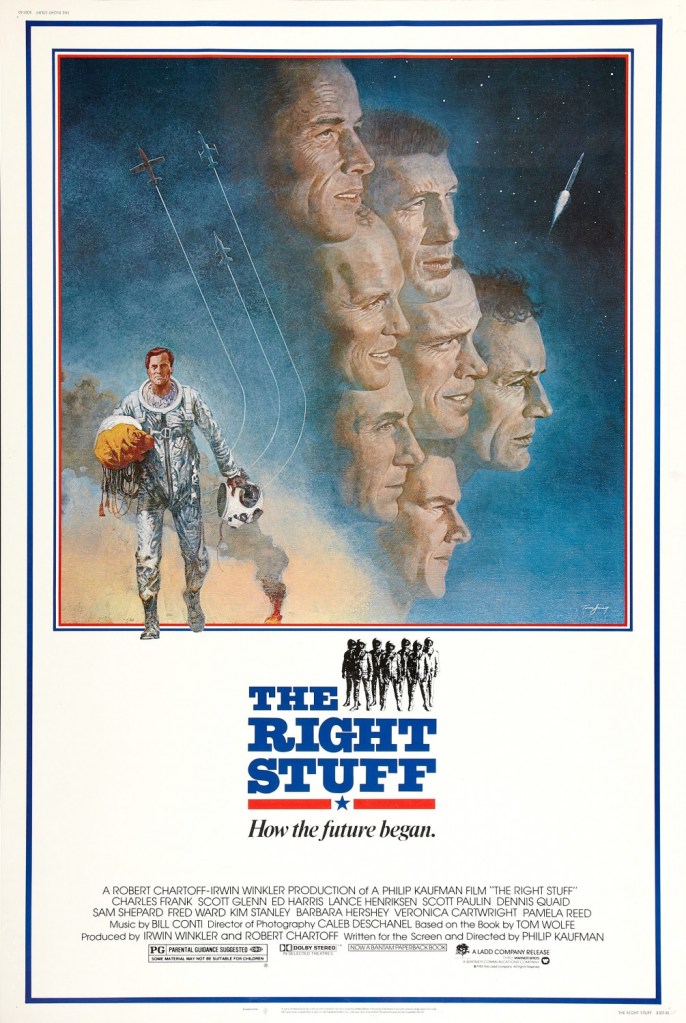
The Plot: “The Right Stuff” tells the true(ish) story of Project Mercury, the first leg of the “space race” in which NASA aimed to have a man orbit the Earth before the Soviet Union could. Among the seven pilots chosen to be the first astronauts are Alan Shepard (Scott Glenn), later the first American in space, and John Glenn (Ed Harris), later the first American to orbit the Earth. The trials and tribulations of all seven men (Fred Ward, Dennis Quaid, Lance Henriksen, Scott Paulin, Charles Frank) are highlighted and counterpointed by Chuck Yeager (Sam Shepard), the test pilot who broke the sound barrier but is overlooked for the mission. While the film explores the amazing feat of becoming an astronaut, it also questions if the men picked for the job really had…the right stuff.

Why It Matters: The NFR calls it “an epic right out of the Golden Age of Hollywood”, praising Kaufman’s equal parts ambitious and subversive screenplay, its “[r]emarkable aerial sequences”, and “spot-on editing”.

But Does It Really?: I found “The Right Stuff” more akin to an efficient machine than a great movie: it’s well-made and gets the job done, but ultimately I have no personal or emotional attachment to it. The film is an impressive undertaking (and the effects hold up remarkably well), but its status as an important movie has waned a bit over the years. Still, any movie that can keep the momentum going for three hours in this day and age is worth a watch, and “The Right Stuff” earns a spot in the “minor classic” column of NFR films.

Everybody Gets One: “Right Stuff” is your one NFR entry for many of the cast, including Ed Harris, Dennis Quaid, Fred Ward, Pamela Reed, Kathy Baker, and William Russ. And thanks to archival footage, this is also the only NFR appearance for Bill Dana as José Jiménez.

Wow, That’s Dated: Synthesizers in the score. I know they’re being used here as symbolism for our entry into a more technological age, but it’s always the synthesizers that give it away.

Title Track: Like “It” 56 years earlier, “The Right Stuff” is that je ne sais quoi needed to become an astronaut; heroism, bravery, machismo, cunning, uniqueness, nerve, talent, etc. This may also be the most prestigious movie with the word “stuff” in the title.

Seriously, Oscars?: A critical hit but a box office miss, “Right Stuff” entered the 1984 Oscars with 8 nominations, including Best Picture. The big winner that night was “Terms of Endearment”, but “Right Stuff” took home four trophies: Editing, Score, Sound Mixing, and Sound Editing.

Other notes 

  • While on assignment with Rolling Stone to cover the Apollo 17 mission, Tom Wolfe became fascinated with NASA and astronauts, inspiring him to write about the Mercury program and why any of these men would take so dangerous a job. “The Right Stuff” was a success, and the film rights were snatched up almost immediately. William Goldman was originally hired to write the script, but his draft was rejected by Philip Kaufman because it eliminated Chuck Yeager entirely and had a more patriotic tone than what Kaufman wanted to convey. When Tom Wolfe declined to adapt his own material, Kaufman wrote the script himself.
  • Who ISN’T in this movie? Quick shout-outs to supporting actors Royal Dano (aka Robot Lincoln) as a minister, and Actors Studio legend Kim Stanley (in her final film role) as real-life aviatrix Pancho Barnes. And be on the lookout for the real Chuck Yeager as the bartender at Pancho’s (he was also the film’s technical consultant).
  • Like her work in “Hoosiers“, Barbara Hershey doesn’t have a lot of screentime. Unlike her work in “Hoosiers”, however, Hershey gets to play a much more interesting, dimensional character.
  • Bill Conti’s score is what I would call “iconic-ish”. If you asked me to hum the theme to “The Right Stuff”, I couldn’t do it; but if you hummed it, I could guess where it’s from.
  • This movie is everything “Top Gun” thought it was but definitely wasn’t.
  • I was not expecting this movie’s comic relief to come from the duo of Harry Shearer and Jeff Goldblum as the NASA recruiters. Bonus points to Shearer for being the only person in this movie to actually say “the right stuff”.
  • For those of you keeping track: Ed Harris is playing John Glenn, Scott Glenn is Alan Shepard, and Sam Shepard is Chuck Yeager. All we need is Ed Harris drinking a Jägermeister and the circle would be complete.
  • The actors playing the astronauts’ wives are all great actors making the most of their limited screentime. Special shoutout to Mary Jo Deschanel as Annie Glenn. Deschanel is married to this film’s cinematographer Caleb Deschanel, and is the mother of Emily and Zooey.
  • I will say for a three-hour movie, “Right Stuff” doesn’t feel bloated. There could have been a little trimming towards the end, but ultimately I felt the movie took the appropriate amount of time telling its story and giving its characters the space they needed, pun not intended.
  • It took 106 minutes, but we finally got “The Shot”: the seven suited-up Mercury astronauts walking down a hallway towards the camera in slow-motion. Now you know where it comes from.
  • I appreciate that this movie treats each of its characters as real people, not lionized historical figures. No one blurts out historical facts about themselves, just a bunch of ordinary people doing something extraordinary.
  • The effects throughout this movie are amazing and hold up almost 40 years later (I spotted only a few instances of bluescreen matte lining). After John Glenn’s orbit scenes I was ready to give the Oscar to this team. Oddly enough, there were not enough eligible films in 1983 to justify a Special Effects category, but a special award was given instead to “Return of the Jedi“. Seriously, Oscars?
  • As far as historical accuracy, “The Right Stuff” is mostly correct. Many of the events happened, though some details are fudged for dramatic weight. The most controversial departure comes from Gus Grissom and whether or not he prematurely detonated his capsule’s hatch upon splashdown. The film’s ambiguous stance was ill-received at the time, as it had already been determined the detonation was a mechanical error, not human error.

Legacy 

  • “The Right Stuff” did not recoup at the box office, and was partially responsible for The Ladd Company’s closure. Despite public criticism from Tom Wolfe and the Mercury Seven astronauts (Wally Schirra called it “Animal House in Space”), the film was well-received by critics; both Siskel and Ebert named it the best movie of 1983.
  • Ron Howard has stated that “The Right Stuff” was the movie that made him believe that he could make “Apollo 13“. A spiritual sequel of sorts, “Apollo 13” also stars Ed Harris, this time playing NASA flight director Gene Kranz.
  • “The Right Stuff” was adapted into a TV miniseries in 2020, because if there was any complaint about this movie, it’s that it wasn’t long enough.
  • The main cultural takeaways from “The Right Stuff” are its title and the aforementioned walking shot, which everyone has spoofed to death. I suspect that the film’s decline in cultural relevancy has more to do with our overall decline of interest in our national space program.

#555) Parable (1964)

#555) Parable (1964)

OR “Clown of God”

Directed by Rolf Forsberg and Tom Rook

Written by Forsberg

Class of 2012

The Plot: When visiting the 1964 New York World’s Fair, be sure to stop by the Protestant Pavilion and see their short film “Parable”. Unlike religious films of the past, Jesus is not presented here in a literal sense, but rather metaphorically as a clown dressed all in white (Clarence Mitchell). This clown wanders into a circus, helping those who are being oppressed by the circus’ cruel puppet master (Gordon Oarsheim). Ultimately, the clown replaces the human marionettes and becomes crucified (if you will). But the clown’s good deeds live on in the most avant-garde passion play you’ve ever seen.

Why It Matters: The NFR gives a history of church-sanctioned short films (typically made in response to overblown Hollywood religious epics) and cites “Parable” as “[o]ne of the most acclaimed and controversial films in this tradition”. There’s also an essay by UCLA archivist Mark Quigley.

But Does It Really?: Oh sure. I’m all for movies on this list that stand on their own piece of ground, and “Parable” sticks out thanks to its experimental interpretation of the Bible. Plus, thanks to its original engagement, “Parable” represents the 1964 New York World’s Fair on this list. No argument for “Parable”.

Everybody Gets One: Rolf Forsberg got his start as a theater director in Chicago, which led to him becoming a writer and director for “Light Time“, a Lutheran TV show that taught morality to children. It was his work on “Light Time” that led to the New York City Protestant Council of Churches commissioning Forsberg to create a short film for their World’s Fair exhibit.

Wow, That’s Dated: Circuses and sideshows.

Wow, That’s Not Dated: Religious groups being upset over depictions of Christ as anything other than a White male. Ok Greg.

Seriously, Oscars?: Due to its screenings at the New York World’s Fair (as opposed to Los Angeles), “Parable” was not eligible for an Oscar. For the curious, 1964’s Live-Action Short Subject winner was “Casals Conducts: 1964”, an appreciation for cellist and conductor Pablo Casals.

Other notes 

  • “Parable” was filmed in Baraboo, Wisconsin, about 40 miles north of Madison (and just south of Wisconsin Dells!). This filming location may seem random, but Baraboo is the home of the Circus World Museum (The Ringling Brothers grew up in Baraboo). I suppose filming in a museum filled with circus artifacts is cheaper than trying to film an actual circus.
  • The only information I could find on co-director Tom Rook is that, like Rolf Forsberg, he also directed the TV show “Light Time”.
  • The opening prologue is the only part of the film with spoken dialogue, in this case a narrator saying that this film is a parable in the truest sense. This film is not meant to accurately portray Jesus, but is rather an original story based on Jesus’s teachings. I guess some people missed the prologue.
  • The clown dresses like he lives beneath the Planet of the Apes.
  • Among the cast members appearing as circus performers are Saeed and Madhur Jaffrey. The couple had both appeared in Rolf Forsberg’s Off-Broadway production of “A Tenth of an Inch Makes the Difference”. Although they divorced shortly after “Parable”, Saeed continued acting in his native England, while Madhur brought Indian cuisine stateside with her book “An Invitation to Indian Cooking“. Plus, Madhur is the one who introduced Merchant to Ivory.
  • Why are all the kids dressed in hoodies? Is that a metaphor too? They all look like Elliot from “E.T.” Side note: the children were all students from Baraboo East Elementary. Hopefully this counted as a day off/field trip.
  • I will admit that if this film didn’t have the prologue, I probably wouldn’t have gotten the Christ metaphor. I would have eventually figured out it was an allegory of some kind, but not necessarily Christ.
  • This is all well and good, but how about a scene where people loudly suppress each other in the name of that clown, despite the fact that their actions obviously go against his basic beliefs and teachings? Or did I just get too real for you.
  • If anyone needs me, I’ll be at that Robot Lincoln exhibit.

Legacy 

  • “Parable” attracted controversy before it even premiered. World’s Fair president Robert Moses tried to get the film removed (even though he declined to see it), other Fair organizers resigned in protest, and some religious-types even threatened violence if the film was shown (oh the irony). The Protestant Pavilion stood by “Parable”, and the film played a successful run at the Fair.
  • After the Fair closed in 1965, the film maintained its controversial status. According to the Quigley essay, “Parable” was on a banned film list at the LA County Library in the ’70s (for promoting “anti-establishment type things”) while at the same time being screened at churches across the country.
  • Among Rolf Forsberg’s later films is 1979’s “The Late Great Planet Earth”, another nuanced take on religion, narrated by Orson Welles.
  • Also inspired by “Parable” and its looser depiction of Jesus: John-Michael Tebelak, who wrote the musical “Godspell” as his master’s thesis at Carnegie Mellon University. A revised version with a new score by Stephen Schwartz landed off-Broadway a year later, and is probably still playing somewhere right now.

Further Viewing: The other religious films made exclusively for the 1964 World’s Fair: “Man in the 5th Dimension” at the Billy Graham Pavilion, and “Man’s Search for Happiness” over at the Mormon Pavilion. Man, there were a lot of movies.

#554) El Mariachi (1992)

#554) El Mariachi (1992)

OR “Guitar Hero”

Directed & Written by Robert Rodriguez

Class of 2011

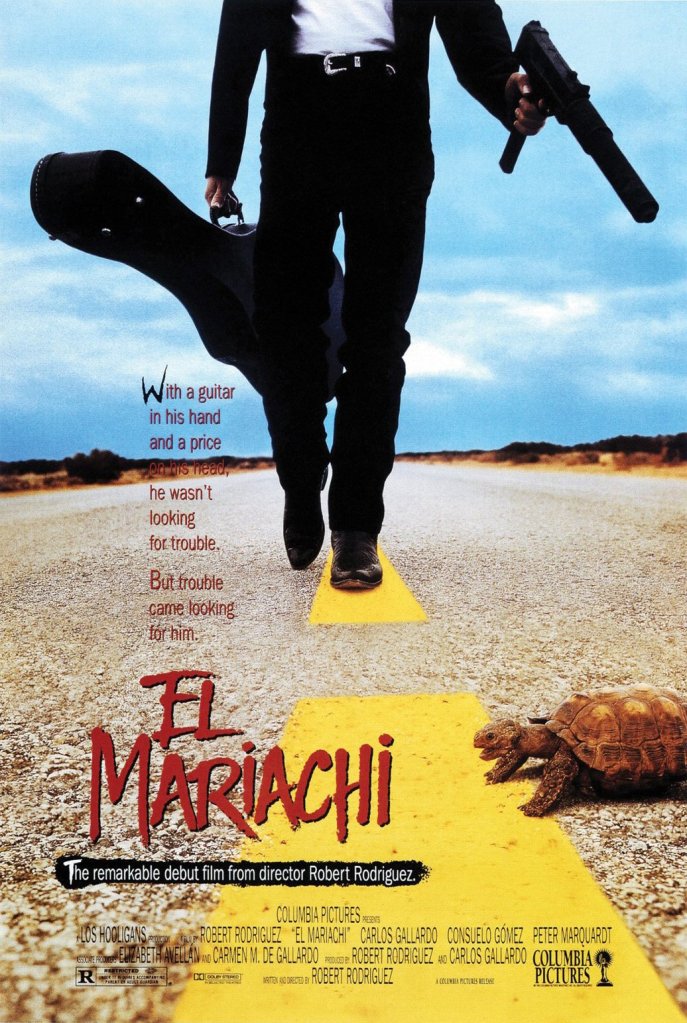
The Plot: A man known simply as El Mariachi (Carlos Gallardo) arrives in the border town of Ciudad Acuña, looking for work as a guitar player. After checking into a hotel, he is mistaken for a criminal (known for carrying a guitar case full of weapons) and chased by some local thugs. El Mariachi takes refuge in a local bar and befriends its owner Dominó (Consuelo Gómez), who it turns out is connected to Moco (Peter Marquardt), the drug lord who the thugs work for. There’s plenty of action and mistaken identity in this thriller from Robert Rodriguez.

Why It Matters: The NFR cites “El Mariachi” as one of the films that “helped usher in the independent movie boom of the early 1990s.” Rodriguez’s creativity on a budget is praised, as is his “energetic, highly entertaining” movie.

But Does It Really?: Maybe it’s the amount of older movies I have to watch for this blog, but it was such a relief to watch something different. With its inventive storytelling and impressive visuals, “El Mariachi” perfectly encapsulates the low-budget indie scene that the NFR has started to recognize in the last few years. Robert Rodriguez uses his budget constraints as a positive, creating a frenetic, riveting action movie that keeps the pace going all through its brisk 81-minute runtime. A yes for “El Mariachi” for its representation of Rodriguez and ’90s indie movies, its sheer entertainment value, and as always, bonus points for being short.

Everybody Gets One: Born in San Antonio, Texas, Robert Rodriguez became interested in film at age 11 when his father bought an early VCR that came with a camera. After a series of successful shorts, Rodriguez began production on “El Mariachi”, which he considered a “practice” film for a bigger movie. As with many of his later films, Rodriguez wore many hats during production: director, writer, cinematographer, camera operator, editor, etc. He refers to this style of solo filmmaking as “Mariachi-style”.

Wow, That’s Dated: “El Mariachi” has that synthesizer score/film by way of video aesthetic that thrived in the early ’90s. And thanks to this movie I get to play one of my favorite early ’90s games: Cordless Landline or Cellular Phone?

Title Track: Forgive my ignorance: I didn’t realize mariachi is also used to describe a singular person in a mariachi band, or someone who plays mariachi music. Columbia opted not to translate the title because they figured people wouldn’t want to see an action movie called “The Guitar Player”.

Seriously, Oscars?: No Oscar love for “El Mariachi”, but the film won its share of festival prizes, as well as the Independent Spirit Award for Best First Feature. Robert Rodriguez was nominated for Best Director, but lost to Robert Altman for “Short Cuts”.

Other notes 

  • “El Mariachi” was made on a budget of $7,000 (most of which went to film processing). Rodriguez’s main approach to keeping a low-budget was frequent cost-cutting. Among his examples: most scenes were shot in only one take, desk lamps were used for lighting, and a wheelchair was used for a dolly.
  • For the record, I watched the English dubbed version, which wasn’t too distracting (considering the Spanish-speaking version is dubbed too). I also appreciated how much common Spanish was kept in, because we all know what “por favor” means.
  • In addition to playing El Mariachi, Carlos Gallardo was this movie’s co-producer. He does well in the lead, but how charming can you be when you have the same haircut as ’80s-era Howie Mandel?
  • One of my notes simply reads “God, this is good”. Even on a shoestring budget Rodriguez knows how to tell a good story, aided by shrewd cinematography and a restraint on dialogue.
  • I don’t like endorsing anything with excessive gunplay, but man are those some good action sequences. El Mariachi’s first escape from Moco’s thugs is an exciting sequence, although Mariachi pulls off the best stunt thanks in part to everyone’s terrible aim. Like, he’s a foot in front of them and they still miss. ¡Anda ya!
  • During this viewing I wondered how much of this film’s budget was spent on squibs. Turns out, not a lot. The “squibs” were actually condoms filled with fake blood over weightlifting belts. Well done.
  • The chemistry between El Mariachi and Dominó is a variation of “He’s a jerk and she’s okay with it” called “He confessed to a murder and she’s okay with it”. Actor Consuelo Gómez only made one other movie after “El Mariachi”, briefly reprising her role of Dominó in “Desperado”.
  • Another nice bit of filmmaking, the constant use of close-ups. It helps give us the intense, disorienting feeling El Mariachi has as he stumbles into each new situation not fully aware of what is happening. Or maybe it’s just another cost-cutting measure. Either way, it works.
  • Something about Peter Marquardt’s performance struck me as off, and it turns out that Marquardt didn’t speak a word of Spanish, and had to learn his lines phonetically. That explains why he feels more stilted than the other characters.
  • I’ll be honest: I didn’t take a lot of notes for this movie, mainly because I was enjoying it so much. I spend so much time watching increasingly problematic classics and long forgotten relics it was nice to watch a (relatively) modern action movie by someone who clearly loves movies. I’m embarrassed to admit I haven’t seen any of Robert Rodriguez’s other movies, and “El Mariachi” got me excited to see the rest of his filmography.

Legacy 

  • Rodriguez made “El Mariachi” with the intention of releasing it on video, but after several video distributors rejected it, Rodriguez sent a trailer to theatrical distribution companies. Columbia Pictures purchased the film, and spent over 200 times the film’s budget on post-production and marketing. Today, “El Mariachi” holds the Guinness World Record as the lowest-budgeted film to gross $1 million at the box office.
  • “El Mariachi” is the first in Robert Rodriguez’s “Mariachi Trilogy”. 1995’s “Desperado” saw Antonio Banderas replacing Carlos Gallardo as El Mariachi, and Rodriguez’s concluded his trilogy with 2003’s “Once Upon a Time in Mexico”.
  • After “El Mariachi”, Robert Rodriguez successfully crossed over to mainstream filmmaking. Later films include “Sin City”, the “Spy Kids” trilogy, that Boba Fett spin-off we’re getting on Disney+, and a movie we won’t see until 2115.
  • 2014 brought us a TV series based on “El Mariachi”, in which another young mariachi is mistaken for another criminal and imprisoned. He escapes, and vows to find the real criminal. Kind of a modern-day “Fugitive”, I guess.
  • And finally, Robert Rodriguez may be the only filmmaker on the NFR with their own cable channel: El Rey Network. Check your local listings.

Further Reading: Rodriguez recounted his beginnings as a filmmaker and the making of “El Mariachi” in his book “Rebel Without a Crew: Or How a 23-Year-Old Filmmaker with $7,000 Became a Hollywood Player“.