
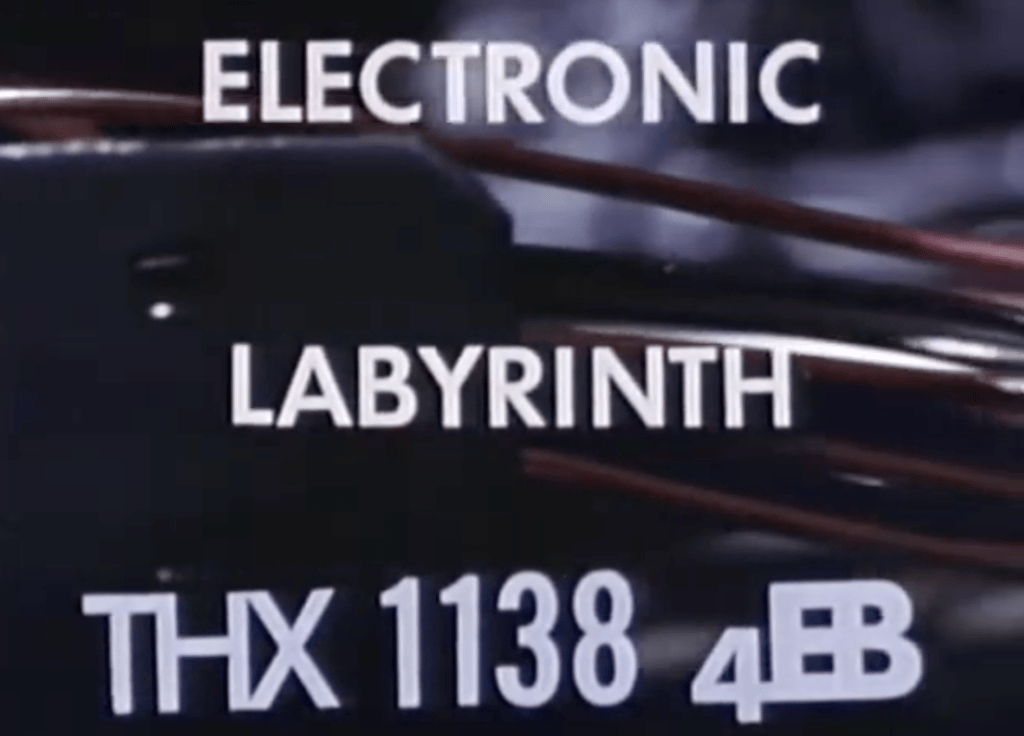
#802) Electronic Labyrinth: THX 1138 4EB (1967)
OR “George Orwell’s ‘The Fugitive’”
Directed & Written by George Lucas
Class of 2010
The Plot: In the dystopian future of 2187, humans are under constant surveillance by both man and machine. One human named THX 1138 (Dan Nachtsheim) has escaped, and operators are determined to locate and capture him. That’s about it plot-wise, but behind the camera is the confident hand of a young filmmaker named George Lucas. And now you know the rest of the story!
Why It Matters: The NFR gives a quick rundown on the movie and praises its “technical inventiveness”. An essay by film scholar Matthew Holtmeier follows Lucas’ trajectory from this film to “Star Wars” and Industrial Light and Magic (and of course this film’s subsequent feature adaptation: “THX 1138”).
But Does It Really?: “Electronic Labyrinth” covers two of the NFR’s favorite subgenres: student films and “stepping stone” movies for big directors. Choosing one of Lucas’ student films for NFR inclusion is an inspired choice. In a way, “Electronic Labyrinth” is a peek at both the future and an alternate universe: the future of Lucas’ sci-fi world building skills, and the alternate universe where Lucas isn’t saddled with the crowd-pleasing tropes of the “Star Wars” franchise. As for the film itself, while “Electronic Labyrinth” is bizarre and a bit impenetrable, the production value is so high, and the filmmaking style so impressive, you almost can’t believe this is a student film. A yes for “Electronic Labyrinth” on the NFR for representing George Lucas’ early artistic promise.
Everybody Gets One: Growing up in Modesto, California, George Lucas spent his adolescence reading comic books, watching old adventure serials on TV, and, as he got older, racing cars. A near-fatal car accident at age 18 deterred Lucas from pursuing a racing career, and he eventually ended up at USC as a film major. As a grad student, Lucas taught a cinematography class to U.S. Navy students, and used his students as crew members for a short science fiction film he wanted to make based on an idea he had with classmates Matthew Robbins and Walter Murch.
Wow, That’s Dated: Good to see that analog technology makes a big comeback in the 2180s. I didn’t realize the nostalgia cycle is 20, 40, and 220 years.
Title Track: THX 1138 is our protagonist, with 4EB his classification: Class 4, Eros Body (whatever that means). The name is allegedly derived from George Lucas’ phone number at the time.
Seriously, Oscars?: No Oscar nod for “Electronic Labyrinth”, but it did win first prize at the 1968 National Student Film Festival. This film predates the Student Academy Awards by six years, where it no doubt would have cleaned up. For the record, the 1967 Oscar for Live Action Short went to Christopher Chapman’s “A Place to Stand”, as seen at the Ontario pavilion at Expo 67.
Other notes
- Super random, but the year 2187 is my bicentennial!
- Does THX 1138 know Hollywood Extra 9413? The number on the forehead has to be a nod to “9413”, right?
- I’ve watched “Electronic Labyrinth” twice now and I will admit that while I’m still not 100 percent sure what is happening, it’s all very impressive. Like, how do you even think up a movie like this? On a related note, this is where Lucas’ reputation comes in handy: If “Electronic Labyrinth” were made by somebody who hadn’t achieved any future success, I’d probably be more apprehensive or downright confused by everything. But because it’s Lucas I’m willing to be more patient with this movie. It didn’t necessarily pay off, but it did help smooth things over.
- Using Navy equipment for your sci-fi short film? What a great idea…
- Is this movie implying that Jesus was 0000? Apparently this is fleshed out a bit more in the feature adaptation.
- I swear at one point THX runs down the “Serene Velocity” hallway. Speaking of location shooting, thanks to the Navy connection, Lucas was able to film in places that were otherwise unavailable, including at both LAX and the Van Nuys Airport, as well as a parking structure on the UCLA campus. Well well well NFR, you couldn’t go one non-UCLA student film without sneaking in a UCLA connection of some kind, could you?
- As with any student film on the NFR (but especially this one), I wonder what Lucas’ final grade on the project was. I’m sure the other submissions were very contemporary and artsty-fartsy, so Lucas must have gotten points for originality.
Legacy
- Following the positive reaction to “Electronic Labyrinth”, Lucas moved to San Francisco and co-founded American Zoetrope with Francis Ford Coppola, who suggested he adapt the short into a feature film. Released in 1971 with a trimmed-down title, “THX 1138” was a box office flop and received mixed critical reception. The film’s box office failure led to George taking a more audience-friendly route with his subsequent pictures, first with the nostalgia vehicle “American Graffiti”, and then “Star Wars”, which skews much more towards optimistic science fantasy than pessimistic science fiction.
- The name THX 1138 has shown up as an easter egg in subsequent Lucas films, including both “American Graffiti” and “Star Wars”. Lucas also named his sound system after THX. Man, I miss seeing that at the beginning of movies.

