
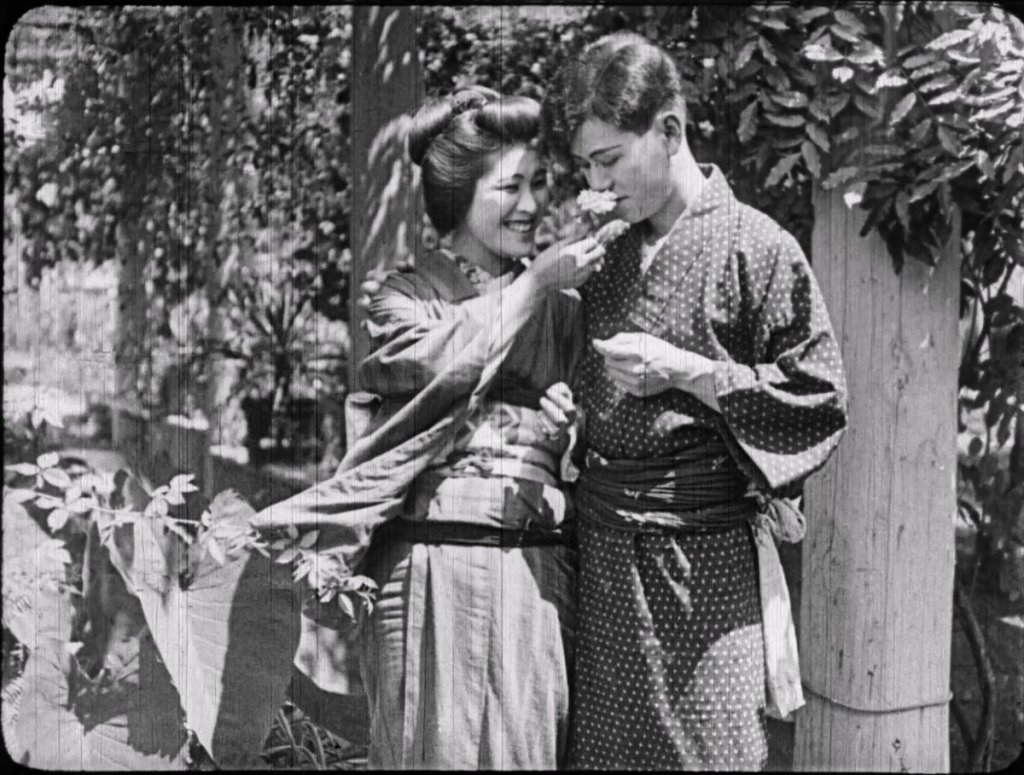
#801) The Oath of the Sword (1914)
OR “Triangle of Sadness”
Directed by Frank Shaw
Class of 2025
“The Oath of the Sword” can be viewed on the National Film Preservation Foundation website.
The Plot: In a small fishing village in Japan, Masao (Tomi Mori) is betrothed to Hisa (Hisa Numa), but yearns to go to America to study. Masao gets his wish, promising to return and marry Hisa when he graduates. While at UC Berkeley, Masao meets Captain Dean (Actor Unknown) who ends up shipwrecked in Masao’s fishing village and falling for Hisa himself. Will Hisa remember her vow to Masao? Or will she dishonor her dying father Gombei (Kohano Akashi) and the oath of the sword?
Why It Matters: The NFR provides a synopsis and some historical context, and praises the film for “highlight[ing] the significance of independent film productions created by and for Asian American communities.”
But Does It Really?: As a film, “Oath of the Sword” is fine. There’s some solid storytelling, although due to some missing footage the plot gets a little hazy towards the end. But once you learn that the film is the earliest surviving film produced by an Asian American company (and that it recently received a National Film Preservation Board-backed restoration), you start to see how “Oath” found its way onto the NFR. No argument for the film’s NFR inclusion, and if you’ve got 31 minutes to spare, you could do a lot worse than watch this movie.
Everybody Gets One: Most of the cast had achieved some success on stage and screen in Japan, but most noteworthy is Yutaka Abe, seen here as Hisa’s brother. Abe appeared in a number of American films (including NFR entry “The Cheat”) under the screen name Jack Abbe, and returned to Japan in the early 1920s, spending the next four decades as a prolific film director.
Title Track: The actual oath of the sword within the film is: “If thou do sin, by this Sword ye must die.” Yeesh, couldn’t you just make them King of England instead?
Other notes
- “The Oath of the Sword” was produced by the Japanese American Film Company, an L.A. based production company founded to counter a growing number of films featuring “yellow peril” and other anti-Asian fear mongering tactics. The JAFC began by producing educational shorts, and “Oath” appears to be their first narrative film, with the authenticity of its Japanese cast used as a major selling point.
- The surviving print of “Oath” is not the full film, and I’m guessing a lot of the missing footage is intertitles. Some are recreated digitally for the restored version, but there’s a lot of the film that goes without intertitles where I could definitely use some. What is happening?
- I’m only a handful of titles into the NFR Class of 2025, but there’s already two movies where our main character is a college athlete. What are the odds? And as best I can tell, “Oath of the Sword” filmed the college scenes on location at the UC Berkeley campus. Take that, “The Graduate”!
- As the third member of this movie’s love triangle, Captain Dean seemingly comes out of nowhere. Am I supposed to know who he is? Apparently there is a scene missing from the surviving print that gives Captain Dean a proper introduction, and also includes his wife! This changes my whole viewing experience!
- Question: Why didn’t Hisa wait for Masao to come back before hooking up with Captain Dean? It’s not like she assumed he was dead or anything, she knew he was going to be gone for four years. Man, long distance relationships are tough.
- Like many Asian-produced films of the era, “Oath” is a variation on Madame Butterfly, the short story by John Luther Long as well as the Puccini opera. If you haven’t read or seen Madame Butterfly, the “Oath” ending takes a surprisingly tragic turn. Then again, once that sword got established, I had a feeling things wouldn’t end well.
- My moral takeaway: As far as romantic relationships are concerned, college changes everything.
Legacy
- While the Japanese American Film Company had plans for more movies (including ones filmed in Japan and Hawaii), the abrupt closure of their distributor Sawyer Film Mart, as well as rising anti-Asian sentiment in America, led to the JAFC quickly folding shortly after the release of “The Oath of the Sword”.
- In the first half-century following the film’s release, the sole surviving print of “The Oath of the Sword” exchanged hands a few times, ultimately landing at the George Eastman Museum in 1963, which made a safety print of the film around 1980. The film was rediscovered in part by the efforts of Denise Khor, who was researching early Japanese American films for her book “Transpacific Convergences: Race, Migration, and Japanese American Film Culture before World War II”. Kohr also assisted with the film’s full restoration in 2021 through a grant from the National Film Preservation Board. The restored version premiered in 2023, and the film joined the NFR two years later (well, technically three years later. Thanks a lot, government shutdown).

